Black Russian Terrier
A large working guardian whose household needs secure boundaries, cooperative handling, coat care, and documented health screening.
How these guides are researched and reviewed
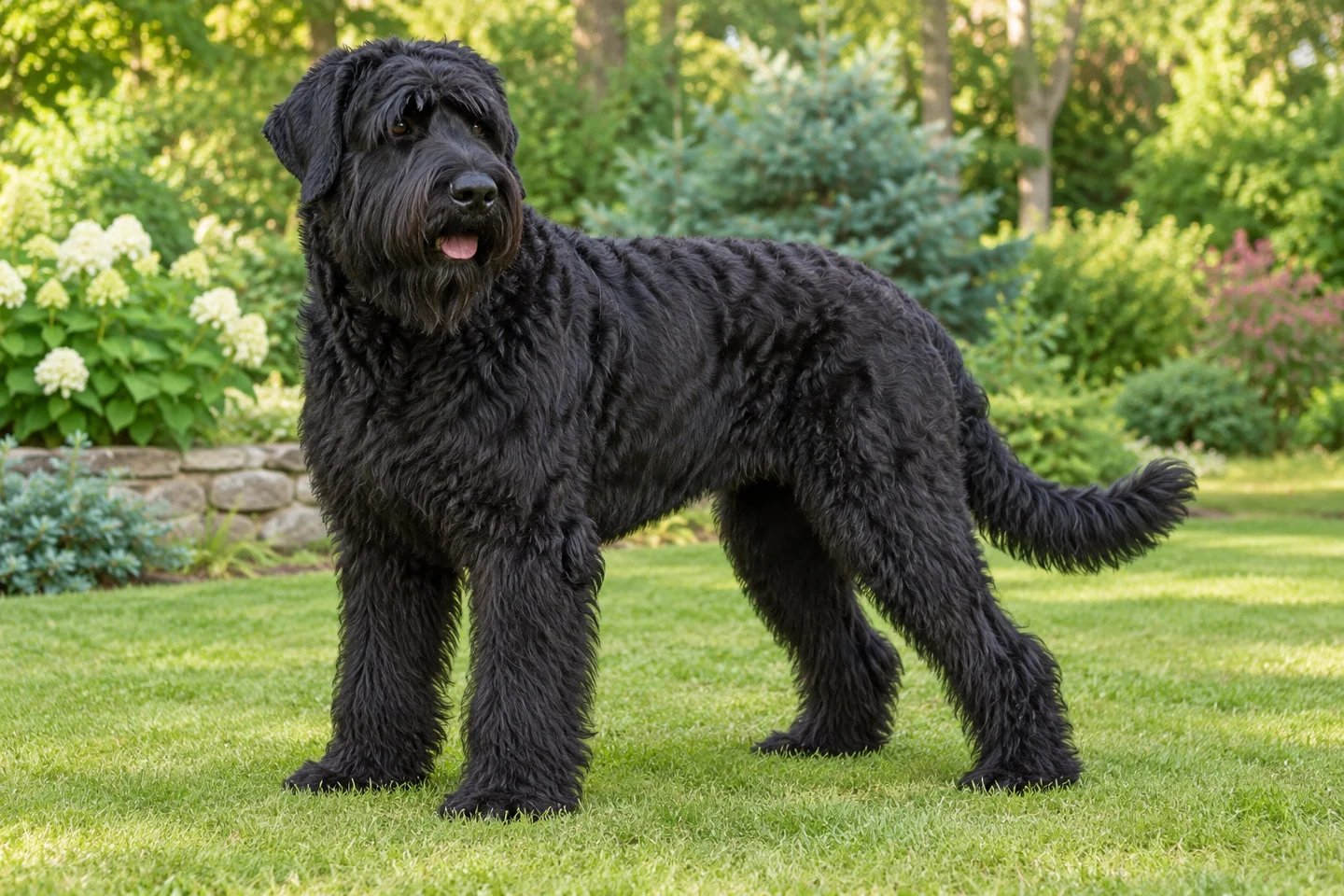
- Origin
- Russia; Soviet working-dog development
- Coat
- Dense black double coat
- Care priorities
- Guardian boundaries, beard and coat care, JLPP results
General information for owners. These articles have not been reviewed by a veterinarian. Medical decisions need your dog's history and an examination.
Choosing a Black Russian Terrier
The Black Russian Terrier is a large working guardian, and the word terrier can give an entirely misleading first impression. This is a substantial dog with a demanding coat and the strength to make an ordinary handling mistake consequential. A prospective owner should think through visitor access, transport, grooming arrangements, and substitute care before looking at puppies. The question is whether the household can provide a consistent, safe routine for an adult that may be much less welcoming to strangers than its family expects.
Visit established owners if possible and watch what happens when the dog is no longer performing for an audience. How does it settle after an arrival? Who can fit equipment or brush its beard? What arrangements allow a tradesperson into the house? Those details reveal more about compatibility than an account of the dog's bravery. A breeder or rescue should welcome practical questions and describe limitations candidly. Affection for this striking breed needs to be matched by the time, facilities, and competence its daily care requires.
Soviet development and the terrier name
The breed was developed through a Soviet working-dog program associated with the Red Star kennel. It drew on more than one established breed rather than representing an ancient unchanged terrier population. Its working identity and large body deserve more attention than the last word of its English name. Do not choose it expecting the size or everyday management of a small terrier. Ask about the recent breeding program and the temperament of adult relatives as well as the broad historical background.
A Black Russian Terrier is distinct from a Giant Schnauzer and a Bouvier des Flandres, although a dark coat and beard can cause confusion in photographs. A rescue description based only on appearance remains an estimate unless stronger records are available. Historical selection for particular work does not establish that a current puppy will recognize which modern visitors are harmless. Household safety still depends on learning, containment, responsible handling, and an owner's ability to notice when the individual is struggling with a situation.
Size, equipment, and household access
Look for comfortable movement and the ability to change position easily, rather than interpreting maximum bulk as desirable. A heavily coated dog can conceal changes in weight or muscle, so regular hands-on assessment matters. Watch how it walks on ordinary ground and rises after resting. Ask about persistent stiffness instead of assuming a dog that moves slowly is simply dignified. Secure footing is useful indoors, especially where a large animal must turn near stairs or negotiate a narrow entrance.
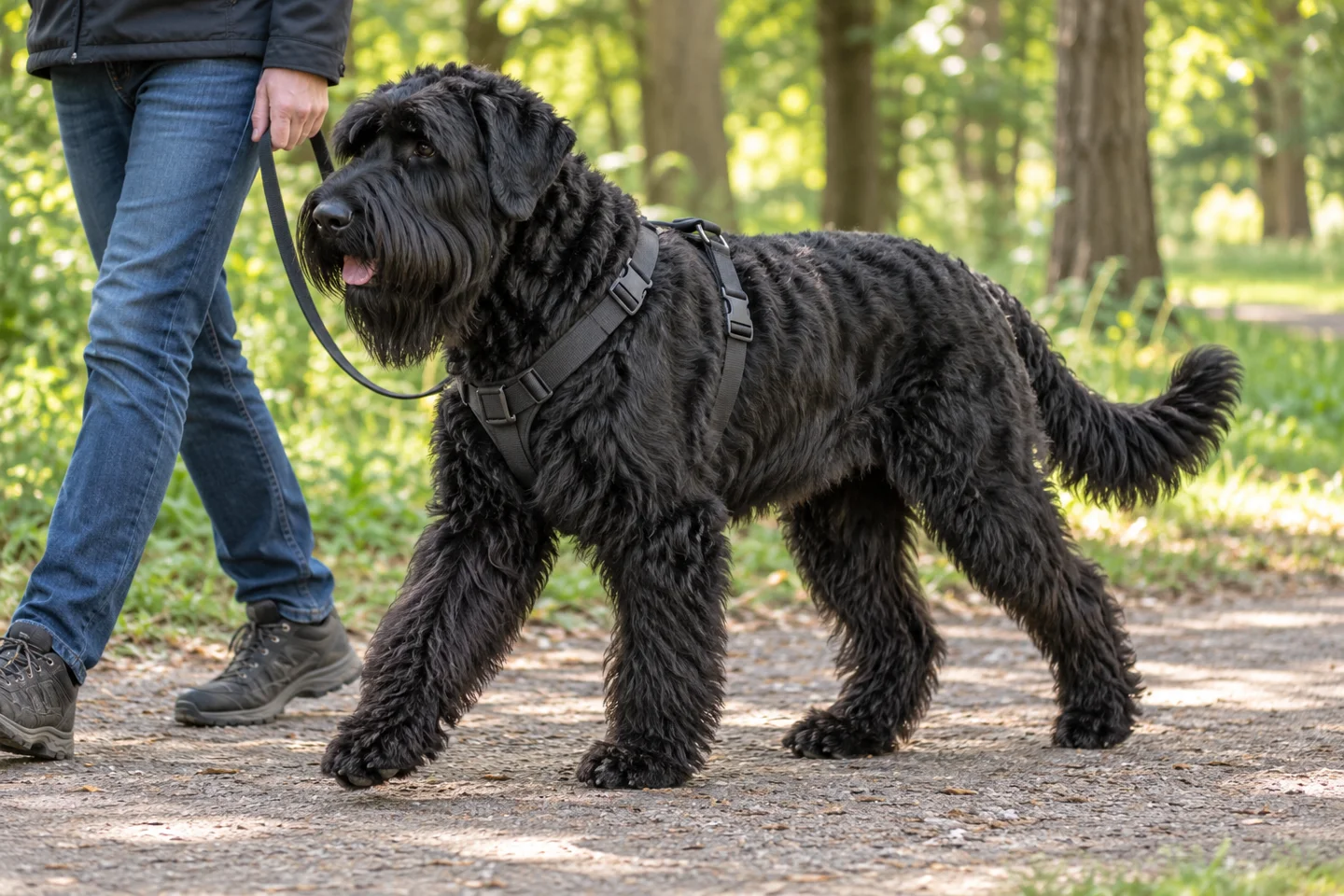
Choose a vehicle arrangement that accommodates the adult body and keeps it restrained safely. Plan for an emergency in which the dog cannot climb in independently; a suitable ramp and additional help may become necessary. Harnesses, collars, and grooming surfaces must fit and remain sound. Introduce each piece of equipment before an urgent appointment. Natural ears and a natural tail need no cosmetic justification. Evaluate the dog as an animal that must move, communicate, and receive care comfortably throughout its life.
Visitors and a guardian's boundaries
Write down an arrival routine everyone can follow. For example, one adult takes the dog to a comfortable room before another opens the outer door, then checks that the barrier is secure before admitting a visitor. This is particularly helpful when deliveries, cleaners, or relatives arrive unexpectedly. A guest should not be asked to establish authority over the dog. Neither a nervous visitor nor an excited dog is likely to benefit from an improvised meeting in a narrow hall.
Some individuals can greet familiar guests comfortably, while others need more separation. Decide according to behavior, not according to what a guardian ought to tolerate. Observe whether the dog can soften its posture, turn away, and settle after noticing someone. Continued fixation warrants distance and a different plan. Keep contractors' access separate from the dog's outdoor area. An open gate during repairs can undo otherwise careful containment, so discuss practical access directly with the people doing the work before they arrive.
Children around beard, beds, and food
A Black Russian Terrier's beard and expressive face can attract a child's hands. Prevent pulling, reaching into the mouth, and close embraces. Show children a quieter way to interact, such as tossing a reward for an adult-approved cue while standing at a comfortable distance. Keep a dog bed beyond the children's play route. The arrangement should make undisturbed sleep possible without requiring the dog to repeatedly move away from small people who follow it from place to place.
Think about physical mismatch as well as intentions. A friendly turn or hurried movement can unbalance a child beside a large dog. Adults should control busy doorways and separate the dog before a group starts running through the house. If a toy lands near its meal or chew, an adult handles retrieval after moving the dog safely. A child's confidence does not establish sound judgment about canine discomfort. Change the setting as soon as the dog withdraws, stiffens, or shows it does not welcome further attention.
Living with other animals
A second large dog changes household logistics. Can the dogs pass without being trapped in a narrow corridor? Is there space to feed apart and give each uninterrupted rest? Observe whether one continually follows, blocks, or monitors the other. An absence of fighting does not prove both are comfortable. Use barriers and separate routines while assessing a new relationship, and get advice when either dog cannot relax. Expecting them to settle disputes themselves can leave a weaker or less confident animal with few options.
Cats need elevated routes and rooms where the dog cannot follow. A new cat running from one doorway to another may generate a different response from a settled cat resting on a familiar chair. Manage those transitions rather than testing the dog's intentions by allowing pursuit. Small pets should remain physically protected. Ask previous carers to describe actual encounters, including distance and barriers used. The information is more useful than a claim that a guardian is gentle enough to live safely with anything smaller.

Aggression, restraint, and warning signals
Guardian behavior can create particular pressure to excuse a threatening response as the dog doing its job. Describe what happened instead. A rush at a visitor, a snap during brushing, and a fight over a chew involve different circumstances and may require different interventions. Protect everyone first, then arrange veterinary and behavioral assessment as appropriate. Do not repeat an encounter to demonstrate the dog's protective nature. The demonstration itself can harm someone and strengthen an unsafe response.
Punishment that suppresses a growl leaves the owner with less visible information about discomfort. Move the person or animal away and identify what made the encounter difficult. Reward-based professional help can address visitor routines, handling, or resource concerns while management prevents further exposure. A conditioned basket muzzle may be useful for specific tasks, but it needs a comfortable fit around the muzzle and beard and must allow appropriate panting. Introduce it patiently before it is needed, rather than making its first appearance part of an already frightening appointment.
Training the tasks that size makes important
Start with moving willingly to a designated place, following a hand target, and standing while equipment is adjusted. These skills reduce the need to push or drag a mature dog through a doorway. Teach an exchange with unimportant objects before tackling something valuable. Reward a relaxed pause while an adult prepares the lead. A puppy can practice these small tasks without long formal sessions. They provide a foundation for the ordinary transitions that are difficult to improvise once the dog has grown strong.
Seek instruction that explains timing and reinforcement clearly. Harsh physical contests are especially poor substitutes for learning with a large guardian. If a cue fails, identify whether the setting is too distracting, the reward insufficient, or the task not yet understood there. Practice care skills away from the grooming table as well as on it. A dog that voluntarily presents a paw or rests its chin for a moment offers the handler an opportunity to proceed gently and notice when comfort changes.
Exercise for a growing working dog
Movement should develop coordination and fitness without chasing an impressive physique. Let puppies explore appropriate surfaces and enjoy short learning experiences, with enough sleep between them. Discuss strenuous or repetitive activity with the veterinarian as the dog develops. A mature Black Russian Terrier may enjoy walking, scent tasks, and suitable structured work, but preferences vary. Assess willingness alongside gait and recovery. Some dogs continue participating even when an owner should have noticed fatigue or discomfort and stopped the session.
The dense coat makes weather planning worthwhile. Choose cooler periods when necessary, provide water, and change the route if shade is scarce. Unusual weakness, breathing difficulty, or collapse requires prompt veterinary attention. Carrying on until the dog refuses is not a reliable safety measure. Quieter days can include simple searches and cooperative care practice rather than frantic indoor play. A sustainable exercise plan should still work when an owner has a busy week or the dog temporarily needs restricted activity.
Grooming beneath the black coat
Plan grooming around access to the skin. Separate the coat into sections and check the undercoat, the areas where limbs rub, and the hair beneath equipment. Surface brushing can leave tight tangles underneath. Ask an experienced groomer to demonstrate tools and technique, and agree a maintenance schedule you can actually sustain. A long session once the coat is matted is harder for both dog and handler than shorter routine work that prevents those tangles from tightening in the first place.
The beard collects water and food, so include gentle cleaning and drying in the daily routine. Inspect the skin if odor, redness, or persistent dampness develops. Avoid treating a sore area repeatedly as a cosmetic problem. Veterinary attention may be needed to identify the cause. Nail, tooth, and ear care are additional tasks, not substitutes for coat work. Tell a groomer about discomfort or previous reactions before the appointment so appropriate handling and support can be arranged without surprising the dog or staff.
Health screening and the JLPP test
The AKC's breed-club health list includes hip and elbow evaluations, cardiac and ophthalmologist evaluations, and DNA testing for juvenile laryngeal paralysis and polyneuropathy, abbreviated JLPP. Ask for the individual reports and identities of the tested parents. A claim that a breeding pair has a clean panel leaves important questions unanswered. Ask explicitly about JLPP and which laboratory performed the test, then discuss any result you do not understand with a veterinarian rather than interpreting abbreviated marketing language as a medical conclusion.
JLPP is an inherited disorder documented in this breed. The UC Davis Veterinary Genetics Laboratory describes the relevant genetic finding in its Black Russian Terrier material. A carrier result concerns inheritance and breeding decisions; it should not be casually equated with an affected clinical diagnosis. Breathing changes, swallowing difficulty, or abnormal coordination need veterinary assessment whatever paperwork accompanied the puppy. Screening information is useful precisely because it answers a defined question. It cannot assess every possible cause of a new symptom in a living dog.
Other medical evidence and follow-up
UC Davis also discusses hyperuricosuria in the Black Russian Terrier. Ask a veterinarian whether a relevant test result or family history should change individual advice. Do not impose a restrictive diet or add urinary products on the basis of an online breed list. Straining to urinate, producing little or no urine, or obvious pain requires prompt clinical guidance. The presence or absence of a named variant does not supply a complete diagnosis for urinary signs or eliminate the need for examination.
Keep orthopedic and eye records alongside laboratory results so a new veterinarian can see what was actually evaluated. Note recurring stiffness, reluctance to jump into the vehicle, skin discomfort, or changes in appetite rather than dismissing them as normal features of a large coated dog. A full coat can make weight loss less visible. Ask about adult relatives and causes of death when available, while acknowledging gaps honestly. Good documentation supports informed care without allowing a breeder or owner to promise that illness has been ruled out for life.
Food, mixes, and long-term resources
A large-breed puppy needs a complete diet suited to growth, not extra calcium added because its feet look enormous. Discuss the food and body condition with the veterinarian and account for rewards used during training. Coat hides shape, so assess weight with hands as well as appearance. The household needs a straightforward way to keep meals separate from other animals and children. A calm feeding arrangement prevents avoidable pressure while leaving room for specific professional advice if the dog shows guarding or digestive difficulty.
Crossing a Black Russian Terrier with another breed does not guarantee a smaller, easier guardian or a coat requiring less work. Consider both parent histories and the actual adult when available. Budget for substantial equipment, grooming, instruction, veterinary care, and emergency transport. Later-life support may require ramps, better traction, and an additional person for particular tasks. Discuss substitute care before travel or illness. A familiar friend who enjoys dogs may still be unable to manage a strong adult whose comfort with unfamiliar handling is limited.
Before choosing boarding, visit the facility and explain the dog's response to unfamiliar handlers. Staff need a workable plan for leads, doors, medication, and emergency access. Arrange a short familiarization stay when appropriate, so a necessary longer absence does not introduce every change at once.
A controlled dogsDating meeting
Before arranging a dogsDating outing, describe the dog's actual experience with unfamiliar dogs and any difficulty at entrances or around equipment. Choose a quiet public route with ample space rather than inviting a new dog into the guardian's garden. Separate competent handlers should begin far enough apart for comfortable observation. Parallel movement can reveal whether both animals can soften and look away. Neither needs to approach closely merely because owners have traveled to meet, and a calm walk may be the whole successful first session.
Keep exact home coordinates private while sharing an approximate area for planning. Agree an exit and explain handling limits in advance. Do not bring prized toys into the introduction or test tolerance by crowding the dogs together for a photograph. If either becomes fixed, tense, or unable to recover, leave more room or finish. Write down what actually worked afterward. A profile connection helps owners communicate; it cannot establish that two large dogs can safely share a vehicle, food, or an unattended space after one pleasant walk.
Sources and editorial notes
Sources checked October 21, 2026. Breed measurements describe reference ranges, not a diagnosis or an individual dog's ideal weight. Images are AI-generated breed illustrations and do not document a particular dog or health condition.
- AVSAB: Humane Dog Training Position Statement
- VCA Animal Hospitals: Food aggression in puppies
- VCA Animal Hospitals: Aggression toward unfamiliar dogs, diagnosis
- VCA Animal Hospitals: Ear infections in dogs
- VCA Animal Hospitals: Common emergencies in dogs
- VCA Animal Hospitals: Heat stroke in dogs
- Orthopedic Foundation for Animals: CHIC program and interpretation of numbers
- VCA Animal Hospitals: Hypoallergenic dog breeds
- American Kennel Club: Black Russian Terrier breed identity and care
- American Kennel Club: Breed-club health testing recommendations
- VCA Animal Hospitals: Grooming and coat care for your dog
- VCA Animal Hospitals: Feeding guidelines for dogs
- Washington State University: Gastric dilation and volvulus and bloat in dogs
- American Kennel Club: Black Russian Terrier history and Soviet development
- UC Davis Veterinary Genetics Laboratory: Black Russian Terrier genetic diversity and inherited disorders
Keep getting to know dogs.
Read another guide or return to your dogsDating community.
Explore breed guidesBack to dogsDating