Boykin Spaniel
A South Carolina sporting spaniel needing scent and retrieving outlets, safe water habits, coat care, and verified health screening.
How these guides are researched and reviewed

- Origin
- United States; South Carolina
- Coat
- Brown coat with feathering
- Care priorities
- Retrieving, water safety, and health records
General information for owners. These articles have not been reviewed by a veterinarian. Medical decisions need your dog's history and an examination.
A Boykin Spaniel needs an outlet and an off switch
A Boykin Spaniel can bring a great deal of interest in scent, movement, and retrieving into a manageable-sized sporting dog. The useful question is whether your household can provide those outlets consistently and help the dog settle afterward. Plan walks that include exploration, short lessons with clear rewards, and enough undisturbed sleep. A brown puppy curled on a sofa gives little information about the adolescent that may later want to carry shoes, inspect every puddle, and follow an interesting smell beyond a gate.
Ask owners and breeders to describe ordinary weekdays, including days without hunting or a long outdoor trip. Find out how the dogs spend quiet hours, tolerate being apart from people, and respond when activity ends. Meet mature relatives where possible. An adult foster assessment can help someone who needs more information about house habits and companionship. Choose a source willing to discuss health, difficult behavior, and placement support without assuming that a sporting pedigree guarantees an easy family companion.
South Carolina history and breed identity
The Boykin Spaniel developed in South Carolina, and the AKC standard describes its sporting function as a flushing and retrieving dog. Its identity is separate from the American Water Spaniel, Field Spaniel, and English Cocker Spaniel, even though people may confuse brown, drop-eared sporting dogs in photographs. A precise pedigree or reliable placement history helps establish identity. When records are absent, use an honest description of uncertain ancestry rather than attaching a famous breed story to every similar rescue dog.
Working history helps frame practical questions about bird interest, retrieval, water, and physical conditioning. It does not prove that a particular puppy will hunt competently or remain safe around household poultry. A non-hunting home can still provide suitable activity through scent work, cooperative retrieving, training, and enjoyable walks. The responsibility is to meet the individual dog's needs consistently. Acquiring a dog because the history sounds appealing is less useful than checking whether your ordinary week contains enough time for those activities.
Brown coat and a functional frame
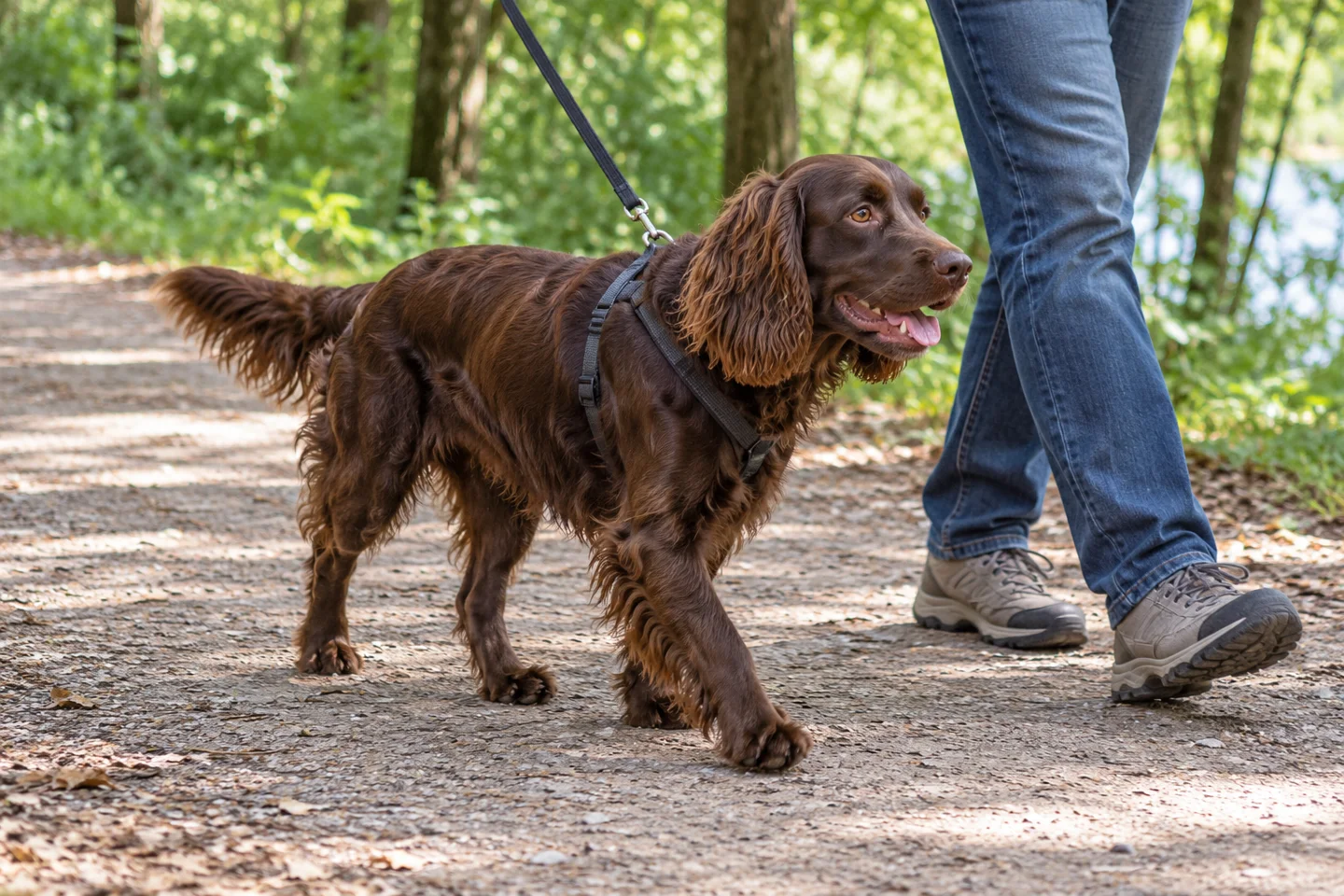
The standard describes a solid brown coat, with shades commonly described as liver or chocolate, and feathering on parts of the body. Appearance varies with age, coat condition, and grooming. A long coat in a photograph does not mean the dog is a different breed, while a short trim cannot establish ancestry. Look at comfortable movement, skin condition, clear eyes, and willingness to explore. Assess body condition beneath the hair rather than confusing a shaggy outline with a well-muscled body.
Some images show shortened tails and others show natural tails, depending on the dog's history and local practice. Describe the individual accurately without implying that a cosmetic change is necessary for ordinary companionship or exercise. Check practical fit as well as appearance: a harness should allow shoulder movement, and ears should not be caught beneath straps. During puppy growth, recheck equipment frequently. A dog that suddenly resists the harness may have pain or rubbing that deserves investigation before further training pressure is added.
Carrying objects and learning an exchange
A retrieving dog benefits from clear rules about which objects can be carried and how people respond when it finds something valuable. Keep socks, medicines, children's toys, and food packaging out of reach while you teach safe alternatives. Reward bringing an appropriate toy toward you and exchange it for food or another toy. Running after the puppy and forcibly opening its mouth can turn a simple discovery into a chase game or a reason to swallow quickly.
Practice an exchange before a dangerous object creates urgency. Begin with something the dog is comfortable releasing and keep hands calm. If the dog has swallowed a suspected toxin or an object that may obstruct the gut, contact a veterinarian immediately rather than waiting for training to work. Repeated theft may also show that the household routine needs better storage and more suitable occupation. It is easier to provide legal carrying opportunities than to make every interaction about catching the dog with something forbidden.
Water activity requires its own plan
Introduce water on a safe, gradual basis, with easy entry and a dependable way out. A Boykin's sporting identity does not certify swimming ability or judgment about currents, cold, or distance. Choose calm conditions and close supervision. A correctly fitted flotation aid may be useful, especially around boats or deeper water, but equipment does not replace active attention. Keep the lead and line arrangement appropriate so it cannot entangle the dog in submerged obstacles or pull it into a dangerous position.
Teach waiting at the bank or boat before a retrieve is sent. An excited dog should not launch after every thrown object or bird without regard to the setting. End sessions before fatigue and give the dog time to recover and dry. Avoid forcing repeated water retrieves to prove enthusiasm. If your household does not have safe water access, land-based scent games and controlled retrieving can provide worthwhile activity. Swimming is one possible outlet, not a test the dog must pass to be a proper spaniel.
Exercise, hunting, and measured conditioning
A long, demanding weekend cannot be balanced by inactivity all week. Build conditioning through a consistent routine appropriate to the dog's age and health. Let a veterinarian help with limits when there is a medical history or a marked change in activity. On warm days, choose cooler times and provide shade, water, and breaks. The dog's eagerness to continue is useful information about motivation, but it does not establish that continuing is physically safe.
For hunting, use competent instruction that considers wildlife rules, firearms safety, the handler's skills, and the dog's welfare. Keep working dogs away from unsafe shooting situations and teach practical control before adding excitement. In a companion home, search games and suitable retrieving can serve a similar need for purposeful engagement without simulating a hunt. Watch how the dog moves after activity and the next morning. Limping, weakness, or a dramatic drop in tolerance calls for assessment rather than tougher conditioning.

Children and games with clear rules
A lively spaniel and a child can turn a tossed toy into a crowded chase very quickly. Adults should organize play so the dog has a clear route and nobody grabs at an object beside its mouth. Avoid throwing toward stairs, traffic, or slippery floors. If excitement rises into mouthing or repeated jumping, pause the game and give both participants space. Do not ask a child to solve the problem by holding the dog's collar or taking away a prized toy.
Children can help hide a safe toy while an adult keeps the dog elsewhere, then watch a short search. These calmer games give the child a role without making physical struggle the main activity. Keep food and resting areas protected, and teach that a sleeping dog is left alone. An adult needs to observe the particular pair rather than trusting a breed reputation for family friendliness. Pain, fatigue, fear, and the presence of a valued object can change how any dog responds.
Birds, cats, and other dogs
A dog bred to search for and retrieve game may find flapping poultry or small running animals highly interesting. Secure enclosures and controlled access matter even if the dog has previously ignored a quiet bird. Do not release it among chickens to find out what instinct will do. Household cats should have protected routes and feeding areas beyond the dog's reach. Prevent chasing early and obtain help if the dog becomes fixated or cannot disengage when the animal moves.
For dog companionship, look beyond a shared interest in fetch. Two dogs may compete over a retrieve even when they walk together comfortably. Start without valued toys in the middle and observe whether both can pause. Separate feeding and chewing areas in a new household. A smaller, quieter, or older dog may prefer a walk rather than sustained spaniel play. Ask a rescue for examples of actual interactions, including conditions where the Boykin needed more space or a different activity.
Aggression and handling a warning usefully
A Boykin may growl when someone reaches for a bird, a stolen sock, or a painful ear. The response needs context and a practical safety plan. Stop reaching, create distance, and arrange an alternative rather than escalating a physical contest. If guarding repeats, work with a qualified behavior professional on management and gradual training. Keep children away from the situation while it is assessed. Do not use the dog's usual friendliness as a reason to ignore a clear change in posture or behavior.
AVSAB supports reward-based methods, which help owners teach cooperation without adding fear through confrontation. A sudden increase in irritability deserves veterinary attention, particularly when the dog shakes its head, avoids touch, or moves differently. Write down what occurred before an incident and what helped the dog recover. Accurate details are more useful than calling it dominant or stubborn. If a bite has occurred, disclose it to professionals and carers so they can make informed decisions about handling and protection.
Training a sporting dog in ordinary places
Teach the Boykin to check in during exploration, wait before being sent for a toy, and return to a comfortable resting place when the activity ends. Build these skills indoors or in a quiet enclosed area before using them beside birds or water. A reward needs to compete with the task at the level you are actually practicing. If the dog cannot respond, reduce the distraction and distance rather than repeating a cue until it becomes irrelevant.
Retrieving can be broken into manageable parts: orienting to a suitable object, picking it up, returning toward the handler, and releasing comfortably. You do not need to turn each session into a fast sequence of throws. Slow searching, short carries, and pauses can teach attention and control. Choose an instructor who explains methods clearly and adjusts to the dog's confidence. Avoid equipment or techniques that rely on pain or intimidation to force a sporting performance.
Grooming after fields and water
Work through the coat regularly, paying attention to feathering, the armpits, and areas beneath a harness. After outdoor activity, check for burrs, ticks, small wounds, and material caught between toes. Remove loose debris gently before it tightens into a mat. Ask a groomer for a practical maintenance plan if the coat catches substantial vegetation. A trim may help household care, while the skin still needs checking and the dog's comfort should guide how long each session lasts.
Drop ears need observation without aggressive cleaning. Redness, discharge, repeated scratching, an unpleasant smell, or pain warrants veterinary advice. Do not push cotton swabs down the canal or put leftover medication into an ear without a diagnosis. Dry the outside gently after water activity and ask your vet whether this individual needs a cleaning routine. Include nail care and toothbrushing in gradual cooperative lessons so the dog is not learning every necessary procedure only after a problem has developed.
Health screening for Boykin families
The AKC's current sporting-group recommendations for Boykins include patella and hip evaluations, an ophthalmologist evaluation, and DNA tests for exercise-induced collapse and Collie eye anomaly. Request the parents' identifiable results and ask a veterinarian to explain findings that are unclear. The word tested is insufficient without the actual condition, method, and result. Family reports about mobility and vision remain useful, particularly when an owner later discovers a problem that was not apparent during the puppy's first weeks.
An eye examination and a Collie eye anomaly DNA result contribute different information about eye health. Likewise, a dog moving happily at a brief visit cannot demonstrate that its hips and patellas have been formally evaluated. Ask what follow-up support the breeder offers and whether health information is shared with owners over time. Avoid treating a screening certificate as a promise that no future illness can occur. A persistent limp, eye change, or new problem with ordinary activity still needs a current examination.
Exercise-induced collapse and urgent decisions
Dynamin-1-associated exercise-induced collapse is relevant to Boykin Spaniels, and university veterinary genetics laboratories offer testing. It can involve weakness and loss of coordination after intense exercise and can become life-threatening. Genetic results need professional interpretation, including what they mean for breeding decisions and the individual dog's activity. Do not assume that an energetic puppy has been cleared because it has played enthusiastically without an obvious episode. Ask for the specific report when a seller claims this condition has been addressed.
If a dog becomes weak, uncoordinated, or collapses during activity, stop immediately and seek veterinary help. Keep it safe from drowning, traffic, or further exertion while following professional instructions. Collapse has other possible causes, so do not diagnose EIC from a video or use a previous DNA result to dismiss the event. Never repeat an intense exercise session deliberately to see whether collapse happens again. A veterinarian needs the circumstances, medical history, and appropriate investigations to decide what caused it.
Feeding, mixes, and lifetime commitments
Use a complete diet appropriate to age and condition, with portions adjusted to actual work rather than the idea that all spaniels are permanently athletic. Count rewards and monitor weight beneath the coat. A quieter month may call for less food than a carefully conditioned working period. Discuss persistent digestive trouble or appetite changes with your veterinarian. Fresh water, safe food storage, and appropriate dental care are ordinary parts of ownership, even when the dog's sporting interests receive more attention.
A Boykin-Poodle cross or another Boykin mix has variable coat, size, and behavior. A combined name cannot guarantee allergy compatibility, easier grooming, or reduced health risk. Ask about both parents and prepare for the care the particular dog needs. Budget for examinations, preventive care, food, grooming, training, and unexpected treatment, as well as dependable cover during long workdays. As the dog ages, adjust activity and access according to comfort while preserving enjoyable searching and companionship at a suitable pace.
Introducing a Boykin through dogsDating
A useful dogsDating profile states whether the dog prefers walking, searching, or physical play, and whether toys create competition. Explain lead needs and relevant medical restrictions. Keep exact home coordinates private and select a quiet public meeting point away from busy water access or an active game of fetch. Agree that either handler can create distance or end the meeting. This lets the dogs meet without their owners feeling committed to a long session simply because arrangements were made.
Start with a short parallel walk and keep retrieving objects out of the introduction. Watch for comfortable movement, pauses, and the ability to turn away. Allow closer interaction only when both dogs remain willing, and interrupt persistent pursuit or crowding. Heat, fatigue, and unusual weakness are reasons to stop immediately. A pleasant walk can be the entire first meeting. Repeated contact should follow the individual dogs' responses, while people continue to control equipment, resources, and access to hazards.
Sources and editorial notes
Sources checked October 21, 2026. Breed measurements describe reference ranges, not a diagnosis or an individual dog's ideal weight. Images are AI-generated breed illustrations and do not document a particular dog or health condition.
- VCA: Ear Infections in Dogs
- VCA: Food Aggression in Puppies
- AVSAB: Humane Dog Training Position Statement
- Orthopedic Foundation for Animals: Diseases
- VCA: Feeding Guidelines for Dogs
- American Kennel Club: Boykin Spaniel Breed Standard
- American Kennel Club: Boykin Spaniel Recommended Health Tests
- University of Minnesota: Exercise-Induced Collapse
- VCA: Grooming and Coat Care for Your Dog
- VCA: Water Sports for Dogs
Keep getting to know dogs.
Read another guide or return to your dogsDating community.
Explore breed guidesBack to dogsDating