Brittany
A compact French pointing dog whose care combines bird-aware walks, clear reward-based teaching, suitable exercise, and regular recovery.
How these guides are researched and reviewed
- Origin
- France; Brittany region
- Coat
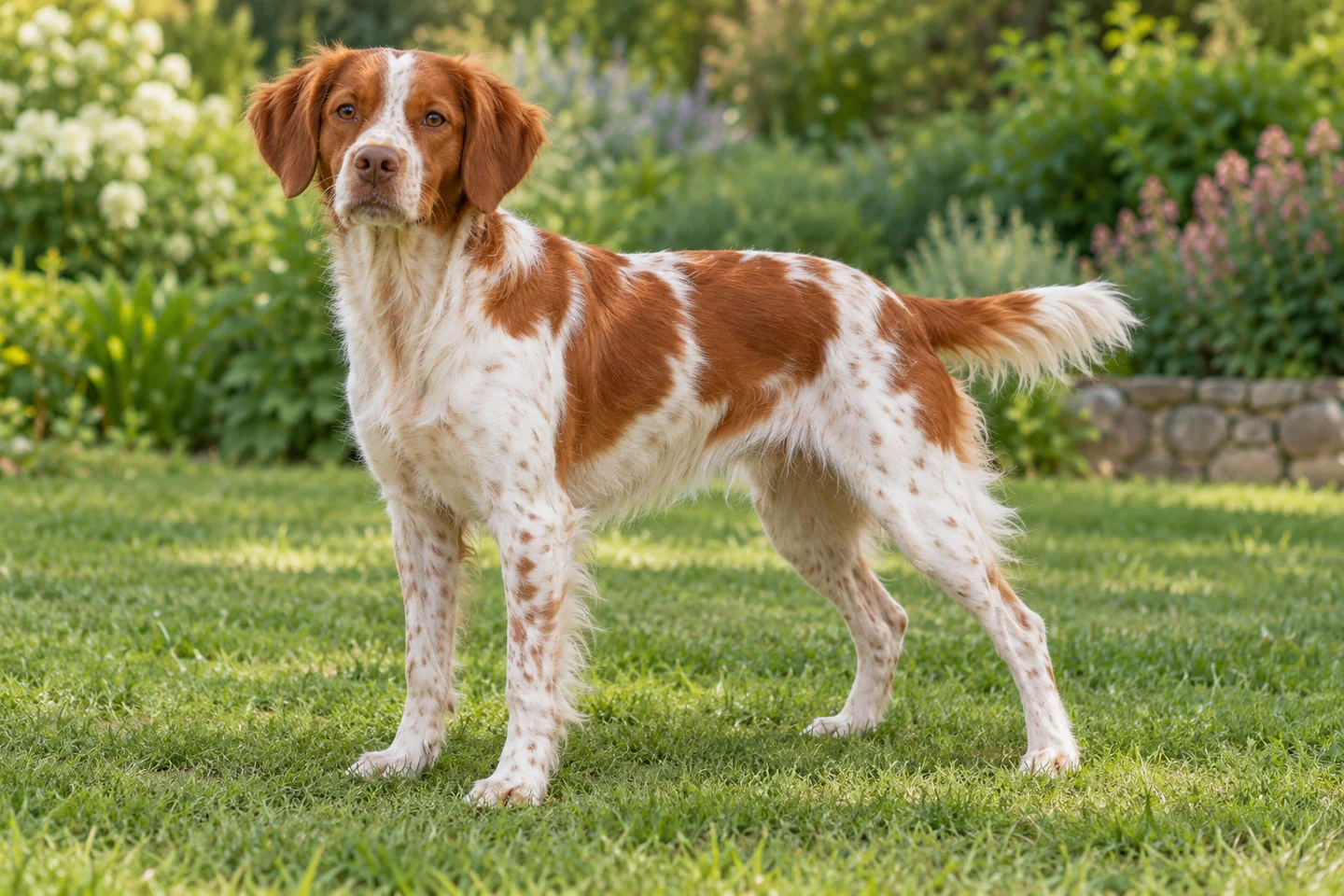
- Orange and white illustration; fine coat and light feathering
- Care priorities
- Bird interest, safe exploration, hips and eye evaluations
- Adult size reference
- FCI height: males 48–51 cm; females 47–50 cm, with stated tolerances
General information for owners. These articles have not been reviewed by a veterinarian. Medical decisions need your dog's history and an examination.
A Brittany needs a working weekday
A Brittany needs regular opportunities to move, investigate scent, learn, and rest beside its people. Its manageable size can conceal how much organization an active pointing dog requires. Consider the weekday when you are tired and the weather is poor, rather than only the countryside outing you picture at the weekend. The dog still needs a useful walk, toilet access, and companionship. A home that enjoys teaching and outdoor activity has a better starting point than one hoping a garden will provide everything automatically.
Before deciding, spend time with adult dogs in domestic settings. Ask how the owner arranges departures, visitors, care after muddy walks, and quiet evenings. A prospective puppy owner can learn about relatives without assuming that any one example predicts the entire litter. An adult adoption may offer more immediate information about preferences and current habits. Choose according to the animal's actual needs and the household's available support, including who will manage exercise if the usual walker is injured or away for several days.
French origins and the spaniel name
The Brittany comes from France and is called the Épagneul Breton in its FCI standard. It is a pointing breed, although English-language names have also included Brittany Spaniel. The naming history can confuse someone expecting a small companion spaniel. Pointing involves finding and indicating game, and a family dog can retain strong interest in birds without ever receiving hunting instruction. That interest belongs in the adoption discussion because it influences containment and the environments in which walking and recall practice can happen safely.
Modern lines and individual backgrounds differ. Ask a breeder what activities its adults do and how they behave away from those activities. Avoid treating field titles, show results, or a label such as family line as a complete temperament assessment. For a rescue without documents, orange-and-white coloring cannot establish purebred ancestry. An estimated identification can still help communication if uncertainty remains clear. The information needed for household planning includes handling tolerance, time alone, interest in other animals, and recovery after excitement, rather than a confident breed label unsupported by records.
Build, feathering, and natural tails
The Brittany is compact and athletic, with a relatively short back, dropped triangular ears, and a coat that may be slightly wavy with restrained feathering. The orange-and-white illustrations show one possible appearance. Coat colors accepted in different registries need checking against the standard relevant to a particular registration question. No unusual marking makes a puppy more capable or safer. Judge a real dog's movement and comfort, including the ease of rising after rest and any tendency to shorten a stride after activity.
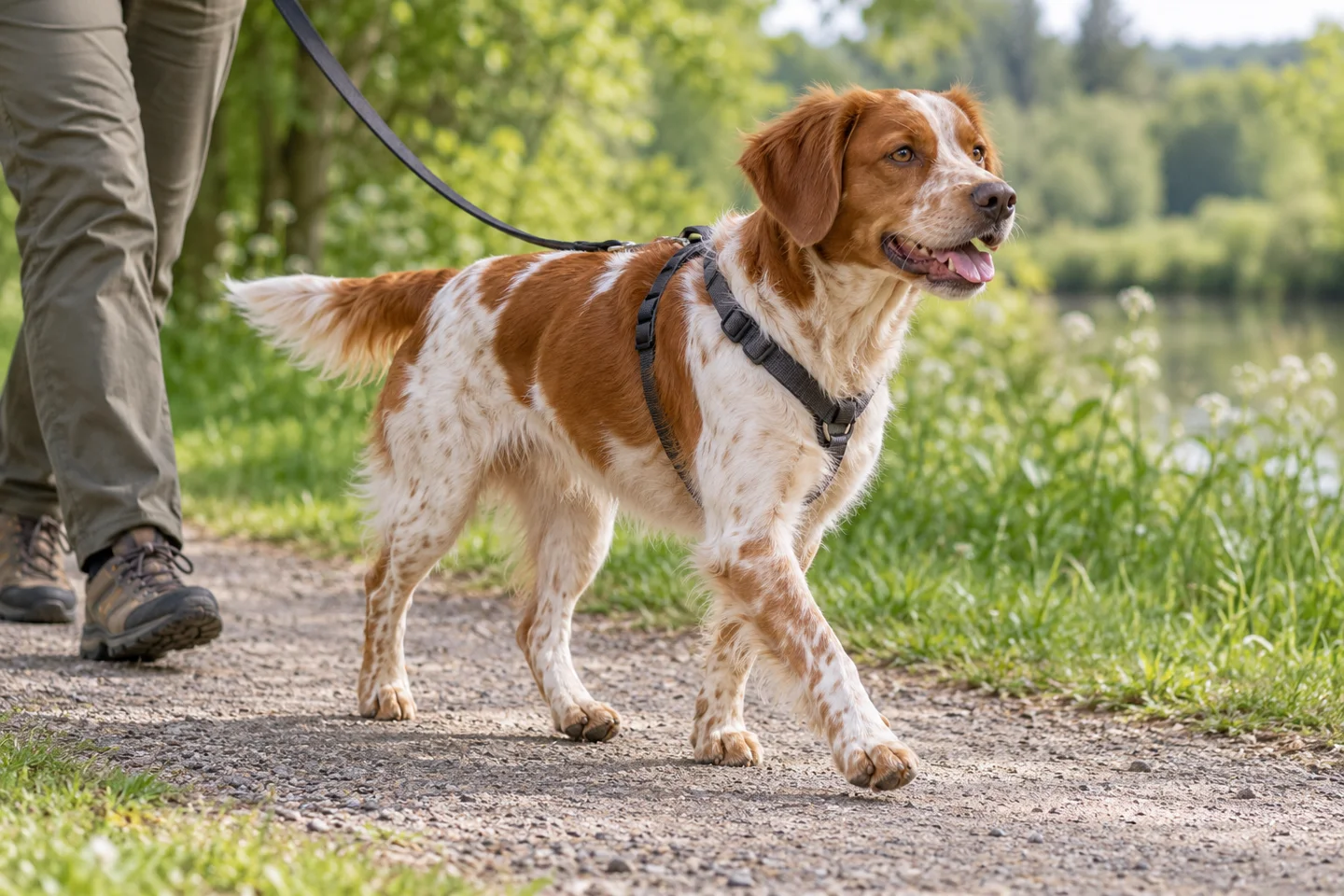
Brittanys can be born with very short tails, and full natural tails also occur. Tail length alone does not tell a buyer how the dog acquired that appearance. Ask directly about an individual rather than assuming every short tail is natural or every full tail indicates a cross. Equipment should fit the chest and shoulders without catching coat or restricting movement. Check under a harness after wet outings, and replace outgrown puppy gear before it begins rubbing. A comfortable functional body matters throughout ownership, beyond appearance in a breed photograph.
The FCI gives males a height range of 48–51 cm and females 47–50 cm at the withers, with a one-centimeter tolerance at either boundary. These show-standard figures describe expected adult scale, not a forecast for every puppy. Check actual chest dimensions when buying a harness and allow space for comfortable movement in the vehicle.
Bird interest and safe exploration
A hedge full of moving birds can become more interesting than the person holding the lead. Set up walks so that this discovery does not put the dog beside traffic or on someone else's land. Reinforce turning toward you well before the dog is fixed on a bird, then move far enough away that learning remains possible. Do not test a developing recall by releasing the dog in an unfenced area with hazards nearby. Safe equipment gives practice time to develop without making one cue responsible for preventing an accident.
A suitable long line can allow sniffing and exploration, provided the handler manages it before the dog accelerates. Check footing and entanglement risks and avoid letting a running dog hit its full length suddenly. Introduce scent games or qualified pointing-dog instruction if those activities appeal to you, with welfare and local access rules respected. An enthusiastic household dog should never be sent after wildlife as a casual test. Appropriate outlets have clear boundaries and allow the owner to finish while the dog remains physically and emotionally comfortable.
Children and an excited young pointer
A young Brittany may arrive beside children at speed, especially when play involves running or a thrown object. Separate fast children's games from the dog's exercise until the household has workable control. Teach the dog to move toward an adult or a resting station instead of joining every chase. A child can help reward a simple behavior under adult guidance, but should not be expected to stop jumping physically or manage a pulling dog while also watching younger siblings.
Make the dog's resting area a place children leave undisturbed. Soft ears, feathered legs, and a wagging tail can invite handling the animal does not enjoy. Demonstrate brief gentle contact and allow it to step away. Food and chews need protection from curious hands. If a child drops something near the dog, an adult organizes the retrieval. Watch the specific interaction rather than depending on a general affectionate reputation. A familiar dog's tolerance can change when it is tired, painful, startled, or faced with a new visitor's different style of contact.
Dogs, cats, and protected small animals
With another dog, assess play style rather than simply matching energy levels. Two enthusiastic animals can still disagree about body contact, chasing, or sharing a toy. Observe pauses and whether each has room to stop participating. Indoors, arrange beds and feeding places so one does not need to crowd the other. A first encounter works better where there is space to move than at a doorway, beside a food bowl, or inside the vehicle that brought one dog to the meeting.
Cats and smaller pets need deliberate arrangements. Introduce a resident cat across secure separation and reward the dog for disengaging before pursuit begins. Provide cat-only routes and rooms. Interest in birds means that cages or runs should be genuinely inaccessible, rather than placed where the dog can repeatedly watch and rush them. A dog that lies quietly beside one household cat may respond differently to a running unfamiliar animal outdoors. Ask carers for concrete observations and continue appropriate protection while learning how the individual behaves in your own setting.

Aggression and the problem behind a response
A growl during removal of a retrieved object deserves attention even if the dog usually enjoys people. Stop turning possession into a contest. Prevent children from reaching toward the object and ask a qualified professional to help teach a safe exchange. Other reactions may arise during frightening encounters or painful handling, so describe what happened rather than assigning one explanation to every snap. A factual note about the setting and preceding actions is more useful than a judgment that the dog has suddenly become bad.
Veterinary assessment matters when tolerance changes or touching a particular area causes a reaction. Avoid repeatedly testing it at home. Use barriers and a safe handling plan until the problem is understood. Reward-based behavior support can help the owner adjust both the environment and the learning task. Punishing warning signals can conceal discomfort while leaving the cause present. If a basket muzzle forms part of an agreed plan, introduce it comfortably through gradual practice. It remains an additional precaution, not permission to continue an encounter the dog cannot manage.
Training for the return journey
Teach the end of an outing as carefully as its beginning. A dog that enjoys investigating outdoors benefits from learning that returning to the owner does not always mean every interesting activity disappears. In a safe practice area, reward coming back, handle the harness briefly, then release toward another appropriate sniff. Later, include calm movement to the vehicle and a reward for loading. Keep safeguards around hazards even when practice is progressing well. Reliability grows from many manageable repetitions in varied settings.
Household lessons can be equally concrete. Practice settling while walking equipment is prepared, following a hand target away from a kitchen counter, and allowing a brief foot inspection. A clear reward tells the dog what worked. When it struggles, change the task before frustration becomes the main feature of the session. A qualified instructor should help the person understand timing and difficulty. Harsh methods or repeated lead corrections do not explain an unfamiliar request, and sensitivity should prompt clearer teaching rather than a contest over obedience.
Exercise that leaves room for recovery
Walking on varied safe terrain, scent exploration, and chosen sports can all contribute to a Brittany's activity. Develop conditioning rather than expecting inherited enthusiasm to supply physical readiness. Puppies need movement appropriate to development, with rest between experiences. Repetitive jumping or forced running deserves discussion with a veterinarian before it becomes routine. For an adult, consider the surface and weather as well as the distance. A short rough ascent may demand more than a longer level walk that looks more impressive on a tracker.
Watch how the dog moves later in the day. Stiffness after sleep, an altered stride, or reluctance to load into the car may reveal a problem not obvious during the outing itself. Seek assessment instead of adding more activity to loosen the dog up. Adjust warm-weather trips and carry water. Marked weakness, collapse, or difficulty breathing requires urgent clinical advice. Quiet days can retain suitable exploration and learning without becoming a desperate effort to exhaust the animal indoors. Rest is part of a functional routine for an active sporting dog.
Grooming after brush and water
Comb through feathering after vegetation catches in it, paying attention behind the ears, under equipment, and around the limbs. Surface brushing alone can miss tight knots close to the skin. Keep handling brief and comfortable while teaching a youngster what the tools mean. A practical grooming appointment may help establish technique, but home checks are still needed between visits. After a wet outing, dry the dog properly and look for irritation instead of leaving damp equipment on while everyone attends to other tasks.
Examine ears for changed odor, discharge, redness, or repeated head shaking and ask the veterinarian about appropriate cleaning. Reusing medicine from a previous episode can delay the right treatment. Nails and teeth need their own routine, introduced in small steps rather than added at the end of an already tiring grooming session. Persistent pain or resistance around one body area should be investigated. Cooperative care helps maintenance, while necessary treatment should be arranged promptly if the owner cannot inspect a sore area safely at home.
Health screening and the evidence supplied
The AKC lists hip evaluation and an ophthalmologist evaluation among the national breed-club recommendations for Brittanys. Ask for results that identify the proposed parents, including assessment dates and the organization involved. A photograph of an athletic adult cannot answer the same questions. Read any result in its original form rather than accepting a summary that says everything is clear. If a reporting system is unfamiliar, ask a veterinarian or the issuing body to explain its meaning before making an important purchase decision.
Discuss the health of adult relatives and what additional evaluations a particular breeding program uses. The absence of a long published list does not mean every possible illness has been excluded. Likewise, an extensive commercial DNA panel cannot replace examinations that address different issues. Keep the paperwork after adoption and arrange ordinary veterinary follow-up for your own dog. New lameness, visual difficulty, or other signs need assessment on their own merits. A screening history informs a clinician without diagnosing every problem that may develop during the animal's life.
Meals, weight, and changing routines
Use a complete diet appropriate to age and condition and measure against the real workload. A dog that spends a holiday hiking and then returns to normal workdays may need a change in portions rather than the same allowance indefinitely. Include treats used to teach recall or handling. Ask the veterinary team to demonstrate body-condition assessment if you are unsure. Avoid feeding toward a preferred silhouette or copying the diet of a much more active working dog whose circumstances differ from your own.
Pay attention to persistent digestive changes, unexplained weight shifts, or altered drinking. Record timing and recent changes so a veterinarian has something specific to assess. For an older Brittany, review access to beds, vehicle loading, and the recovery time after walks. Suitable activity can continue while intensity changes. New difficulty with stairs should not be dismissed merely as age. Budgeting for routine care and unexpected illness gives the household more options when something changes, including diagnostic work and practical help during a period of restricted movement.
Mixes and selecting a sustainable home
A Brittany mix may vary in coat, bird interest, size, and the ability to settle. A cross with a retriever, Poodle, or another sporting dog does not guarantee the easiest features of each parent. Parent health records and upbringing remain relevant, and a marketed cross name is not a fixed standard. A Poodle contribution also cannot promise freedom from human allergy. For an adult dog of uncertain ancestry, assess observed behavior and care requirements directly rather than trying to infer every need from its markings.
Include training support, secure facilities, travel equipment, and backup care in the budget. Consider who will maintain suitable outings when the usual owner cannot, and whether the home offers quiet recovery after activity. A compact body may fit an apartment while vocalization or scheduling still creates problems there. A large property may provide space while leaving the dog short of company. Choose from the arrangements you can reliably sustain, with enough flexibility for changes in employment, family responsibilities, and the dog's health over the coming years.
A bird-aware dogsDating meeting
Use dogsDating to describe your Brittany's preferred pace and play, including whether birds or wildlife make attention harder to regain. Choose a public route with room for separate handlers to move apart. A pond crowded with waterfowl may be a poor first venue for this particular dog, even if it is convenient. Start walking with space between the animals and observe whether both can disengage. A successful first outing can remain a shared walk without a close greeting or a game afterward.
Keep exact home coordinates private and use approximate location information to find suitable local contacts. Agree on the meeting point and an exit before arriving. Leave prized retrieving toys out of the introduction so they do not become a competition. If either dog repeatedly crowds, stiffens, or cannot recover after a pause, change distance or finish. Owners can compare what they observed and decide whether another outing is useful. The profile supports that communication; the animals' responses determine whether the arrangement actually suits them.
Sources and editorial notes
Sources checked October 21, 2026. Breed measurements describe reference ranges, not a diagnosis or an individual dog's ideal weight. Images are AI-generated breed illustrations and do not document a particular dog or health condition.
- AVSAB: Humane Dog Training Position Statement
- VCA Animal Hospitals: Food aggression in puppies
- VCA Animal Hospitals: Aggression toward unfamiliar dogs, diagnosis
- VCA Animal Hospitals: Heat stroke in dogs
- VCA Animal Hospitals: Common emergencies in dogs
- VCA Animal Hospitals: Grooming and coat care for your dog
- VCA Animal Hospitals: Ear infections in dogs
- VCA Animal Hospitals: Feeding guidelines for dogs
- VCA Animal Hospitals: Hypoallergenic dog breeds
- Orthopedic Foundation for Animals: CHIC program and interpretation of numbers
- AVSAB: Humane Dog Training Position Statement
- Fédération Cynologique Internationale: Brittany official breed standard
- American Kennel Club: National breed-club sporting group health testing recommendations
Keep getting to know dogs.
Read another guide or return to your dogsDating community.
Explore breed guidesBack to dogsDating