Bulldog
A British companion whose care starts with functional breathing, moderate anatomy, skin comfort, weather planning, and a realistic medical budget.
How these guides are researched and reviewed
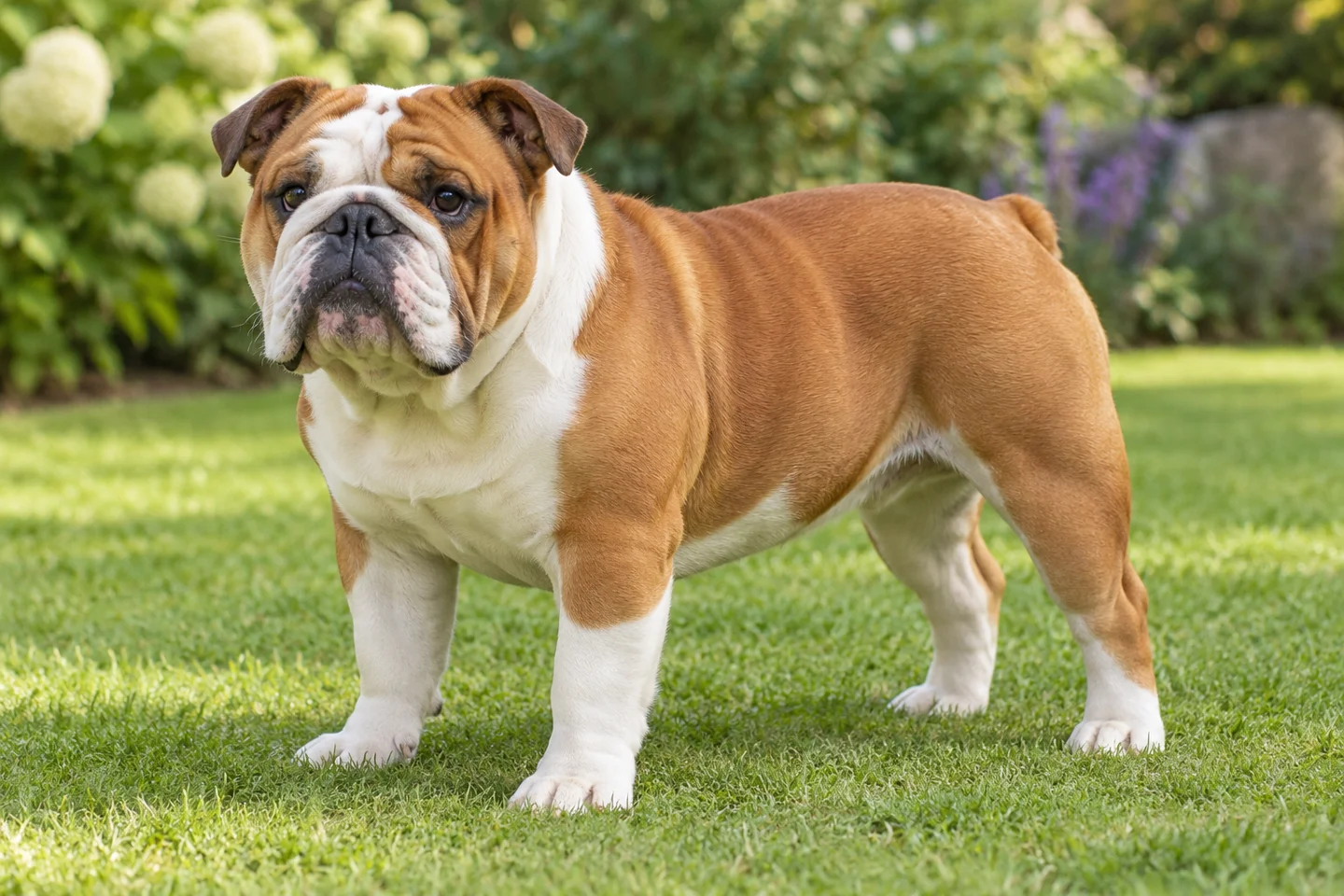
- Origin
- Great Britain
- Coat
- Smooth red-and-white example illustrated
- Care priorities
- Comfortable breathing, heat management, folds and functional movement
- Adult size reference
- FCI adult weights: males 25 kg; females 23 kg
General information for owners. These articles have not been reviewed by a veterinarian. Medical decisions need your dog's history and an examination.
Choose a Bulldog by comfort and function
A Bulldog's ability to breathe, move, sleep, and keep comfortable should lead the decision to adopt or buy one. A familiar broad face or affectionate interaction cannot answer those questions. Ask for veterinary and screening information, observe ordinary activity, and consider the budget for care before committing. A dog that makes persistent respiratory noise should not have its difficulty treated as a charming personality trait. The owner needs a realistic understanding of the individual animal's health, including what management or treatment is already required.
Meeting an adult can show more than a photograph of a puppy, especially when observation includes resting and recovery from a suitable short walk. Ask what daily care involves in warm weather and who provides it when the owner is absent. A rescue with known medical needs may fit a prepared household very well. A promise that a puppy is the healthiest type without supporting evidence is much less useful. The decision should rest on function, records, candid discussion, and the care the home can sustain over time.
The British Bulldog and different bulldog breeds
The Bulldog is the British breed also commonly called the English Bulldog. It is distinct from the French Bulldog, American Bulldog, and other dogs carrying bulldog in their names. Those identities involve different standards and care considerations, so advice should be read for the correct animal. The FCI standard describes the breed's British background and transition from historical bullbaiting to later companion and show development. That history supplies context; it cannot establish an individual's behavior toward children or other animals today.
If a rescue's ancestry is uncertain, say so rather than assigning a precise breed from a short muzzle and broad chest. A marketed cross name also does not create a recognized standard or a health guarantee. Ask which parent records and evaluations actually exist. Modern ownership should prioritize the living animal rather than trying to reproduce an exaggerated historical appearance. A source that responds to health questions with slogans about toughness or iconic looks has not supplied the information a prospective owner needs to assess welfare and practical fit.
Moderate structure and the tail area
The standard calls for a broad compact smooth-coated dog while rejecting features that interfere with movement or respiration. Look for an animal that uses its body comfortably, with functional limbs and an accessible face. Extreme bulk, deep folds, or exaggerated head size should not be purchase goals. Coat color and rarity claims do not establish better health. The illustrations choose a moderate red-and-white example with natural rose ears and a visible natural short tail, rather than suggesting that every Bulldog has exactly that appearance.
Examine the tail area during ordinary care and ask about any skin problems there. Some individuals need attention around folds; the approach should suit actual anatomy and veterinary advice. Pain, discharge, or persistent odor is a reason to investigate, not simply add a stronger cleaning product. A tail should not be assessed only by its outline in a posed image. Watch movement and comfort when the dog sits, rises, and turns, and discuss changes with a clinician rather than assuming an unusual posture is inevitable for the breed.
The FCI standard specifies 25 kg for males and 23 kg for females. Those reference weights are not instructions to feed every dog until it reaches a particular number. Frame, condition, and clinical needs differ. Ask the veterinarian to assess the individual, especially when respiratory comfort or reduced mobility makes excess weight consequential.
Breathing signs deserve a clinical explanation
Brachycephalic obstructive airway syndrome concerns upper-airway abnormalities associated with short-faced anatomy. Narrow nostrils and changes involving internal soft tissues can restrict airflow. A veterinarian should assess noisy or effortful breathing, reduced exercise tolerance, disturbed sleep, or poor recovery. Do not diagnose the full problem from a view of the nostrils alone. External appearance supplies only part of the information, and a cheerful dog can still be working harder than it should to breathe during ordinary activity.
Ask the veterinary team what signs require urgent help for this individual and what management or treatment is appropriate. Severe respiratory difficulty, collapse, or marked distress needs emergency attention. An owner's role is to recognize change and arrange care, rather than repeatedly test the dog's limit on a walk. Where surgery is recommended, discuss its purpose, likely limitations, and aftercare with the clinician. A procedure may improve function without becoming proof that every future breathing concern has been eliminated or that hot-weather exertion is now safe without limits.
Heat, travel, and a workable daily environment
Make warm-weather arrangements before the first hot day. Choose cooler outing times where appropriate, provide access to comfortable indoor conditions, and avoid a schedule that requires prolonged effort in heat or humidity. The route should allow a quick return if the dog struggles. Never use a parked vehicle as a waiting place. A car journey also needs suitable ventilation, secure restraint, and planning around stops, with veterinary advice when the individual has respiratory disease or other medical needs.
Boarding and substitute care require direct discussion of these arrangements. A general dog-friendly promise does not establish that staff recognize breathing difficulty or can maintain a suitable environment. Provide written instructions, clinic contacts, medication details, and the emergency plan. Owners should not depend on another person's ability to read the dog from a brief introduction. Familiarity can also cause symptoms to be underestimated, so review changes with the veterinarian rather than treating a louder night or slower recovery as merely the dog's usual way of being.
Children and a dog that needs undisturbed rest
A Bulldog may enjoy gentle interaction while still needing protection from climbing, hugging, or close face contact. Teach children to invite the dog from a settled position and allow it to leave. Resting and feeding areas should be outside children's play routes. Adults need to notice the interaction rather than assuming that a relaxed-looking face means consent. Stiffening, withdrawal, or attempts to turn away are enough reason to stop. A dog should not have to snap before the household accepts that it needs space.
Keep energetic games separate when body contact or dropped food would create confusion. Children should ask an adult to retrieve an object near the dog's bowl or chew, and should never be given responsibility for pulling something from its mouth. Discuss new discomfort or handling changes with the veterinarian. Illness, fatigue, and pain can affect tolerance, including in a familiar affectionate animal. Visiting children introduce different movements and touching, so review arrangements for each gathering. When close supervision is unavailable, use comfortable secure separation and check the dog's needs regularly.

Other dogs and the right pace of contact
Choose companions whose behavior permits pauses and space. A dog that repeatedly crowds the Bulldog or encourages relentless chasing may create a physically demanding encounter even without aggression. Observe recovery and interrupt when needed. Begin outside the home in a setting where separate handlers can move apart. A peaceful walk at an appropriate pace can reveal more about compatibility than putting unfamiliar animals into a crowded room and hoping that play will establish friendship.
At home, provide separate meals and enough resting places that neither dog must displace the other. Cats need safe access to their own spaces and protection from pursuit. Ask a rescue for the details of actual prior interactions, not a simple friendly label. If a respiratory or mobility issue limits the Bulldog, explain that to the other owner before arranging contact. The animal should not be expected to keep up with every energetic playmate. Social arrangements work best when both dogs can participate comfortably and decline further contact without being followed persistently.
Aggression and uncomfortable handling
A reaction during fold cleaning or lifting may involve discomfort, fear, or previous experience. Stop unnecessary pressure and arrange veterinary assessment when pain is possible. Tell the clinic which task prompted the response so handling can be planned appropriately. Other incidents may concern food, rest, or another animal. Keep the context clear and protect people from repeating it while qualified help is arranged. Breed identity cannot establish safety, and a reputation for friendliness should not override what this particular dog is communicating.
Avoid forcing the animal into submission or repeatedly taking possessions to prove control. Reward-based support can teach movement, exchanges, and cooperative care while the environment prevents avoidable conflict. Respond to a growl by creating space rather than suppressing a useful warning. Equipment also needs clinical thought in a short-faced dog: a muzzle or restraint arrangement must suit anatomy and respiratory needs, with professional guidance. A safety tool cannot justify prolonged exposure to a frightening or physically difficult encounter. The plan should protect breathing and comfort as well as prevent injury.
Training that makes care easier
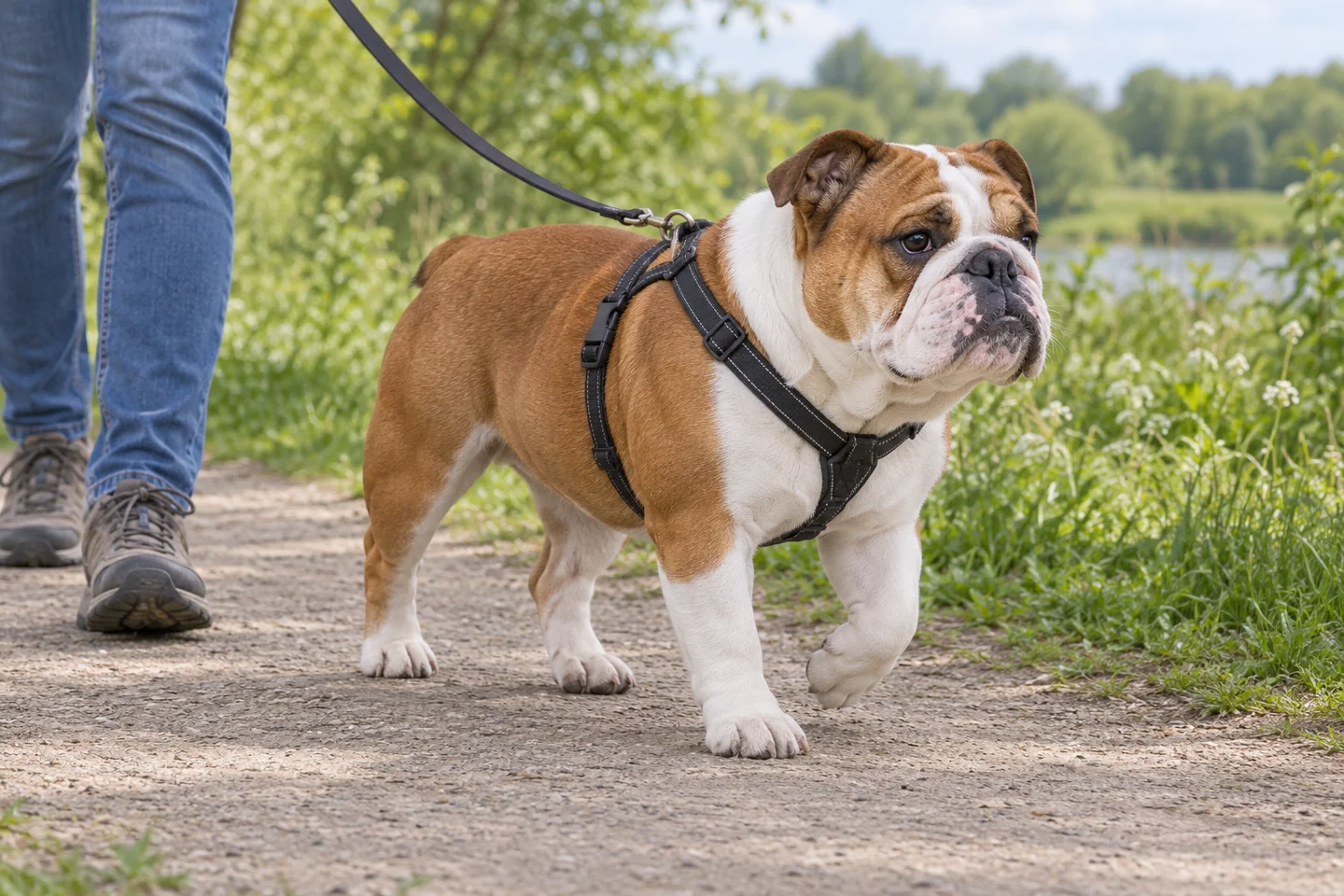
Teach the dog to walk toward a target, step onto a mat, and wait while a doorway is managed. These practical behaviors reduce the need to pull or lift it through routine transitions. Reward success in an easy setting before adding distraction. A short session can fit before a meal or after a suitable walk, provided the dog is comfortable. If it struggles, consider understanding, motivation, fatigue, and physical limitation instead of assuming that a familiar breed stereotype about stubbornness explains everything.
Cooperative care can begin with a brief look at a paw or gentle contact near the face, followed by a reward and a pause. Introduce equipment gradually and keep the task manageable. Necessary treatment may require additional veterinary support while training develops. A household should agree on cues and expectations so the dog receives consistent information. Good instruction helps an owner understand timing and environment, rather than simply supplying a stronger correction. Progress means daily care becomes more predictable and comfortable, including occasions when someone other than the usual handler must help.
Exercise for function and enjoyment
A Bulldog still benefits from appropriate movement, sniffing, and engagement. The amount and intensity should suit the individual and any veterinary plan. Avoid using either extreme as a rule: a flat-faced dog should not be pushed through distress, and its breed name should not automatically confine it to inactivity. Start from comfortable function and monitor recovery. Shorter walks may offer better options than one prolonged outing, especially when temperature, mobility, or respiratory limitation changes what the animal can manage.
Play on stable surfaces and avoid repeatedly encouraging awkward leaps from furniture. A dog's willingness to continue does not replace the owner's judgment. Report new lameness, altered endurance, or difficulty rising, including changes noticed later that day. Stop and seek urgent help for severe weakness or respiratory distress. During restricted periods, ask which quieter activities are appropriate. An enjoyable routine may include simple searches, gentle learning, and social contact without trying to exhaust the dog. Fitness should support ordinary comfort, rather than serve an owner's wish to disprove concerns through strenuous demonstrations.
Grooming folds, feet, and the mouth area
A smooth coat still needs a routine. Brush gently, inspect equipment contact areas, and look at folds that retain moisture or debris. Ask your veterinarian how to clean and dry the individual dog's skin rather than following an aggressive universal recipe. Persistent redness, odor, or pain requires assessment. The Royal Veterinary College's research identifies skin-related concerns among important Bulldog welfare issues. Cosmetic appearance should not lead an owner to conceal or repeatedly treat a problem without understanding why it recurs.
Keep eye-area products and sharp tools away from a struggling dog. Soreness around the face can make handling difficult, and clinical care may be needed before home maintenance becomes comfortable again. Check nails, feet, ears, and teeth through small cooperative sessions. Discharge from an ear or repeated head shaking deserves advice, not leftover medication. A dog that suddenly refuses a task it previously accepted may be giving useful information about discomfort. Share that observation with the veterinary team rather than turning the next grooming session into a longer restraint contest.
Health screening and what research can establish
The AKC's current listed national breed-club recommendations include cardiac and patella evaluations for Bulldogs. Ask about the breeder's broader health program too, including respiratory assessment and any other documented examinations it uses. Obtain original results for identified animals and ask how findings affect breeding decisions. A list of completed tests is not identical to normal findings, and a general puppy examination does not answer every question about parent health. Unclear paperwork should be interpreted with a clinician or the issuing organization.
Royal Veterinary College VetCompass research found poorer overall health in the sampled English Bulldogs than in the comparison dogs, with important problems related to conformation. This is evidence about the studied population, not a diagnosis for every individual or a prediction of one dog's lifespan. It does justify careful questions and a focus on moderate, functional anatomy. Ask about serious family illness and the practical health of adult relatives. Avoid accepting rare-color pricing, athletic photographs, or a breeder's reassurance as substitutes for relevant evidence and an honest account of remaining uncertainty.
Feeding, body condition, and ongoing costs
Use complete food appropriate to life stage and measure portions alongside the whole day's treats. Excess weight can worsen respiratory difficulty in an affected short-faced dog, so body-condition guidance is useful. The target is comfortable function rather than a rounder silhouette. If appetite or chewing changes, consider dental and other medical causes before labeling the animal fussy. Seek advice for unexplained weight shifts or persistent digestive signs. Repeated dietary experiments without a clear history can make the clinical picture harder to interpret.
Budget for routine examinations, dental care, skin treatment, respiratory assessment, and emergency support as appropriate to the individual. Review insurance terms or an emergency fund before a problem occurs, including how known conditions are handled. A sitter may need specific instructions or availability for medication and monitoring. An older dog can require easier access, improved footing, and a modified walk schedule. Those arrangements should evolve with current comfort. A caring household needs practical capacity for treatment and management, rather than an expectation that every issue will be minor because the dog lives mostly indoors.
Mixes and claims about healthier shapes
A Bulldog cross can vary widely in muzzle, body, skin, activity, and health. Crossing with another breed does not automatically establish normal breathing or eliminate inherited disease. Assess the actual dog and request appropriate parent information when available. A marketing name suggesting a return to an old type is not itself evidence of medical benefit. Ask which measurable functions and examinations support the claim, and distinguish established findings from a seller's expectation about how a litter will develop.
For an adult rescue, a known care plan may allow a clearer decision than unsupported promises about a puppy. Discuss present breathing, mobility, skin needs, sleep, behavior, and the support available after placement. A household should also consider its schedule, climate-control options, and access to veterinary care. Some individuals require more resources than others. Choose on that concrete basis rather than treating every dog carrying bulldog in its description as the same proposition. Candid information protects both the animal and the person responsible for maintaining its comfort.
A comfortable dogsDating outing
Tell a prospective dogsDating walking partner about your Bulldog's actual pace, preferred contact, and any relevant medical limits. Meet in a quiet public place under comfortable weather conditions, with separate handlers and an easy route home. Avoid an encounter that depends on chasing or rough contact to count as successful. Begin with room between the dogs and observe whether both remain relaxed and able to disengage. A peaceful short walk can provide useful social contact without testing endurance or requiring a physical greeting.
Keep exact home coordinates private and use approximate location information for planning. Agree how to pause or end the meeting, and leave prized items out of the introduction. If either dog becomes tense, persistent, or physically uncomfortable, create distance and finish as needed. Compare observations afterward instead of interpreting a profile match as certification. Future outings should follow the animals' demonstrated comfort and the Bulldog's care plan. Sharing a home, vehicle, or resources is a different arrangement and deserves its own assessment beyond one pleasant walk together.
Sources and editorial notes
Sources checked October 21, 2026. Breed measurements describe reference ranges, not a diagnosis or an individual dog's ideal weight. Images are AI-generated breed illustrations and do not document a particular dog or health condition.
- AVSAB: Humane Dog Training Position Statement
- VCA Animal Hospitals: Food aggression in puppies
- VCA Animal Hospitals: Aggression toward unfamiliar dogs, diagnosis
- VCA Animal Hospitals: Heat stroke in dogs
- VCA Animal Hospitals: Common emergencies in dogs
- VCA Animal Hospitals: Grooming and coat care for your dog
- VCA Animal Hospitals: Ear infections in dogs
- VCA Animal Hospitals: Feeding guidelines for dogs
- Orthopedic Foundation for Animals: CHIC program and interpretation of numbers
- VCA Animal Hospitals: Brachycephalic airway syndrome in dogs
- Royal Veterinary College: English Bulldog health comparison in the VetCompass study
- Royal Veterinary College: Bulldog skin disease and obesity research
- AVSAB: Humane Dog Training Position Statement
- Fédération Cynologique Internationale: Bulldog official breed standard
- American Kennel Club: National breed-club non-sporting group health testing recommendations
Keep getting to know dogs.
Read another guide or return to your dogsDating community.
Explore breed guidesBack to dogsDating