Bullmastiff
A powerful British guardian whose care depends on cooperative handling, practical arrival routines, suitable conditioning, and documented health assessments.
How these guides are researched and reviewed
- Origin
- Great Britain
- Coat
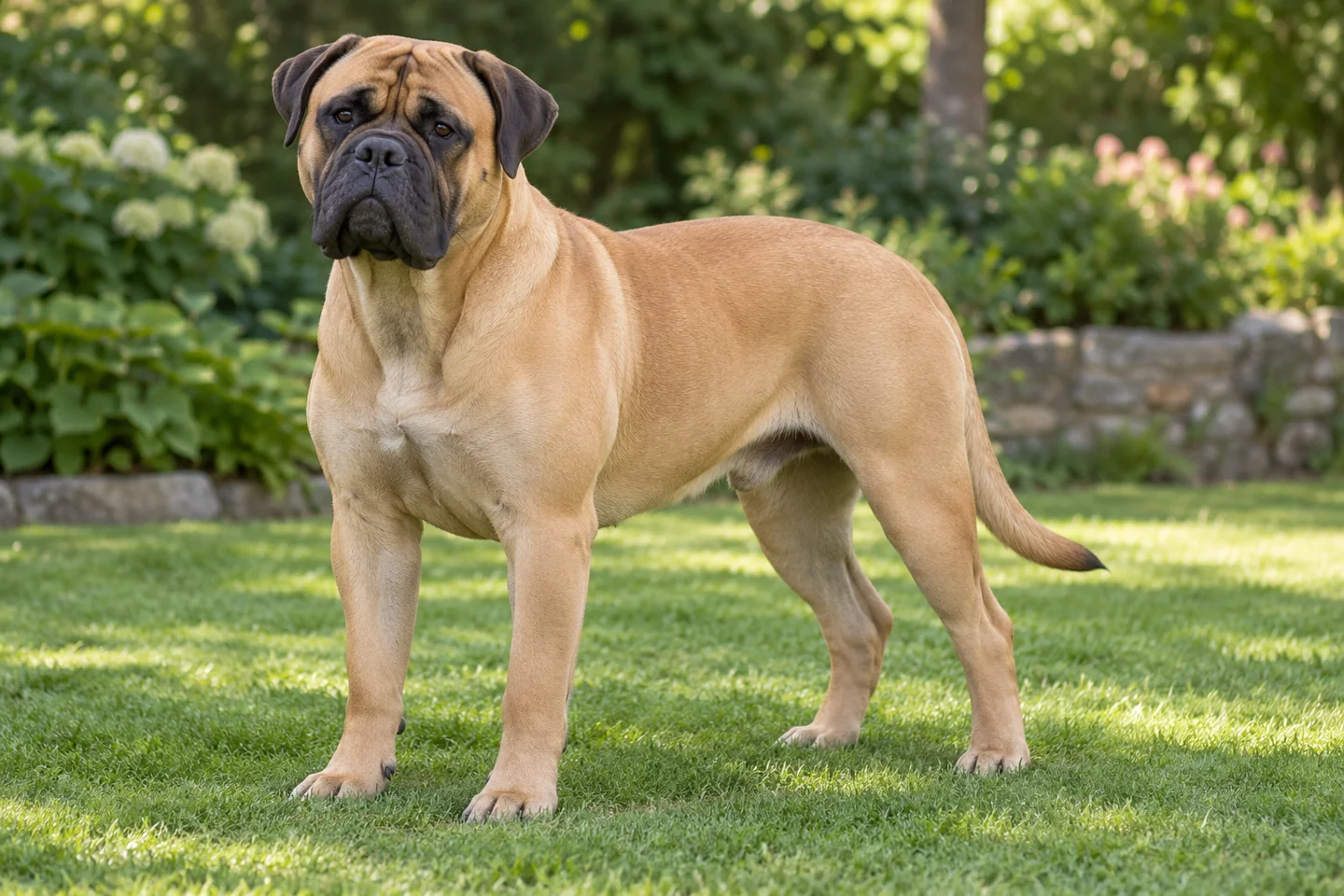
- Short fawn coat with black mask illustrated
- Care priorities
- Capable handling, visitor access, orthopedic and cardiac records
- Adult size reference
- FCI: males 64–69 cm, 50–59 kg; females 61–66 cm, 41–50 kg
General information for owners. These articles have not been reviewed by a veterinarian. Medical decisions need your dog's history and an examination.
A Bullmastiff needs a capable everyday handler
A Bullmastiff needs a household that can manage a powerful adult calmly, including when a visitor arrives unexpectedly or a loose dog approaches. Its substantial body makes ordinary skills consequential. Teaching a puppy to move aside and wait is much easier than improvising those requests with an untrained mature animal. Before choosing the breed, consider whether everyone responsible for care can follow the same plan. A dog that is affectionate with its family still requires an individual assessment around unfamiliar people and animals.
Meet adults and ask owners about the work between outings: settling while someone repairs the house, grooming, veterinary access, and care when the usual handler is absent. A quiet demonstration does not reveal every demand, so seek honest discussion of difficult situations too. A rescue's foster information may clarify present needs, while puppies remain uncertain despite useful family history. The best decision rests on a realistic match with the home, not the hope that a calm expression guarantees uncomplicated behavior in every setting.
British development and the gamekeeper association
The Bullmastiff developed in Britain from Bulldog and Mastiff ancestry. Its FCI standard describes a historical role helping gamekeepers confront poachers. That background explains the guardian association, but a companion owner should resist stories that turn every protective response into proof of quality. A modern dog must live among delivery workers, guests, veterinary staff, and neighbors. Their safety depends on owner management and the animal's actual learning and temperament, rather than a romantic expectation that it instinctively identifies every legitimate person.
The breed is distinct from the English Mastiff and from the many other dogs described broadly as mastiffs. Ask for clear registration and parent identities if a puppy is sold as a registered Bullmastiff. An adult rescue may have only an estimated identification, which should remain explicit. Shared features such as a dark mask or broad chest cannot settle ancestry. Regardless of the label, assess the individual body, behavior, and medical needs directly. An uncertain pedigree does not prevent thoughtful care, but it limits what a source can honestly promise about breed-specific predictions.
A compact powerful body with a visible muzzle
A Bullmastiff has a powerful balanced build, broad head, short coat, and small folded ears. Fawn, red, and brindle occur, with a dark muzzle contributing to the familiar expression. The illustrations choose a fawn dog with natural ears and a long tail. The short muzzle should remain visibly functional. Avoid treating maximum head size, deeper folds, or heavier weight as automatic improvements. Watch comfortable movement and recovery in a real dog instead of judging quality from a pose designed to emphasize bulk.
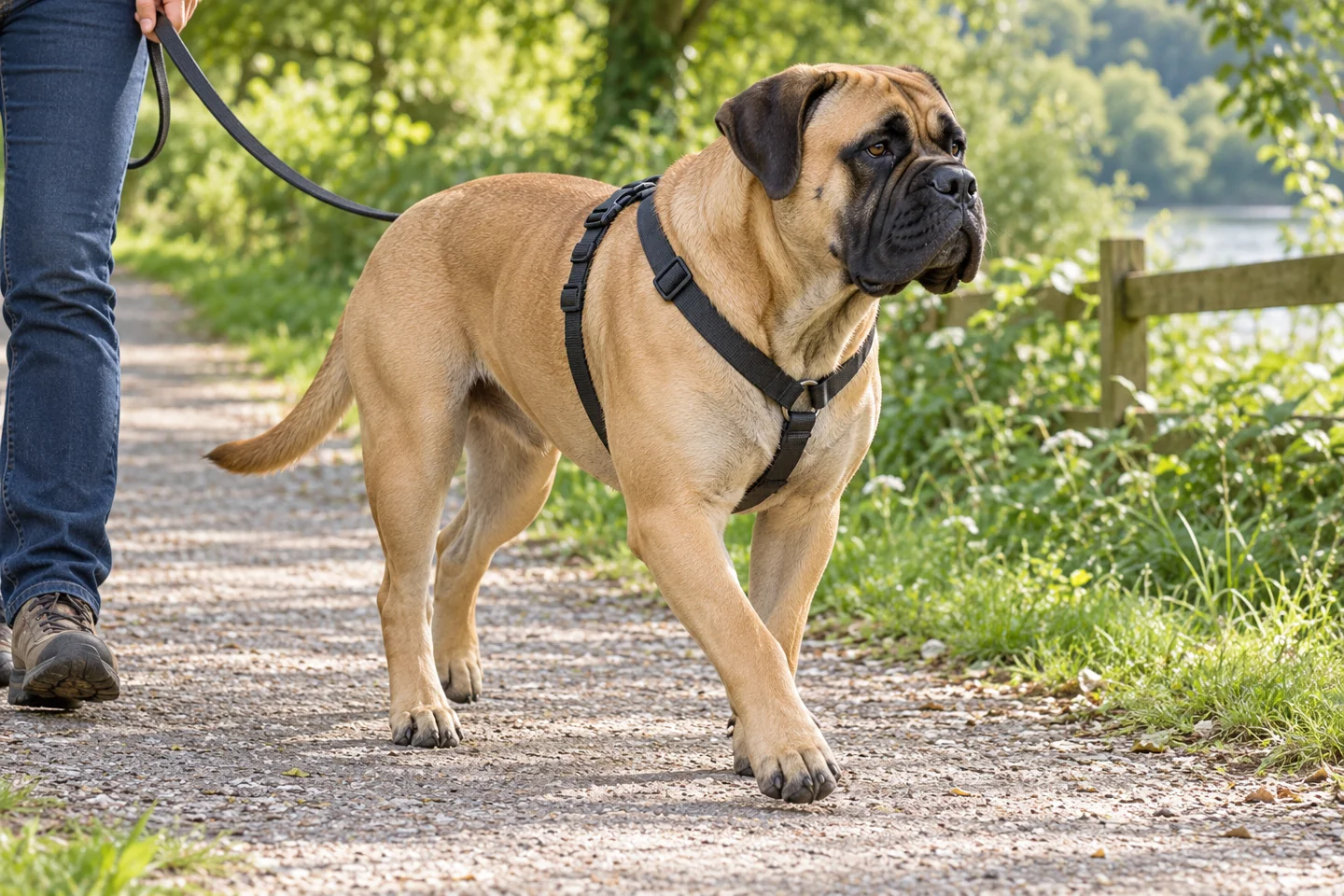
Discuss persistent respiratory noise or poor exercise tolerance with a veterinarian. Short-faced anatomy can create airway concerns, but individual assessment is necessary to understand what is present. A broad muscular body also needs suitable equipment and space. Fit a harness carefully, check rubbing, and arrange a secure travel position. Plan the adult's route through the home before placing beds and barriers. Non-slip surfaces and room to turn can prevent an awkward domestic layout from becoming a daily handling problem or a later obstacle when mobility changes.
FCI males are listed at 64–69 cm at the withers and 50–59 kg; females at 61–66 cm and 41–50 kg. These figures show why an owner needs suitable transport and competent backup handling. They describe standard adults, not a reason to increase food or delay assessment when an individual seems unusually heavy or loses muscle.
Visitor arrangements that do not depend on a greeting
A household can welcome a guest while the Bullmastiff remains comfortably separated. Teach the dog to go to an inner room or station before the outer door opens, and make that place pleasant rather than a punishment. The routine should work when parcels arrive as well as during a planned visit. Tell guests what will happen before they enter. Do not ask an unfamiliar person to reach over the animal's head or present a hand repeatedly when it is trying to maintain distance.
If a dog can greet calmly, proceed according to that individual and the setting. Continued fixation, stiffness, or inability to recover calls for more space and qualified advice. A visitor should never be used to test the animal's willingness to accept authority. Review garden and gate access during repairs too. Someone carrying materials may leave a door ajar without realizing the consequence. Clear separation protects both the worker and the dog while allowing the household to complete an ordinary necessary task without a confrontation.
Children and the consequences of weight
A friendly Bullmastiff can knock a small child over when turning or moving toward something interesting. Arrange enough room that children are not constantly squeezed between the dog and furniture. Keep fast games separate and supervise shared time with attention to the actual interaction. A child should not climb onto the animal, hang from its neck, or attempt to move it by the collar. Adults remain responsible for doors and leads even when an older child is enthusiastic about helping.
Protect rest, meals, and chews. If an object lands beside the dog, an adult can organize a safe exchange or move it away before retrieval. Teach children that turning away or leaving is a sufficient refusal of contact. A reputation for family affection does not make repeated hugging comfortable. Visiting children also change the noise and movement in a home. Plan a quiet separate area when supervision will divide, and review arrangements when pain or aging affects tolerance. The dog should not have to escalate warnings before an adult intervenes.
Canine companions, cats, and crowded spaces
A first meeting with another dog needs room and a handler for each animal. Watch whether both can look away, pause, and resume ordinary behavior. Do not push them into a narrow entrance or a shared car after one pleasant greeting. At home, create separate feeding and enough resting options that one need not displace the other. An absence of fighting is only one observation; repeated monitoring, blocking, or pursuit can leave a companion unable to relax even when the interaction remains quiet.
Play must account for physical mismatch. A smaller dog's attempts to stop contact should be respected before weight causes an accidental injury. Interrupt persistence and give both a route away. Cats need protected rooms and escape routes, and early encounters can be managed across suitable barriers. Prevent chasing instead of waiting to discover whether the cat can defend itself. Ask previous carers for specific observations and retain uncertainty where experience is limited. A dog that accepts a familiar animal does not thereby establish safety with all animals in all surroundings.
Aggression and the temptation to excuse guarding
Describe threatening behavior accurately instead of treating protective as a complete explanation. Was someone arriving, touching a painful area, reaching for food, or crowding the dog during rest? The details influence assessment. Secure separation should prevent another incident while veterinary and behavioral help is arranged. A large guardian's response can have serious consequences even when the owner believes it would never follow through. Avoid repeating the situation to prove that belief or obtain a dramatic demonstration for a trainer or online audience.
Choose qualified support using reward-based methods and a management plan the household can follow. Punishing a growl may reduce visible warning without removing the underlying fear or discomfort. A safe exchange, changed access, or cooperative handling lesson can offer more useful information than confrontation. When a basket muzzle is recommended, fit and respiratory comfort require care with this head shape. Teach wear gradually before using it for a difficult task. It remains an additional precaution within supervision and appropriate distance, not permission to continue contact that overwhelms the dog.
Training useful movement through the home
Teach a hand target and a station so the dog can move willingly through a doorway or away from a busy kitchen. Reward brief waits as equipment is fitted, then increase difficulty slowly. A mature animal can be hard to guide physically in a narrow space; early learning reduces the need for that struggle. Use clear cues consistently across carers. If a familiar request fails somewhere new, check what changed rather than assuming the dog has decided to oppose the person.
Care skills are part of the same practical education. Standing on a scale, accepting a brief paw check, and allowing gentle examination can make necessary appointments easier. The owner should pause and investigate new sensitivity. A slower response could reflect discomfort, an unclear request, or distraction. Reward-based instruction helps identify those differences and adjust the next step. Long repetitive sessions are unnecessary when small successful lessons fit ordinary transitions. The aim is a dog that understands how to participate in everyday care, including when someone else must provide it.
Exercise with a sensible recovery measure
Regular movement and exploration belong in a Bullmastiff's routine, with intensity matched to age, health, and conditioning. Puppies need appropriate activity and sleep rather than exercise intended to maximize muscle or speed growth. Discuss demanding repetitive tasks with the veterinarian. An adult returning from a quiet period should build workload progressively. Distance alone is a poor measure: slopes, soft ground, and temperature can make a modest route more demanding than its length suggests. Leave room to change the plan when conditions differ.
Evaluate recovery later, including rising after rest and entering the vehicle. New lameness, difficulty breathing, or unusual fatigue deserves clinical attention rather than being attributed casually to a heavy breed. Provide water and adjust warm-weather activity. Severe weakness or collapse requires urgent help. A practical routine includes quieter days that retain suitable sniffing and learning without frantic efforts to exhaust the dog indoors. Exercise should help maintain function and enjoyment, not create an expectation that the animal must reach its limit before it is allowed to settle.
Health screening for joints, heart, eyes, and thyroid
The AKC's current national breed-club list includes hip and elbow evaluations, a cardiac examination, an ophthalmologist evaluation, and thyroid evaluation for Bullmastiffs. Ask for the proposed parents' actual reports, with identities and dates, and discuss how the results informed the breeding decision. A photograph of active parents answers a different question. Completion of assessment does not necessarily establish normal findings, so learn what the specific reports mean before accepting a general assurance that the animals were fully tested.
Ask about significant family illness and any additional assessment used in that program. There is no need to invent a percentage risk for every concern to justify careful questions. Your own dog needs individual veterinary care after adoption, and new symptoms deserve attention even when parent reports were reassuring. Keep screening and clinical records together. A new limp, cough, altered stamina, or visual difficulty should be assessed rather than explained through a certificate. The purpose of records is to improve understanding, not to declare that future medical uncertainty has disappeared.
Emergency preparation and changes in the older dog
Discuss gastric dilatation and volvulus, often called bloat, and an individual emergency plan with your veterinarian. Repeated retching without producing vomit, sudden abdominal enlargement, collapse, or marked distress warrants urgent contact with a veterinary service. Do not wait for an online discussion or assume that a particular feeding schedule makes a serious abdominal problem impossible. Ask about preventive options when relevant and understand their limits. The household needs a way to transport a large dog that may not be able to walk.
Later-life support also benefits from planning before a crisis. A dog that once climbed into the car may need a trained ramp routine and additional assistance. Better floor traction and accessible beds can make movement easier. Gradual stiffness should still be discussed clinically, especially when it changes tolerance of touching or contact from other pets. Record ordinary function, such as how the dog rises and recovers from its usual route. Those details help the veterinarian assess change more clearly than an owner's general impression that a large animal is simply getting older.
Meals, body condition, and household resources
Select complete food for the dog's stage of life, with particular attention to appropriate large-breed growth when feeding a puppy. Do not add supplements merely because the breed has a substantial frame. Measure portions and include rewards used in training. Body condition matters more than an owner's wish for maximum size. Ask a veterinarian to demonstrate assessment when you are unsure. Persistent changes in appetite, drinking, weight, or digestion need investigation, not endless food switches based on comments from people who have not examined the dog.
Include suitable equipment, secure access, veterinary care, instruction, and backup handling in the budget. The capacity to feed an adult is only part of the commitment. Check housing and insurance conditions that apply to your situation before adoption, and plan who can help during illness or travel. A boarding facility needs details about visitor and dog contact, medication, and transport. A familiar friend may require practice with the individual before care becomes straightforward. Responsible planning accounts for those concrete needs rather than assuming affection and a calm reputation will make every arrangement work automatically.
Mixes and uncertain identity
A Bullmastiff mix may vary in head shape, size, social responses, and medical needs. Crossing with another guardian or sporting breed does not guarantee the easiest combination of traits. Ask what is actually documented about the parents and which health assessments exist. An adult may allow observation of current needs, while a puppy's eventual behavior and body remain less certain. A muscular fawn dog with a mask might have several backgrounds, so retain uncertainty when identification rests only on appearance.
Choose according to the present animal and the support available. Can it rest in the intended home, navigate neighborhood walks, and receive necessary handling comfortably? Does the household have a reliable plan for its known difficulties? A placement can fail when a person expects training to remove every retained preference or guarding response. Qualified instruction can help substantially while management remains necessary. An honest account of those limits is more useful than an appealing breed label or a promise that a mix will always be healthier and easier than either parent.
A spacious dogsDating meeting
Use dogsDating to describe whether your Bullmastiff prefers walking, gentle contact, or a slow approach to unfamiliar dogs. Meet on a quiet public route with separate competent handlers and enough room to change distance. Avoid beginning at the home gate or inside a shared vehicle. Watch whether each animal can turn away and return to ordinary investigation. A brief comfortable walk may provide all the information needed for a first session, without requiring play or a close face-to-face greeting.
Keep exact home coordinates private and share an approximate area while choosing the venue. Agree how to end the outing if either animal becomes tense or persistent. Do not introduce prized toys to test sharing or crowd the dogs together for a photograph. Discuss what actually worked afterward and plan future contact from those observations. Some pairs enjoy parallel walks while close play remains unsuitable. The profile supports communication between owners; compatibility depends on the animals' responses and needs in the particular arrangement, including any medical limitation affecting pace or physical contact.
Sources and editorial notes
Sources checked October 21, 2026. Breed measurements describe reference ranges, not a diagnosis or an individual dog's ideal weight. Images are AI-generated breed illustrations and do not document a particular dog or health condition.
- AVSAB: Humane Dog Training Position Statement
- VCA Animal Hospitals: Food aggression in puppies
- VCA Animal Hospitals: Aggression toward unfamiliar dogs, diagnosis
- VCA Animal Hospitals: Heat stroke in dogs
- VCA Animal Hospitals: Common emergencies in dogs
- VCA Animal Hospitals: Grooming and coat care for your dog
- VCA Animal Hospitals: Ear infections in dogs
- VCA Animal Hospitals: Feeding guidelines for dogs
- Orthopedic Foundation for Animals: CHIC program and interpretation of numbers
- VCA Animal Hospitals: Brachycephalic airway syndrome in dogs
- Washington State University Veterinary Teaching Hospital: Gastric dilation and volvulus and bloat in dogs
- AVSAB: Humane Dog Training Position Statement
- Fédération Cynologique Internationale: Bullmastiff official breed standard
- American Kennel Club: National breed-club working group health testing recommendations
Keep getting to know dogs.
Read another guide or return to your dogsDating community.
Explore breed guidesBack to dogsDating