Cane Corso
An athletic Italian guardian whose daily care requires prepared handling, managed access, suitable conditioning, and precise interpretation of clinical and genetic screening.
How these guides are researched and reviewed

- Origin
- Italy
- Coat
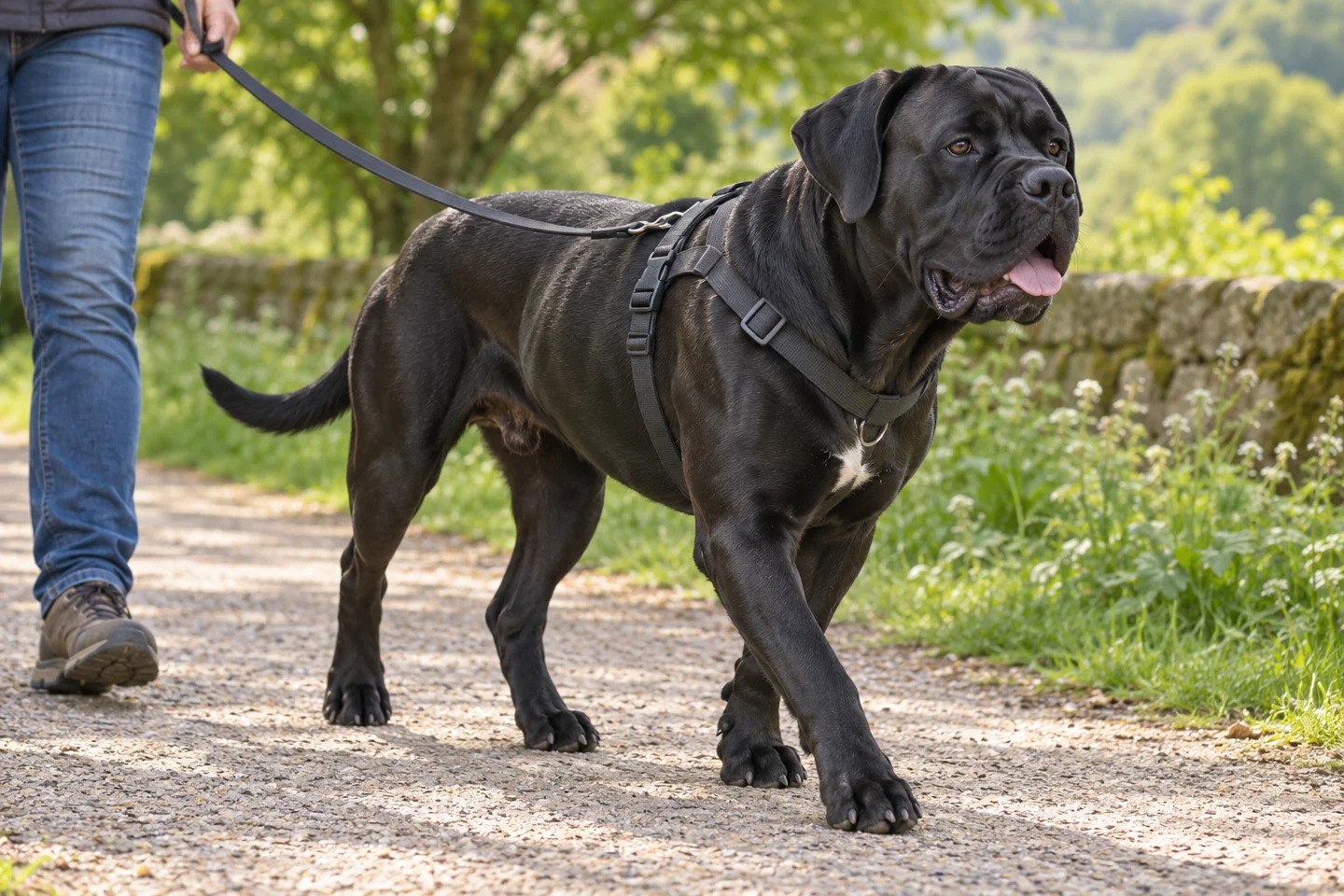
- Short dense black coat; natural ears and tail illustrated
- Care priorities
- Cooperative handling, visitor management, orthopedic and DSRA records
- Adult size reference
- FCI: males 64–68 cm, 45–50 kg; females 60–64 cm, 40–45 kg, with height tolerance
General information for owners. These articles have not been reviewed by a veterinarian. Medical decisions need your dog's history and an examination.
A Cane Corso needs prepared ownership
A Cane Corso needs a home ready to manage an athletic guardian at adult strength. Affection with familiar people can coexist with reserve around others, so the household must plan both companionship and access. Before choosing a puppy, consider your entrances, neighboring animals, transport, and who can provide care when you are unavailable. A garden is useful only alongside secure boundaries and meaningful daily contact. The animal should not have the job of deciding which unfamiliar person is entitled to enter an occupied space.
Meet adults in ordinary settings and ask owners what management actually involves. Watch recovery after arrivals and the ease of necessary handling rather than focusing only on an impressive physique. A breeder or rescue should describe difficult situations candidly. Choose according to the individual and available support, including your ability to obtain qualified instruction. A puppy's future remains uncertain even with useful parent information, while an adult's known behavior may still change with the demands and surroundings of a new home.
Italian identity and mastiff comparisons
The Cane Corso is an Italian breed identified as Cane Corso Italiano in the FCI standard. Its history includes work as a general farm and property dog. Those roles provide context for its guardian identity without proving that a particular puppy will make safe decisions automatically. Avoid narratives that use presumed ancient ancestry to dismiss questions about modern behavior, health, or handling. Recent relatives and documented experience are more useful to a household planning daily walks, visiting children, and ordinary veterinary care.
A Corso is distinct from the Neapolitan Mastiff, Bullmastiff, American Bully, and other substantial short-coated dogs. Ask how a registered animal's identity is documented. For a rescue, appearance alone may support only an estimate. Keep uncertainty visible rather than using a precise breed claim to promise either danger or safety. The animal's present condition and actual responses matter. A responsible placement discussion includes who will handle the dog, how unfamiliar arrivals are managed, and which situations may continue to require separation despite useful training.
Adult scale and a functional body
The FCI lists males at 64–68 cm at the withers and 45–50 kg, with females 60–64 cm and 40–45 kg; the height standard includes a two-centimeter tolerance. These references convey adult scale rather than an exact puppy forecast. Ask about real adults in the family and measure the individual for equipment. Pursuing extra weight to create an imposing appearance is not a useful goal. A dog should be able to walk, turn, rise, and recover comfortably within its actual frame.
The short dense coat, broad head, and muscular slightly elongated body need no cosmetic alteration to be recognizable. The illustrations select a black dog with natural hanging ears and a long tail. Check beneath equipment for friction and adjust fit through growth or weight change. Secure travel needs room for comfortable positioning without allowing movement beside the driver. Consider how the dog will reach a clinic if it cannot climb into the vehicle, because independent loading and physical strength cannot be assumed during an emergency.
Entry routines before a visitor arrives
Set up a clear sequence for doors: move the dog to a comfortable secure area, admit the visitor, and assess whether any closer contact is appropriate. Practice the sequence before the first busy occasion. A guest should not be asked to approach a tense animal or demonstrate confidence through staring and touching. Some dogs greet familiar people comfortably; others need more distance. Neither outcome should be decided by an owner wanting to prove that a guardian is sociable in every setting.
Check access during deliveries and repairs. An open side gate or a worker returning for tools can create an encounter nobody intended. Explain the physical arrangement directly and keep the dog's area separate. Watch repeated fence-line or window confrontations and reduce opportunities to rehearse them. Reward movement toward a quieter station before excitement becomes difficult to interrupt. If the animal remains fixed or cannot settle, increase separation and obtain help. Good household management allows necessary work to happen without using unfamiliar people as training subjects under unsafe pressure.
Children and power at close range
A friendly Corso can unbalance a child through turning, jumping, or joining a running game. Provide enough room and separate energetic play before it becomes a collision risk. An adult remains responsible for leads and doors. Children can participate in simple supervised reward-based tasks, but should not move the dog by its collar or try to hold it when attention shifts toward another animal. The plan needs to work according to a child's actual abilities rather than confidence or enthusiasm.
Give the dog a sleeping place free from interference and protect meals and chews. An adult should retrieve a dropped object after safely moving the animal or arranging an appropriate exchange. Demonstrate gentle brief contact without hugging or climbing. Observe withdrawal, stiffness, or attempts to leave and stop pressure early. Visiting children introduce new handling and noise, while pain or fatigue can change tolerance within a familiar family. When close supervision is not available, use secure comfortable separation instead of expecting either participant to manage the encounter alone.
Dogs, cats, and resources in a shared home
A second dog needs an introduction with space and separate handlers. Observe pauses and the ability to look away rather than assuming close continuous contact is welcome. At home, arrange separate meals and enough rest options that one animal cannot control the other's access. Repeated blocking or following deserves attention even without a fight. A large athletic dog can overwhelm a smaller companion by persistence or weight, so interrupt unwanted contact before the recipient must escalate to obtain relief.
Cats need protected routes and rooms, and new encounters can begin across secure barriers. Reinforce disengagement before chasing becomes established. Small pets require physical protection, and previous familiarity with one animal does not establish safety with an unfamiliar one running outdoors. Ask carers what was observed and under which conditions. Broad claims about being good with pets are less useful than a description of actual behavior and management. Expand access according to comfort in the new environment, retaining separation when that is the workable way to protect every animal involved.

Aggression and the difference between explanation and excuse
A rush at a stranger, a snap during care, and a dispute over a chew should be described separately. Record the trigger, distance, actions, and possible escape routes. Prevent another incident while arranging assessment. Calling a reaction protective does not determine its cause or establish that it is acceptable. A guardian's response can have serious consequences before an owner fully understands the pattern, so practical safety measures cannot wait for complete certainty or an attempt to reproduce the event for a demonstration.
Veterinary assessment matters when pain or a new behavioral change is possible. Use qualified reward-based help for learning and management rather than intimidation or forced submission. Suppressing a growl can reduce visible warning without making the dog comfortable. A conditioned basket muzzle may help with particular tasks, provided fit, panting, and supervision are addressed. It remains part of a broader plan that respects distance and treatment needs. The owner's goal is predictable safe participation, not proof that the animal will endure any pressure from a person claiming authority.
Training cooperation for ordinary transitions
Teach a station, a hand target, and waiting while equipment is adjusted. These tasks can move a mature dog through the home without pushing or dragging. Reward success where the animal can concentrate and increase distraction gradually. A response learned in a quiet room needs further practice near visitors or passing dogs. If it fails, ask whether the task is understood in that setting and whether the difficulty can be reduced. Repeating the request more forcefully does not necessarily supply missing learning.
Include care in daily practice: standing briefly on a nonslip surface, offering a paw, and accepting a gentle look at the mouth area. Stop to investigate new sensitivity. A clinician may need to support essential procedures while cooperative skills develop. Consistency among carers makes expectations clearer, especially for access and resource routines. Professional instruction should improve the person's timing and judgment as well as the dog's responses. A capable home is one that can organize comfortable cooperation and safe limits, rather than relying entirely on the physical strength of one owner.
Exercise that develops useful fitness
Provide regular walks, exploration, and suitable activities matched to age and health. A muscular outline does not establish readiness for strenuous work. Build conditioning after inactivity and discuss repetitive high-impact tasks with a veterinarian, especially during growth. The dog may continue enthusiastically while feet or joints need a limit set by the handler. Consider slope, surface, weather, and recovery rather than counting distance alone. An outing should remain adjustable when conditions or the animal's response differs from expectations.
Watch how the dog rises later and moves the following morning. Persistent stiffness, limping, or unusual fatigue deserves clinical attention. Choose cooler conditions when necessary and provide water. Severe weakness, collapse, or respiratory distress calls for urgent help. Quiet days can retain appropriate sniffing and learning without a frantic indoor attempt to exhaust the animal. A sustainable plan should work through busy employment periods, bad weather, and temporary injury. Fitness is useful when it supports comfortable function over time, not when it becomes a performance intended to maximize bulk or prove toughness.
Grooming and observing the short coat
Gentle brushing is an opportunity to examine skin and equipment contact areas. Check feet after rough ground and dry wet or muddy regions that need attention. A short coat does not prevent irritation, and a shiny surface cannot identify the cause of persistent itch or odor. Record recurring problems and discuss them with a veterinarian instead of applying a succession of unprescribed products. The history of timing and exposure may be more useful clinically than a general impression that the dog has always had sensitive skin.
Introduce nails, teeth, and ears in small cooperative steps. Ask a professional to demonstrate tools and technique when uncertain. A painful ear or mouth should be assessed rather than handled repeatedly until the dog stops objecting. Do not insert objects deeply into the ear canal or reuse medication without advice. Tell staff about handling concerns before appointments. Clinical treatment should not wait until every home lesson is complete; veterinary support can make essential care possible while the owner continues building comfortable participation during easier tasks.
Health screening and the current Corso list
The AKC's current national breed-club recommendations include patella, hip, elbow, and cardiac evaluations, with DNA tests for dental-skeletal-retinal anomaly and neuronal ceroid lipofuscinosis type 1. Request actual results for identified parents and ask how findings informed the mating. A commercial panel described only as clear is insufficient detail. Different evaluations answer different questions, and a genetic result does not replace clinical assessment. A puppy examination also cannot stand in for documented breeding-health information about the adults involved.
Ask about serious illness in close relatives and the dates and methods of assessment. A normal result for one condition does not establish freedom from every acquired or inherited problem. Keep reports available after adoption and arrange an individual preventive plan. New lameness, visual difficulty, or altered coordination deserves examination even when parent paperwork was reassuring. The purpose of screening is to reduce uncertainty about defined concerns, with clinical follow-up for the animal that exists now. It cannot justify delaying care until a symptom matches an anticipated list precisely.
Dental-skeletal-retinal anomaly needs precise interpretation
Dental-skeletal-retinal anomaly, abbreviated DSRA, is an inherited disorder described in Cane Corsos. Research and OFA information connect it with abnormalities affecting teeth, skeletal development, and vision, and identify a relevant MIA3 variant. Ask which laboratory performed testing and obtain the result rather than interpreting unusual teeth or body proportions yourself. A carrier designation concerns inheritance; it should not be casually treated as an affected clinical diagnosis. A veterinarian can explain how a particular report relates to breeding decisions and the individual dog's care.
Discolored or fragile teeth, abnormal growth, vision change, or lameness warrants clinical assessment. Those signs can have different causes, so do not diagnose DSRA from an illustration or a short video. Necessary dental care should not be postponed while waiting for an online group to decide which genetic condition might fit. Keep both laboratory and clinical records. A named variant supplies useful information without assessing every cause of a symptom, and the discovery of a specific disease does not establish its prevalence in every country, family, or population of the breed.
Food, growth, and emergency preparation
Choose complete food appropriate to growth or adult needs and discuss large-breed puppy nutrition with a veterinary professional. Do not add calcium or other supplements to accelerate size. Measure meals and include training rewards. Assess body condition through touch and clinical advice rather than feeding toward a dramatic muscular outline. Persistent changes in appetite, thirst, digestion, or weight deserve investigation. An active guardian can gain excess fat, and a lean silhouette should not conceal unexplained muscle loss or a medical problem.
Know the nearest emergency service and how the household will transport a large dog that cannot move normally. Repeated unproductive retching, abdominal enlargement, collapse, or marked distress requires urgent veterinary contact. Discuss bloat risk and preventive options individually rather than assuming one feeding rule guarantees protection. Older dogs may need better traction, accessible beds, and changes to loading and walks. Gradual stiffness remains worth clinical discussion. Write down practical observations about rising and recovery, so the clinician can understand the change beyond a vague statement that a large breed is getting old.
Mixes, costs, and a sustainable match
A Corso mix may vary in body, guardian responses, social preferences, and medical needs. Crossing with another mastiff or working breed does not guarantee a convenient midpoint or remove inherited risk. Ask what is known about both parents and distinguish documents from appearance-based estimates. An adult's foster observations can help with practical fit, while a new setting still needs careful assessment. Avoid a placement built on the promise that training will erase every retained preference or make every household arrangement suitable.
Budget for secure access, durable equipment, veterinary care, instruction, and backup handling. Check housing and insurance conditions relevant to your situation before committing. The ability to feed a large dog is only part of the responsibility; someone must also provide care during illness or travel. Assess whether that person can follow the routine comfortably. A home may love the breed yet lack practical access or reliable support for a particular individual. A candid decision based on those limits protects both owner and dog from an avoidable mismatch.
A managed dogsDating walk
Describe your Corso's current social experience on dogsDating, including whether it likes parallel walking, needs space initially, or has difficulty around shared objects. Choose a quiet public route with separate competent handlers and room to move apart. Avoid beginning at the home's entrance or inside a shared vehicle. Observe whether each dog can pause and resume ordinary exploration. There is no requirement for a first outing to end in play or a close greeting, particularly when uncertainty makes distance a more comfortable option.
Keep exact home coordinates private while sharing an approximate area for planning. Agree on the meeting point and an exit before starting. Leave prized toys out of the introduction and do not crowd dogs together to photograph a successful match. If either remains tense, fixed, or persistent, create space or finish. Compare what worked in that setting afterward. The matching feature supports communication, while the animals' behavior determines compatibility. Sharing a home, vehicle, food, or unsupervised space requires separate assessment beyond one pleasant walk with both owners present.
Sources and editorial notes
Sources checked October 21, 2026. Breed measurements describe reference ranges, not a diagnosis or an individual dog's ideal weight. Images are AI-generated breed illustrations and do not document a particular dog or health condition.
- AVSAB: Humane Dog Training Position Statement
- VCA Animal Hospitals: Food aggression in puppies
- VCA Animal Hospitals: Aggression toward unfamiliar dogs, diagnosis
- VCA Animal Hospitals: Heat stroke in dogs
- VCA Animal Hospitals: Common emergencies in dogs
- VCA Animal Hospitals: Grooming and coat care for your dog
- VCA Animal Hospitals: Ear infections in dogs
- VCA Animal Hospitals: Feeding guidelines for dogs
- Orthopedic Foundation for Animals: CHIC program and interpretation of numbers
- Washington State University Veterinary Teaching Hospital: Gastric dilation and volvulus and bloat in dogs
- Orthopedic Foundation for Animals: Dental skeletal retinal anomaly in the Cane Corso
- AVSAB: Humane Dog Training Position Statement
- Fédération Cynologique Internationale: Cane Corso official breed standard
- American Kennel Club: National breed-club working group health testing recommendations
Keep getting to know dogs.
Read another guide or return to your dogsDating community.
Explore breed guidesBack to dogsDating