Catahoula Leopard Dog
An athletic Louisiana working dog whose coat variety should sit behind careful decisions about activity, other animals, sensory health, and household handling.
How these guides are researched and reviewed
- Origin
- United States; Louisiana
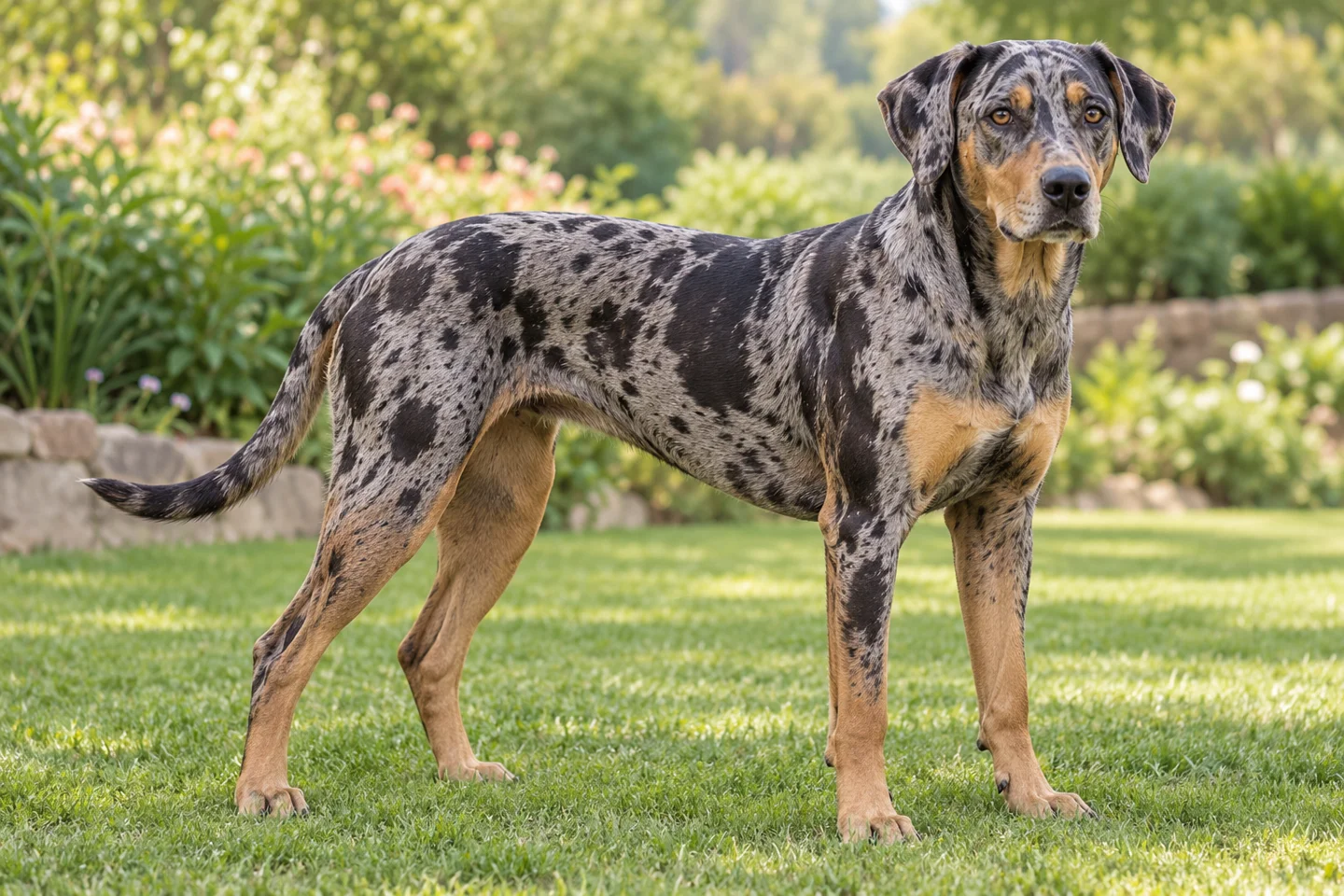
- Appearance illustrated
- Short blue-leopard coat, brown eyes, natural ears and full tail
- Adult size reference
- UKC ideals: males 24 in; females 22 in, ±2 in; proportional weight 50–95 lb
General information for owners. These articles have not been reviewed by a veterinarian. Medical decisions need your dog's history and an examination.
Start with the work your household can provide
A Catahoula Leopard Dog needs more than admiration for its coat. Before meeting a litter, decide how daily exploration, instruction, rest, and safe containment will work when the household is busy. A high fence around an empty garden is not a complete care plan. Ask which adult will teach useful habits and who can take over if that person is absent. An athletic dog can become difficult to manage when excitement repeatedly produces access to everything it wants.
Look for an individual whose experience fits the proposed home. A mature dog observed in foster care may provide information about indoor settling and ordinary walks that cannot be inferred from a puppy's appearance. Ask about incidents as well as successes, particularly around other animals, visitors, and resources. A responsible source should explain what it knows, what remains uncertain, and what support follows placement. Enthusiasm for a striking dog is a starting point; a usable weekday routine determines whether the arrangement remains fair to everyone.
Louisiana identity without a fictional pedigree
The Catahoula is an American working breed associated with Louisiana and several kinds of stock and hunting work. The UKC records its designation as Louisiana's state dog in 1979 and UKC recognition in 1995. Detailed origin stories include uncertain ancestry, so a modern pedigree should not be presented as proof of every historical account. Nor does a working title establish that a dog is ready for a different job, household, or group of animals without further preparation.
The name Louisiana Catahoula Leopard Dog and the shorter Catahoula Leopard Dog refer to the same breed in this guide. Leopard-patterned coats also occur in dogs with different ancestry. If a rescue label rests on appearance, keep that uncertainty visible and discuss actual behavior and medical findings. Working labels such as hog dog or cattle dog also describe activities across more than one population. Ask what a particular animal actually did and under whose supervision rather than using the label to predict every future response.
Size, patterns, and the body underneath
The UKC standard gives ideal adult heights of 24 inches for males and 22 for females, allowing two inches either way, and describes a broad proportional weight range of 50–95 pounds. Those figures are references for an athletic breed, not a target to force on an individual. The blue-leopard illustrations show one possible coat, with natural dropped ears and a long tail. Catahoulas also occur in other patterns and colors, and blue eyes are not required to establish identity.
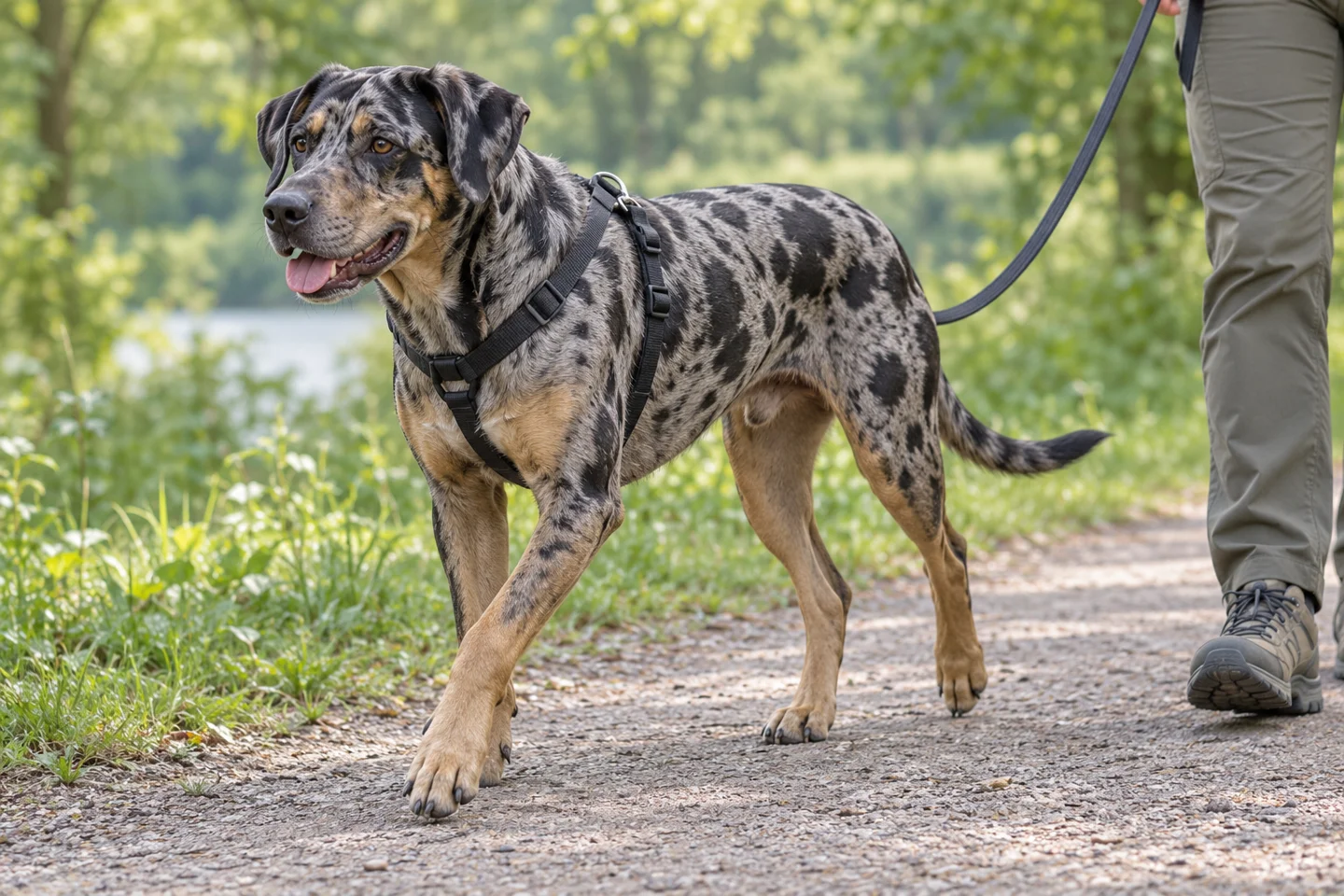
Meet the actual adult when choosing equipment. Check chest measurements, the ability to turn in the vehicle, and whether a harness allows normal shoulder movement. Color can draw attention away from gait or body condition, so watch rising, turning, and recovery after suitable activity. A glossy short coat does not prove that joints are comfortable. Ask about recurrent limping or reluctance to load into a car. A veterinary assessment should guide decisions about a physical concern instead of a claim that a working dog must be sound.
A job begins with instruction and boundaries
Someone interested in genuine cattle or hunting work should seek experienced instruction and lawful, welfare-conscious arrangements. A pedigree does not teach a young dog how to approach stock safely or recover from an overwhelming encounter. Ask how introductory work is organized, what animals are protected by barriers, and when an instructor would stop. Never release an inexperienced dog among livestock to see whether instinct appears. The consequences can include injured animals, a frightened dog, and habits that become harder to change.
Companion households can provide controlled searching, suitable retrieving, learning games, and sports chosen for the dog in front of them. Give an activity a clear beginning and finish. Reinforce coming away from it rather than making every interruption a loss of something valuable. If the dog remains unable to settle after a session, review difficulty, excitement, and recovery instead of adding another strenuous task immediately. A useful occupation fits the household and leaves room for sleep; it should not become an escalating demand that nobody can sustain.
Training an exit before you need one
Practice turning toward the handler and moving away from an interesting place while conditions are easy. Reward the response and sometimes allow a return to an appropriate investigation. This gives the dog a reason to listen without learning that attention always ends the outing. Add distractions gradually, retaining a physical safeguard near roads, stock, or wildlife. A cue that works in the kitchen has not yet been learned beside every moving animal or unfamiliar smell outdoors.
A long line can provide investigation space on suitable ground when the handler manages speed and entanglement. Avoid allowing a running dog to reach the end abruptly. Teach waiting during lead attachment and vehicle-door opening so neither depends on catching the dog at the last moment. Everyone who walks it needs to understand the equipment and the situations where extra distance is required. A rehearsed exit from a difficult setting is more useful than a collection of impressive tricks that do not transfer beyond one familiar training area.
Other dogs need compatible contact
Ask whether the Catahoula has enjoyed walking company, close play, or sharing an indoor space, because those are different experiences. Start with one suitable partner and room for movement rather than a crowded group. Watch both animals for pauses and voluntary disengagement. Persistent chasing, pinning, or blocking should not be excused as one dog's preferred style when the other repeatedly tries to leave. Owners need to interrupt early enough that the recipient does not have to escalate its objection.
At home, separate feeding and valuable chews while relationships develop. Give each animal a place to sleep without being followed. Corridors, doorways, and the route to a water bowl can become pressure points even without an obvious fight. A pair that walked quietly together outside may still need substantial management indoors. Consult qualified help when there has been repeated conflict or an injury. Do not add another dog as a treatment for isolation distress or assume that acquiring a puppy guarantees acceptance by an existing adult.
Cats, poultry, and animals beyond a fence
A history of hunting or handling stock makes the details of exposure important. Calm behavior beside a familiar cat cannot establish safety with a running unfamiliar animal. Pet birds and poultry need reliable protection, including during cleaning, feeding, and movement between enclosures. Ask whether the dog has shown fixation or pursuit and be candid about any incident. A confident statement that it loves people answers a different question from whether vulnerable animals can safely share its environment.
Review the garden as part of that plan. Gates, drains, stacked objects, and areas softened by digging can defeat a fence that looked sufficient from the house. Check unfamiliar accommodation and rented exercise fields before release. If neighboring animals are a persistent trigger, change visibility or access rather than relying on repeated correction. Identifying information and a microchip can help after an escape, but prevention remains the main responsibility. The household must be able to maintain separation consistently while professional advice and observation clarify what arrangements are realistic.
Children and fast household transitions
Children arriving home can be a moment of concentrated excitement. Arrange somewhere for the dog to wait comfortably while bags, coats, and doors are managed. An adult should supervise interaction closely enough to stop rough play or crowding immediately. Teach invitations that allow the dog to decline and protect its sleeping and eating areas from interference. A child should not be responsible for controlling a strong pulling animal while also managing a school bag or a younger sibling.
Discuss the same rules with visiting families. Running games, squealing, and thrown objects may create a different situation from quiet contact with familiar children. Separate before adults become distracted. If a toy lands beside the dog or an object is being guarded, an adult handles the next step. Prevent hugging around the neck, grabbing the tail, and following the dog into its retreat. Evaluate current behavior each time. Previous tolerance is useful history, but pain, fatigue, or an unfamiliar person's approach can change how the next encounter feels.
Aggression needs a factual account
If a Catahoula stiffens over a possession, threatens during handling, or rushes toward another animal, protect everyone involved and stop adding pressure. Describe the incident without deciding that it proves either courage or bad character. Note what happened immediately beforehand and how long recovery took. Avoid provoking another episode for a video or asking an unsuspecting visitor to test whether the problem remains. Immediate management should make repetition less likely while the cause is assessed.
Arrange veterinary attention for a sudden behavior change, particularly when touch or movement appears relevant. Seek a qualified behavior professional for recurring threats, guarding, or bites. Punishing a growl may make discomfort less visible without resolving it. A professional plan can combine environmental changes, rewarded learning, and appropriate protective equipment. If a muzzle is recommended, introduce it gradually and check fit. It adds a safeguard rather than making continued close contact acceptable when the dog is frightened, sore, or unable to disengage safely.
Exercise for an athletic individual
Use a mix of suitable walking, exploration, controlled games, and instruction rather than measuring success only by speed or exhaustion. Consider how much activity the dog has managed recently before planning a long trip. An adult returning from injury or a quiet period needs conditioning. Puppies need sleep and developmentally appropriate movement, with repetitive high-impact work discussed with their veterinarian. Choose surfaces that allow comfortable footing, and stop a session when fatigue makes movement or attention noticeably less controlled.
Look again after rest. Reluctance to rise, altered stride, or unusually slow recovery deserves assessment even if the dog was keen outdoors. Inspect paws after abrasive ground and keep equipment from trapping moisture against skin. Modify outings in heat and carry water. Severe weakness, collapse, or breathing difficulty calls for urgent veterinary advice. A sensible activity plan includes days when the owner cannot provide the usual trip. Those days still need toilet access and manageable enrichment, without frantic indoor play becoming the only way the household knows how to end an energetic afternoon.
Grooming that uses the short coat well
A short coat makes some inspection easier, but the owner still has to notice changes. During relaxed handling, check areas beneath straps, between toes, and along the underside for irritation or debris. Use brushing that suits the coat and introduce bathing without a struggle over the surface or water. Persistent odor, redness, or repeated attention to one area should be investigated rather than covered with fragrance. Ask a professional to demonstrate necessary care when the dog is sensitive or the method is unfamiliar.
Dropped ears deserve observation for discharge, altered smell, shaking, or pain. Cleaning should follow advice for the individual, and medication from an earlier episode may be inappropriate now. Introduce toothbrushing and nail work in brief separate lessons so they do not always follow a tiring outing. A new refusal to accept touch can be medical information. Tell a groomer or clinic about prior difficulties before arrival. Necessary treatment should not depend on the owner completing a painful examination unaided or forcing the dog to tolerate a procedure it does not yet understand.
Hearing, eyes, and the limits of coat information
Ask about documented hearing and eye assessments, not simply whether the puppy responds to a household sound. LSU's veterinary information explains the role of BAER testing in assessing hearing, including loss affecting only one side. A dog can appear responsive while relying on its other ear. Knowing its abilities helps with communication and safety. If hearing is reduced, ask for guidance on visual signals and approaches that avoid startling a sleeping animal, while retaining secure access near traffic.
The merle pattern also deserves informed breeding questions. UC Davis describes merle genetics and the increased sensory risks associated with some combinations. Coat appearance alone is not a complete genetic report, and striking eye color does not certify normal vision or hearing. Ask a laboratory or veterinarian to interpret relevant results rather than choosing a mating from photographs. An individual medical concern needs examination even when the genetic paperwork appears reassuring. Do not infer a precise disease probability from a particular patch pattern or treat every leopard-coated dog as having identical status.
Health records beyond color and performance
Request the actual orthopedic, eye, hearing, or other reports used by the breeding program, with dog identities and dates. Ask why those evaluations were selected and what significant illness occurred among relatives. Avoid accepting an invented universal checklist in place of a clear explanation of the source's practices. A registry standard describes the breed's structure; it is not a medical survey. A strong working performance supplies different information from formal screening or an investigation of a current clinical sign.
After adoption, establish a preventive plan appropriate to the dog's age, location, and activities. Keep the history together when care moves between clinics. Persistent lameness, weakness, altered appetite, urinary difficulty, or changed tolerance of handling needs individual assessment. A broad genetic panel covers selected variants rather than every cause of illness. With a rescue, mark missing information as unknown and use current findings to plan care. That is more useful than assuming good health from an energetic appearance or interpreting the absence of a record as proof of a specific diagnosis.
Feeding, mixes, and practical costs
Choose a complete diet for the life stage and adjust measured portions using body condition and veterinary guidance. Include rewards used during training and searches. A quieter recovery period can change requirements, while appetite alone does not tell the owner how much food is appropriate. Feed away from children and competing animals. Discuss supplements or home-prepared food before relying on them. Persistent digestive signs deserve investigation rather than repeated unplanned changes that make the history harder to follow.
Catahoula mixes vary in coat, size, pursuit interest, and household behavior. A Catahoula cross with a retriever, shepherd, or bully-type dog does not guarantee a predictable compromise or freedom from inherited problems. Ask about both parents where possible and evaluate actual needs. Budget for instruction, secure facilities, capable care during travel, and unexpected treatment. Before a holiday, let the proposed sitter demonstrate equipment fitting and the arrival routine. A person being willing to help does not establish that the arrangement works safely with this individual.
A dogsDating profile should describe real encounters
Use dogsDating to explain the Catahoula's preferred activity and the situations that need space, including pursuit interests or concerns around resources. Keep exact home coordinates private and select a meeting place away from livestock and busy entrances. Discuss the other dog's play before arriving. For some pairs, walking at a distance may be a better first activity than running together. Each handler needs a practical way to change direction or finish without relying on a close confrontation.
Leave prized equipment, chews, and competitive retrieving games out of the introduction. Notice whether both dogs seek contact, pause, and move away freely. If one repeatedly tries to escape or becomes fixed on the other, increase separation or end the session. Tell the other owner what you observed without turning a short pleasant meeting into a promise about future compatibility. Shared housing, transport, and access to valued objects need their own assessment. The app can support accurate communication; it cannot replace the decisions made by attentive people at the meeting.
Sources and editorial notes
Sources checked October 21, 2026. Breed measurements describe reference ranges, not a diagnosis or an individual dog's ideal weight. Images are AI-generated breed illustrations and do not document a particular dog or health condition.
- AVSAB: Humane Dog Training Position Statement
- VCA Animal Hospitals: Food aggression in puppies
- VCA Animal Hospitals: Aggression toward unfamiliar dogs, diagnosis
- VCA Animal Hospitals: Heat stroke in dogs
- VCA Animal Hospitals: Common emergencies in dogs
- VCA Animal Hospitals: Grooming and coat care for your dog
- VCA Animal Hospitals: Ear infections in dogs
- VCA Animal Hospitals: Feeding guidelines for dogs
- Orthopedic Foundation for Animals: CHIC program and interpretation of numbers
- United Kennel Club: Louisiana Catahoula Leopard Dog breed standard
- Louisiana State University Veterinary Medicine: Deafness in dogs and cats
- UC Davis Veterinary Genetics Laboratory: Merle genetics and testing
Keep getting to know dogs.
Read another guide or return to your dogsDating community.
Explore breed guidesBack to dogsDating