Chien Français Blanc et Orange
A large French white-and-orange scenthound whose secure exercise, household experience, animal compatibility, and documented care needs deserve an individual plan.
How these guides are researched and reviewed

- Origin
- France
- Adult height
- 62–70 cm, with 2 cm upper tolerance in the FCI standard
- Coat
- Short and fine, white with lemon or orange
- Distinct identity
- Separate from Grand Anglo-Français Blanc et Orange
General information for owners. These articles have not been reviewed by a veterinarian. Medical decisions need your dog's history and an examination.
Choose the household routine before the unusual breed
The Chien Français Blanc et Orange is a large French scenthound. Anyone considering one needs a practical plan for exercise, secure handling, company, and the transition into the particular home on offer. Start with where the adult will walk and rest, who can manage it, and how other animals will be protected. The white-and-orange coat may make identification memorable, but it cannot tell you how the dog will behave when a door opens or a scent trail leaves the path you intended to follow.
Seek direct contact with people who know the individual and its family. Ask about experience inside houses, travel, strangers, and time apart from other hounds. A dog accustomed to one management system may need substantial help learning another. Explain stairs, neighbors, children, work hours, and the pets already present. An honest discussion may show that the household is suitable with preparation, or that a different dog would be a better choice. Rarity should not create pressure to accept unanswered questions or make a decision before meeting real adults.
French identity and what the historical record supports
The FCI records France as the country of origin and places the breed among large scenthounds. Its official designation is Français Blanc et Orange, translated as French White and Orange Hound. The standard records an official valid standard dated 1982. That is a documented reference point, not proof that every detail of the breed's earlier development is settled. Avoid repeating elaborate ancestry stories or assigning a single creator without a reliable historical source. Owners can understand the dog's present needs without inventing an origin narrative.
This breed is distinct from the Grand Anglo-Français Blanc et Orange. It is also distinct from the Français Blanc et Noir and Français Tricolore, despite related-sounding names. Verify the full registry identity when examining records or arranging an import. A large white-and-orange dog with unknown parentage should not receive a confident pedigree label based on its photograph. For uncertain ancestry, describe the animal cautiously and assess current condition and behavior. That approach still supports responsible care while preserving the difference between evidence and a visual guess.
Adult measurements and a large hound outline
The FCI height range is 62–70 centimeters at the withers, with a two-centimeter tolerance at the upper limit. The standard describes a substantial French hound with a broad chest, strong limbs, long tail, and a relatively large, elongated head. It does not set a universal adult weight range for owners to pursue. Have your veterinarian assess body condition and movement. Plan equipment and transport around the actual animal, including whether a relief caregiver can move it safely if it becomes unwell or reluctant to walk.
Look beyond the number when choosing a bed, harness, and vehicle restraint. A long-legged dog needs enough space to turn and lie comfortably, while equipment should remain secure without rubbing. Check fit after growth or a change in condition. A puppy that can be carried through a difficult doorway will not remain a small temporary problem. Teach practical access and handling early. If the home requires repeated awkward lifting of a large adult, investigate an alternative layout or suitable access equipment before that arrangement becomes unavoidable.
White and orange are a pattern, not a medical promise
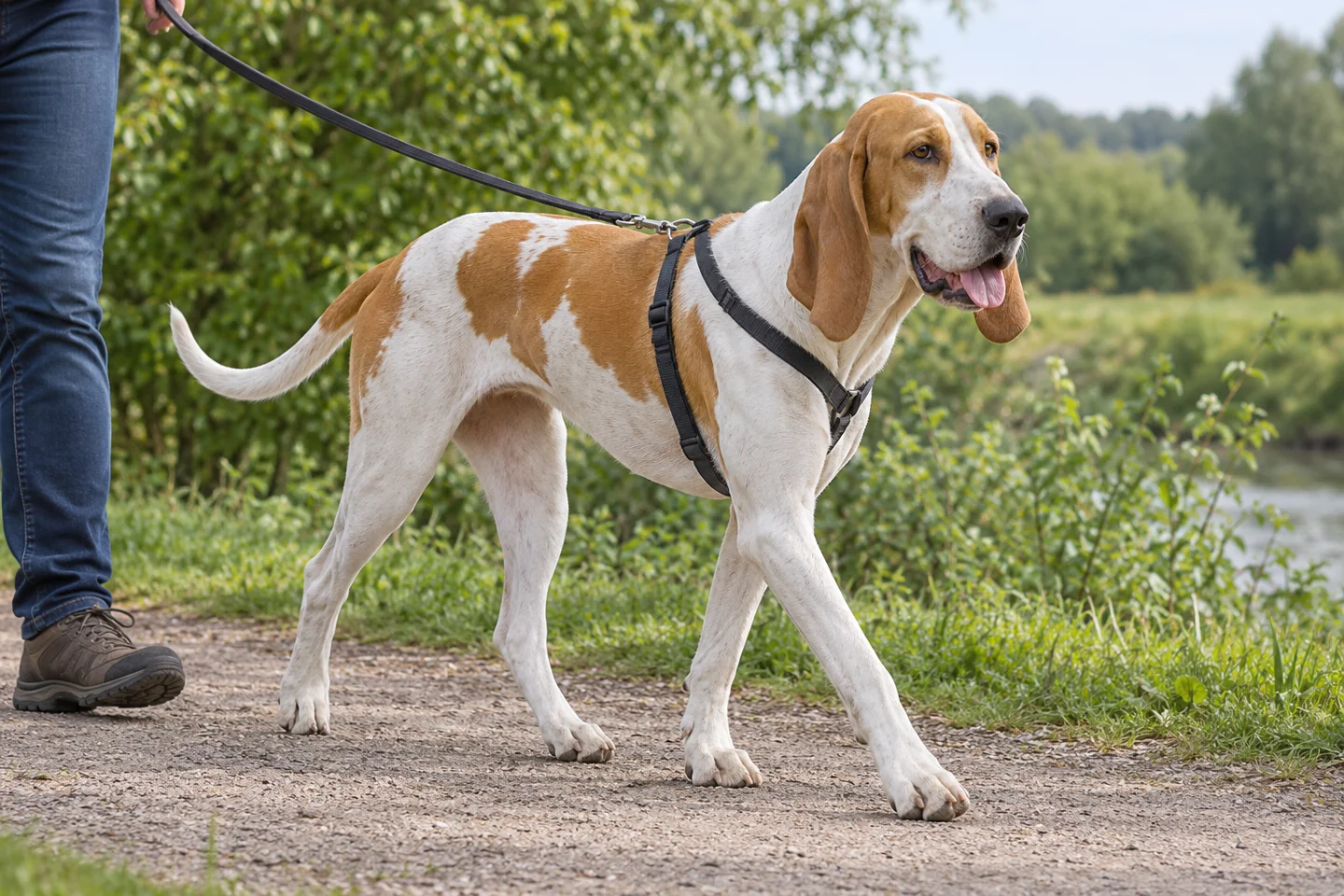
The standard allows white with lemon or orange coloring and excludes orange that becomes too dark toward red. Its coat is short and fine, with hanging ears that have a slight inward twist. The illustrations accompanying this article use clear white and pale orange patches, brown eyes, natural ears, and a long tail. They are AI-generated illustrations, not photographs of an identified dog. They cannot verify family, health, coat texture, temperament, or comfortable movement, and should not substitute for meeting adults and reviewing reliable records.
Discuss markings without letting cosmetic preferences take over the placement conversation. A buyer needs medical information, observed behavior, support arrangements, and a realistic care plan more than a promise that each puppy will resemble one attractive image. If a seller cannot explain identity and family records, unusual coloring does not resolve the gap. The same principle applies to a rescue: an imperfect match to a standard is not a diagnosis or a reason to ignore the dog's needs. Assess welfare and practical suitability directly.
Indoor habits and a predictable arrival routine
Prepare a quiet sleeping place and a clear schedule for food and outdoor access. Supervise exploration while the dog learns which rooms are available and where toileting is appropriate. If it has little household experience, prevent access to unattended food and valuable objects instead of expecting it to infer rules from human annoyance. Reward useful behavior immediately. A hound accustomed to different surroundings may need repeated successful opportunities before it understands a domestic routine that seems obvious to the people who already live there.
Use barriers thoughtfully during the first weeks. They can protect visitors, other pets, and open doors while teaching progresses. Practice waiting for the lead in quiet conditions, and make sure every person knows how to leave securely. Do not rely on a newly learned cue as the only protection beside an open street. Physical arrangements should work when someone is distracted or unfamiliar with the dog. Keep a written care routine for temporary caregivers, explaining access restrictions rather than assuming a pleasant introduction has taught them how the home is managed.
Children need space that does not depend on obedience
A large hound moving enthusiastically through a narrow room can overwhelm a child without intending harm. Arrange separate areas for energetic games and quiet dog rest. An adult should supervise interaction closely enough to intervene, including during apparently gentle affection. Children need to know that beds, meals, and chews are left alone. If the dog picks up a child's possession, an adult should handle the situation with a safe exchange. Chasing and grabbing can create a conflict that a better storage and supervision plan would have prevented.
Ask about contact with children of similar ages and in comparable settings. Previous calm behavior around older visitors does not predict a response to a toddler falling onto a sleeping animal. Let the dog leave, and end contact when it repeatedly retreats, becomes still, or shows tension. At busy gatherings, a comfortable separate room may be appropriate. Do not require a child to control a lead where scent or movement could produce a strong pull. Adults remain responsible for access and handling even when the dog has a friendly history.

Aggression and warnings need an individual response
Treat growling, snapping, lunging, and bites as events to investigate rather than arguments about the breed's reputation. Write down where the incident happened, what was present, and what changed immediately beforehand. Prevent a repeat while seeking professional assessment. A new response to touch or movement warrants veterinary attention because discomfort can affect behavior. Share accurate information with everyone providing care. A history that is concealed or softened into a vague comment about temperament cannot help a sitter or clinician plan a safe interaction.
Protect food and valued objects from interference, and teach the dog to move away or exchange an item voluntarily using rewards. Repeatedly taking a bowl or punishing a warning does not explain a safer alternative. Management might involve separate meals, closed doors during gatherings, or conditioned muzzle use under guidance. A muzzle should not become permission to crowd the animal or ignore handling limits. The aim is prevention while a suitable plan is developed, with everyone following the same arrangements rather than improvising during conflict.
Training a useful response while scent is present
Teach recall first in a secure, low-distraction place. Reward returning fully to the handler and practice calm attachment of the lead. Sometimes return the dog to safe exploration afterward so coming back does not always predict the end of an enjoyable outing. Increase difficulty deliberately. If the response is unreliable where scent is strong, use a secure enclosure or suitable lead arrangement. Learn long-line handling before entering cover with obstacles, and avoid allowing the line to tangle around people or other animals.
Add practical tasks such as pausing at a gate, following a change of direction, and standing comfortably for equipment. The behavior learned beside an empty door may need further teaching when several people are leaving together. AVSAB recommends reward-based methods and opposes aversive techniques. Choose help that explains the desired response and the stages needed to reach it, rather than claiming a hunting dog requires intimidation. Review progress through daily improvements, including easier handovers and safer exits, rather than only through impressive performances in a controlled training area.
Exercise and the difference between activity and exhaustion
Provide regular movement and appropriate opportunities to use the nose. The amount and intensity need to fit age, health, condition, weather, and terrain. A breed's scenthound classification does not supply a fixed daily distance suitable for every individual. Talk to the veterinarian before demanding new work or after a period of illness. Use safe places and secure control where recall is uncertain, respecting wildlife, livestock, and local access rules. A quiet landscape can still contain a stimulus that makes a previously calm dog difficult to interrupt.
Simple searches and controlled exploration can add interest without requiring constant fast running. Build difficulty gradually and allow recovery. Carry clean water and choose cooler hours when conditions are warm. Stop for discomfort instead of interpreting continued interest in scent as proof that the animal is fine. At home, preserve uninterrupted sleep and reward settling around ordinary activity. If the dog repeatedly struggles after outings, examine workload, arousal, pain, and rest opportunities with appropriate help. Increasing exercise indefinitely may leave the original difficulty unexplained.
Grooming a fine coat and inspecting long ears
A short coat still needs hands-on attention. Brush gently and inspect the skin where a collar or harness lies. After outdoor activity, check the feet, lower body, and folds around hanging ears for trapped material or irritation. Teach standing comfortably and accepting brief examination before a long session becomes necessary. Bathe with a suitable canine product when needed and dry the dog comfortably. Persistent itching or an altered patch of skin deserves assessment rather than repeated washing or stronger brushing of an already sensitive area.
Ears should be checked for a change in odor, discharge, redness, pain, or repeated head shaking. Seek veterinary advice before deciding how to treat the problem. Do not insert objects deeply or use medicine left over from a different episode. Ask for a demonstration if the clinic recommends cleaning, and build tolerance for that procedure in manageable steps. Nail care deserves the same patient approach. If previously easy handling becomes difficult, investigate discomfort instead of assuming the dog is challenging authority or tightening restraint until the task is completed.
Health information where population evidence is limited
A less familiar breed should not be described as free of inherited disease merely because comprehensive prevalence information is hard to find. Ask for relevant parental examinations, diagnosed conditions in relatives, and the individual dog's records. Clarify the current recommendations of the registry or breed organization involved. Do not borrow a mandatory screening list from another French hound simply because the names resemble each other. Each test has a defined purpose, and its result needs interpretation with identity, timing, family history, and the dog's present clinical condition.
Completed screening cannot guarantee lifelong health or establish that every recorded finding was normal. Discuss available reports with your veterinarian and keep missing information explicit for a rescue. Plan prevention for the dog's activities and local risks. Record meaningful changes in gait, appetite, drinking, elimination, or tolerance of exercise. Sudden severe pain, collapse, serious breathing difficulty, or inability to move needs urgent clinical advice. A claim that the family has always worked well should never be used to explain away an individual animal's new symptoms or delay assessment.
Nutrition, emergencies, and later-life access
Choose a complete diet appropriate to life stage, measure an initial allowance, and review condition as activity changes. Account for rewards and food supplied by other household members. Feed in a protected place without competition. Seek qualified veterinary nutrition help before relying on a home-prepared plan or adding supplements without a clear need. Persistent appetite or digestive changes should lead to advice rather than repeated switches that make the original problem difficult to track. Keep instructions simple enough for a relief caregiver to follow accurately.
Discuss recognition of gastric dilatation and volvulus with the veterinary team and make a transport plan. Repeated unsuccessful retching, sudden abdominal enlargement, pronounced distress, or collapse requires urgent contact. No favored feeding routine guarantees prevention. As the dog grows older, review floor traction, car access, and resting comfort. Changes in speed or recovery may require assessment and adaptation, not automatic retirement from all interesting activity. A shorter comfortable search or walk can preserve participation while the owner investigates why the earlier routine has become harder.
Other animals and Chien Français Blanc et Orange mixes
Ask about each animal category separately. Living calmly with familiar hounds does not establish safety with cats, poultry, rabbits, or a small unfamiliar dog that runs. Protect enclosures and allow resident cats secure routes beyond the hound's access. Do not arrange a chase as a compatibility test. For dog introductions, begin with space and independent handlers, keeping resources separate until a relationship is understood. Observe whether each animal can disengage and rest. Constant proximity is not a necessary measure of friendship or a sensible initial requirement.
A cross involving this breed may vary in height, coat, voice, hunting interests, medical risks, and household behavior. A cross name cannot guarantee an intermediate size or remove inherited disease. Review parental information where it exists, and preserve uncertainty where ancestry is guessed. Choose the actual dog on the basis of needs you can meet. If permanent separation from another animal might be necessary, consider whether your layout and daily routines can sustain it before adding the newcomer. Good intentions do not make an impractical management arrangement reliable.
Costs, suitability, and dogsDating plans
Budget for veterinary prevention, emergency funds or insurance, secure equipment, transport, training, and capable holiday care. Check that a sitter understands the dog's door routine and animal restrictions, and arrange a short trial before a long absence. A suitable household has time for both activity and teaching, space that can be managed safely, and agreement about who handles daily responsibilities. If changing work hours or illness would remove the only capable caregiver, identify realistic cover. The purchase price does not represent the full practical commitment.
Describe the individual hound accurately on dogsDating, including its walking pace, scent interests, and experience with unfamiliar companions. Keep exact home coordinates private and agree on a public route with room to turn away. Start with shared walking and secure handling rather than loose pursuit or valued toys. End when either dog cannot disengage or repeatedly pressures the other. A comfortable outing supports another considered meeting. Shared travel, home visits, and play require their own assessment, because one pleasant encounter cannot establish compatibility across every resource and setting.
Sources and editorial notes
Sources checked October 21, 2026. Breed measurements describe reference ranges, not a diagnosis or an individual dog's ideal weight. Images are AI-generated breed illustrations and do not document a particular dog or health condition.
- AVSAB: Humane Dog Training Position Statement
- VCA Animal Hospitals: Food aggression in puppies
- VCA Animal Hospitals: Aggression toward unfamiliar dogs, diagnosis
- VCA Animal Hospitals: Grooming and coat care for your dog
- VCA Animal Hospitals: Ear infections in dogs
- VCA Animal Hospitals: Feeding guidelines for dogs
- VCA Animal Hospitals: Common emergencies in dogs
- VCA Animal Hospitals: Heat stroke in dogs
- Orthopedic Foundation for Animals: CHIC health screening programs
- Washington State University Veterinary Teaching Hospital: Gastric dilation and volvulus and bloat in dogs
- Fédération Cynologique Internationale: Français Blanc et Orange standard 316
Keep getting to know dogs.
Read another guide or return to your dogsDating community.
Explore breed guidesBack to dogsDating