Cimarrón Uruguayo
A muscular Uruguayan breed with cattle-work, hunting, and guarding roots, requiring capable handling, secure access, deliberate social introductions, and honest health information.
How these guides are researched and reviewed
- Origin
- Uruguay
- FCI height
- Males 58–61 cm; females 55–58 cm, with tolerance
- Coat
- Short, dense; brindle or fawn in the standard
- Care priorities
- Strength, boundaries, social handling, and documented family health
General information for owners. These articles have not been reviewed by a veterinarian. Medical decisions need your dog's history and an examination.
Decide how the adult dog will be managed
A Cimarrón Uruguayo needs an owner who can guide a muscular working dog through everyday situations without relying on physical contests. Think about the front door, the pavement, the vehicle, and the veterinary waiting room before selecting a puppy. A rural property still needs managed boundaries, and a large garden cannot replace company or training. Ask whether the household can maintain the same routine during illness, travel, or a busy working week. Adult strength is a daily logistical matter, not simply an appealing breed feature.
Meet established adults where possible and ask for specific observations. How does the dog respond to visitors, unfamiliar dogs, livestock movement, and a person adjusting equipment? What situations require separation? A responsible source should discuss those limits plainly, together with medical records and placement support. An adult assessed in a suitable foster home may provide more concrete information than a puppy selected from photographs. Avoid choosing a rare breed mainly because an advertisement promises automatic protection or a uniquely fearless temperament.
Uruguayan identity and the limits of the history
The FCI standard identifies Uruguay as the country of origin and describes cattle work, large-game hunting, and guarding among traditional uses. It also acknowledges uncertainty about the breed's early origin. That is a reason to keep historical statements proportionate. The story of dogs brought to the region and later selected locally does not establish a precise pedigree for every modern line. Current parent records, health findings, and behavior give a prospective owner more direct evidence about the puppy being offered.
The Cimarrón is an established breed, distinct from the Dogo Argentino, Cane Corso, and other muscular short-coated dogs. Brindle coloring or a broad head alone cannot confirm ancestry. Ask which organization issued registration papers and whether the parents can be identified. If a rescue label is based on appearance, keep that uncertainty visible. A dog's practical care should not depend on making the label sound more certain than the evidence permits. Assess its body, medical needs, and actual responses while learning its history.
Athletic substance without exaggeration
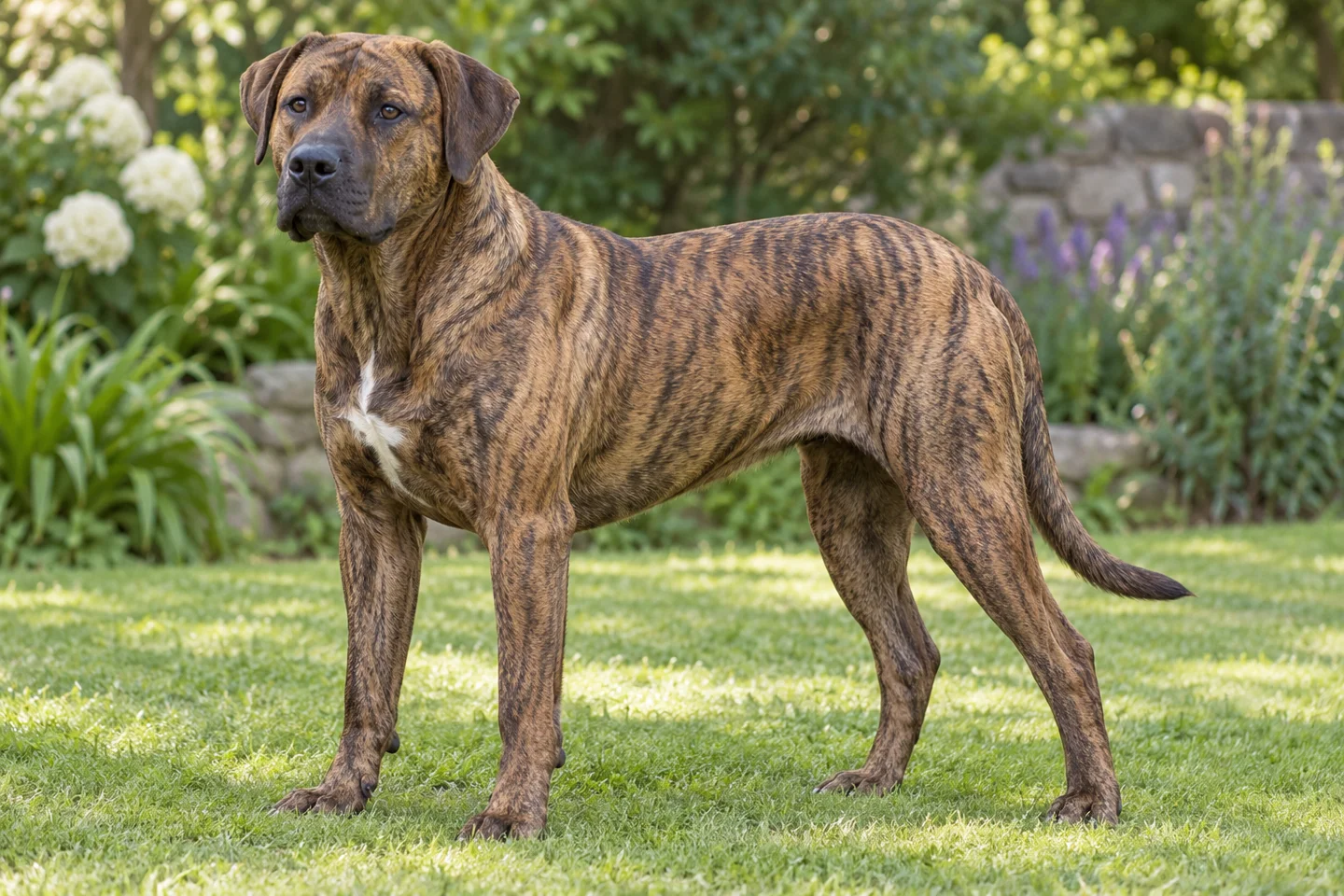
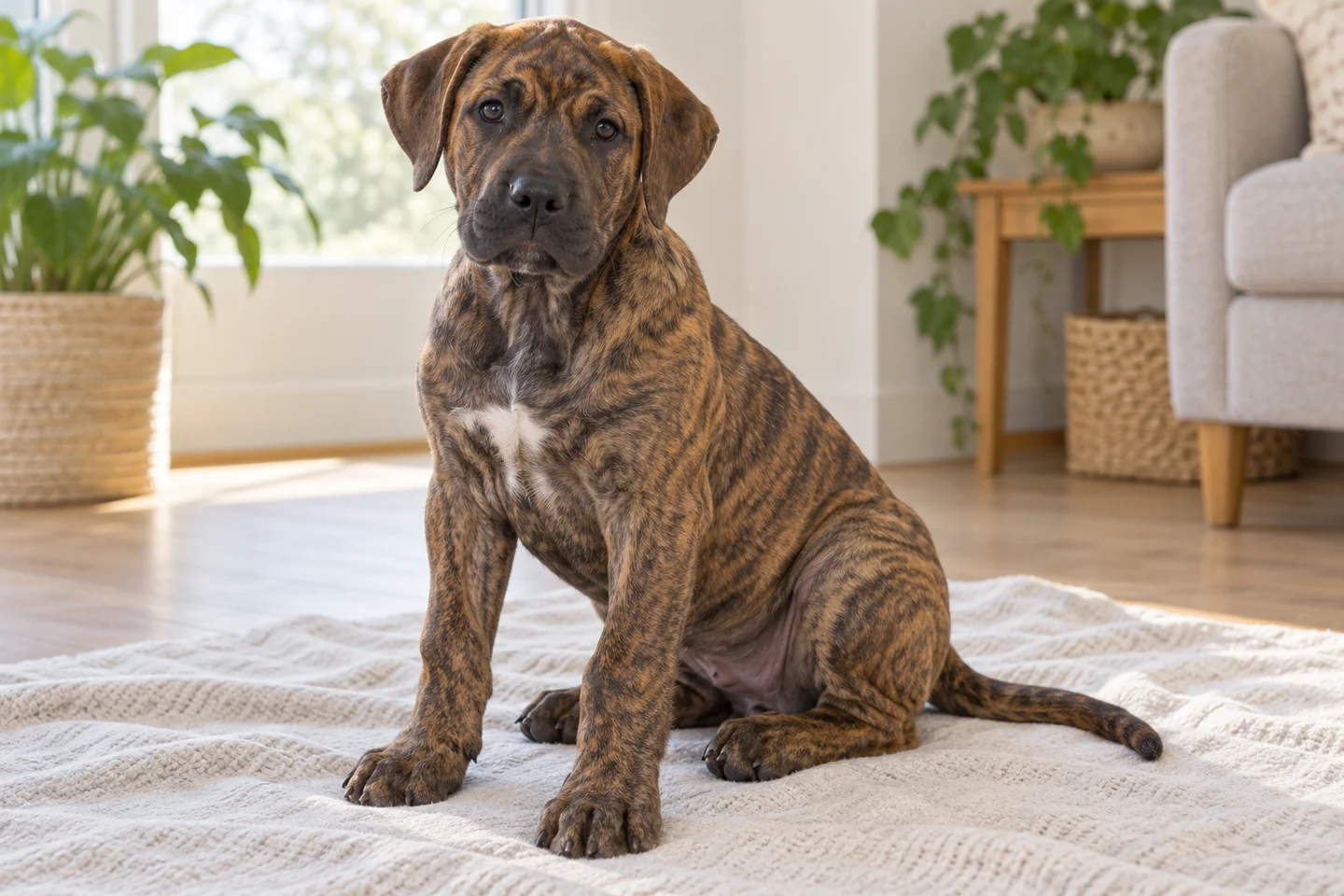
The standard describes a medium-sized molosser with a strong athletic frame, short coat, and substantial head. Brindle and fawn are described colors. The illustrations here select brindle, intact naturally dropped ears, and a complete natural tail. Historical or regional images may show altered ears, but those images do not require a companion dog to undergo a cosmetic procedure. A good visual reference should show comfortable proportions and usable movement rather than making the head and chest as massive as possible.
Watch an adult turn, rise, and walk on ordinary ground. A posed stance can hide hesitation, and a highly excited dog may move despite discomfort. Learn hands-on condition assessment with veterinary help so coat pattern and muscle do not obscure excess weight or loss of condition. Choose equipment for actual measurements and inspect it after growth or weight changes. A strong dog can damage worn fittings quickly, so a routine check of clips and stitching should accompany training rather than being postponed until something breaks.
The FCI specifies males at 58–61 cm and females at 55–58 cm at the withers, allowing a 2 cm tolerance. Listed weights are 38–45 kg for males and 33–40 kg for females. Those figures explain why adult handling and transport belong in the decision. They are standard descriptions, not targets for adding weight to a leaner individual.
A boundary plan for a working property
Map access before the dog arrives. Decide how gates remain closed during deliveries, where vehicles stop, and how visitors reach the house without unexpectedly entering the dog's space. A secure holding area can prevent a routine parcel arrival from becoming an improvised handling problem. Everyone using the property needs the same instructions, including workers and visiting relatives. A sign or verbal warning is insufficient if the physical arrangement still requires an unfamiliar person to walk past a loose dog to get help.
At the fence, prevent repeated rehearsals of rushing at movement. Manage visual access and supervise outdoor time while teaching a calmer alternative. Do not leave the dog to decide which people or animals may approach and then punish its decision afterward. If boundary reactions are intense, obtain qualified behavioral guidance and protect space meanwhile. A farm background does not automatically provide reliable judgment around a modern household's gates, traffic, children, and contractors. Those are specific tasks that need human planning and deliberate teaching.
Visitors without a protection performance
Before opening the door, cue a familiar resting place behind a suitable barrier. Give the dog room to observe without a visitor leaning over it or reaching toward its head. A greeting can remain optional. Some visits are easier with the dog resting separately, especially while a new owner learns its responses. Practice the sequence during quiet times so a busy gathering does not become the first attempt. Reward calm participation and let guests know their role before they enter.
Repeated blocking, threatening approaches, or inability to recover after someone leaves needs assessment. Record what actually happened and avoid flattering labels that hide risk. A dog described as a natural guardian still needs a plan that protects invited people and the dog itself. Do not encourage suspicion for amusement or try informal protection exercises with friends. Household ownership requires predictable access and safe care, including when someone other than the usual owner must handle the dog during an emergency.
Cattle, wildlife, and other moving animals
Traditional cattle work does not mean a puppy understands how to move livestock safely. Work with a competent instructor who considers the dog, livestock, handler, and setting together. Prevent unsupervised chasing, grabbing, or pressure on animals. An inexperienced dog and frightened cattle can injure each other or nearby people quickly. If livestock work is not part of your life, suitable alternatives can provide movement and learning without staging a risky demonstration of inherited ability.
Hunting history also makes it sensible to ask about pursuit and responses to vulnerable animals. Keep the dog attached where wildlife, roads, or stock create danger, and do not test recall by allowing a chase to begin. Provide safe investigation through controlled walks and appropriate searching. Small pets and poultry need genuine protection. Affection toward a human says little about how the same dog responds to a flapping bird or a running animal. Compatibility questions need direct evidence and a dependable separation plan.
Children around power and excitement
A muscular dog can knock a child down through an excited turn, even when no threat is intended. Arrange household routes and play so children are not squeezed beside a resting dog or forced through its feeding area. Adults should prevent climbing, neck-hugging, grabbing a tail, and face-to-face posing. Teach that moving away ends the dog's invitation to interact. Supervision means watching closely enough to interrupt pressure before the animal needs to escalate its response.
Fast games deserve particular care. Separate before children run and shout if the dog's response is uncertain, and avoid interpreting pursuit or clothing-grabbing as useful herding. Children can help prepare a calm search activity with adult direction while the dog waits elsewhere. Adults handle leads, chews, and difficult exchanges. Review arrangements whenever visiting children arrive or the dog's comfort changes. A favorable experience with one familiar child cannot establish safety in a crowded gathering or during painful handling.
Aggression and the need for accurate descriptions
If the Cimarrón stiffens over an object, growls during touch, or threatens another dog, first reduce pressure and arrange safe distance. Do not reach again simply to see whether the warning was serious. Keep children and visitors away from unresolved situations. A veterinarian should investigate a sudden behavior change, while a qualified professional can help with recurring fear, guarding, or dog-directed threats. Immediate barriers and controlled access protect everyone while the cause and a practical response are worked out.
AVSAB recommends reward-based methods. Physical confrontation can increase fear and is particularly hazardous with a powerful adult. Describe incidents through actions, distance, and context, including any contact or injury, rather than labels such as dominant or protective. That information helps a carer or professional understand what to avoid. Suppressing a growl does not reliably remove the underlying concern. A useful plan aims to prevent repetition and teach a workable alternative, not prove that another person can force the dog through the same conflict.
Training ordinary cooperation before specialist work
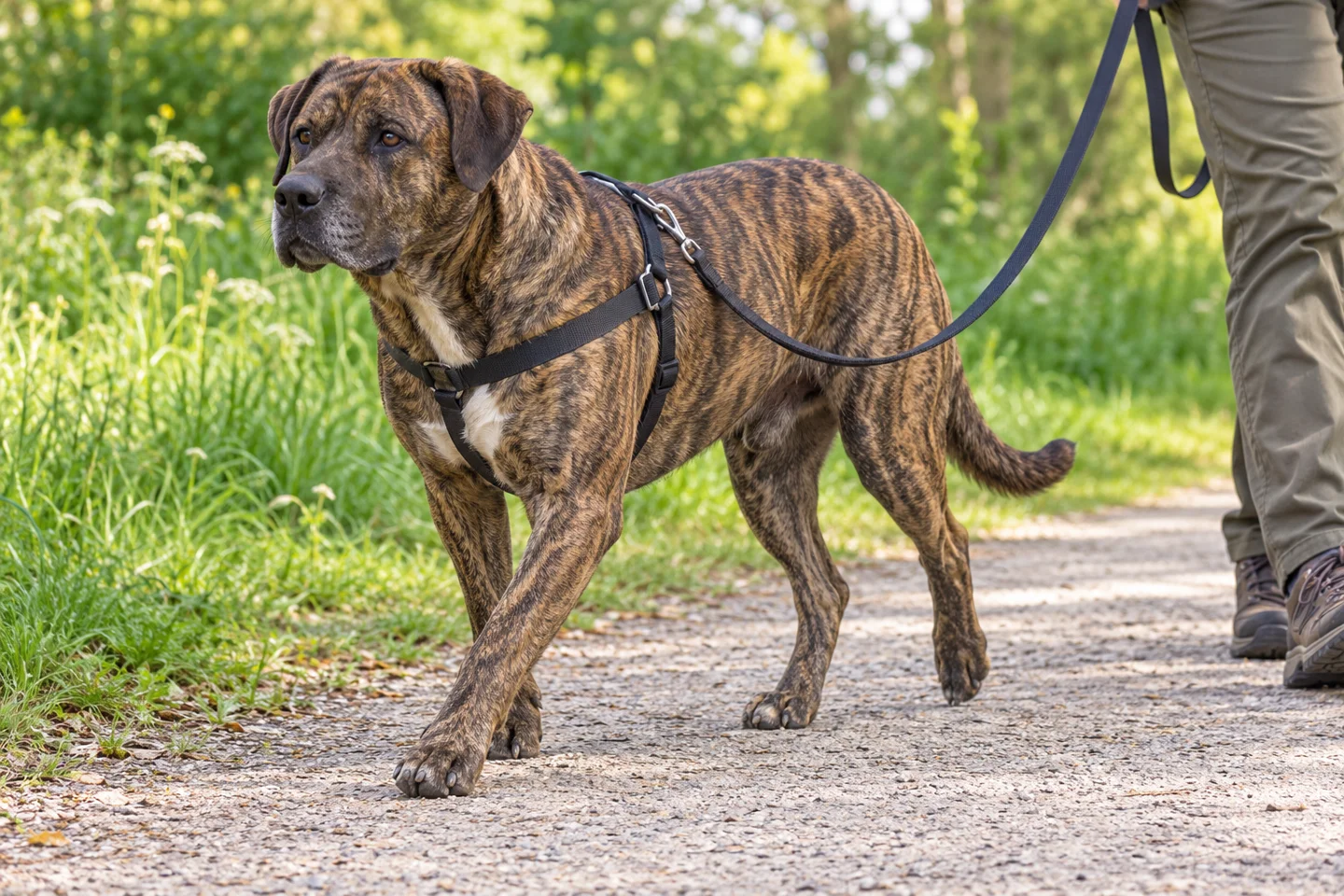
Prioritize approaching equipment, walking on a slack lead, moving onto a mat, and coming away from a manageable distraction. Teach releasing an ordinary object through a worthwhile exchange before a dangerous item creates urgency. Keep rewards and task difficulty appropriate to the individual. A dog that cannot respond beside livestock or an unfamiliar dog may need greater distance and an easier lesson. Louder repeated cues do not resolve an overwhelming situation or fill a gap in learning.
Body-care training is equally practical. Reward a brief stand, a paw touch, or entering the vehicle voluntarily, building duration gradually. Use stable surfaces and avoid forcing a frightened dog into a position because its strength makes cooperation inconvenient. A professional can help prepare for examinations and positively introduce safety equipment where appropriate. All household handlers should use consistent routines. A dog cannot infer that pulling is rewarded by one person and physically corrected by another, especially when both claim to be enforcing the same rule.
Exercise that matches condition and purpose
Provide steady activity through the week, combining comfortable walking, safe investigation, and short lessons. Build demanding work gradually with advice suited to the dog's age and health. A young animal should not be asked to perform an adult workload because it appears muscular or eager. Observe movement and recovery after rest, not just enthusiasm during the outing. A persistent limp, stiffness, or reluctance to move deserves examination rather than another session intended to improve toughness.
In heat, choose cooler periods, shade, water, and an easy route back. Avoid a fixed distance target when the dog is struggling. Collapse or marked respiratory distress needs urgent veterinary advice. On quieter days, suitable searching and cooperative training can provide occupation without repeated frantic chasing indoors. A substantial working dog also needs time to rest. The best routine is one the household can maintain through changing weather and owner commitments, with modifications whenever the dog's medical condition or age requires them.
Grooming the short coat and checking contact areas
A short coat makes some maintenance straightforward, but it does not remove the need to inspect skin. Brush with an appropriate tool and look around harness straps, folds near joints, feet, and any area repeatedly licked. After countryside activity, check for superficial wounds and attached debris. Do not dig into a painful area or cover a persistent odor with fragrance. Redness, sores, or ongoing irritation needs veterinary advice and a cause-specific plan rather than repeated guesses at products.
Introduce nails, ears, and teeth through manageable rewarded steps. Ear pain, discharge, head shaking, or an unpleasant smell deserves assessment; avoid probing the canal and reusing an old prescription. A dog that suddenly resists a familiar care task may be uncomfortable. Tell the groomer or veterinary team about handling concerns before the visit. Necessary treatment and future training may both be needed, and the animal should not wait for relief until an owner has learned to perform every examination without professional help.
Health information and the limits of a breed standard
The FCI standard describes identity and conformation, but it does not provide a complete medical screening program or reliable disease-prevalence figures for every breeding population. Avoid treating rarity or traditional hardiness as proof that inherited illness is absent. Ask the relevant breed organization and your veterinarian what evaluations are appropriate to the family's history and region. Request evidence for claims about screening, including the identity of each dog and the actual findings, rather than accepting an assurance that working animals are naturally healthy.
Ask about significant diagnoses, orthopedic treatment, vision problems, unexplained deaths, and the source's practice of collecting follow-up reports from owners. If records are incomplete, acknowledge the gap. A current examination can guide preventive care for an adopted adult, while new symptoms need investigation on their own merits. Normal movement during a visit does not answer every question about joint development or future illness. A responsible account of uncertainty helps owners plan better than an invented universal Cimarrón test checklist or a guaranteed lifespan.
Food, household fit, and mixes
Feed a complete diet appropriate to age and expected adult size, adjusting portions to actual activity and body condition. Discuss growth with the veterinarian instead of trying to accelerate it through extra calories. Include food rewards in the total intake and monitor changes beneath the short coat. Persistent appetite loss, excessive thirst, digestive problems, or a marked weight change deserves assessment. Supplements and home-prepared diets need sound nutritional reasons, rather than a belief that every traditional working breed must eat the same way.
A Cimarrón mix can vary in adult size, strength, coat, pursuit, and social preferences. A combined name does not promise an easier temperament or remove parental health concerns. For a rescue, observed behavior and a current medical assessment may be more useful than speculative ancestry. Consider whether the home can maintain secure access, suitable company, and capable care throughout the dog's life. If local housing, travel, or service rules may affect a powerful working dog, check those requirements before committing to placement.
Costs and a controlled dogsDating introduction
Budget for food, preventive care, secure transport, training support, reliable holiday care, and unexpected treatment. Check that another adult can handle the dog safely if the usual owner is unavailable. Practice normal loading and decide how an injured animal would reach a clinic. With age, adjust floor traction, resting places, and activity while preserving comfortable engagement. A new objection to movement or touch needs investigation instead of dismissal as a natural change in a mature working dog's attitude.
A dogsDating profile should describe the individual's walking pace, contact preferences, lead requirements, and relevant resource or animal concerns. Keep exact home coordinates private. Choose a spacious public route and two capable handlers, beginning with a brief parallel walk. Leave toys out and separate promptly if either dog cannot disengage. A calm outing can be the entire first meeting. Future access to shared rooms, vehicles, or resources should follow separate careful assessment, while both owners remain responsible for clear communication and safe management.
Written routines for everyone using the property
Put the gate and visitor plan in writing and review it when household arrangements change. A new worker, temporary carer, or relative may not know which entrance is used or where the dog rests during deliveries. Demonstrate the equipment and show how to create separation without grabbing at the animal. Keep veterinary contacts and current treatment information in an accessible place. The routine should work during an ordinary distraction, such as a ringing phone or a vehicle arriving, rather than depending on everyone remembering an unwritten instruction at precisely the right moment.
Sources and editorial notes
Sources checked October 21, 2026. Breed measurements describe reference ranges, not a diagnosis or an individual dog's ideal weight. Images are AI-generated breed illustrations and do not document a particular dog or health condition.
Keep getting to know dogs.
Read another guide or return to your dogsDating community.
Explore breed guidesBack to dogsDating