Dogue de Bordeaux
A substantial French mastiff whose home needs comfortable access, careful visitor routines, practical coat care, and attention to breathing and joint health.
How these guides are researched and reviewed

- Origin
- France
- FCI height
- Males 60–68 cm; females 58–66 cm, with stated tolerances
- FCI minimum weight
- Males 50 kg; females 45 kg
- Illustrated example
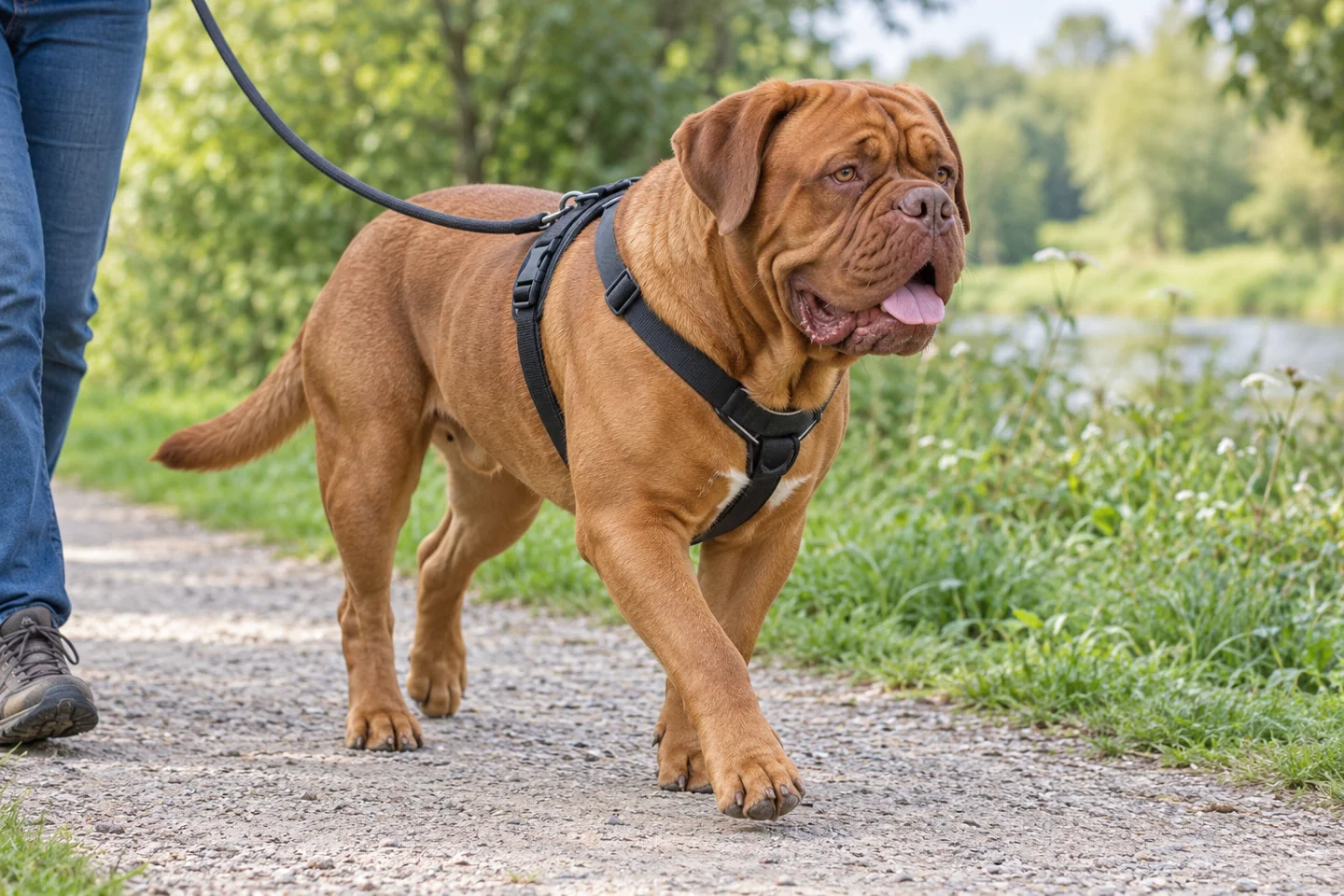
- Fawn with brown mask, natural ears and full tail
General information for owners. These articles have not been reviewed by a veterinarian. Medical decisions need your dog's history and an examination.
Plan the household around the adult Dogue
Living with a Dogue de Bordeaux begins with space and access. Before choosing a litter, examine the route from its bed to the garden and from the front door to the vehicle. A large dog needs room to turn without being squeezed against furniture, and someone must be able to manage its care if the usual owner is unavailable. An affectionate youngster sitting on a visitor's feet gives little indication of the arrangements required when that animal reaches adult weight.
Consider cleaning and daily contact as part of the choice. Water around the bowl, saliva on clothing, and a broad head asking for attention may be manageable features of life, but everybody sharing the home should understand them. More consequential questions concern rest, visitors, handling, and the ability to obtain veterinary treatment. Choose a source willing to discuss those matters candidly. An adult placement with good household observations may offer clearer information than optimistic promises that every puppy will adapt to any family routine.
French identity and the Bordeaux name
The FCI identifies the Dogue de Bordeaux as a French breed and places it among molossoid dogs. Its historical account describes several regional dogue types and the development of the Bordeaux identity. Historical suggestions about earlier ancestry should not be repeated as a verified pedigree stretching unchanged across centuries. For an owner, the established guardian background supplies context for thoughtful handling and visitor management. Recent family behavior and health records provide more direct evidence about a proposed puppy than a story about an ancient predecessor.
This is a distinct breed from the Bulldog, Bullmastiff, and other broad-headed dogs. A reddish coat and heavy head cannot prove ancestry in a rescue, and informal names may cover crosses. Ask what documentation exists and keep uncertain identification visible. A pedigree also does not explain whether the individual has learned to remain alone, accept grooming, or share a home with another animal. Those everyday abilities need their own questions and, after adoption, careful observation rather than assumptions attached to a familiar breed name.
Size facts that inform equipment rather than feeding targets
The FCI describes males at 60–68 cm at the withers and females at 58–66 cm, with specified tolerances. It gives minimum weights of 50 kg for dogs and 45 kg for bitches. These are conformation measurements, not instructions to make every individual heavier. Ask a veterinarian to assess condition and muscle, especially when a puppy's frame is changing. Maximum bulk is a poor goal if it compromises comfortable movement, temperature tolerance, or the ability to rise and change position easily.
Use actual measurements for a bed, travel arrangement, ramp, and harness. A vehicle advertised as suitable for large dogs may still have a steep step or insufficient turning space for this one. Let the dog practice entering before a clinic visit becomes urgent. Check whether floors remain safe when wet, and avoid placing the only resting space where people must repeatedly step over the animal. Small practical changes made early can preserve access more comfortably than trying to solve every difficulty through lifting or physical guidance.
The face needs comfortable breathing and clear eyes
A short muzzle requires attention to function. Noisy breathing, poor recovery after ordinary activity, disrupted sleep, or apparent difficulty moving air deserves veterinary discussion. Do not dismiss every sound as a charming feature of a large head. Cornell's guidance on brachycephalic airway problems explains why shortened facial anatomy can affect breathing, while the severity and treatment needs must be assessed individually. A generated picture or a breeder's claim about a broad nose cannot establish that an actual dog has a comfortable airway.
Notice the eyes and the skin around them during calm daily contact. Persistent squinting, redness, discharge, or obvious pain requires advice rather than cosmetic cleaning alone. Avoid putting unprescribed preparations near the eyes. If you need a recording of an intermittent breathing sound, obtain it during ordinary activity without provoking distress. Severe breathing difficulty or collapse needs urgent care. A household should know which clinic to contact and how to reach it, instead of beginning that search while a large dog is struggling.
A guardian's welcome starts before the door opens
Decide where the Dogue will be when somebody arrives carrying shopping, tools, or a parcel. Teach it to move to that place while there is no guest to add excitement. Reward the movement and make the resting area comfortable. Another adult should be able to perform the same sequence. If the plan depends on one person gripping a collar while leaning across the doorway, improve the physical arrangement before relying on it during a busy or unexpected arrival.
Allow visitors to settle without demanding immediate contact with the dog. Some individuals are comfortable after a quiet introduction; others need longer separation or a professional plan. A familiar relative entering regularly is a different event from a stranger moving furniture or reaching toward a sleeping animal. Tell people what to do rather than assuming they know dog behavior. An owner can provide hospitality while the dog remains apart. Direct interaction is optional, and the visit does not need to become a demonstration of the animal's tolerance.
Children and the spaces between furniture
A small child and a substantial dog need more room than a narrow gap between a sofa and coffee table. Arrange routes that let both leave comfortably, with a separate resting area that children cannot enter. Adults should prevent climbing on the dog, pressing faces together, pulling loose skin, or trying to push it from a bed. A quiet expression cannot promise acceptance of repeated unwanted touch. Watch actual interaction closely enough to change it before either participant becomes trapped or distressed.
Keep food bowls and valued chews away from children's activities. A child finding a toy beside the Dogue should call an adult instead of reaching across its head. Adults need a safe exchange plan of their own. Visiting children may create movement and noise unfamiliar to the dog, so use separation before attention becomes divided. Review the arrangement after changes in mobility, pain, or family circumstances. Teaching respectful behavior matters, while the responsibility for access remains with adults who can manage the environment consistently.

Aggression, discomfort, and factual incident records
A Dogue that stiffens during a collar adjustment may be worried, sore, or reacting to a learned experience. Pause the procedure and make the situation safe. Do not settle on an explanation from the breed's reputation. Note where the person stood, what was touched, whether the dog had a route away, and how it recovered. A veterinarian can investigate physical contributors, and a qualified behavior professional can use the observations to develop a plan that fits the actual household.
Resource conflict also deserves a change in routine. Feed privately, control access to valued items, and teach exchanges under conditions where the dog remains comfortable. Repeatedly taking things away to prove authority can increase concern about approach. Punishing a warning may leave the underlying problem present while reducing its visibility. Any muzzle or restraint plan for a short-faced dog needs professional attention to fit, breathing, and welfare. Equipment adds a safeguard within a suitable plan; it does not justify continuing pressure the dog is struggling to tolerate.
Training cooperation instead of moving a heavy body by force
Useful lessons include stepping onto a stable surface, following a target, waiting while a door is secured, and turning toward a person before walking resumes. Teach these in short sessions with rewards that the dog values. A slow response does not tell you that the animal is deliberately resisting. The instruction may be unclear, the surface uncomfortable, or the situation too demanding. Adjust the task so you can reward a successful choice rather than repeating a cue while adding physical pressure.
Teach standing for a brief body check before expecting a full examination. Practice with carers of different heights and movements so one owner does not become the only person able to help. A large dog should not need to be hauled into every position. If a previously comfortable action becomes difficult, consider pain and seek advice. Training can support medical care without replacing treatment. A good routine gives professionals more usable options while respecting the difference between ordinary practice and an urgent procedure.
Company and manageable time apart
Set up ordinary rest while people are still at home. An animal that follows every preparation may be anticipating another interaction rather than sleeping comfortably. Reward brief settled periods and provide an area away from repeated street activity. A predictable end to play helps the dog understand when attention changes. Keep expectations modest during the first days after adoption, when apparent quietness may reflect adjustment. Learn what the individual does between events instead of deciding its settled adult temperament from the first evening.
Build absences from periods the dog can manage and observe its response after departure. A recording can reveal persistent distress or attempts to escape that the owner never sees directly. Seek qualified assistance rather than assuming that a longer walk will solve every separation problem. Arrange a practiced backup carer and a plan for holidays, illness, or an unexpected work change. That person needs to understand door routines, handling concerns, food, medications, and the dog's preferred pace before taking sole responsibility for a demanding day.
Exercise matched to breathing, joints, and weather
Plan comfortable daily movement rather than relying on the dog to stop before it has done too much. Choose terrain with good footing and places to pause, then increase distance according to condition and veterinary advice. A growing Dogue needs opportunities to explore without a program built around repetitive impact or maximum endurance. Eagerness during a game is only one observation. Check how the animal rises later and whether its ordinary breathing and movement return comfortably after the outing.
Warm conditions can make a familiar route unsuitable. Shorten the plan, provide shade and water, and use transport that does not leave a dog waiting in a parked car. Distress, collapse, or a substantial change in breathing requires urgent advice. On quieter days, suitable sniffing and easy learning can retain interest without frantic indoor efforts to compensate. A household routine should remain workable when the main walker has an injured knee or the weather stays difficult, which may require help rather than an unrealistic promise to push through every circumstance.
Grooming a short coat and maintaining comfortable folds
Ask the veterinary team which skin areas need cleaning or drying in this individual. Check around the mouth after food and water, and inspect beneath equipment rather than covering odor with a scented product. A persistent irritated fold needs diagnosis and an appropriate plan. Similar-looking episodes do not automatically have the same cause. Keep cleaning gentle and introduce materials during easy moments, so a cloth approaching the face is not always the beginning of restraint around an already painful area.
Brush loose hair as needed and include nails and teeth in separate short lessons. Natural drop ears should be observed for pain, discharge, repeated shaking, or changed smell. Avoid probing deeply or reusing medication from another episode. A groomer needs advance notice of handling concerns, difficulty standing, or previous reactions. Where home care has become a struggle, obtain assistance and simplify the task while working on cooperation. Necessary treatment should proceed through appropriate clinical care rather than waiting for a perfect training response at home.
Health records include shoulders as well as hips
The AKC's current national-club list for Dogues de Bordeaux includes hip, elbow, cardiac, and shoulder evaluations. Request the named reports rather than accepting a general promise that the parents were checked. Ask how dogs are identified on the documents and what the findings mean. Shoulder information is worth noticing because a buyer focused only on hip scores could miss another recommended part of the program. Discuss significant diagnoses and the source's follow-up with owners of older offspring.
An examination of a puppy and formal parental screening answer different questions. Results also need their actual interpretation: a program recording completed tests does not guarantee that every finding was normal. Have your veterinarian relate the documents to family history and current clinical needs. In an adult rescue, preserve uncertainty where reports are absent and start from examination rather than assuming a favorable result. A current limp or change in exercise tolerance requires investigation even when the animal comes from a family described as sound.
Feeding, bloat planning, and medical observation
Choose a complete diet suited to life stage, measure an initial allowance, and review condition with the veterinarian. Growth should not become a race to reach a large number on the scales. Count training rewards and reassess portions when activity changes. Feed where the dog can eat without another animal or child interfering. Seek qualified advice before supplements or a home-prepared plan, and investigate persistent appetite or digestive changes instead of changing food repeatedly without understanding the problem.
Discuss gastric dilatation and volvulus with the clinic and make an individual emergency plan. Unproductive repeated retching, sudden abdominal enlargement, marked distress, or collapse needs urgent veterinary contact. A preferred feeding arrangement cannot guarantee prevention, and online speculation should not delay care. Ask whether a preventive procedure is relevant and what its limits are. Keep transport and assistance realistic for an adult that cannot walk unaided. Other changes, including altered drinking or a new reluctance to move, also deserve useful records and assessment rather than casual explanations based on age or size.
Other dogs, mixes, and a long-term budget
A second dog changes the use of hallways, bowls, beds, and human attention. Ask about the Dogue's observed responses and introduce suitable animals gradually with space to disengage. Persistent blocking or pursuit needs interruption even if one owner calls it play. Cats and smaller pets require their own protected access and a cautious assessment. Affection toward familiar people does not establish safety with another species. A household that cannot maintain necessary separation should resolve that problem before taking on an additional animal.
A Dogue mix can vary in head shape, adult weight, coat, medical risks, and response to visitors. A cross name cannot guarantee improved breathing, easier training, or a predictable middle size. Review both parent histories where known and assess the actual dog. Budget for preventive medicine, unexpected treatment, capable sitting, equipment, and changes that preserve access as the animal ages. The financial plan should include time away from work for care and suitable transport, not merely the initial price and a comparison of food bags.
Keep a written care sheet for anyone who looks after the dog. Describe the usual walking pace, food quantities, comfortable handling positions, and the clinic to contact. Practice the handover while you are present so the sitter can identify a problem before managing an entire weekend alone.
dogsDating without turning contact into a test
Use dogsDating to describe the individual Dogue's preferred pace, tolerance of close movement, and any resource or medical limits. Keep exact home coordinates private. Before meeting, ask whether the other dog uses fast collisions or persistent wrestling, and decide whether a quieter walking companion is more suitable. Choose comfortable conditions and enough space for separate handlers to change direction. Explain that the outing can end early. A first meeting should not depend on either dog continuing after fatigue or discomfort appears.
Allow a short shared route with distance instead of insisting on a face-to-face greeting. Watch breathing as well as social behavior and finish before either becomes overwhelmed. Leave competitive objects out of the plan, and avoid squeezing both animals into one vehicle afterward. A pleasant walk gives owners one useful observation. Repeated comfortable encounters may build familiarity, while access to a home, shared sleeping space, or valued resources still needs separate thought. The goal is a workable relationship supported by clear information about the actual animals involved.
Sources and editorial notes
Sources checked October 21, 2026. Breed measurements describe reference ranges, not a diagnosis or an individual dog's ideal weight. Images are AI-generated breed illustrations and do not document a particular dog or health condition.
- AVSAB: Humane Dog Training Position Statement
- VCA Animal Hospitals: Food aggression in puppies
- VCA Animal Hospitals: Aggression toward unfamiliar dogs, diagnosis
- VCA Animal Hospitals: Grooming and coat care for your dog
- VCA Animal Hospitals: Ear infections in dogs
- VCA Animal Hospitals: Feeding guidelines for dogs
- VCA Animal Hospitals: Common emergencies in dogs
- VCA Animal Hospitals: Heat stroke in dogs
- Orthopedic Foundation for Animals: CHIC health screening programs
- American Kennel Club: Working group health testing requirements
- Washington State University Veterinary Teaching Hospital: Gastric dilation and volvulus and bloat in dogs
- Fédération Cynologique Internationale: Dogue de Bordeaux standard 116
- Cornell University Riney Canine Health Center: Brachycephalic obstructive airway syndrome
Keep getting to know dogs.
Read another guide or return to your dogsDating community.
Explore breed guidesBack to dogsDating