Entlebucher Mountain Dog
An Entlebucher Mountain Dog needs a home prepared for a compact, powerful cattle dog rather than a smaller substitute for a leisurely giant breed.
How these guides are researched and reviewed
- Origin
- Switzerland
- Identity
- Herding / Swiss Cattle Dog
- Care priorities
- Cattle-dog outlets, hip and eye records, urinary questions
- Adult standard size
- FCI height: males 44–50 cm; females 42–48 cm; tolerance +2 cm
General information for owners. These articles have not been reviewed by a veterinarian. Medical decisions need your dog's history and an examination.
Smallest Swiss mountain dog still means cattle dog
An Entlebucher Mountain Dog needs a home prepared for a compact, powerful cattle dog rather than a smaller substitute for a leisurely giant breed. The FCI identifies it as the smallest of the four Swiss Mountain and Cattle Dogs, with driving, farm, and watch work in its background. That identity helps frame the ownership decision. Consider movement, alertness, handling, and the need for understandable work alongside the practical size of your house or vehicle.
Ask to observe an adult when something changes: a person enters, a walk ends, or another animal crosses the room. Those transitions can tell you more about household suitability than a brief greeting. A young dog will need ongoing learning, while an adult may bring habits from a different environment. Discuss what the current carer knows and what remains uncertain. Choose on the basis of that individual and your sustainable routine, including who provides care when your normal availability changes.
Entlebuch origins and separate Swiss identities
The standard places the breed in the Entlebuch valley associated with the Lucerne and Bern regions of Switzerland. Its development as a recognized breed is separate from the Appenzeller, Bernese, and Greater Swiss Mountain Dogs. The familiar tricolor pattern should not make their medical records or practical expectations interchangeable. Ask for the complete recorded breed when reading a pedigree and clarify any advertisement that uses Swiss mountain dog as if it were a precise identity.
An adopted dog can have uncertain parentage despite convincing markings. Describe the estimate honestly and assess its actual body and behavior. Historical work gives useful questions about interests, but it is not evidence that every modern individual has performed farm tasks. Ask about the recent family and the current living setting. If someone claims a dog will naturally manage a property, request details about training and supervision. Responsibility for livestock, visitors, and boundaries stays with the owner, regardless of ancestry or the dog's confidence.
Short coat, elongated body, and tail choices
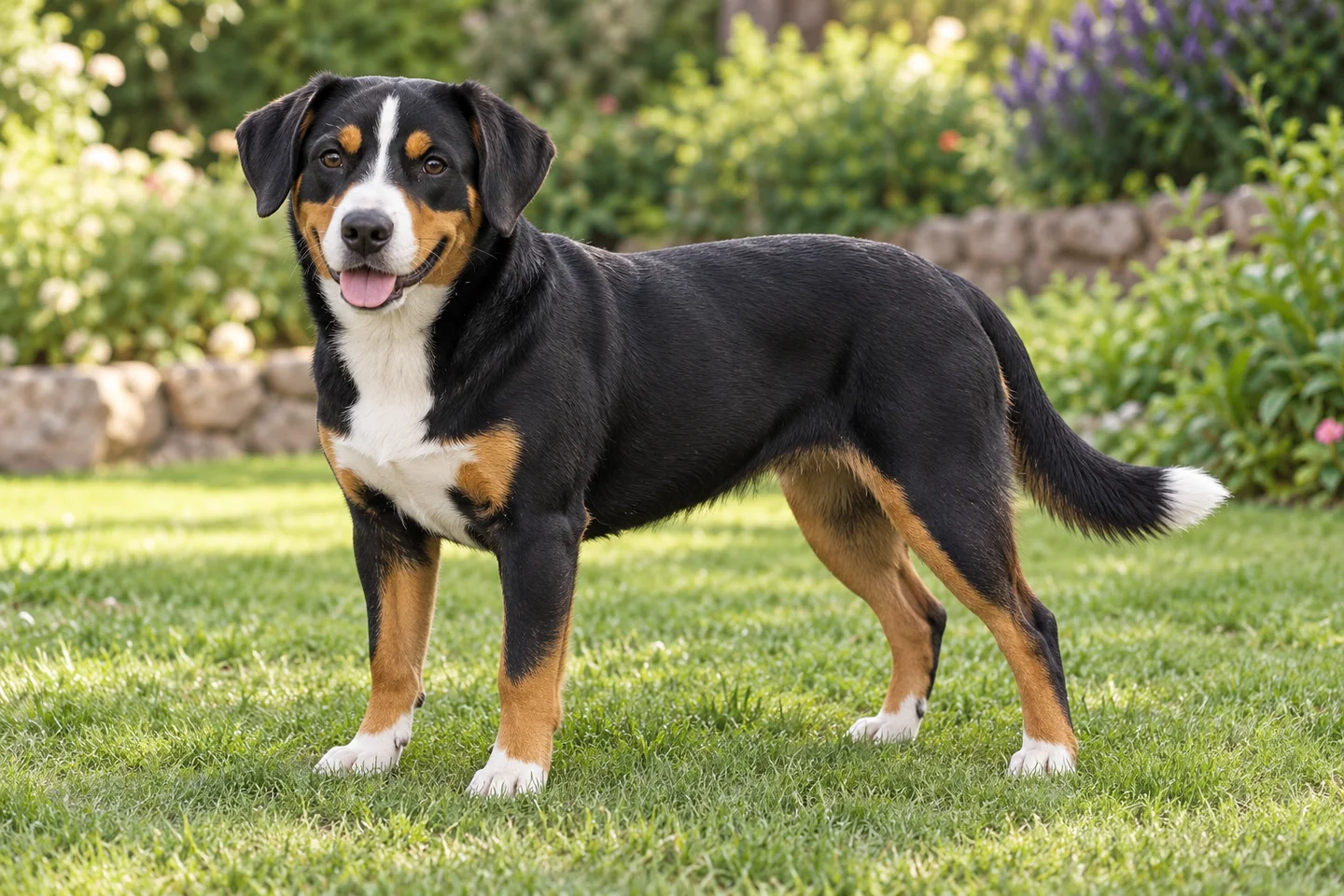
The Entlebucher is compact and somewhat longer than tall, with sturdy legs and a short tricolor coat. Black is combined with tan and white markings. The FCI accepts both a natural long tail and a congenital bobtail. This guide's images show a long natural tail, rather than suggesting that every short tail was produced by the same process. Ask about the actual dog's record when the distinction matters. Tail appearance alone cannot establish a pedigree or a clinical conclusion.
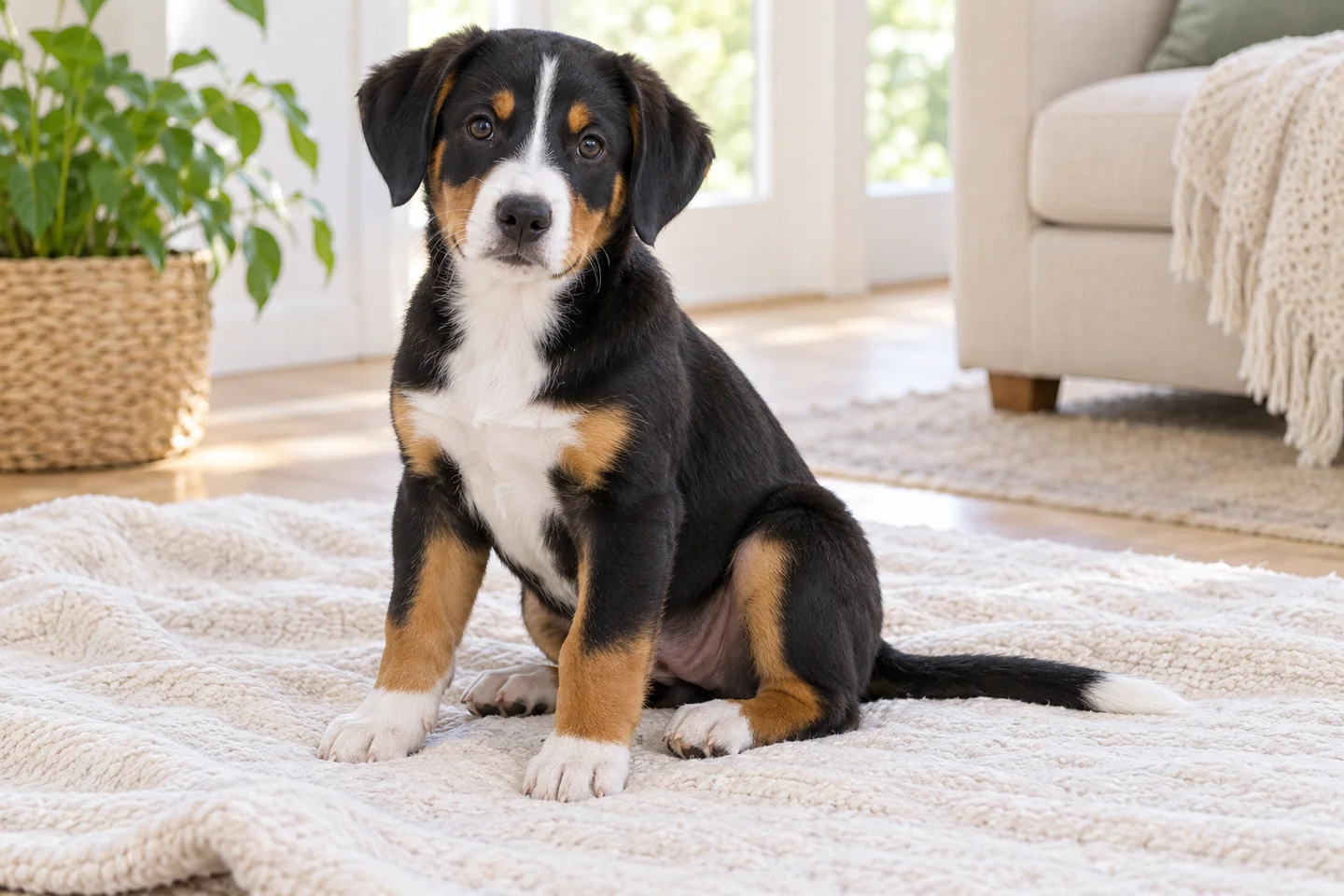
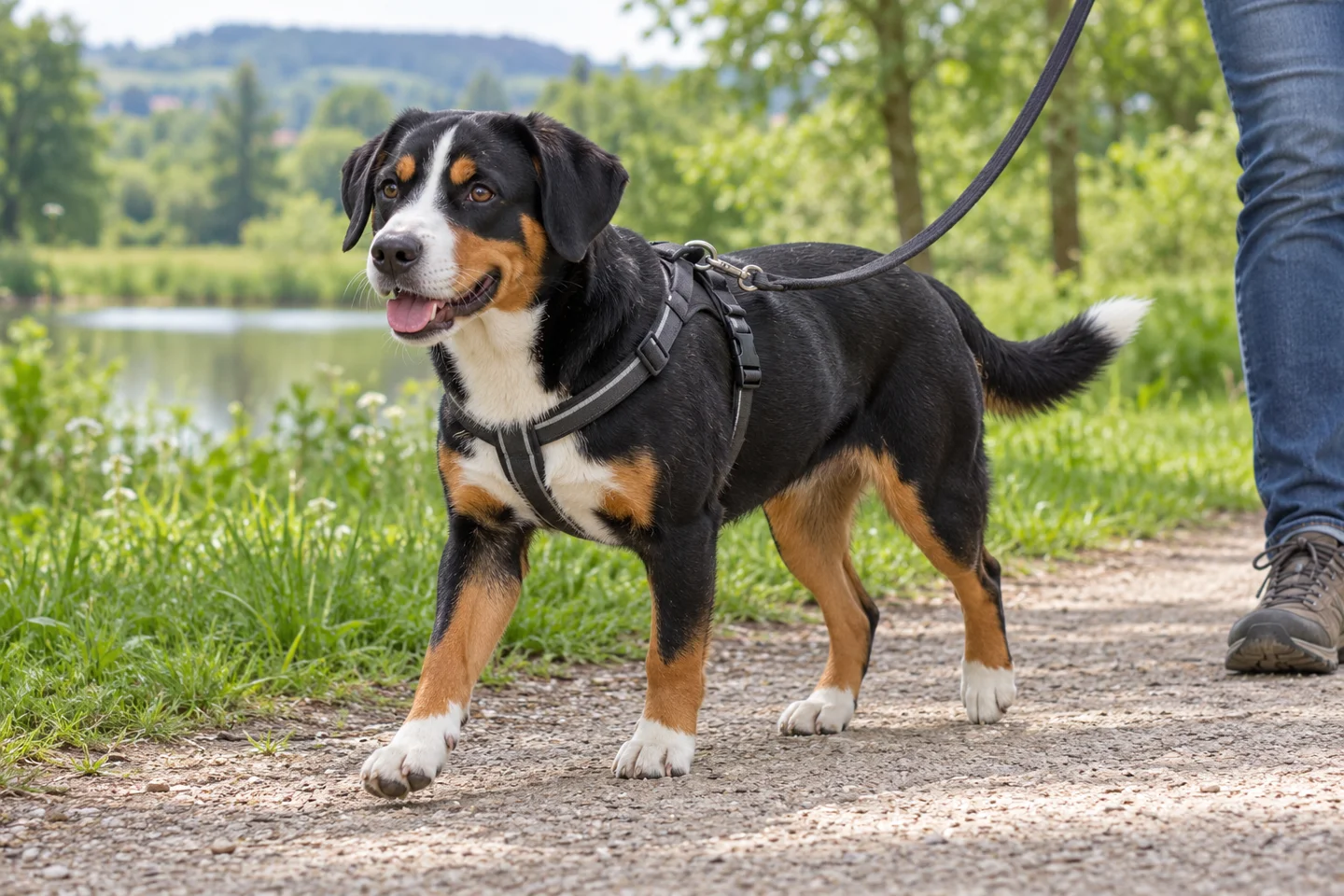
The illustrations are generated breed examples and cannot show the soundness or identity of a particular animal. Observe ordinary walking and rising from rest in person. Look beneath the visual impression of a muscular body and ask the veterinary team how to assess condition. A dog can appear strong while a recurring movement problem still needs attention. Fit a harness to the individual, checking its security during a backward step and whether straps allow the shoulders to move. Growth and weight change require another check.
FCI shoulder heights are 44–50 cm for males and 42–48 cm for females, allowing an upper tolerance of 2 cm. The reference helps distinguish this compact Swiss breed from its larger relatives, but it does not imply light handling or a small exercise commitment. Base transport and equipment on the actual adult. A substantial body on sturdy legs still needs a plan if injury prevents ordinary loading.
Training a dog that notices household movement
Give the Entlebucher specific alternatives to following and directing every moving person. A mat outside a busy hallway, a hand target away from an opening door, and waiting while equipment is clipped can become useful parts of the day. Teach them when the setting is quiet before expecting them during an excited arrival. Reward the first manageable step and provide a clear release. The dog should not have to guess whether it is being asked to wait or continue participating.
AVSAB recommends reward-based teaching. If a lesson fails, examine timing, distractions, and the reward before increasing pressure. A cattle-dog background does not make harsh corrections necessary or explain away distress. Short practice within daily routines can develop useful responses without prolonged repetition. Include a finish to activity so a dog accustomed to attention can learn that resting is also part of the household. Seek coaching if the family repeatedly reacts to unwanted behavior without successfully teaching an action that works better.
Herding interests without using people as stock
Watch for circling, heel-directed pursuit, or blocking that interferes with ordinary movement. Interrupt and change the situation rather than labeling it charming herding. Running children, cyclists, or a resident pet need protection from rehearsal while training progresses. Use distance and barriers to keep the task achievable. Reward turning toward the handler before the dog is too absorbed. A busy public path may need to be replaced temporarily with a setting where both participants can concentrate.
Livestock work needs experienced instruction and facilities appropriate to the animals involved. Do not turn a youngster loose to discover whether instincts will organize the job. Frightened stock can injure themselves, people, and the dog. A novice handler also needs to learn when to stop and how to recognize rising pressure. For companion homes, choose suitable tasks that do not require controlling another living being. Searching and structured learning can provide engagement while keeping responsibility for the household firmly with the people.
Exercise, traction, and honest conditioning
A compact dog may be easier to transport without needing a smaller commitment to activity. Plan regular movement, investigation, and learning that fits the individual's age and clinical condition. Build endurance from its recent routine rather than a general working description. Watch the response after rest, when stiffness may become clearer than during excitement. A puppy needs developmentally appropriate exploration and sleep, with veterinary advice before repetitive jumping or other demanding sport is introduced.
Consider footing around the home as well as outdoors. Slippery surfaces or an awkward vehicle entrance can complicate a tired dog's movements. Change access when needed and investigate persistent reluctance instead of repeatedly encouraging a painful action. In heat, choose suitable timing and shade, keep water available, and shorten the outing if recovery becomes difficult. Collapse or severe respiratory distress needs urgent care. A prepared route includes an early return option, not only a target that everyone is expected to complete regardless of the animal's response.
Children and busy family transitions
Arrange a child's arrival and the dog's excitement as separate tasks when necessary. One adult can manage the dog behind a gate while another deals with bags and food. Children should not be responsible for correcting pursuit or physically moving a strong dog out of a doorway. Set up a resting area that does not lie within the route of energetic games. Active supervision means an adult can notice and interrupt pressure, not merely hear noise from another room.
Teach invitations to contact and permit the dog to remain away. Avoid hugging, climbing, pulling at the tail, or leaning into the face. An adult retrieves anything lying beside food or a chew. Visiting children require clear rules even if the dog knows the family well. End an interaction when it avoids, freezes, or repeatedly tries to leave. Review arrangements when the dog has pain or when a child's movement changes with age. Familiar affection supplies history, but it cannot promise comfort in every later encounter.
Aggression and watchful behavior at entrances
Plan how a delivery worker or unfamiliar visitor can arrive without facing a loose dog at the threshold. A secure comfortable area gives the owner time to manage the entrance. For a planned guest, allow observation with enough distance and avoid requiring immediate touch. The standard's watch-dog background does not make threatening behavior at a shared doorway acceptable or remove the owner's duty to protect people. Do not let a visitor become an informal test of whether the dog is safe.
If growling, snapping, lunging, or blocking occurs, document the circumstances and prevent repetition while obtaining assessment. A new reaction during touch should prompt veterinary examination. Repeated incidents or a bite need qualified behavior support and an explicit safety plan. Use separate resources where guarding is involved and teach appropriate exchanges rather than routinely confiscating meals. Punishing warnings may obscure risk without resolving discomfort. Tell carers what has occurred and demonstrate the management arrangement; vague reassurances do not prepare another person to handle a difficult entrance safely.
Grooming a short double coat and maintaining feet
A short coat can still hold loose hair and conceal a rubbed area beneath equipment. Brush appropriately, inspect friction points, and check feet after rough ground. Use the routine to notice changes in skin or tolerance of touch. A few comfortable stages can teach the dog to cooperate with drying or a foot check before a muddy return makes the procedure urgent. If a task repeatedly turns into a struggle, ask whether the method, footing, timing, or a painful area needs attention.
Maintain nails and teeth using suitable equipment and a gradual learning plan. Ear discharge, odor, tenderness, or repeated shaking deserves veterinary advice. Do not probe deeply or reuse an old prescription because the signs seem familiar. Explain handling concerns when booking professional care so staff can prepare. Immediate treatment may need a different arrangement from long-term cooperative training, and both should be planned with welfare in mind. A practical maintenance routine is one the household can repeat comfortably rather than a rigid schedule that ignores the individual's condition.
Health records for joints, eyes, and DNA information
The AKC's Entlebucher recommendations list patella and hip evaluation, ophthalmologist evaluation, and PRA-prcd DNA testing, along with an AKC DNA profile. Ask what each item means. An identity-related DNA profile is different from a test for a disease-associated variant, and an eye examination provides information a selected variant test cannot supply. Obtain the actual reports with dates and identifiers instead of accepting a broad claim that all genetic checks were clear.
Discuss significant family diagnoses and how the source follows up after placement. A normal result under one assessment cannot guarantee lifelong freedom from illness. Your veterinarian can interpret findings alongside current movement, eyes, and general examination. If an adult arrives without parental records, record the gaps honestly and start with present clinical needs. Do not convert a missing result into a normal result or assume a rescue cannot receive useful preventive care. Symptoms still need investigation regardless of earlier screening or an athletic appearance.
Health concern: urinary leakage is not a training failure
The National Entlebucher Mountain Dog Association describes ectopic ureter and a broader urinary presentation in this breed. Misplaced or abnormal urinary connections can produce signs ranging from leakage to more serious illness, while some affected dogs have no obvious leakage. A puppy that persistently leaks or struggles with house-training despite sensible opportunities deserves a veterinary discussion. The owner should not intensify punishment for a problem that may have a medical cause.
Ask the source what urinary information exists for the family and whether a screening or specialist assessment was performed. The club explains limits in predicting these abnormalities, so do not accept a promise that a particular line guarantees an unaffected puppy. Diagnosis and treatment depend on the individual's findings; they cannot be selected from a home description. Keep the veterinarian informed about leakage, recurring urinary trouble, or other concerning signs and follow up as directed. Accurate records help separate a training question from a clinical problem requiring care.
Food and maintaining comfortable condition
Choose a complete food appropriate to age and medical requirements and measure an initial allowance. Include rewards used in the many brief lessons that can occur through a day. Check body condition with the veterinary team and review portions after changes in work, recovery, or age. A compact strong frame is not a reason to encourage excess weight. Where several people offer food, coordinate amounts so generous intentions do not conceal how much the dog actually receives.
Feed apart from other animals and children so the dog can eat without competition and intake remains visible. Persistent appetite, digestive, or drinking changes need assessment instead of a succession of product changes without a plan. Ask about supplements before adding them to an already complete diet. Home-prepared feeding requires qualified nutritional advice. When the dog is unwell, follow clinical directions and tell carers exactly what has changed. A familiar feeding routine should support observation and treatment, not prevent necessary adjustment to a diagnosed condition.
Mixes, costs, and dogsDating
An Entlebucher mix can differ in coat, proportions, activity, and social behavior from the standard image. Tricolor markings cannot confirm ancestry. Ask what is documented, and consider both parents' relevant health information for a planned cross. Budget for clinical care, diagnostics, training, transport, secure equipment, and relief care. The financial plan should account for unexpected needs as well as routine food. As the dog ages, adapt access and demands without assuming a sturdy appearance makes new discomfort unimportant.
A dogsDating profile should describe actual preferences and incidents, including difficulty at entrances or around resources. Keep exact home coordinates private and use a public route for an initial meeting. Separate handlers should allow distance and independent exploration without shared chews or toys. Stop persistent pursuit or blocking and finish if either animal cannot disengage. A calm walk is useful information about that situation. Home visits, shared travel, and breeding decisions require their own assessment rather than a promise inferred from one agreeable outing or a friendly photograph.
Sources and editorial notes
Sources checked October 21, 2026. Breed measurements describe reference ranges, not a diagnosis or an individual dog's ideal weight. Images are AI-generated breed illustrations and do not document a particular dog or health condition.
- VCA Animal Hospitals: Grooming and coat care for your dog
- VCA Animal Hospitals: Ear infections in dogs
- VCA Animal Hospitals: Common emergencies in dogs
- American Kennel Club: Entlebucher Mountain Dog health recommendations
- National Entlebucher Mountain Dog Association: Ectopic ureter
- VCA Animal Hospitals: Food aggression in puppies
- VCA Animal Hospitals: Heat stroke in dogs
- VCA Animal Hospitals: Aggression toward unfamiliar dogs, diagnosis
- AAHA: Feeding plans for healthy, appropriate weight cats and dogs
- Orthopedic Foundation for Animals: CHIC health screening programs
- Federation Cynologique Internationale: Entlebucher Mountain Dog breed standard
- AVSAB: Humane Dog Training Position Statement
Keep getting to know dogs.
Read another guide or return to your dogsDating community.
Explore breed guidesBack to dogsDating