French Spaniel
A French Spaniel needs an owner who sees a substantial pointing dog beneath the feathered coat.
How these guides are researched and reviewed

- Origin
- France
- Identity
- Sporting / Pointing Spaniel
- Care priorities
- Pointing outlets, brown-and-white feathering, foot inspection
- Adult standard size
- FCI height: males 56–61 cm; females 55–59 cm; tolerance +2/−1 cm
General information for owners. These articles have not been reviewed by a veterinarian. Medical decisions need your dog's history and an examination.
A pointing spaniel needs a plan for the ordinary week
A French Spaniel needs an owner who sees a substantial pointing dog beneath the feathered coat. The FCI places it among continental pointing breeds, despite the spaniel name. Before choosing one, think about safe outdoor access, useful learning, company, and the practical return from a wet outing. A pleasant expression at a visit cannot reveal how the dog will respond to birds, cope with absence, or settle when everyone else is busy.
Start the placement conversation with your actual schedule and existing animals. Ask what the individual does now, which experiences are known, and what support will be available. An adult observed in a home may provide a clearer account of some habits; a puppy has much of its development ahead. Neither should be chosen on the promise that a generally cooperative breed will fit every circumstance. Meet adults where possible and pay attention to everyday transitions, including equipment, travel, handling, and the end of activity, rather than only an impressive outdoor demonstration.
French identity and the distinction from flushing spaniels
The FCI identifies the French Spaniel, or Épagneul Français, as a French pointing breed with retrieving ability. That differs from treating every spaniel as primarily a flushing dog. Its standard records an early written standard from 1891 and links the breed's background to older bird dogs. These details provide historical context without supplying a precise ancestry account for an individual. Recent relatives and actual experience remain more useful for choosing a companion.
Ask for the exact recorded identity when comparing pedigree and medical information. The French Spaniel is separate from Brittanys and other similarly colored continental breeds. A rescue estimate may remain uncertain, and brown-and-white feathering cannot resolve every ancestry question. Be honest about what is documented. Care can still follow an animal's current build, behavior, and clinical findings without an invented family tree. A source describing natural ability should also explain which tasks have been taught and which situations have never occurred, rather than assuming a label answers the whole question.
Brown-and-white coat and a substantial outline
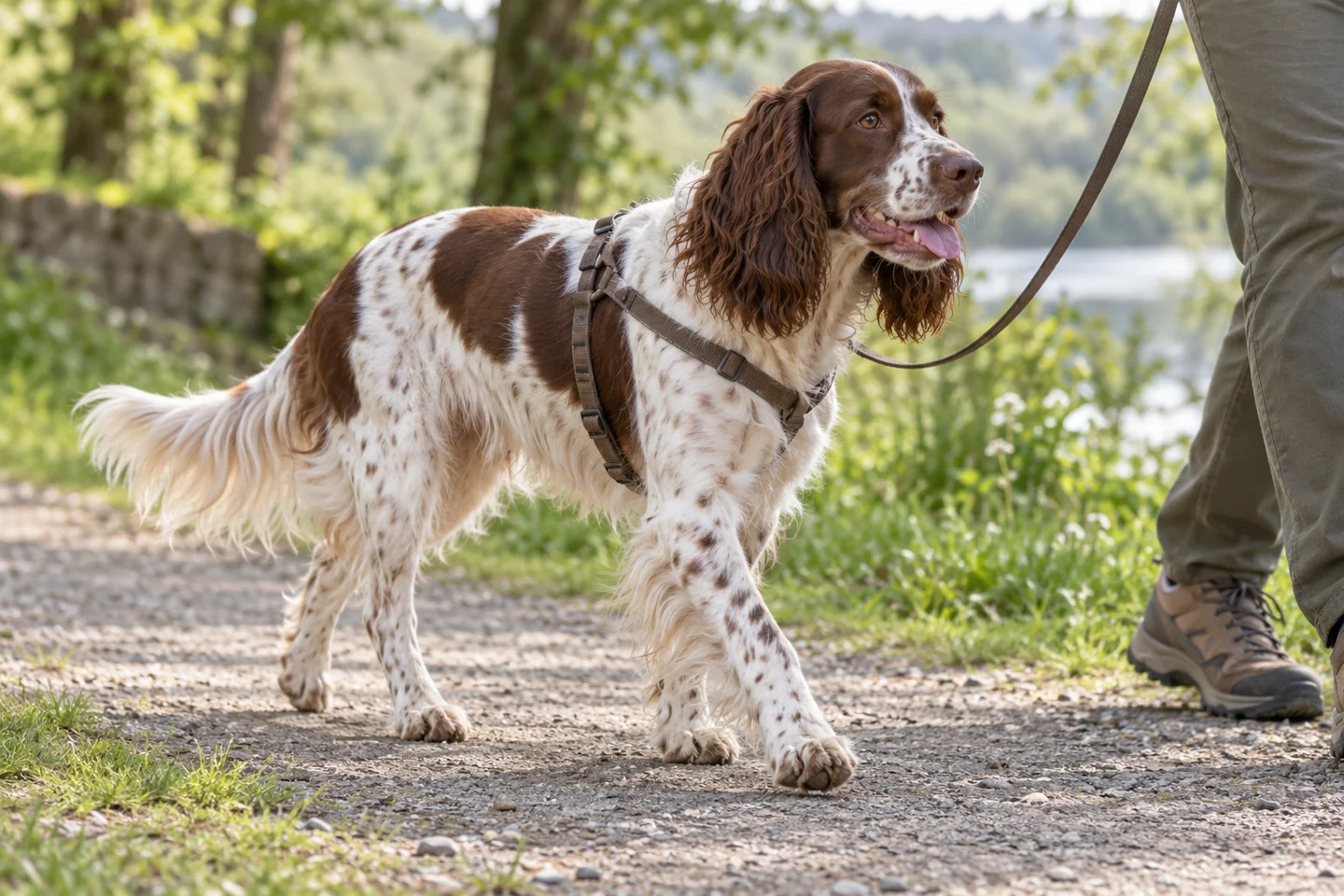
The French Spaniel has an athletic slightly rectangular body, strong bone without an intended coarse appearance, and a white-and-brown coat. The brown can vary in shade, with irregular markings and some flecking. Feathered drop ears and a long natural tail contribute to the familiar outline. The illustrations are generated breed examples, not photographs documenting a specific dog. They cannot establish a pedigree, demonstrate soundness, or predict exactly how every puppy will mature.
Observe a prospective adult in ordinary movement, including turning and getting up after a rest. Ask about repeated stiffness or reluctance to load into a vehicle even if the dog looks eager when active. A veterinarian can demonstrate appropriate body-condition assessment beneath the hair. Equipment should remain secure when the animal reverses and allow shoulder movement without trapped furnishings. Trial it in a calm place before adding an unfamiliar route. Recheck after growth or weight changes rather than assuming a generic spaniel size or one initial adjustment will remain appropriate.
FCI shoulder-height ranges are 56–61 cm for adult males and 55–59 cm for females, with a stated tolerance of 2 cm above or 1 cm below. That substantial spaniel outline deserves practical planning for car space and handling. It cannot be reduced to one target number for every individual. Evaluate comfortable movement and body condition, then choose equipment and access arrangements around the actual adult rather than a desired appearance.
Training around birds before expecting field competence
An interest in birds does not teach an individual every skill required for safe work. If field activity is intended, find qualified humane instruction that includes the owner's handling, conditioning decisions, terrain, and animal-welfare responsibilities. Do not introduce gunfire or uncontrolled quarry contact as a casual test. Ask the source what the dog has actually experienced and begin there. A pedigree contributes background without making either the puppy or a novice handler ready for a demanding outing.
Companion homes can use appropriate searching and retrieving tasks in controlled spaces. Select safe objects and a difficulty the dog can manage, then build gradually. Reward moving toward a person before expecting a response beside compelling scent. Keep other animals separated if food or objects could create competition. A useful session has an understandable finish and leaves room for ordinary rest. The household should not depend on an ever more elaborate program that nobody can maintain when weather or work changes the weekend plan.
Training cooperation for doors, care, and pauses
Teach useful positions while the dog is able to concentrate: standing for a clip, following a hand target, moving behind a gate, and resting briefly on a mat. Reward a small successful action promptly and introduce distractions in stages. These skills can help a different trusted person provide care without pushing or dragging the dog into place. Include a release so a short procedure does not always predict a long period of restraint.
AVSAB recommends reward-based methods and warns about aversive approaches. If the dog hesitates, examine clarity, reward, comfort, and setting before deciding the response requires stronger correction. A known cue performed indoors has not automatically been taught beside every outdoor interest. An instructor can help identify a workable distance and timing. Practice the end of activity as deliberately as the start. Repeatedly throwing an object whenever the animal approaches restlessly can teach a routine the family later finds difficult to stop.
Exercise that follows current fitness
Use the dog's recent activity as a starting point. Increase duration and terrain in stages before long trips, observing movement after rest and the following day. An eager dog may continue while an owner misses early fatigue. Puppies need sensible exploration and sleep, with individual advice before repetitive impact, jumping, or sport. A working description cannot establish a universal daily amount or remove the need to review an adult returning after illness or a quiet period.
Weather changes the practical plan. Choose cooler hours, water, shade, and an early exit in heat. Severe distress, weakness, or collapse needs urgent assistance. In rain or cold, think about comfort on the journey home and during recovery. Inspect feet and coat after vegetation, seeking help for embedded material, wounds, or painful swelling. Persistent lameness or reluctance to rise deserves assessment. Keep a manageable local alternative for difficult days so an altered schedule does not become a frantic indoor session intended to compensate for every missed mile.

Boundaries and the animals you did not plan to meet
A dog that returns in a quiet enclosure has succeeded there, not proved safety near traffic, livestock, or every bird. Retain appropriate physical control where the consequences of pursuit are serious and follow access restrictions. A line needs handling that prevents entanglement and an abrupt stop at speed. Check the entire garden or rented field before free access, including shared gates and gaps beneath fencing. Identification helps after escape but cannot prevent the first dangerous encounter beyond a boundary.
Captive birds and poultry deserve a deliberate placement discussion. Pointing or retrieving experience does not establish safe coexistence beside vulnerable pets. Protect housing during cleaning and feeding as well as when it is shut. Cats need inaccessible routes and introductions arranged to prevent chasing. A familiar cat resting indoors differs from an unfamiliar animal running outside. If fixation or pursuit occurs, stop access and obtain guidance. Decide whether the layout and available carers can sustain the required separation before relying on it as the long-term safety system for several animals.
Children and a quiet return from outdoors
Set up a clear route for equipment removal, drinking, and rest after an outing. An adult can manage the dog while children continue activities elsewhere. Keep towels ready rather than leaving a tired animal in a busy doorway while people search for supplies. A resting place should lie outside the play route and remain off limits to children seeking another interaction. Use barriers when adult attention is divided or visitors make supervision harder.
Teach a calm invitation and accept the dog staying away. Avoid hugging, pulling ears or feathering, climbing, and faces near the muzzle. Children should ask an adult for an object beside a meal or chew instead of taking it themselves. Watch avoidance or a suddenly rigid posture and end pressure early. A history of affection contributes useful context without guaranteeing every encounter. Review routines when a child changes with age or the dog becomes uncomfortable. Both participants need adults to manage the situation rather than relying on a stronger warning to make the limits clear.
Aggression and uncomfortable procedures
A French Spaniel that begins growling during a familiar foot check needs an assessment of the change, not a conclusion that a generally gentle breed cannot have a problem. Stop the procedure safely and describe the location and sequence to the veterinarian. Pain or illness can alter tolerance while ordinary activity continues. For any incident, record what approached, whether resources were involved, and whether the dog could leave. Do not recreate it with another person as an informal test.
Recurrent threats or a bite requires qualified behavioral help, clinical involvement, and a clear interim plan. Keep meals protected and teach safe exchanges rather than confronting the dog over repeated removal, consistent with VCA's guarding guidance. Punishing warnings can make discomfort less apparent without changing its cause. Give carers and professionals factual information before they take responsibility. Any muzzle recommended as a safeguard should be introduced positively and used alongside appropriate distance and barriers. Equipment cannot make painful contact or an unwanted social approach comfortable.
Grooming feathering without concealing a problem
Work through the coat gently in sections, checking behind ears, beneath equipment, along the underside, and around the feet. Ask an experienced owner or groomer to show appropriate tools and a practical routine for an adult. A tidy surface can hide tangles or skin irritation beneath it. Severe matting needs professional help, and scissors near skin concealed within a knot can injure the animal. Maintenance should remain comfortable between appointments rather than preserve a look the household cannot sustain.
Introduce towel use, a brief foot presentation, nails, and dental care through small rewarded stages. A new resistance in one area deserves investigation rather than escalating restraint to finish. Ear odor, discharge, shaking, or tenderness needs clinical advice; avoid deep probing or old medication without direction. Tell professionals about handling concerns at booking. Immediate treatment and longer-term cooperative learning may need different arrangements, and a painful condition should not be postponed indefinitely while the owner waits for perfect home training.
Health question: acral mutilation syndrome
Laboklin lists the French Spaniel among breeds for acral mutilation syndrome testing and describes a hereditary sensory neuropathy affecting the extremities. Affected dogs can have reduced pain sensation and damage their feet by licking or biting. This is a specific medical concern, not a description of every case of ordinary foot licking. Persistent self-injury, wounds, or an unusual response to injury requires veterinary assessment rather than an attempt to correct the behavior through punishment.
Ask the source which named test was performed, whose sample was tested, and how results were interpreted for breeding. Laboklin describes autosomal recessive inheritance. Clear, carrier, and affected findings are different results and should be explained by the veterinarian or an appropriately qualified genetics professional. A selected variant test cannot exclude every cause of reduced sensation or self-trauma. Do not test pain perception at home with force or a sharp object. Protect the animal from further injury and follow clinical advice about diagnosis, treatment, and the care it currently needs.
Health records beyond one named genetic result
Ask about significant diagnoses in close relatives, the source's full screening policy, and the evidence behind each assessment. A conformation standard is not a population medical survey. Do not accept a copied list from a different spaniel as proof that every relevant question is covered. Imaging, specialist examination, routine physical checks, and DNA panels answer different questions. Keep dates, identifiers, and findings with the documents and discuss their meaning with your own veterinarian.
An adopted adult may arrive without parental information. Mark those gaps as unknown and establish a present clinical baseline instead of converting missing results into normal ones. Persistent changes in appetite, drinking, movement, skin, or behavior still deserve assessment regardless of earlier reassurance. Plan prevention around actual activity and location, including vaccination, parasite, dental, and travel needs. Keep urgent contacts and transport ready for collapse, serious respiratory difficulty, trauma, or rapidly worsening illness. A dog that remains keen to work may still be unwell and should not have symptoms dismissed through its breed identity.
Feeding, rest, and the lifetime cost of care
Use a complete diet suited to age, condition, and medical requirements, measuring a baseline amount and counting training rewards. Review portions when activity changes, including during recovery. Ask the veterinary team to show condition checks beneath the coat. Separate meals so intake is clear and resources are not competitive. Supplements need a reason within the full diet, and home-prepared feeding deserves qualified advice. Persistent digestive signs should prompt a plan rather than a succession of unstructured food changes.
Provide quiet sleep and build comfortable absences gradually. A recording may reveal pacing or calling that has ended by the time you return. Seek help for sustained distress and arrange practical care when work exceeds current coping ability. Budget for routine treatment, diagnostics, instruction, grooming help, transport, and backup people who have practiced the actual routine. As the dog ages, adapt surfaces and access while retaining comfortable opportunities to explore. New reluctance or sensitivity warrants review instead of an automatic conclusion that the animal has simply become difficult or old.
Mixes and dogsDating with honest expectations
A French Spaniel mix can vary in adult size, coat, outdoor interests, and social preferences. Brown markings and feathering cannot establish ancestry. Ask what is verified and evaluate the animal itself. Planned crosses need relevant records from both parents, while mixed parentage cannot guarantee fewer inherited concerns or easier care. A responsible source discusses uncertainties and support, including what happens if a placement cannot continue, without using an appealing name as a replacement for information.
On dogsDating, describe known preferences, incidents, and any professional plan plainly. Keep exact home coordinates private and choose a public route with room for separate handlers. Begin without shared food or toys, allowing exploration at a comfortable distance. Stop persistent pursuit or blocking and finish if either dog cannot disengage. One relaxed walk is useful information about that setting, not proof of comfort sharing a home or vehicle. Reproductive and clinical suitability are separate questions too. Let welfare and accurate observations guide what happens next rather than pressure for a close greeting or photograph.
Sources and editorial notes
Sources checked October 21, 2026. Breed measurements describe reference ranges, not a diagnosis or an individual dog's ideal weight. Images are AI-generated breed illustrations and do not document a particular dog or health condition.
- Laboklin: Acral mutilation syndrome, inheritance and testing
- VCA Animal Hospitals: Grooming and coat care for your dog
- VCA Animal Hospitals: Ear infections in dogs
- VCA Animal Hospitals: Common emergencies in dogs
- VCA Animal Hospitals: Food aggression in puppies
- VCA Animal Hospitals: Heat stroke in dogs
- VCA Animal Hospitals: Aggression toward unfamiliar dogs, diagnosis
- AAHA: Feeding plans for healthy, appropriate weight cats and dogs
- Orthopedic Foundation for Animals: CHIC health screening programs
- Federation Cynologique Internationale: French Spaniel breed standard
- AVSAB: Humane Dog Training Position Statement
Keep getting to know dogs.
Read another guide or return to your dogsDating community.
Explore breed guidesBack to dogsDating