Gordon Setter
A practical guide to the Gordon Setter, including outdoor training, feathering care, health records, family safety, mixes, and calm dogsDating walks.
How these guides are researched and reviewed

- Origin
- Great Britain; Scottish setter
- FCI adult size reference
- Males 66 cm and 29.5 kg; females 62 cm and 25.5 kg
- Coat
- Black with chestnut-red markings and feathering
General information for owners. These articles have not been reviewed by a veterinarian. Medical decisions need your dog's history and an examination.
A setter built for outdoor work
A Gordon Setter needs a home that makes room for a substantial bird dog. Its black coat and chestnut markings may attract your attention first, but the more useful questions concern daily walks, training, company, and coat care. Think about who will take the dog out on a wet weekday and how you will manage a long lead near wildlife. An attractive garden does not answer those questions. A household that enjoys outdoor learning and has a workable care routine can assess the breed more realistically than one choosing from a photograph.
The American Kennel Club identifies the Gordon as a Scottish sporting dog named for an aristocrat. The FCI classifies it among British and Irish pointing dogs and setters. That working background explains why a potential owner should ask about the particular family's field activity, as well as its life indoors. Meet adult relatives when possible. Ask what they do when birds move nearby, how they settle after a walk, and how they cope with visitors. A breeder's description of intended temperament gives context; observation supplies information about the dogs you may actually live with.
Appearance and adult size
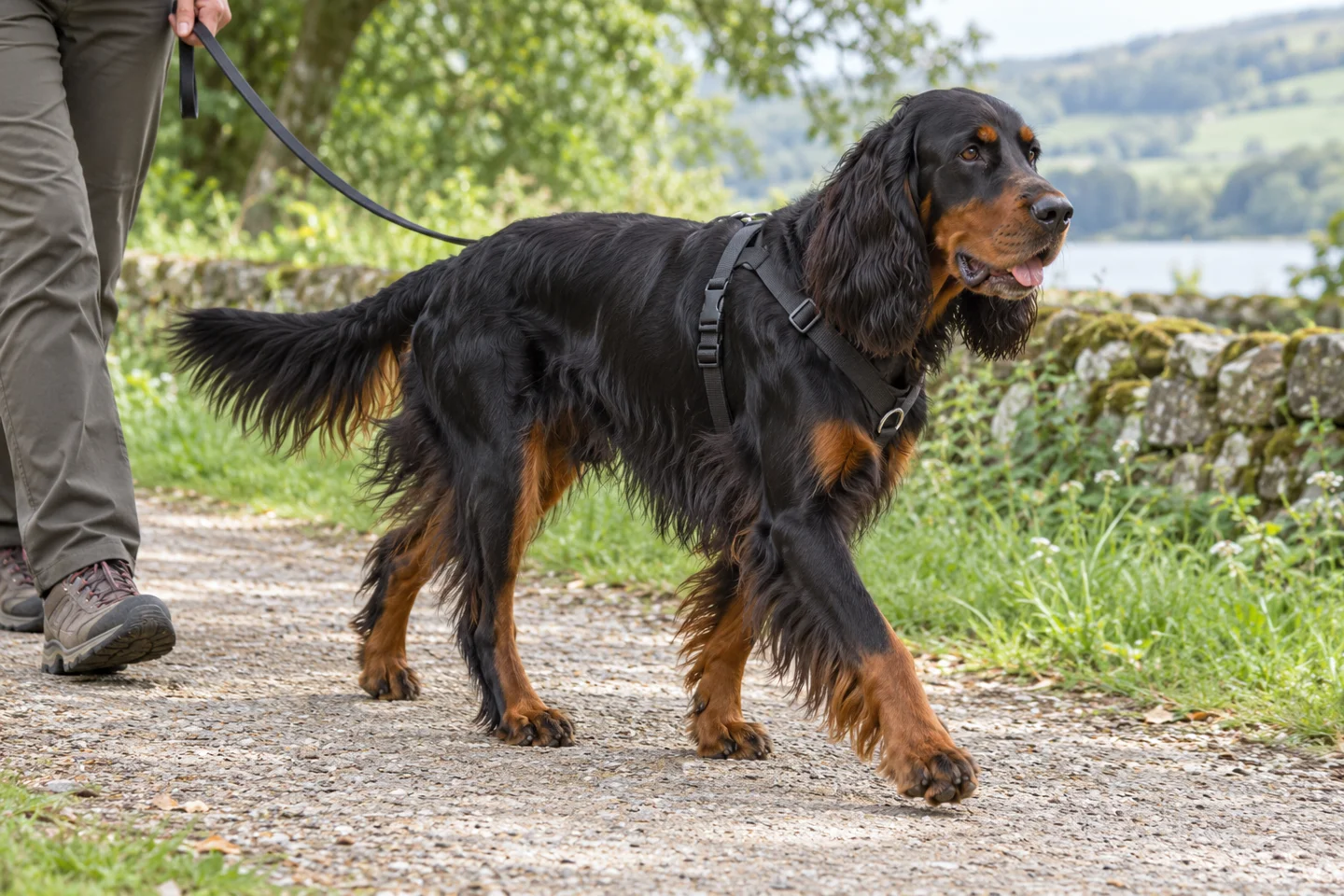
The FCI standard describes a symmetrical dog with a deep chest, long muzzle, low-set ears, and a feathered tail carried around the back's level or lower. Its specified coloring is black with chestnut-red markings. The standard gives males a height of 66 cm and weight of 29.5 kg, and females 62 cm and 25.5 kg. These are standard references, not a prediction of every puppy's final measurements or an instruction to feed an adult toward a particular number. Your dog's condition and comfort matter when interpreting its weight.
Use those dimensions for practical planning. Check whether an adult can turn comfortably in your vehicle's intended travel space and lie down in the area you have reserved at home. Try the route from the door to the car with a lead in one hand and ordinary belongings in the other. If your entrance opens directly onto a busy pavement, plan an additional secure barrier. The illustrations in this guide show the breed's general form. They are AI-generated examples and cannot establish pedigree, correct movement, or the health of an actual animal.
Temperament in everyday life
An affectionate Gordon still needs to learn the details of your household. Consider the difference between resting beside someone during an evening and coping alone while that person works. Ask an owner or foster carer to describe both situations. A useful account includes how the dog behaves after the door closes, whether it can rest in another room, and what happens when the usual schedule changes. Avoid treating a pleasant first meeting as evidence that all of these skills already exist. Prepare a quiet sleeping place and keep the first days predictable.
At home, define what settling looks like. It could mean lying on a mat while you cook or resting behind a gate while a delivery arrives. Place the mat where the dog can relax without blocking a doorway or being stepped over. Notice and reward quiet choices before the dog becomes frustrated. Record situations that repeatedly produce difficulty and adjust the arrangement. That gives a trainer something concrete to assess. Describing an animal as stubborn tells you much less than explaining that it leaves its mat whenever food is carried past.
Training around birds and distractions
Teach a return cue in a quiet place before relying on it outside. Start close enough that the dog can hear you and succeed. Reward arriving, then release it to another permitted activity when appropriate. With a Gordon that is absorbed by moving birds, do not make the first difficult test an unfenced area beside a road. Use a secure space or suitable long lead, and ask a reward-based instructor to help you increase distractions gradually. AVSAB recommends reward-based methods and advises against aversive techniques for ordinary training and behavior problems.
Write down one useful goal for each outing. On a narrow path, that might be turning toward you while another walker passes. In a quiet field, it might be checking in voluntarily. Keep the reward ready and end the exercise before attention is exhausted. If a cue repeatedly fails, make the task easier instead of repeating it louder. Review distance, distraction, and what the animal receives for responding. A lesson that succeeds in your kitchen must be practiced elsewhere before you count on it at a park entrance.
Exercise with space to recover
Plan exercise as part of the whole day rather than a single exhausting event. A Gordon's outdoor schedule can include a sniffing walk, a short lesson, and time in an enclosed area when appropriate. What matters is whether the individual remains comfortable and can recover afterward. Ask your veterinarian about activity for a growing puppy, an older dog, or an animal with an orthopedic problem. Avoid copying the routine of a fit adult simply because the breed name matches. Keep a record of stiffness, reluctance, or altered movement after activity.
Give yourself a realistic bad-weather option. Identify a sheltered route, a place for short indoor searches, and someone who can help when your normal walker is unavailable. In hot conditions, change the plan before the dog struggles. VCA identifies heavy panting and other changes in a hot dog as reasons to take heat illness seriously. If the animal appears distressed, stop activity, move to a cooler area, and contact a veterinarian for immediate guidance. Do not use persistence or enthusiasm as proof that continuing a run is safe.
Socialization without a greeting quota
For a puppy, discuss safe exposure with your veterinary team while vaccinations are in progress. The aim is to help it experience ordinary life at an intensity it can handle. A short observation of a passing bicycle from a comfortable distance may be more useful than standing beside a busy cycle path. Let the puppy move away and provide a quiet break. Keep notes about what was easy and what needs a slower approach. You do not need a photograph with every stranger to show that an outing achieved something.
An older newly adopted Gordon also needs time to learn your surroundings. Begin with routes that offer room to turn away and avoid making the first weekend a series of crowded visits. Ask the previous carer about travel, household noises, and unfamiliar dogs. Test new arrangements gently. If the dog stays comfortable with one visitor sitting at a distance, you can plan another small step later. A calendar cannot tell you that an individual is ready for a larger event. Use what you observe and seek help when fear repeatedly interrupts ordinary activities.

Aggression and early intervention
A Gordon's breed identity cannot certify that it will never bite. Pay attention to the situation around a warning: a painful movement, someone approaching food, an unfamiliar dog, or pressure near a resting place. If the dog freezes, growls, snaps, or repeatedly attempts to leave, create space and prevent another confrontation. Do not punish the warning or ask someone to repeat the approach to prove a point. Contact your veterinarian about a new behavioral change and arrange qualified behavior help when safety is uncertain.
VCA explains that aggression toward unfamiliar dogs can have several motivations, including fear and frustration. Pulling toward another dog does not prove that releasing the lead will produce a friendly meeting. Until you understand the pattern, choose routes with escape space and avoid close encounters. Keep a written account of distance, location, and what happened before the reaction. That record can guide an assessment. If a bite has occurred, stop casual introductions and discuss a management plan with a veterinary behavior professional before arranging another dogsDating walk.
Children and a safe household routine
Children need an adult who is actively supervising contact, and the dog needs somewhere children cannot follow it. Put that resting area in place before the first visit. During meals, chewing, or sleep, use a gate or separate room when necessary. Explain that a dog walking away has ended the interaction. Adults should intervene rather than asking a child to hold the collar or take away an object. The size of an adult Gordon also makes accidental collisions worth planning for, especially in a small hallway or beside a staircase.
Choose calm activities suited to the child and the dog. An adult can manage the lead while a child helps prepare a simple search game at a distance. Keep food handling organized and stop if competition or grabbing begins. If you cannot watch the interaction properly, separate them comfortably. When assessing a rescue, ask about specific ages, settings, and previous incidents rather than accepting the word family-friendly. A dog that was relaxed with an older teenager has not necessarily been assessed around a running toddler. Preserve those distinctions when making decisions.
Other dogs, cats, and small animals
A working bird-dog background makes it sensible to plan carefully around birds and other small animals. Ask about the individual's observed responses and maintain secure separation where needed. A calm look through a barrier does not establish safety during free movement. If you have a cat, arrange protected escape routes and places the dog cannot reach. Do not let a chase become your method of finding out whether the animals can share a home. Discuss the household with the breeder or rescue before committing to the placement.
For a resident dog, keep the first arrangements simple. Use separate feeding and resting areas, and arrange an introduction where both handlers have room to move away. Remove shared toys from the initial setting if they could create conflict. Observe whether either animal is trying to disengage. A successful first walk gives you a reason to plan another careful meeting; it does not settle every question about living together. Take account of differences in age, mobility, and preferred play. The quieter dog also needs choices and access to its carer.
Grooming feathering and outdoor debris
The Gordon's feathering needs attention after outdoor activity. Check behind the ears, along the belly, and around the legs for tangles or trapped debris. Work gently with suitable tools and ask a groomer to demonstrate the technique on your dog. Do not pull a comb through a tight knot until the animal protests. VCA recommends regular brushing and inspection and warns against using scissors on mats close to the skin. An uncomfortable tangle is a reason to get skilled help rather than turn a coat-care session into a struggle.
Build grooming into the return-home routine. Keep a towel near the entrance, choose a surface where the dog can stand securely, and inspect a small area at a time. Reward cooperation and stop before the dog becomes overwhelmed. Arrange professional help when the coat has become difficult to manage or the dog is painful. Ask the groomer what you should maintain between appointments and write down the answer. A clear routine helps another household member or sitter provide the same care when you are away, including checking the less visible feathering underneath.
Ears, feet, and comfortable handling
Low-set ears deserve regular observation, especially when a dog spends time outdoors. Notice redness, discharge, odor, head shaking, or sensitivity and contact your veterinarian when those signs occur. VCA explains that ear infections need assessment of their cause. Avoid treating a painful ear with leftover drops or pushing cotton buds down the canal. A previous prescription may be inappropriate for the current problem. If your veterinarian recommends cleaning, ask for a demonstration and instructions for the particular product and condition.
Practice handling during comfortable moments. Touch a shoulder briefly, reward the dog, and build gradually toward an examination of a foot. Keep sessions small enough that the animal can participate without restraint escalating. Ask your clinic or groomer for help with nails if you are unsure about technique. After a walk, check any area the dog repeatedly licks or protects, and seek advice about persistent discomfort. A handling record can be practical: note which positions are easy, what tools have been introduced, and which areas currently need professional assessment.
Feeding the dog you have
Choose a complete food appropriate to life stage and discuss the starting portion with your veterinary team. Measure what actually goes into the bowl and include training rewards in the daily total. AAHA's nutrition guidance recommends that complete, balanced food supply at least 90 percent of calories, with treats and other extras limited to the remainder. A busy walk does not provide a reliable calculation of how much extra food a dog needs. Review weight and body condition over time, then adjust the plan with useful evidence.
Make feeding instructions clear enough for a sitter to follow. Name the food, write down the measured amount, and explain where rewards come from. Keep fresh water available and tell the sitter about any prescribed diet or known problem. If the dog leaves meals, vomits repeatedly, loses weight, or develops a persistent digestive change, contact the clinic rather than repeatedly switching products without a plan. A puppy's growth and an older dog's changing needs deserve their own review. The standard's reference weight is not a substitute for assessing the individual in front of you.
Health screening and family information
The AKC's current national-club recommendations for Gordon Setters list hip and elbow evaluations, an ophthalmologist evaluation, contribution to the CHIC DNA Repository, and a DNA test for progressive retinal atrophy, rod-cone dysplasia 4 (PRA-rcd4). Request the actual records and check the identities of the dogs they concern. A repository contribution stores material for research; it should not be mistaken for a normal result on a disease test. Ask the breeder to explain each document and discuss unfamiliar findings with your veterinarian.
OFA explains that CHIC certification records completion and public availability of the required screenings. Read the individual findings instead of treating a certificate as a guarantee of lifelong health. Ask about later diagnoses in relatives and how the source keeps owners informed. If an adopted adult has no parental records, record that gap honestly and arrange a current examination. Selected DNA variants, clinical examinations, and imaging answer different questions. A dog with reassuring screening information can still need investigation for a new limp, eye change, or loss of normal activity.
Urgent changes and planning for older age
Know where you would go for urgent veterinary care before you need it. Repeated unsuccessful attempts to vomit, especially with restlessness or abdominal enlargement, warrant immediate contact because they can signal bloat and gastric dilatation-volvulus. VCA identifies this as an emergency. Breathing difficulty or collapse also needs urgent assessment. Describe what you can observe and follow the clinic's transport instructions. Do not wait for an online discussion to identify a diagnosis or for the next routine appointment when the dog is deteriorating.
For an older Gordon, keep the home arrangement easy to revise. A resting place on an accessible floor and a vehicle-loading plan can become useful if mobility changes. Tell your veterinarian about changes you have noticed rather than dismissing them as age: difficulty rising, altered sleep, hesitation on familiar surfaces, or a different response to handling. Keep a short dated record so that gradual changes are easier to describe. Ask what level of exercise is comfortable now and how you should judge recovery. Adjust outings around the dog's current abilities.
Mixes and uncertain pedigrees
A Gordon Setter cross may be described simply as a setter mix or by the other claimed parent. Those descriptions do not create a recognized Gordon variety or a predictable package of traits. Ask what is documented, what was inferred from appearance, and what the source has observed. A black-and-tan coat alone cannot identify parentage. For an adult, assess actual size, coat maintenance, outdoor behavior, and ability to rest. For a puppy, leave room in your plans for uncertainty in mature appearance and behavior.
Health questions should follow verified ancestry and available family information. If both parents are known, ask about relevant assessments for each and have the records interpreted properly. Crossing breeds does not establish that every inherited condition has been removed. Avoid paying more for a claim that a mixed puppy is guaranteed healthy or will behave exactly like one parent. If a rescue cannot establish pedigree, it can still provide valuable information about daily care and observed needs. Make the household decision from that evidence and the support you can provide.
Costs and choosing a source
Price the ordinary week before concentrating on the purchase fee. Include suitable food, veterinary prevention, training, grooming help, secure transport equipment, and care during working hours. Ask local providers for current quotes because costs depend on where you live and what the individual needs. Read insurance exclusions and decide how you would cover an urgent bill. A larger dog may also affect transport and accommodation choices. Verify those arrangements directly before bringing one home, particularly if you rent or travel regularly.
When speaking with a breeder or rescue, ask who will help after placement. Review the contract, return arrangements, known medical history, and the circumstances in which they would advise professional support. Meet the animal in a setting that permits useful observation rather than accepting a rushed handover. Prepare questions about daily life and request examples. If your household cannot provide a workable exercise, care, and company routine now, wait until that changes. Choosing an older assessed dog may answer some questions more clearly than choosing a puppy from appearance alone.
dogsDating walks for a Gordon Setter
Use your dogsDating profile to describe the dog another handler will meet. Explain whether your Gordon prefers a quiet walking partner, needs space near birds, or is still learning to pass unfamiliar dogs. Describe observed needs without promising universal friendliness. Share an approximate area and agree on a public meeting point. Keep your home address and exact coordinates private. Confirm that each adult will manage their own dog, and choose a route with enough width to turn away if either animal becomes uncomfortable.
Begin with walking in the same direction at a distance both dogs can handle. Leave toys and shared food games out of the first meeting. Watch for a dog that repeatedly stops, turns away, stiffens, or cannot disengage from the other animal. Increase space or end the outing when needed. Afterward, record something specific for the next plan: the quieter path worked, the narrow bridge was difficult, or the dogs were comfortable without greeting. A useful match can be a familiar companion for calm walks. Physical play is optional, and both dogs should have a comfortable way to leave.
Sources and editorial notes
Sources checked October 21, 2026. Breed measurements describe reference ranges, not a diagnosis or an individual dog's ideal weight. Images are AI-generated breed illustrations and do not document a particular dog or health condition.
- AVSAB: Humane Dog Training Position Statement
- VCA Animal Hospitals: Food aggression in puppies
- VCA Animal Hospitals: Common emergencies in dogs
- Orthopedic Foundation for Animals: CHIC health screening programs
- American Kennel Club: Gordon Setter breed information
- FCI: Gordon Setter standard 6, 6 October 2026
- American Kennel Club: Sporting Group Health Testing Requirements
- VCA Animal Hospitals: Aggression toward unfamiliar dogs, diagnosis
- VCA Animal Hospitals: Grooming and coat care for your dog
- VCA Animal Hospitals: Ear infections in dogs (otitis externa)
- AAHA: Feeding plans for healthy, appropriate weight cats and dogs
- VCA Animal Hospitals: Heat stroke in dogs
- AVSAB: Puppy Socialization Position Statement
- VCA Animal Hospitals: Dog behavior problems, aggression toward children
Keep getting to know dogs.
Read another guide or return to your dogsDating community.
Explore breed guidesBack to dogsDating