Great Pyrenees
A large mountain guardian whose independence, voice, dense coat, and visitor decisions call for reliable boundaries and a realistic daily care plan.
How these guides are researched and reviewed
- Origin
- France; Pyrenean mountains
- Adult height
- Males 70–80 cm; females 65–75 cm
- Coat and feet
- Dense white coat, sometimes with colored patches; double rear dewclaws
General information for owners. These articles have not been reviewed by a veterinarian. Medical decisions need your dog's history and an examination.
A guardian needs a household that can manage access
A Great Pyrenees needs people who can organize boundaries and arrivals before the dog makes its own decisions about them. Assess the fence, delivery entrance, visitor parking, and route to the veterinary clinic. An attractive large garden can still be unsuitable if gates are left open or callers must walk through the dog's resting space. Decide who will manage access when the usual owner is away. A guardian's physical size and attention to its surroundings make a workable household system part of everyday care.
The breed is also called the Pyrenean Mountain Dog. It is distinct from smaller Pyrenean herding breeds and from other white livestock guardians. Confirm identity through records when available, then assess the individual. A white coat does not prove which working background a dog has or what it knows about living in a home. Ask a breeder or rescue to discuss the setting honestly. If the household expects every visitor to enter freely and every unfamiliar dog to become a playmate, explain those expectations before selecting an animal.
Mountain work and a modern companion
The FCI describes a French mountain guardian selected to protect flocks from predators, often making decisions independently. Its historical account records the official French standard in 1923. That background helps explain why owners need to teach cooperation without expecting constant instruction-seeking. It does not mean every pet can be placed directly with livestock. Successful working placement requires appropriate upbringing, experience, and management. A companion that has never learned around sheep cannot be declared suitable from its breed name alone.
Ask how the actual dog has lived. A rural working animal may need a gradual introduction to interior doors, traffic, household absences, and close handling. A home-raised puppy still needs preparation for those experiences. Discuss the dog's response when someone approaches its familiar territory and when it meets people elsewhere. These settings can produce different observations. Treat a change of environment as a period of learning, with a predictable routine and controlled introductions. A traditional role gives useful context but cannot answer every question about an individual's current behavior.
Adult height, coat, and practical space
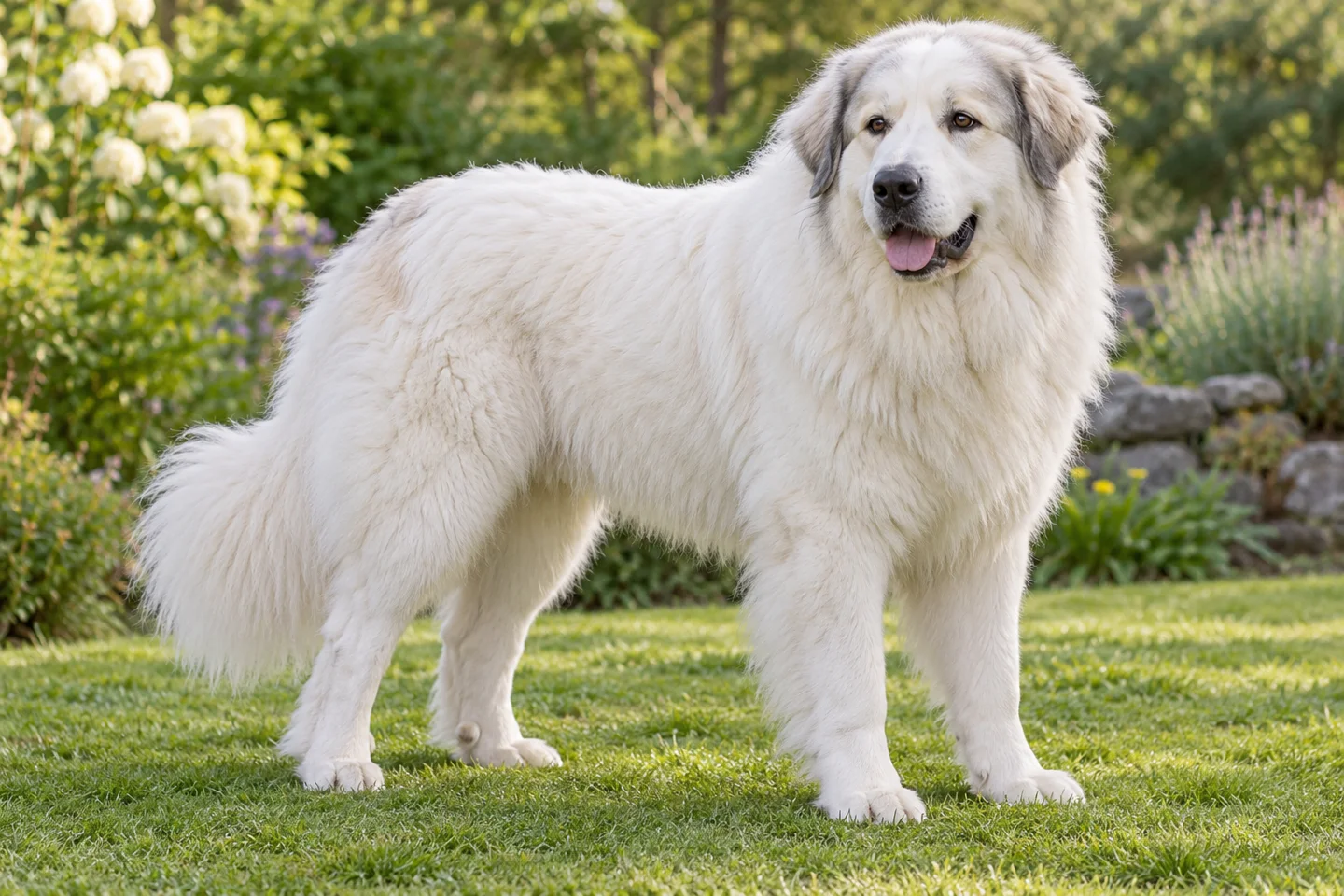
FCI height ranges are 70 to 80 centimeters for males and 65 to 75 for females. The coat is dense and white, sometimes carrying permitted patches, and the standard includes double rear dewclaws. The illustrations show a white dog with subtle pale badger markings. They are AI-generated examples rather than evidence of ancestry or clinical quality. When meeting a real adult, watch comfortable movement and ask about its health records. Do not increase feeding to reproduce the impression of bulk created by a thick coat.
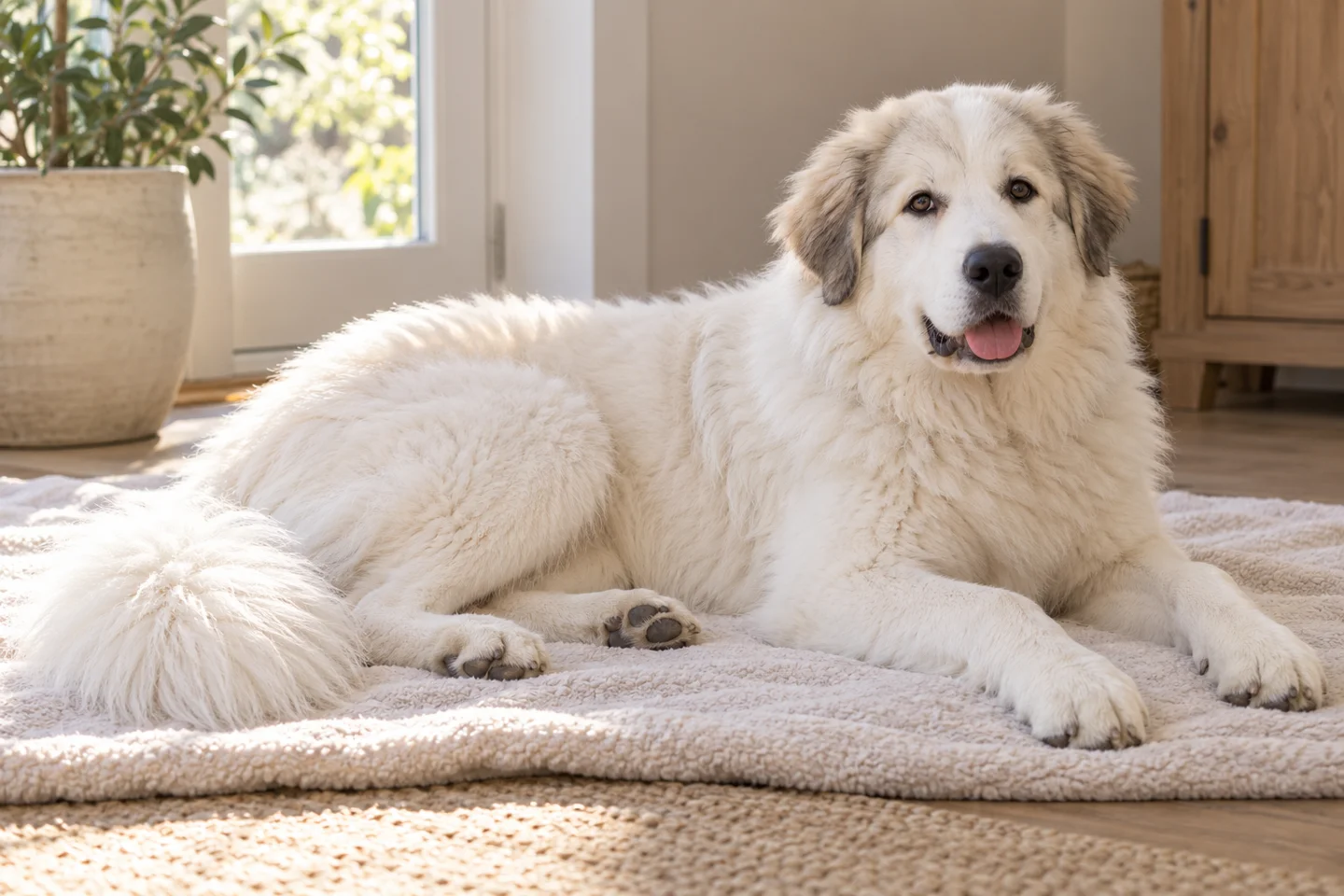
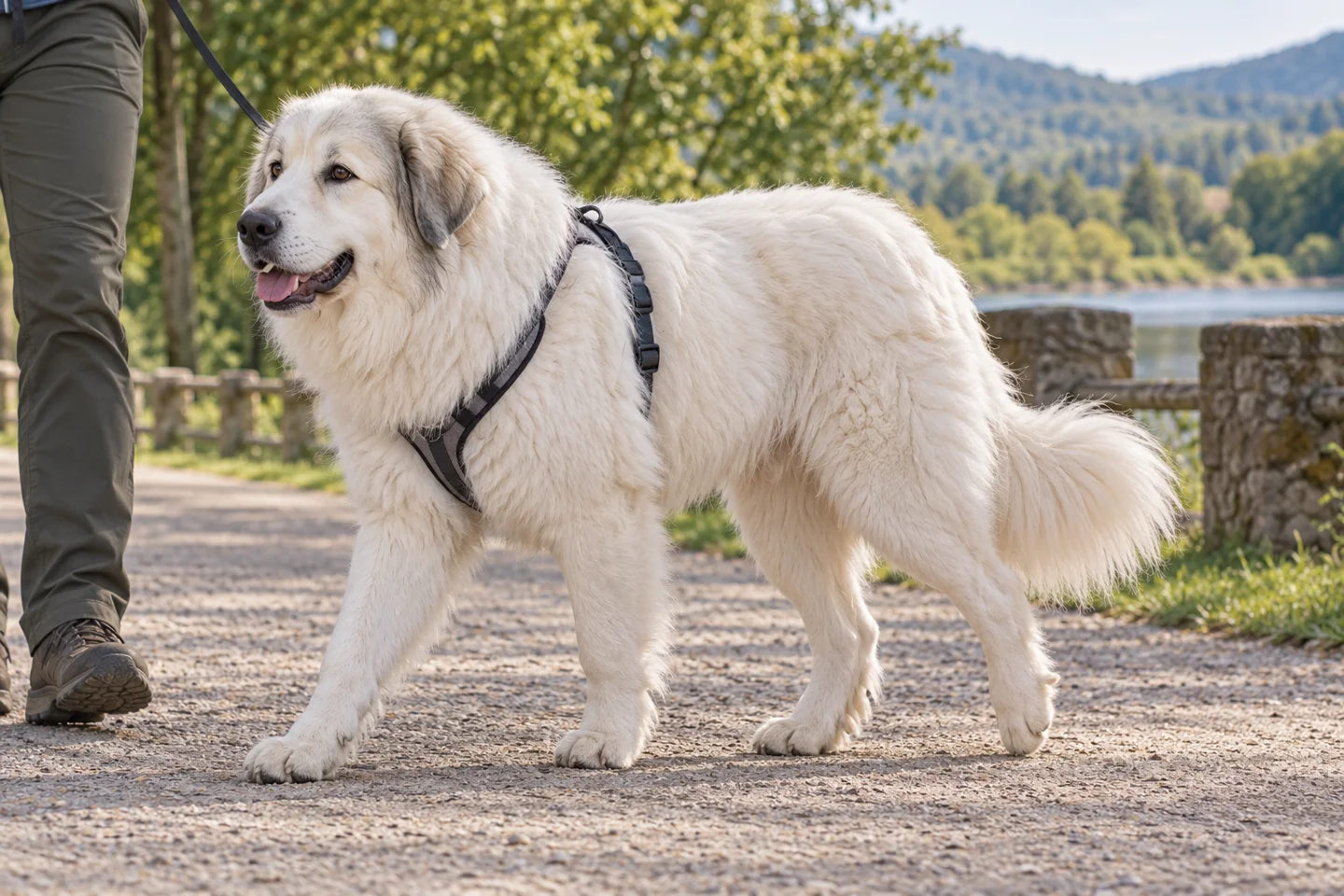
Plan resting and travel space around the individual adult. It should be able to lie comfortably without blocking a passage and to turn in its intended vehicle area. Thick hair can hide equipment fit, so part the coat and check straps properly. Consider who could help an injured dog enter a vehicle, and ask your clinic about a suitable method. The physical arrangements also matter during grooming. A stable surface and room for the person to move around the dog can make routine care less awkward than trying to work in a crowded corridor.
Watchfulness, company, and the hours at home
A dog watching the property may appear occupied while still needing regular human contact and a comfortable routine. Ask the source what happens when it is left alone and how it rests after activity. Avoid assuming that independence means indifference to company. A newly placed dog may also react differently after it becomes familiar with its surroundings. Keep observing rather than treating an easy first meeting as a permanent assessment. Explain household working hours, visitors, and other animals clearly during the placement discussion.
Provide a quiet resting option with a clear route away from activity. Teach being behind a gate or in a separate area while the household is calm, before relying on it during a busy arrival. Give the dog something appropriate to do and release it when comfortable. If separation leads to persistent distress, seek help instead of increasing duration by force. Everyone should understand the routine, including the person who answers the door unexpectedly. A plan dependent on one owner's presence may fail precisely when care needs to be delegated.
Voice and boundaries during the evening
Consider how alerting will affect your household and neighbors. Ask to hear adults and find out when this particular dog vocalizes. A guardian watching a boundary may respond to activity after your own day has quietened down. Location matters: an open fence line, a shared path, and animals moving nearby can create different demands. Explain the property's actual layout to the breeder or rescue. Do not count on a single command or a larger garden to resolve every reason for barking.
Where possible, change arrangements that repeatedly produce arousal. A more protected sleeping area or supervised access at particular times may help make a routine manageable. Reward calm responses and teach an alternative before asking for it at the most difficult moment. Persistent noise, panic during absence, or a sudden change calls for professional assessment. Avoid punishment designed only to suppress the sound while leaving its cause in place. People supplying care need to know what the dog is reacting to and how to maintain the agreed arrangement.
Training for willing movement and everyday care
Useful lessons include walking with a handler, leaving a doorway, standing for equipment, and returning from a quiet area. Start while the dog can readily succeed and reward each small response. Cooperation is easier to build when the request has a clear meaning and a predictable outcome. AVSAB recommends reward-based methods. A guardian's independent decision-making does not justify escalating physical confrontation. Ask an instructor to show how to teach the task safely and what an easier version looks like when the dog is not ready.
Practice moving away from interesting events before visitors or animals create high excitement. A turn with you can begin in the garden, then on a quiet route, before becoming part of an arrival routine. Check that all regular carers can use the cues and equipment. A person unfamiliar with the dog should not be expected to drag it from a defended doorway. Keep barriers available while learning develops. Training and management serve different purposes, and a skill successfully practiced yesterday does not make every unfamiliar situation safe today.
Exercise that fits the individual and the weather
Plan regular movement and exploration appropriate to age, health, and conditioning. A Great Pyrenees should have opportunities to investigate beyond the same patch of garden under suitable control. Choose routes with room to leave situations that become difficult. Introduce a new workload gradually and seek veterinary advice during growth, illness, or recovery. Watch how the animal feels afterward, including changes in rising, gait, or willingness to go out. The breed's working background cannot certify that a particular pet is fit for a demanding walk.
Dense hair does not remove the need for heat management. Use cooler conditions, access to water, and a route that can be shortened. If the dog struggles, stop and contact the clinic rather than assuming it will recover by continuing slowly. Plan vehicle waiting and rest stops as carefully as the walk. Ask a groomer and veterinarian about individual coat care rather than adopting a universal shaving rule. The immediate way to reduce an unsuitable heat load is to change the environment and activity, not rely on a cosmetic change to make exertion safe.
Socialization and the difference between familiarity and access
Early experience should let a puppy encounter ordinary life without being overwhelmed. Discuss suitable outings and disease precautions with the veterinary team. Start with quiet observation and enough distance to remain comfortable. Adults with limited history also need small steps. Watching a delivery vehicle from a secure distance can be an initial lesson; receiving a crowd inside the garden is a different demand. Let the dog recover and use observations to plan the next stage rather than relying on a calendar alone.
Familiarity with people does not require unrestricted entry to the property. Teach the household how to organize arrivals and offer a protected waiting area. Visitors should follow the handler's directions and avoid testing whether the animal will accept a hand over a barrier. Practice calm release and movement under controlled conditions. If fear or threatening behavior interrupts ordinary care, arrange appropriate support. A guardian may have long-term limits on particular interactions, and the owner needs to maintain those limits consistently. Be candid about them when arranging visitors or outside care.
Aggression must be described without romantic labels
Calling a dog protective does not explain a snap, threat, or bite. Record who approached, what space the animal had, the objects involved, and what happened before the response. Prevent another exposure while arranging assessment. A sudden handling problem or altered tolerance of movement deserves veterinary investigation. Do not punish a warning or ask a visitor to repeat the interaction so you can see whether it happens again. The practical responsibility is to protect everyone while the cause and workable options are considered.
Qualified behavior support can help the household assess risk and teach suitable responses using humane methods. Be honest about incidents when seeking help or arranging care. A muzzle may be advised for particular situations, but comfortable conditioning, correct fit, and a broader management plan remain necessary. VCA notes that behavior toward unfamiliar dogs can have several motivations. Removing a restraint to test the dog is not a safe shortcut to understanding them. Distance and reliable barriers should remain available while any learning or treatment plan is developed.
Children, sleeping space, and food
Children need an adult actively supervising contact, regardless of a breed's family reputation. A large guardian also needs a place where a child cannot follow it. Set up that area before a visit or placement, and keep eating and chewing separate from children's activity. Teach children to stop contact when the dog moves away. They should not climb over a resting dog, take an object, or hold its collar. If an adult cannot watch fully, use comfortable separation instead of expecting the child to remember every rule.
Ask about previous experience in specific terms. A dog accustomed to an older child may not have been assessed around infants or energetic play. In a busy household, decide who will handle the dog during arrivals, meals, and visitors. Avoid leaving a young person responsible for enforcing boundaries they cannot physically manage. Report growling or guarding to an appropriate professional without blaming a child or dismissing the event. A clear account allows the household to change the setting and protect future interactions before someone is injured.
Other dogs, cats, and genuine livestock work
A livestock guardian should not automatically be assumed safe with every animal. Ask about observed behavior with the species and circumstances in your home. Keep cats and small animals protected while any assessment is made. With resident dogs, arrange controlled introductions and preserve access to separate resting and feeding areas. Pay attention to the quieter animal's ability to leave. A short successful walk provides useful information, but living together introduces food, space, visitors, and attention that the walk did not test.
If your goal is actual livestock protection, seek experienced guidance before selecting the dog. Ask how it was raised, which stock it knows, and what supervised transition the source recommends. An adult accustomed to one farm cannot be expected to understand a new boundary and every new animal immediately. A pet puppy also needs appropriate development rather than being left to work on instinct alone. When a placement would require separation the household cannot maintain, resolve that problem first. Breed identity cannot compensate for a setting that fails to protect the animals involved.
Grooming down to the skin and around dewclaws
Part the dense coat and work gently through the layers, paying particular attention behind ears, under equipment, and where limbs move. Brushing the visible surface can leave a tangle underneath. Ask a knowledgeable groomer to demonstrate tools and a realistic home schedule. A tight mat near skin needs skilled help rather than hurried scissors. Keep sessions short enough for cooperation, and provide breaks. Check for irritation, trapped debris, or changes that require veterinary attention instead of treating every difficulty as a grooming problem.
Include the rear dewclaws in routine checks and ask the clinic to demonstrate safe nail care. The double dewclaws are a recognized feature of the breed, so discuss the actual anatomy rather than assuming an extra claw is abnormal. Check feet after rough ground, and report a painful or damaged nail. Teach touch while the animal is comfortable and protect a nonslip standing position. If a familiar care step suddenly produces resistance, investigate pain before increasing restraint. Another carer should have clear instructions and know when to stop and call for help.
Health screening and the limits of reassurance
The AKC's current national-club recommendations for Great Pyrenees list patella and hip evaluations. Request identifiable parental results and discuss relevant clinical and family history with your veterinarian. A screening program addresses defined questions; it is not a promise that no other condition can occur. Ask how later diagnoses are shared with owners and what support follows placement. Keep a clear distinction between an examination having been performed, a normal finding, and information that has never been recorded.
For an adopted adult, collect treatment records and arrange a current veterinary plan. Note persistent changes in movement, drinking, appetite, or normal behavior. A thick coat can conceal changes in condition, so learn to assess the body beneath it with professional guidance. A commercial DNA panel covers selected variants and cannot replace clinical investigation. Keep records available across clinics. If the source cannot establish a result, mark it unknown rather than accepting a guess based on a healthy-looking parent or the assumption that a working breed must be medically resilient.
Feeding, emergency access, and ongoing costs
Choose complete nutrition appropriate to life stage and measure the amount actually fed. Include rewards in the plan and review body condition with your veterinary team, especially during growth. The aim is comfortable function rather than maximum bulk. Report sustained appetite or weight changes instead of changing foods repeatedly without a reason. Give helpers precise instructions and make water access reliable. If several animals live together, arrange feeding so that each can eat without pressure and you can see what the individual actually consumes.
Obtain current local estimates for preventive care, grooming help, training, transport equipment, and cover during absences. Check that an available carer can handle the actual guardian and property routine. Maintain a plan for urgent transport if the dog cannot walk. Collapse, severe injury, breathing distress, suspected poisoning, or repeated unsuccessful retching requires prompt veterinary contact. Insurance conditions or another emergency funding arrangement should be understood before a crisis. A breeder or rescue should also explain follow-up and return provisions clearly, so the household knows where support is available if circumstances change.
Mixes and dogsDating meetings with clear boundaries
Great Pyrenees crosses may be described by a second known parent or simply as guardian mixes. These descriptions do not establish a recognized variety or predictable temperament. Confirm what is documented and assess observed behavior, size, and coat needs. A white adult with unknown ancestry can still be evaluated carefully without assigning certainty to its parentage. When both parents are known, ask about relevant health evidence for each. Crossing breeds does not guarantee that every inherited problem or demanding behavior has been removed.
Use dogsDating to explain the walking arrangement your dog can manage. Mention space needs, controlled greetings, and any restrictions around other animals. Share an approximate area while keeping exact coordinates and your home address private. Choose a public route with wide exits and let each adult manage their own dog. Begin with calm parallel movement rather than immediate close contact. Increase distance or finish when either animal cannot disengage comfortably. A familiar partner for quiet walks can be a worthwhile match, with no expectation that the guardian must share toys, territory, or physical play.
Sources and editorial notes
Sources checked October 21, 2026. Breed measurements describe reference ranges, not a diagnosis or an individual dog's ideal weight. Images are AI-generated breed illustrations and do not document a particular dog or health condition.
- AVSAB: Humane Dog Training Position Statement
- VCA Animal Hospitals: Food aggression in puppies
- VCA Animal Hospitals: Common emergencies in dogs
- Orthopedic Foundation for Animals: CHIC health screening programs
- VCA Animal Hospitals: Aggression toward unfamiliar dogs, diagnosis
- VCA Animal Hospitals: Grooming and coat care for your dog
- AAHA: Feeding plans for healthy, appropriate weight cats and dogs
- VCA Animal Hospitals: Heat stroke in dogs
- AVSAB: Puppy Socialization Position Statement
- VCA Animal Hospitals: Dog behavior problems, aggression toward children
- Official breed standard: Great Pyrenees
- American Kennel Club: Working Group Health Testing Requirements
Keep getting to know dogs.
Read another guide or return to your dogsDating community.
Explore breed guidesBack to dogsDating