Greater Swiss Mountain Dog
A substantial Swiss farm breed whose companion care needs adult-size handling, cooperative training, short double-coat maintenance, and informed emergency planning.
How these guides are researched and reviewed
- Origin
- Switzerland
- Adult height
- Males 65–72 cm; females 60–68 cm
- Coat
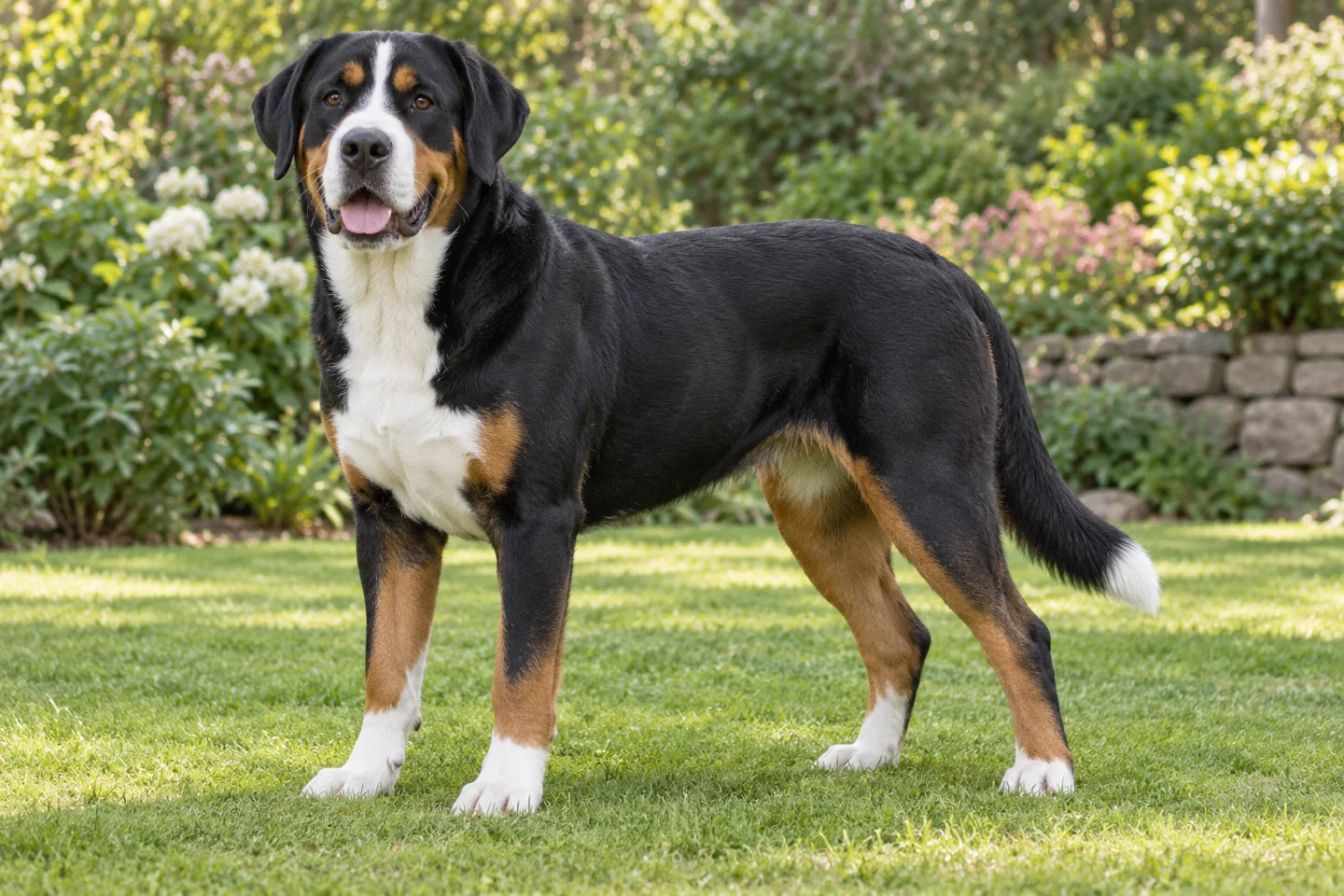
- Black, rust and white double coat; distinct from the long-coated Bernese
General information for owners. These articles have not been reviewed by a veterinarian. Medical decisions need your dog's history and an examination.
A Swissy is a substantial household responsibility
The Greater Swiss Mountain Dog, often called a Swissy, needs a home prepared for an adult with strength as well as size. Think through a normal arrival, a walk past another animal, and a veterinary visit before choosing a puppy. Who will manage the lead when the usual handler is ill? Can the dog rest without blocking a doorway? Are transport and emergency assistance available? These questions concern the routine you can provide, rather than whether a tricolor puppy fits comfortably on the sofa today.
The breed is separate from the Bernese Mountain Dog, Appenzeller Sennenhund, and Entlebucher Mountain Dog. Their family resemblance does not make their size, coat, and screening needs interchangeable. Ask a source to use the correct name and provide relevant records. Meet adult Swissies in a setting that allows you to observe ordinary behavior. A calm presentation is useful, but also ask about excitement at meals, visitors, and other dogs. Knowing what happens outside a carefully arranged first meeting helps you judge whether the household can manage the individual.
Farm work and the modern breed
The FCI describes the breed's earlier work in watching, hauling, and farm life. Its history records Albert Heim identifying examples at Langenthal in 1908, separate Swiss recognition in 1909, and a breed club in 1912. That account gives context for the modern dog's substantial build. It does not establish that a pet should pull weight without preparation or that inherited farm work automatically teaches manners around today's traffic, visitors, or household equipment.
Ask what the family or adopted dog actually does now. A dog raised with regular outdoor work may need new lessons about relaxing in a busy house. One raised as a companion can still enjoy appropriate structured activities. If you intend to pursue hauling or another sport, discuss growth, health, equipment, and instruction with qualified people before starting. Avoid placing a load on an inexperienced dog because its ancestors performed a similar task. The individual needs suitable conditioning and a handler who can recognize when the activity should stop.
Size, markings, and the shorter double coat
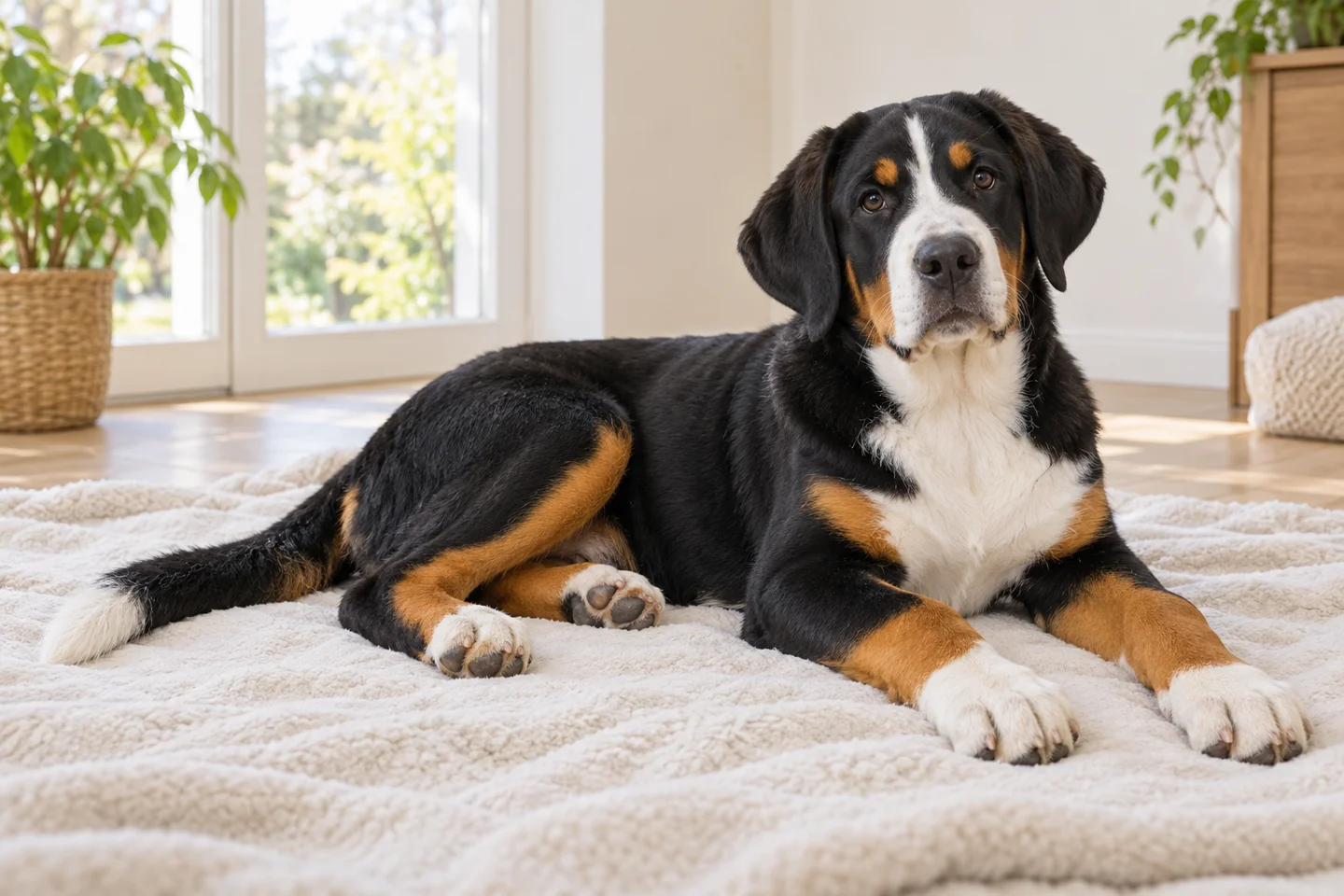
FCI adult heights are 65 to 72 centimeters for males and 60 to 68 for females. The recognizable coat has a black base with rust and white markings and a dense undercoat. It is shorter than the Bernese coat; the breed is not a clipped Bernese. The illustrations show natural hanging ears and a full tail. They provide general visual context and cannot establish pedigree, movement, or health. Assess the animal in front of you and use actual measurements when selecting equipment.
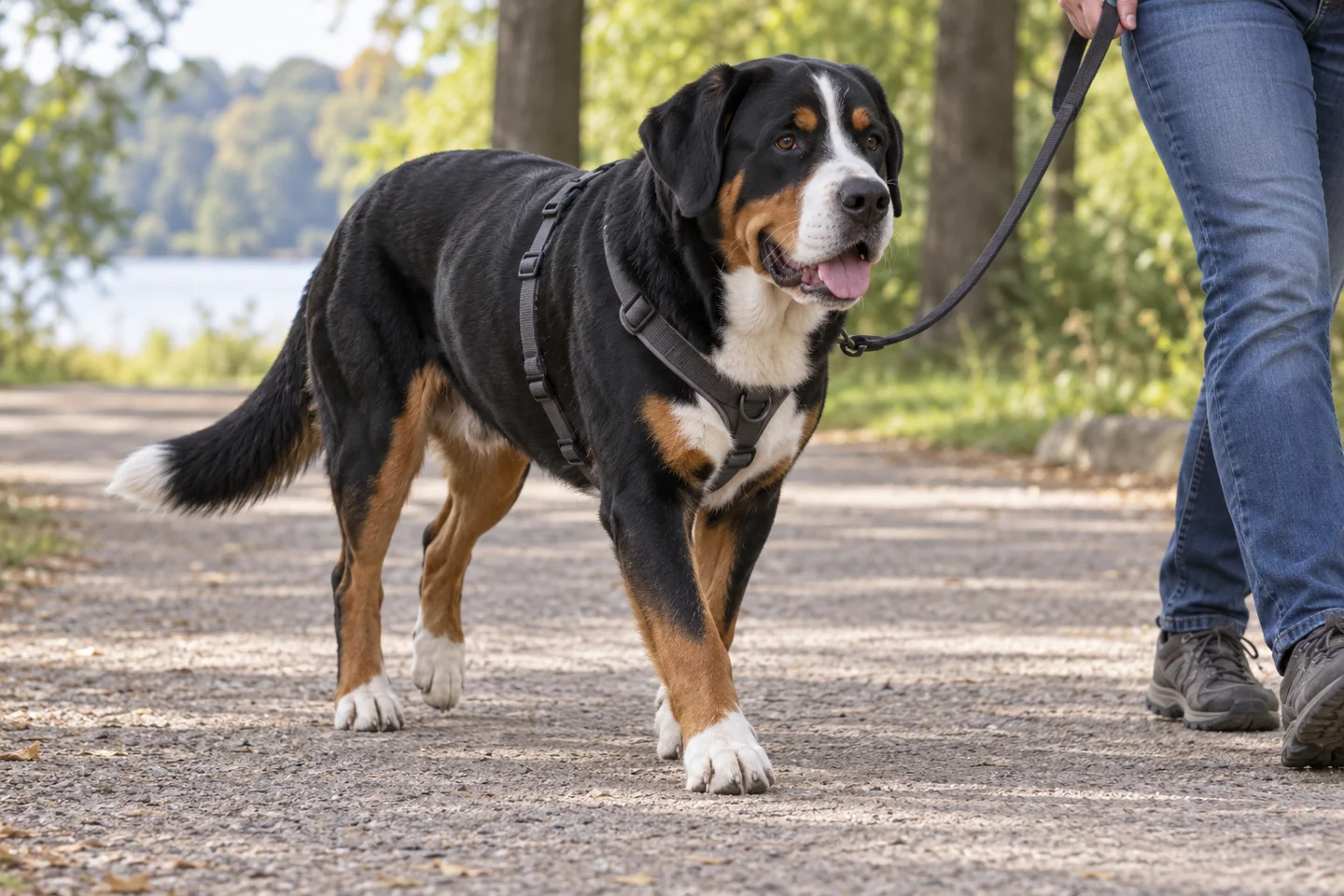
A substantial chest and body require a harness that sits comfortably rather than one chosen only by neck size. Check straps under the forelegs and review fit as a puppy grows. Look at the route through the house and vehicle from the adult dog's perspective. It needs room to turn and settle without repeated contact from passing people. Ask about safe assistance if mobility changes. A strong young adult may enter a car easily, while an older or injured dog needs a loading plan the household can provide without improvising a painful lift.
Company and learned quiet behavior
Ask how the dog spends an ordinary quiet afternoon. A devoted companion can still need help learning to rest while people work or leave briefly. Find out what routines have already been observed and which are predictions. In a new home, make the first days understandable: a clear resting place, predictable outside access, and small amounts of unfamiliar activity. Keep a note of what causes repeated arousal or distress so the next change can address an actual problem rather than a broad assumption about temperament.
Decide which behavior you want when meals are prepared or a caller arrives. Reward a manageable alternative before the dog becomes excited. Everyone should follow the same routine so the dog is not being invited to jump one moment and pushed away the next. A gate can help organize movement, but comfortable separation should be taught gradually. If the dog repeatedly panics when alone, seek professional guidance. More physical exercise may be useful for some routines, but it cannot be assumed to treat every reason an animal struggles to settle.
Training that remains usable as strength increases
Prioritize walking with a handler, waiting at exits, returning from a quiet distraction, and standing for care. Begin with tasks small enough for the dog to succeed and reward the response clearly. AVSAB supports reward-based methods and advises against aversive techniques. A strong breed does not require painful handling to learn. Choose a professional who explains the lesson and can show how the regular carer should practice it, including an easier version when the animal is currently too distracted.
A useful threshold lesson includes what happens after the pause. Open a gate under control, release to a permitted area, and practice returning without turning every approach into the end of an enjoyable activity. Rehearse a direction change before a crowded walk demands it. The person providing care during holidays also needs to understand the cues and equipment. Avoid relying on a particular owner's physical strength as the entire management plan. Skills taught well, suitable barriers, and sensible distances remain valuable even when the dog usually appears willing and affectionate.
Exercise and suitable working activities
Give the Swissy regular opportunities for movement, exploration, and learning at an appropriate level. The exact routine depends on age, condition, health, and previous activity. Discuss growth and any sport plans with the veterinary team. A puppy does not become ready for adult workload simply because it looks large. Watch its movement and recovery, and report persistent stiffness or reduced willingness rather than labeling it lazy. A dog still eager to accompany people may need the owner to make the decision to shorten an outing.
Consider weather and surfaces before setting out. Keep water and a shorter route available, and change the plan in heat rather than trying to finish a predetermined distance. For structured work, get instruction in the equipment and conditioning actually needed. A video of an accomplished adult cannot establish readiness in a novice. Rest and comfortable sleep belong in the routine as well. Review what happened later that day and the next morning so that the next session follows the individual's response rather than an imagined breed-wide exercise requirement.
Aggression, guarding, and new sensitivity
A Swissy that growls over a resting place or snaps during a foot check needs a clear account and a changed arrangement. Write down the setting, approach, available space, and what happened afterward. Prevent further attempts while advice is sought. New sensitivity can have a medical cause, so tell the veterinary team about changes in movement or tolerance of touch. Do not ask someone to repeat an unsafe interaction to produce a video, and avoid punishment aimed at removing a warning without understanding it.
For behavior toward unfamiliar dogs, maintain appropriate distance and seek qualified assessment. VCA explains that reactions can involve different motivations; lunging does not prove friendliness or establish a single diagnosis. A carer should know the observed incidents and the management needed. If a professional recommends muzzle conditioning, ask about fit, gradual teaching, and the situations in which it is useful. It remains one part of a wider plan. Reliable barriers and responsible handling are necessary when people or animals could be injured by a repeat event.
Children, visitors, and a large dog at rest
Organize greetings so a child or unsteady visitor is not caught in an excited dog's path. An adult should manage the animal, and a protected resting area should remain available afterward. Children need active supervision and must be kept away from feeding, chewing, or sleeping dogs. They should not be expected to move the Swissy by its collar or take an object away. If the supervising adult needs to concentrate elsewhere, separate comfortably rather than depending on the child to manage a difficult moment.
Ask about previous household experience in specific terms. A relaxed adult beside older children has not necessarily been assessed around a toddler's movement or noise. Plan where the dog waits while a visitor enters, and practice that routine before a busy occasion. Explain it to guests so they do not release a gate or encourage jumping accidentally. An affectionate history does not remove the need to observe the current situation. Make it easy for both the people and dog to obtain space without anyone needing to win a physical contest.
Living with dogs and smaller animals
Introduce a potential canine housemate with enough room for both handlers to leave calmly. Keep shared resources out of the first encounter and maintain separate feeding and rest areas as the relationship develops. A successful greeting does not establish how the animals will share narrow spaces or attention. Observe the less assertive dog and preserve access to its own carer. Play that repeatedly overwhelms a smaller or older animal needs interruption, even when the stronger dog continues to appear enthusiastic.
Find out about cats and other species separately. Maintain secure protection while the household assesses whether contact is appropriate. A quick look through a barrier does not guarantee safety during free movement. Do not stage a chase or hold a small animal near the dog's face to test its response. If the placement requires separations you cannot maintain reliably, discuss that before committing. The correct decision may depend more on the individual dog's history and the home's practical arrangements than on a general description of the breed.
Grooming and routine body checks
The shorter double coat still sheds and needs gentle inspection. Use suitable tools and check the skin beneath straps, around feet, and where the dog rests. A tidy surface cannot rule out irritation underneath. Ask a groomer or veterinary professional to demonstrate nail and coat care you can perform safely. Work on a nonslip surface, reward cooperation, and keep sessions manageable. A painful mat, embedded object, damaged nail, or persistent sore deserves professional attention rather than more determined home treatment.
Observe ears for odor, redness, discharge, or repeated head shaking. Have the clinic assess a problem and demonstrate any cleaning it recommends. Do not insert cotton buds deeply or reuse medication simply because an earlier episode looked similar. Teach brief ear lifting and foot touch when comfortable, then release. Sudden resistance to a familiar action may indicate pain. Keep carers informed about affected areas and any restrictions so a routine inspection does not turn into an avoidable confrontation. Comfortable access to care is an ongoing skill, not a one-time puppy achievement.
Health screening should include the shoulders
The AKC's current national-club list for Greater Swiss Mountain Dogs includes hip, elbow, ophthalmologist, and shoulder evaluations. Ask for identifiable reports and the actual findings. A buyer looking only for a hip result could overlook another recommended assessment. Discuss the age and method involved and ask how significant later diagnoses are shared. A performance record, attractive pedigree, or routine puppy examination cannot supply the same evidence as the specific recommended screening.
Read certificates as information, not guarantees. OFA explains the role of breed-specific screening and publicly available results. Completion does not establish that every finding was normal or that the animal will remain free from illness. Your own veterinarian needs current history and examination findings. With an adult rescue, document missing parental information honestly and investigate present symptoms. Persistent lameness, altered coordination, unusual fatigue, or changes in drinking and urination deserve assessment even when the dog comes from a family described as active and healthy.
Breed health concerns and urgent abdominal signs
The Greater Swiss Mountain Dog Club of America discusses orthopedic problems, epilepsy, urinary incontinence, and splenic torsion among its health concerns. These topics are reasons to ask informed questions, not a basis for diagnosing a dog at home. Ask about relevant family history and the veterinary work already performed. Repeated urinary leakage, a suspected seizure, or new mobility difficulty should be described to the clinic. Avoid assuming a behavior problem or using another animal's treatment before the cause has been investigated.
Splenic torsion involves twisting of the spleen's blood supply and can be life threatening. The American College of Veterinary Surgeons provides information for owners. Sudden collapse, marked abdominal pain, pale gums, or other severe illness requires urgent veterinary contact; repeated unsuccessful retching is also an emergency warning. Tell the team that the dog is a Greater Swiss Mountain Dog and describe the onset. Do not wait for an online diagnosis or assume an earlier gastropexy rules out every abdominal emergency. Keep transport and a receiving clinic planned in advance for a large dog unable to move comfortably.
Feeding, costs, and commitments after placement
Discuss suitable complete nutrition and measured portions with the clinic, particularly during growth. Keep track of rewards and monitor condition beneath the coat. Feeding toward maximum size or adding supplements without a clinical reason can undermine a sensible plan. Make instructions clear for helpers and report persistent appetite, digestive, or weight changes. An individual diet plan also needs revision when activity, age, or health changes. The breed's name does not determine one fixed food amount for every adult or a reason to dismiss a new symptom.
Get current local estimates for preventive care, training, transport equipment, and cover when you are away. Ask services directly about handling a large adult and any medical or behavior restrictions. Understand insurance terms or another way to fund urgent care. A responsible source should explain follow-up, known health information, and return arrangements in writing. If your household's ability to provide care depends on one unconfirmed service, resolve that uncertainty before placement. Planning also includes the help needed later if the dog becomes less mobile or requires regular treatment.
Mixes and dogsDating companions
A Swissy cross may be named for the other claimed parent or described as a tricolor mountain-dog mix. These are ancestry descriptions of varying certainty, not recognized Greater Swiss varieties. Ask which parentage is documented and assess actual behavior and dimensions. For a puppy, make room for uncertainty in mature coat, size, and care. Review relevant health evidence for both known parents. A cross cannot promise automatic freedom from inherited disease or produce only the most convenient characteristics associated with each family.
On dogsDating, tell a prospective partner about your dog's pace, size, and preferred distance. Use an approximate area and public meeting point while keeping exact coordinates and your home address private. Each adult should manage their own dog. Start with quiet parallel walking and leave shared toys or food activities for another decision. Watch for a dog trying to leave or becoming too aroused to respond. End or increase space when necessary. A compatible familiar walker can be a useful match without expecting close play or shared access to the home.
Sources and editorial notes
Sources checked October 21, 2026. Breed measurements describe reference ranges, not a diagnosis or an individual dog's ideal weight. Images are AI-generated breed illustrations and do not document a particular dog or health condition.
- AVSAB: Humane Dog Training Position Statement
- VCA Animal Hospitals: Food aggression in puppies
- VCA Animal Hospitals: Common emergencies in dogs
- Orthopedic Foundation for Animals: CHIC health screening programs
- VCA Animal Hospitals: Aggression toward unfamiliar dogs, diagnosis
- VCA Animal Hospitals: Grooming and coat care for your dog
- VCA Animal Hospitals: Ear infections in dogs (otitis externa)
- AAHA: Feeding plans for healthy, appropriate weight cats and dogs
- VCA Animal Hospitals: Heat stroke in dogs
- AVSAB: Puppy Socialization Position Statement
- VCA Animal Hospitals: Dog behavior problems, aggression toward children
- Official breed standard: Greater Swiss Mountain Dog
- American Kennel Club: Working Group Health Testing Requirements
- Greater Swiss Mountain Dog Club of America: Health Concerns
- American College of Veterinary Surgeons: Splenic Torsion
Keep getting to know dogs.
Read another guide or return to your dogsDating community.
Explore breed guidesBack to dogsDating