Hokkaido
A sturdy Japanese hunting spitz whose care needs secure exploration, patient handling, eye-health records, and introductions shaped around the individual.
How these guides are researched and reviewed
- Origin
- Japan
- Adult standard size
- Males 48.5–51.5 cm; females 45.5–48.5 cm
- Illustrated coat
- Red double coat
General information for owners. These articles have not been reviewed by a veterinarian. Medical decisions need your dog's history and an examination.
A Japanese hunting spitz in a companion home
The Hokkaido is a sturdy Japanese dog with a hunting background, a thick coat, and a useful capacity for sustained activity. Anyone considering one should look beyond the upright ears and curled tail. The important questions concern secure walking, responses to wildlife, comfort with handling, and the care available during an ordinary working week. Ask to meet adults and discuss the particular family being bred. An attractive puppy picture cannot show how an adult will respond when a fox crosses the path or a visitor enters a narrow hallway.
The FCI places the breed among Asian spitz and related dogs. Its historical account connects it with the Ainu people and describes its use for hunting bears and other animals. Ainu-ken is a historical name for the Hokkaido, rather than a separate crossbreed. Treat broad origin stories cautiously where the standard itself uses uncertain language. The relevant modern question is how a dog from that background has been raised and assessed. Ask what environments the parents know, what their handlers find difficult, and how puppies learn about life outside the breeder's property.
Adult size and the outline beneath the coat
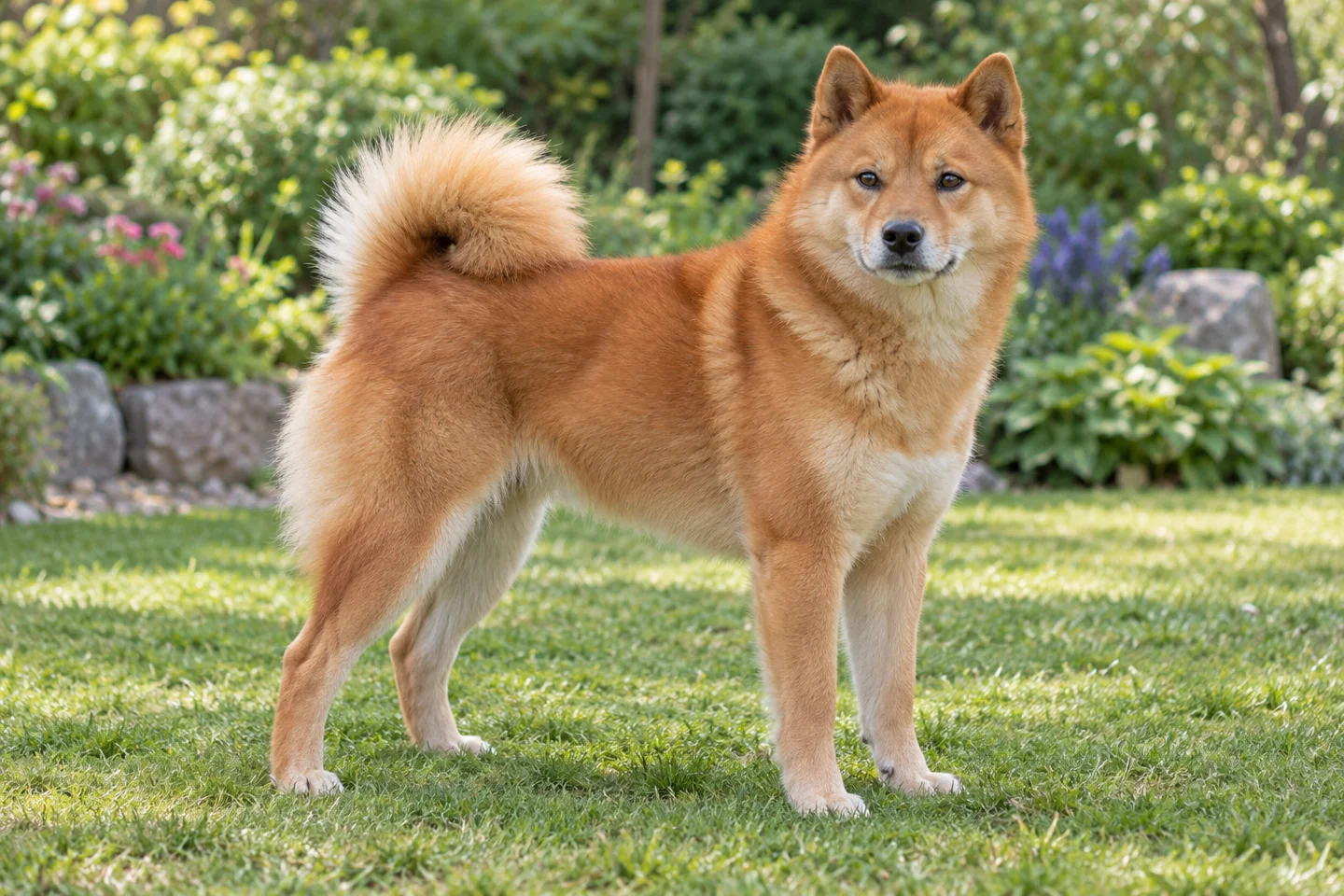
FCI adult height ranges are 48.5–51.5 cm for males and 45.5–48.5 cm for females. The standard describes a medium-sized, well-boned animal with a body slightly longer than its height, a wedge-shaped head, small pricked ears, and a substantial tail curled or curved over the back. Our illustrations use red, one of several accepted colors. The coat has a harsh straight outer layer and dense softer undercoat. These references help explain the breed's appearance; they cannot establish pedigree or health from an image.
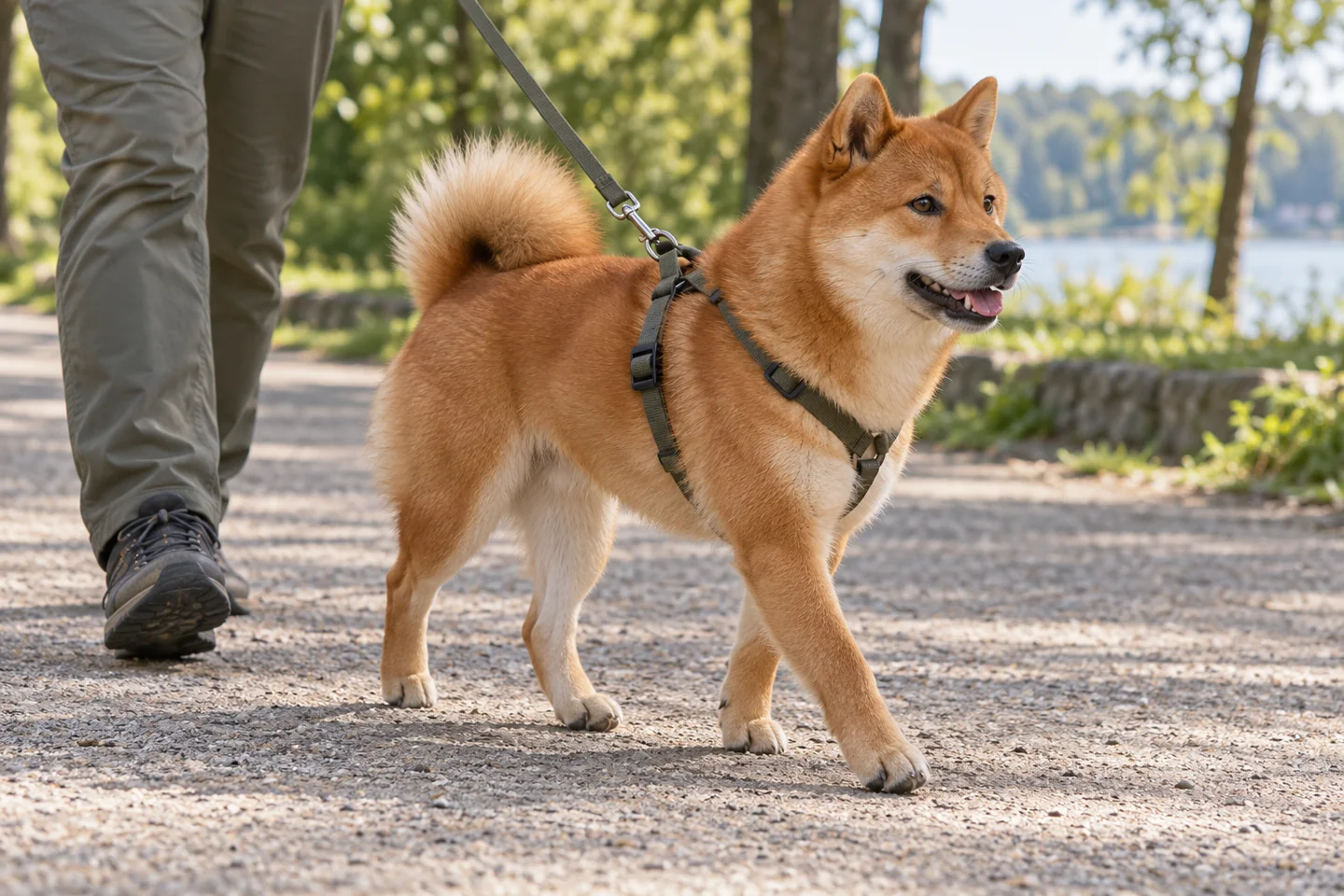
Fit equipment around the actual dog, allowing for coat thickness without leaving an escape gap. Check the chest, neck, and position behind the elbows with someone who understands harness fit. A secure fastening is especially important when an unfamiliar sound produces a sudden backward movement. Measure the animal for its travel space and bed rather than buying by breed label alone. If a puppy grows rapidly or changes shape, reassess equipment. A veterinary body-condition check is more useful than adding food to reproduce the bulky silhouette of a heavily coated adult photograph.
Temperament needs specific examples
Ask a breeder how the adults behave when they are interested, disappointed, or surprised. Descriptions such as faithful and alert tell you the intended type, but they leave practical questions unanswered. Can a dog rest while someone moves around the kitchen? Does it remain comfortable when a familiar carer steps outside? What happens when a stranger stops near the gate? Seek accounts of actual events and notice whether the source can describe how the dog recovered after something difficult. A calm appearance during one visit is only a small part of that information.
Set up the home so that the first days require few difficult decisions. Give the Hokkaido a quiet bed, predictable access to toileting, and a secure area where visitors cannot approach without your involvement. Invite contact rather than leaning over it or repeatedly reaching for its collar. Keep handling brief and useful. If it chooses distance, let that choice work. A dog that can move away has less reason to escalate its efforts to end an interaction. Explain the arrangement to everyone in the household before a busy arrival or family gathering changes the routine.
Training that makes outdoor choices manageable
Reward-based lessons should begin where the dog can pay attention. Teach responding to a name, turning with the handler, and approaching for a reward before asking for those skills near moving animals. Break a return into manageable stages: orienting toward you, moving closer, and arriving comfortably. A suitable long lead in an appropriate open space can support practice, but it needs thoughtful handling to avoid tangles and sudden stops. Ask an instructor to demonstrate rather than attaching extra length and assuming it solves every control problem.
AVSAB recommends reward-based methods for everyday learning and behavior problems. Physical confrontation is especially unhelpful when the task already involves pressure around equipment, possessions, or unfamiliar people. If the dog repeatedly fails, inspect the situation. Perhaps the reward is inaccessible, the other animal is too close, or the lesson has continued after the dog needs a break. Change one manageable part and try an easier version. Keep a small record of progress so another household member knows which cues are ready for daily use and which still require a quiet practice setting.
Exercise with safe boundaries and recovery
A Hokkaido needs opportunities to move and investigate within limits its owner can maintain. Plan walks that offer scent, changes of direction, and room to step aside. An enclosed area may allow freer movement when the fencing and entrances are suitable, but inspect it before use. Do not assume a previous dog's success proves that a gate, gap, or boundary will contain this one. Keep the animal under control around wildlife and livestock. Following scent and looking at movement can be enjoyable parts of a walk without allowing a chase.
Match the work to current age, conditioning, and health. Discuss sustained running or demanding sport with your veterinarian, particularly during growth. Notice the response afterward: stiffness, reluctance to rise, or an unusual loss of interest deserves attention. The thick coat also makes sensible weather planning necessary. Cold-weather ancestry does not protect a dog from overheating during unsuitable exertion. Carry water, choose cooler conditions when needed, and stop if the dog shows distress. Contact a veterinarian promptly if heat exposure produces concerning signs instead of waiting to see whether enthusiasm returns.
Socialization at a tolerable distance
For puppies, ask the veterinary team how to provide useful exposure while managing local infectious-disease risk. Social learning can include watching ordinary traffic from a quiet place, hearing household appliances at a low intensity, and meeting a calm person who will respect distance. It does not require the puppy to be passed between strangers. End an outing while the animal remains able to explore and recover. If it stops taking interest, attempts to hide, or cannot disengage from something frightening, reduce the difficulty and arrange professional advice when the pattern persists.
An adult joining a new household needs its own introduction to the area. Start with a small number of predictable routes and visitors. Ask the previous carer about transport, veterinary visits, and responses to other dogs, then test unfamiliar arrangements gradually. A dog that was comfortable in a rural yard may find a communal lift or busy pavement quite different. Plan those transitions before moving day where possible. Write down what helped, such as a quieter entrance or additional distance. That gives future carers a usable routine rather than a vague request to socialize the dog more.
Aggression and bite prevention in daily situations
Any Hokkaido can react aggressively under particular conditions. A breed description cannot clear an individual as safe. If the dog stiffens over food, growls when touched, snaps at a visitor, or lunges at another animal, prevent the situation from recurring while you seek advice. Note what happened immediately beforehand and whether there was room to leave. Do not recreate an incident for a video or ask a confident friend to prove that the animal will accept them. Accurate information and effective separation are more useful than another risky trial.
Arrange veterinary assessment for new or escalating behavior, particularly where movement or touch has become uncomfortable. A qualified behavior professional can help evaluate the pattern and build a practical plan. Avoid punishing a warning or removing possessions by force. Teach exchanges for safe items during low-pressure practice and leave meals undisturbed. A conditioned basket muzzle may be useful if a professional recommends it, but fit, ventilation, and gradual teaching matter. It adds a precaution within a wider management plan; it does not make forced greetings or painful handling acceptable.
Children need space and active adult supervision
Make the dog's resting area inaccessible to young children. A child should not follow a retreating Hokkaido, hug it, climb onto its bed, or touch it while it eats or chews. Adults need to supervise contact closely enough to intervene early. When attention is divided by cooking, a phone call, or another child, use a secure gate or separate comfortable rooms. Explain the plan to visiting families before they arrive. Expecting a young child to interpret every warning signal places responsibility where it cannot safely be managed.
Choose shared activities with a clear adult role. An adult can hold the lead while an older child helps identify a quiet route or prepares a simple search away from the dog. Stop before excitement becomes chasing or grabbing. A history of living with children needs detail: ages, settings, and any incidents matter. Comfort around one familiar teenager does not establish readiness for a toddler's sudden movements. If the source lacks that information, preserve the uncertainty and choose a placement plan that protects both child and dog rather than relying on a reassuring breed stereotype.
Other animals and the limits of an introduction
Discuss the Hokkaido's hunting history honestly when planning a home with cats, birds, rabbits, or other small animals. Ask about the individual's observed responses and the circumstances in which they were assessed. A quiet look through a barrier does not predict what happens when a smaller animal runs. Keep reliable separation where needed, provide protected escape routes for a resident cat, and avoid making a chase the test of compatibility. Some combinations may require permanent management or a different placement. Make that decision before a preventable incident narrows the available options.
For another dog, arrange an initial walk with separate adult handlers and enough space to turn away. Avoid starting at a doorway, in a cramped vehicle, or beside a bowl. Notice whether either animal seeks more distance or becomes persistently fixed on the other. The goal is comfortable coexistence, which may involve walking without direct contact. At home, manage food and resting areas separately at first. Review play by what both animals choose to do, not simply by whether the larger or more persistent dog appears to enjoy it.
Grooming a dense double coat
Learn to part the coat and inspect down to the skin. Loose undercoat can accumulate while the outer surface still looks tidy, particularly around the rear, neck, and places where straps sit. Ask a groomer to demonstrate appropriate tools and a gentle method. Work in short sessions on a secure surface, giving the dog time to adjust to brushing in unfamiliar areas. Do not drag a comb through a tight tangle. Seek skilled help for mats close to skin and avoid scissors where the skin's position cannot be seen.
Check after muddy or grassy walks for trapped debris and sore areas. Bathing and drying should suit the actual coat and skin, with professional guidance if irritation or recurrent problems occur. Persistent odor, hair loss, redness, or discomfort needs veterinary attention. A heavy coat should not hide an untreated patch because the dog resists inspection. Teach cooperative handling when comfortable, then arrange necessary clinical care if pain interrupts the process. Keep notes about products and reactions so the next groomer or clinician can distinguish a new change from something that has happened repeatedly.
Health records and Collie eye anomaly
The Hokkaido Association of North America lists hip evaluation, cardiac evaluation, a CAER eye examination, and a Collie eye anomaly DNA test among its mandatory pre-breeding clearances. Those are the requirements of that organization, not a claim that every international registry has identical rules. Ask the source which program it follows and request identified reports. The club also discusses optional evaluations. Completion of testing and a normal result are separate questions, so read the findings with veterinary help where interpretation is unclear.
Collie eye anomaly is a specific inherited eye concern discussed by the club and in veterinary research on Hokkaido dogs. Ask about both the relevant DNA findings and clinical eye examinations. Do not decide visual function from eye color, confidence on a familiar path, or an online photograph. Avoid turning small historical studies into a precise prediction for today's entire breed population. If your dog develops a change in navigation, eye appearance, or response to light, arrange examination. Preserve missing ancestry information honestly in an adopted adult and plan care from current findings.
Feeding and routine clinical care
A complete diet appropriate to life stage provides a useful starting point. Ask your veterinary team to assess portions alongside weight, body condition, and activity. The volume of a thick coat can obscure weight change, so learn how to check the body beneath it. Include rewards in the daily food record and keep instructions consistent between carers. Avoid adding supplements merely because the breed has a working history. A growing puppy and an older companion require different decisions, best made from the individual's condition and the diet actually being fed.
Keep ear, nail, mouth, and preventive-care plans practical. Report persistent scratching, head shaking, discharge, altered chewing, or sensitivity rather than applying leftover medication. For an emergency, have the clinic number and transport arrangement ready. Collapse, serious breathing difficulty, suspected poisoning, or severe injury needs urgent veterinary contact. Tell the clinic about any handling concern before arrival so care can be planned. Screening paperwork remains useful, but it cannot explain every new symptom. A dog with apparently favorable family results still needs assessment when ordinary behavior or physical function changes.
Mixes, sourcing, and the cost of everyday support
A Hokkaido mix is not a recognized Hokkaido variety, and appearance alone cannot establish its parents. Ask which ancestry is documented and what was guessed. If both parents are known, discuss health information relevant to each rather than assuming a cross removes all inherited risk. An adult's actual size, coat, behavior, and handling needs may be clearer than predictions made about a young puppy. Keep that evidence central when deciding whether the household can provide a suitable life.
Budget for food, preventive care, training, equipment that fits, grooming help, and suitable care when you travel or work. Obtain local quotes and read insurance conditions; a general online price cannot represent every location or medical history. Ask a breeder or rescue what support continues after placement and what happens if the match fails. Review records and agreements before handover. If ordinary care would depend on a sitter who is uncomfortable with the dog, resolve that gap first. A workable support network matters as much as enthusiasm for a rare breed.
dogsDating introductions for a Hokkaido
Describe your own dog's preferences in its dogsDating profile. State whether it needs a quiet route, additional space from wildlife, or gradual introductions to unfamiliar dogs. Avoid promising that a breed label guarantees friendliness. Share an approximate area and agree on a public meeting point while keeping your home address and exact coordinates private. Confirm that each adult can manage their own animal and choose a place with room to walk apart. A narrow entrance crowded with waiting dogs is a poor setting for finding out whether a meeting feels comfortable.
Begin by walking in the same direction at a distance that allows both dogs to respond to their handlers. Leave shared toys and food games for another decision. If either animal repeatedly turns away, stiffens, or cannot disengage, increase space or finish the outing. Afterward, record something useful for next time: the quiet section worked, a passing animal changed the response, or walking without greeting was enough. A successful connection may be a familiar companion for calm walks. Direct play is optional, and ending early can preserve a better experience for a later meeting.
Sources and editorial notes
Sources checked October 21, 2026. Breed measurements describe reference ranges, not a diagnosis or an individual dog's ideal weight. Images are AI-generated breed illustrations and do not document a particular dog or health condition.
- AVSAB: Humane Dog Training Position Statement
- VCA Animal Hospitals: Food aggression in puppies
- VCA Animal Hospitals: Common emergencies in dogs
- Orthopedic Foundation for Animals: CHIC health screening programs
- VCA Animal Hospitals: Aggression toward unfamiliar dogs, diagnosis
- VCA Animal Hospitals: Grooming and coat care for your dog
- VCA Animal Hospitals: Ear infections in dogs (otitis externa)
- AAHA: Feeding plans for healthy, appropriate weight cats and dogs
- VCA Animal Hospitals: Heat stroke in dogs
- AVSAB: Puppy Socialization Position Statement
- VCA Animal Hospitals: Dog behavior problems, aggression toward children
- Hokkaido Association of North America: Hokkaido health
- Fédération Cynologique Internationale: Hokkaido official breed standard
Keep getting to know dogs.
Read another guide or return to your dogsDating community.
Explore breed guidesBack to dogsDating