Hovawart
A German working guardian whose companion life needs deliberate visitor routines, steady training, coat care, and clearly interpreted health records.
How these guides are researched and reviewed
- Origin
- Germany
- Adult standard size
- Males 63–70 cm; females 58–65 cm
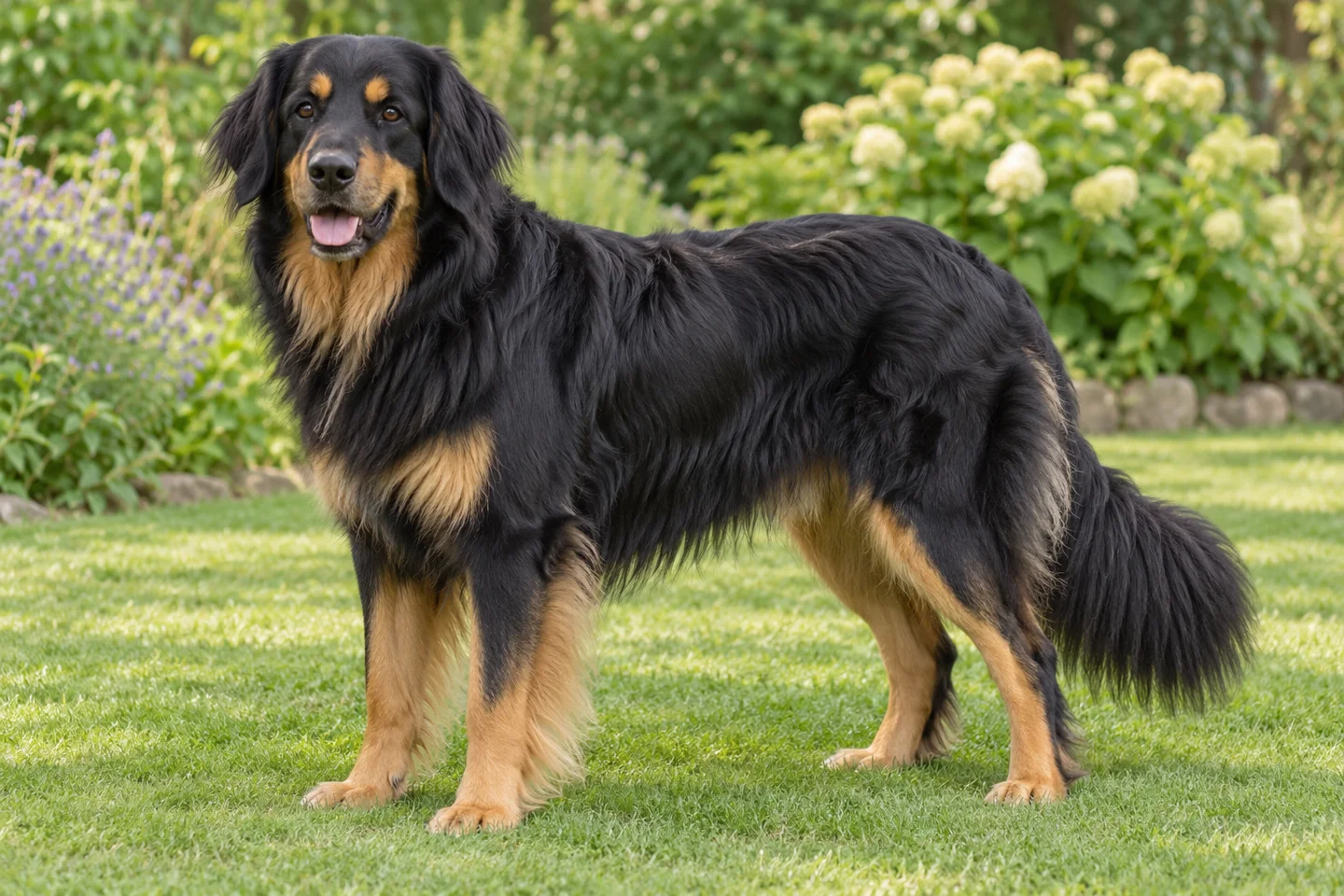
- Illustrated coat
- Black and tan, long and slightly wavy
General information for owners. These articles have not been reviewed by a veterinarian. Medical decisions need your dog's history and an examination.
Living with an estate guardian
A Hovawart needs an owner who can organize arrivals, outdoor activity, and ordinary household boundaries. Its long coat and familiar outline can lead people to expect the same experience they had with a retriever, but a resemblance does not settle temperament or working purpose. Meet adults before choosing a puppy. Ask what happens at the gate, during a repair visit, and when a person the dog does not know reaches toward its owner. Concrete examples help you plan the home and identify skills that will need teaching.
The FCI describes the Hovawart as a German working breed whose name refers to guarding a yard or estate. Its account explains that modern development began in 1922 using farm dogs of the desired type and crosses with other breeds. That is more precise than presenting every modern Hovawart as an unchanged medieval animal. The standard's historical references do not provide a medical guarantee or a prediction of one puppy's behavior. Focus on current relatives, the breeder's selection, and the experiences the individual has had before entering your household.
Adult dimensions and three coat colors
Under the current FCI standard, males stand 63–70 cm and females 58–65 cm at the withers. The body is slightly longer than tall, with a substantial head, hanging triangular ears, and a long bushy tail. Black and tan, black, and blond are recognized colors. The illustrations here use black and tan. Long, slightly wavy hair lies close to the body, with feathering in several areas. An AI illustration can show those general features but cannot assess structure, gait, pedigree, or the condition of a real dog.
Consider those dimensions in relation to your daily route through the house. A large dog resting across an entrance can make a delivery or school departure awkward even without threatening anyone. Provide a comfortable place away from the main traffic and teach access to it before visitors arrive. Check vehicle space, restraint fit, and how you would assist an injured adult without relying on it jumping. Ask your veterinary team about suitable handling. Choosing a puppy does not postpone these questions for long, and selecting for extra bulk creates no advantage for comfortable companion life.
Temperament is also an environment question
The standard's intended working temperament includes confidence, attachment to family, and watchfulness. A home still has to teach the practical meaning of those traits. Decide whether the dog will see a busy pavement through the fence, accompany you to public places, or spend time near frequent visitors. Different settings demand different skills and management. Ask owners how they arrange the ordinary day and what they would change if starting again. An account that includes difficulties is often more useful than a description consisting entirely of favorable adjectives.
Give a new Hovawart time to learn where it can rest and how people move around it. Avoid scheduling a large welcome gathering on arrival. Keep entrances controlled, introduce household members calmly, and let the animal approach without being cornered. Predictable arrangements reduce the number of conflicts you must solve by physically holding the dog. If it appears unable to relax despite reasonable adjustments, consult the veterinary team and an appropriate behavior professional. Rest should become an ordinary household skill rather than something expected only after exhausting exercise.
Training a useful response at the door
Teach movement to a designated resting area with rewards while the house is quiet. Begin with the smallest successful step and release the dog before increasing duration. Later, practice familiar people moving through the entrance while another adult manages the setup. Use a secure barrier when necessary so learning does not depend on catching the collar at the last moment. If a doorbell recording is part of practice, start at an intensity the dog can handle. The goal is a reliable routine with room for mistakes, not a dramatic test of self-control.
AVSAB supports reward-based training and advises against aversive methods. For a strong working dog, teaching cooperation is more useful than making every interaction a contest. Prepare rewards, keep lessons brief, and explain the same cues to other carers. When progress stalls, review whether the task is too long, too close to a trigger, or insufficiently practiced in that location. A class can help if its instructor works within the dog's current abilities and manages spacing. Avoid a setting that deliberately provokes threatening behavior as a demonstration of authority.
Practice the same door routine with the people who will actually provide care. A sitter may carry a bag, wear unfamiliar outdoor clothing, or enter at a different time. Introduce those changes in manageable steps while you are present. Leave written instructions about gates, resting places, and what to do if the dog does not follow the cue. If the arrangement only works for one person under ideal conditions, it needs further preparation before that person travels.
Exercise and practical work without constant arousal
A Hovawart can enjoy tasks that involve finding, following, or learning with its owner. For a companion, that may mean a quiet scent search, an exploratory walk, and a short handling lesson across the day. Formal tracking or another suitable activity requires instruction and conditioning for both partners. It should fit the individual rather than serve as proof that every Hovawart must follow one sport. Ask your veterinarian about exercise during growth, recovery, or a major change in workload.
Make provision for rest and ordinary weeks when ambitious plans are impossible. Identify a safe local route, a simple indoor activity, and a suitable backup carer. Repeatedly raising excitement with fast games may leave the household with fewer opportunities to practice settling. Observe how the animal feels later and report persistent stiffness or unusual fatigue. On hot days, alter the outing before difficulty develops. A long coat cannot replace sensible choices about temperature, exertion, water, and breaks. Stop and obtain veterinary guidance if the dog shows distress after heat exposure or activity.
Socialization that respects the individual
A puppy should learn about normal life through safe, manageable experiences. Discuss local health precautions and appropriate classes with your veterinary team. Visitors can begin by sitting quietly and allowing the puppy to decide whether to approach. Short observations of traffic, unfamiliar surfaces, and calm animals can be planned without forcing contact. The useful measure is how the dog copes and recovers, not how many people have touched it. Reduce intensity if an experience repeatedly produces avoidance, persistent alarm, or difficulty returning to ordinary behavior.
Continue that process as circumstances change. A move from a rural property to a flat introduces different entrances, noises, and encounters even for an adult with a good history. Ask the previous carer what the dog already knows and arrange a gradual transition where possible. If a new environment overwhelms it, seek help before confrontation becomes the daily pattern. Write down workable distances and routines so visitors and sitters can follow them. Saying that a guardian needs socialization is incomplete advice unless the household also knows how to provide it without making the dog feel trapped.
Aggression should lead to assessment and prevention
A Hovawart that blocks a visitor, guards a bowl, or snaps during touch needs a clear account of the event. Do not reduce each situation to protectiveness. Note the location, approach, available retreat, and behavior immediately before the incident. Keep people away from the trigger while arranging advice. A history of previous friendly contact does not justify repeating a risky interaction. Inform the veterinary team about new handling sensitivity or a sudden behavioral change, since physical discomfort can be relevant to assessment.
Qualified behavior help should produce a plan the household can maintain when tired, busy, or dealing with unexpected arrivals. That may include physical separation, alternative routes, gradual teaching, and specific limits on contact. Do not punish growling or deliberately take valued objects to establish control. Rewarded exchanges can be practiced with safe items under appropriate guidance. If a basket muzzle is advised, introduce it positively and check fit and ventilation. It remains one additional measure. A muzzled dog still needs space, comfortable handling, and protection from situations it cannot manage.
Children, visitors, and supervision
A large dog and a small child should not have to negotiate a crowded doorway together. Arrange the entrance so an adult can manage the dog while children come and go. Give the Hovawart a resting space children cannot enter and separate it during meals or valued chewing. Teach children to leave a dog that moves away. Adults need to watch closely enough to prevent grabbing, climbing, or following. When supervision is unavailable, a comfortable physical separation is the appropriate arrangement.
Ask for detailed history when a breeder or rescue describes a dog as suitable for families. Find out which ages it has met, what those meetings involved, and whether any warnings or incidents occurred. A quiet response to a familiar child does not establish that every visiting child can run past or hug it. Offer structured, calm activities where an adult controls the setup. If either participant becomes excited or uncomfortable, stop. Planning for the dog and child to have time apart makes family life easier to manage and avoids asking the animal to tolerate repeated unwanted contact.
Dog relationships and smaller household animals
Evaluate compatibility with another dog through observed behavior and a gradual plan. An introduction in open space with two capable adults provides more options than a meeting in a small kitchen. Walk apart first and notice whether each animal can disengage. Leave shared toys and food out of the initial encounter. At home, provide separate places to eat and rest. A resident dog should retain access to its owner and have somewhere the newcomer cannot repeatedly follow it.
A cat, poultry, or another small animal needs its own assessment and secure arrangements. General confidence about a Hovawart's family attachment does not answer a chase-risk question. Ask about previous responses to moving animals and maintain reliable separation while decisions are made. A calm barrier encounter is a useful observation, not a guarantee of safety during free movement. If the household cannot keep the animals apart when necessary, resolve that problem before placement. Permanent management may be required for some combinations, and another home can sometimes better meet the needs of everyone involved.
Grooming feathering without losing skin access
Part the coat and work gently through it, checking behind ears, along the underside, and where equipment rubs. A long outer coat can look tidy while hidden tangles tighten near the skin. Ask a groomer to show suitable tools and technique on your own dog. Keep the animal on a secure surface and reward short periods of cooperation. Avoid pulling through a knot until the dog struggles. Mats close to skin should be handled by someone with the skills and equipment to remove them safely.
After outdoor walks, inspect the feet and feathering for trapped debris and signs of irritation. Arrange bathing and drying around the actual coat and medical needs rather than copying a universal schedule. Persistent odor, hair loss, redness, or tenderness needs veterinary attention. Teach acceptance of a towel, brush, and brief foot inspection separately so a wet return home does not introduce every new procedure at once. Maintain a written care routine for sitters. A manageable companion coat depends on what happens between appointments as well as on professional grooming visits.
Health screening and thyroid questions
The Hovawart Club of Great Britain states that its breeding requirements include hip scoring, thyroid testing, and degenerative myelopathy testing. Ask which organization's rules a source follows and request the actual identified results. Rules in different countries need not be identical. A DNA risk result should be interpreted for the particular variant, while a thyroid blood assessment and hip imaging address other questions. Have the findings explained rather than accepting a statement that a large panel was clear.
The club discusses thyroid disease and the importance of sharing later health information. Changes in coat, weight, stamina, or behavior have several possible causes and require clinical assessment. They should not lead to a diagnosis from a checklist or to medication being altered without advice. Ask about relevant diagnoses in relatives and how the breeder collects updates as dogs age. An adult with missing parental records can still receive useful current care. Preserve the gap honestly and let examination, history, and appropriate investigation guide the veterinary plan for that dog.
Nutrition, ordinary care, and emergencies
Review food portions against the individual's body condition, growth, and activity. A complete diet suitable for life stage supplies the foundation; treats and training rewards belong in the same daily record. The Hovawart's coat can conceal changes, so learn a hands-on condition check from the clinic. Avoid feeding toward maximum height or a bulky image. Ask before adding supplements to a balanced diet, particularly during growth. Write clear quantities and product details for carers so a busy week does not produce several incompatible feeding routines.
Keep preventive care and comfortable handling current. Ear discharge, persistent head shaking, altered chewing, or reluctance to use a limb deserves professional advice. Plan transport for an adult that cannot climb into a vehicle. Repeated unsuccessful retching, collapse, serious breathing difficulty, severe injury, or suspected poisoning needs urgent contact with a veterinary service. Call ahead and explain size and behavior needs. Favorable family screening cannot rule out an emergency, and the dog's willingness to follow its owner does not establish that a serious new sign can wait for a routine appointment.
Mixes and choosing an achievable household commitment
A Hovawart cross may resemble a retriever, shepherd, or another long-coated dog, but appearance cannot document its parents. Ask the source to separate verified ancestry from an impression. Where both parents are known, investigate relevant health information for each. Crossing does not remove every inherited risk or produce a predictable average temperament. For an adult, observed behavior, body size, coat care, and response to handling are especially useful. Those details should guide placement more than a fashionable crossbreed description.
Price the support the dog will actually use: food, preventive care, training, grooming, suitable equipment, and care during absences. Obtain local quotes and read insurance exclusions. Discuss what the breeder or rescue offers after handover and how a failed placement would be managed. Arrange more than one competent adult who understands visitor management and can assist during illness or travel. If the ordinary routine depends on repeatedly leaving the dog with someone unable to handle it safely, change that plan before adoption. Working-breed enthusiasm must be matched by practical time and support.
dogsDating walks with clear expectations
Tell another dogsDating handler how your Hovawart currently meets unfamiliar animals. Include meaningful details such as preferred distance, a quieter route, or the need to avoid narrow entrances. Keep the profile factual without turning a guardian label into a promise of safety. Share an approximate area and choose a public meeting point. Keep your home address and exact coordinates private. Confirm that each adult can control their own dog and that the route provides room to turn away if either animal needs to stop.
Walk in the same direction with space between the dogs before considering direct contact. Avoid starting with food sharing, crowded cafe seating, or a test of off-lead play. If one dog persistently stares, stiffens, retreats, or cannot respond to its handler, make more room or end the meeting. Record what helped and agree on a smaller next step if another walk is suitable. Compatibility can mean comfortable parallel walking with no physical interaction. A useful match respects the Hovawart's current skills and the other dog's preferences instead of trying to complete a greeting because it was planned.
Sources and editorial notes
Sources checked October 21, 2026. Breed measurements describe reference ranges, not a diagnosis or an individual dog's ideal weight. Images are AI-generated breed illustrations and do not document a particular dog or health condition.
- AVSAB: Humane Dog Training Position Statement
- VCA Animal Hospitals: Food aggression in puppies
- VCA Animal Hospitals: Common emergencies in dogs
- Orthopedic Foundation for Animals: CHIC health screening programs
- VCA Animal Hospitals: Aggression toward unfamiliar dogs, diagnosis
- VCA Animal Hospitals: Grooming and coat care for your dog
- VCA Animal Hospitals: Ear infections in dogs (otitis externa)
- AAHA: Feeding plans for healthy, appropriate weight cats and dogs
- VCA Animal Hospitals: Heat stroke in dogs
- AVSAB: Puppy Socialization Position Statement
- VCA Animal Hospitals: Dog behavior problems, aggression toward children
- Hovawart Club of Great Britain: Health and breeding tests
- Fédération Cynologique Internationale: Hovawart official breed standard
Keep getting to know dogs.
Read another guide or return to your dogsDating community.
Explore breed guidesBack to dogsDating