Irish Water Spaniel
A liver-colored Irish water dog with a curly topknot and distinctive rat tail, whose care needs skilled grooming, safe water choices, and specific health discussions.
How these guides are researched and reviewed
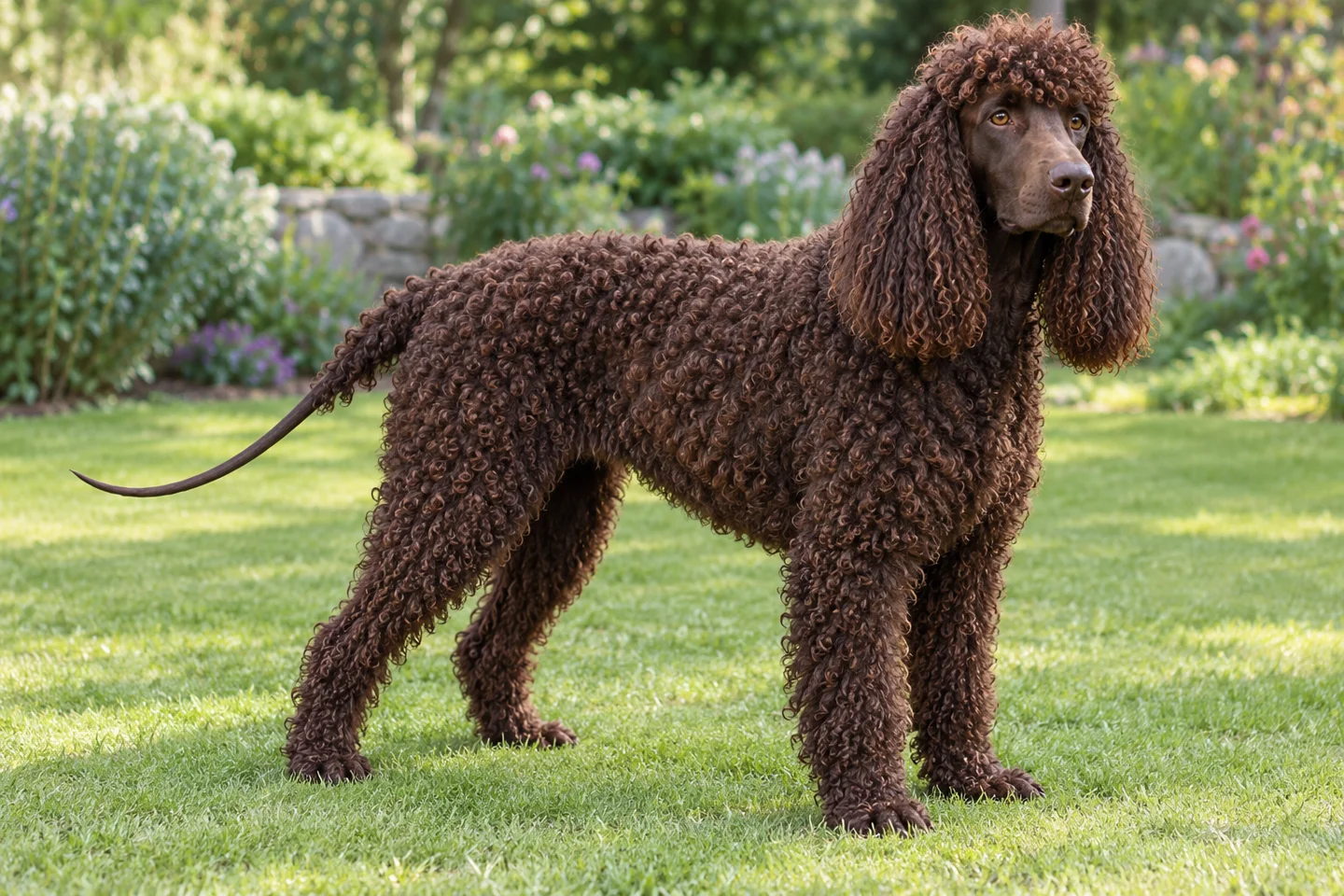
- Origin
- Ireland
- Adult standard size
- Males 53–59 cm; females 51–56 cm
- Illustrated coat
- Rich dark liver curls, smooth face and rat tail
General information for owners. These articles have not been reviewed by a veterinarian. Medical decisions need your dog's history and an examination.
A water spaniel with an identity of its own
The Irish Water Spaniel is a distinct Irish gundog with tight liver-colored curls, a loose curly topknot, and a smooth tapering tail. It should not be treated as a Poodle cross because of the coat or as an interchangeable version of every water dog. Ask a source how the adults live, work, and settle at home. A companion household needs to plan for activity, grooming, company, and cooperative handling before choosing a puppy from its unusual silhouette.
The FCI describes a background in hunting and retrieving, particularly waterfowl work. It also acknowledges that the breed's exact origins are obscure. That uncertainty should remain visible rather than becoming a confident list of undocumented ancestors. The practical modern question concerns this family's traits and the individual dog's experiences. Ask how puppies encounter household life and what support continues after placement. If you plan sport or water activity, discuss preparation with an experienced instructor. If your aim is ordinary companion life, explain that clearly so the source can assess the proposed match.
Size, curls, and the natural rat tail
FCI height ranges are 53–59 cm for males and 51–56 cm for females. The standard describes a strong, compact body, a smooth face, very long ears covered in twisted curls, and rich liver coloring. The tail has curls at its base followed by a smooth length tapering to a fine point. That is a natural feature, not evidence that the dog's tail has been shaved or docked. The illustrations preserve it. An image cannot establish correct movement, pedigree, or health.
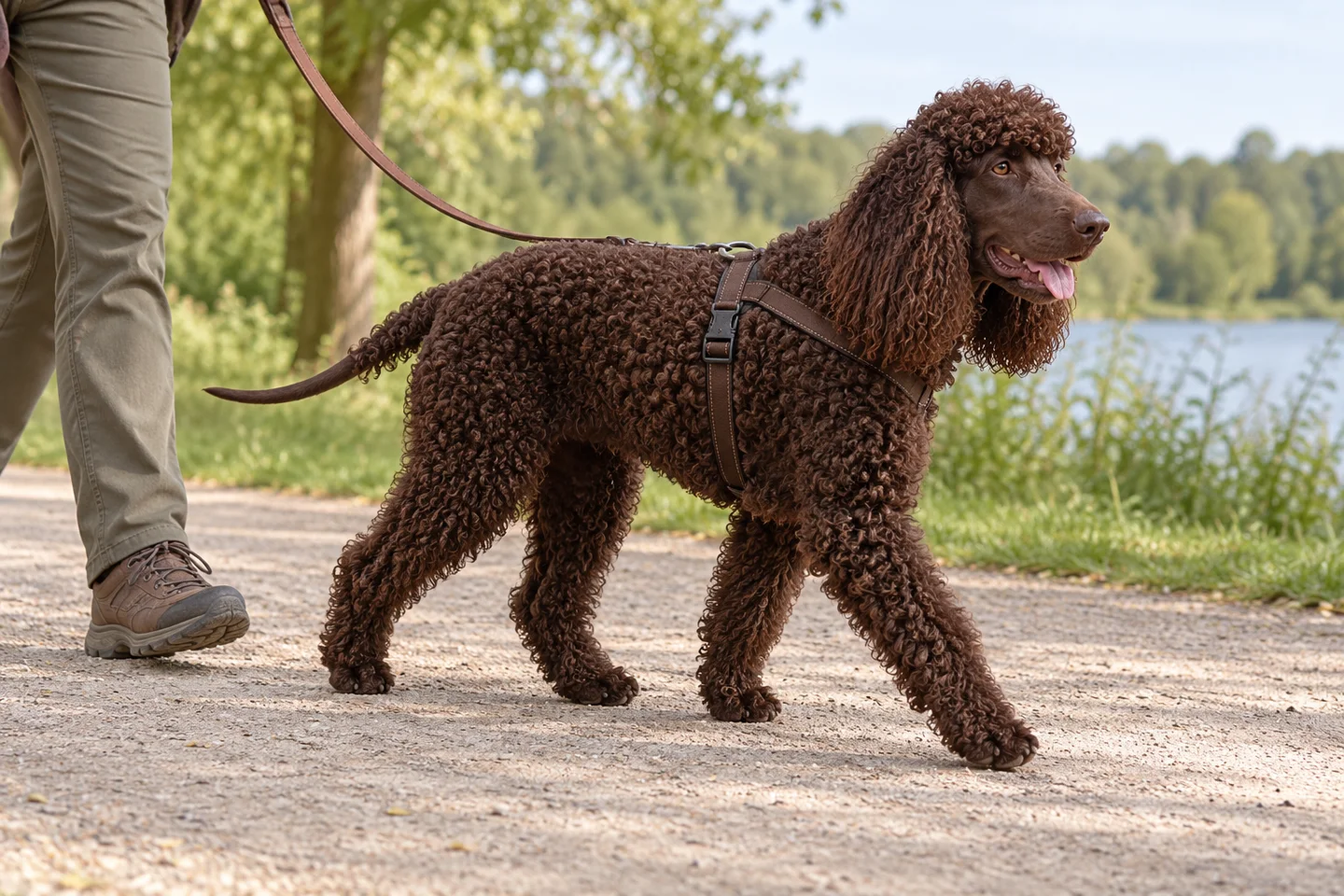
Plan equipment around the actual body beneath the coat. Check harness straps for fit and trapped hair and measure travel space for comfortable rest. Ask the veterinary team to show how to assess condition through curls rather than judging weight from volume. A growing puppy's changing shape may require equipment adjustments long before the item looks worn. Choose a resting area where the adult can stretch out without blocking the household's busiest route. A functional setup makes ordinary care easier and avoids relying on physical restraint whenever a person needs to pass.
Temperament beyond a comic description
Some breed descriptions emphasize humor or playfulness. Those words can describe an enjoyable interaction while leaving care questions unanswered. Ask what happens when the dog must wait, when an unfamiliar person approaches, and when its usual carer goes out. A pleasant first greeting does not establish comfort during grooming or a workday absence. Meet adults in situations that allow observation of recovery and rest as well as excitement. Look for a source able to describe difficulties honestly and explain how they are managed.
After arrival, keep the day predictable and allow a quiet place to withdraw. Invite contact without reaching into the resting area or repeatedly handling the topknot and ears for visitors. Teach short periods of calm behavior while people move nearby. If the animal shows persistent distress or cannot settle, review the environment and schedule with appropriate help. More activity is not automatically the answer to every problem. A useful care plan describes what the dog needs to do during ordinary household moments, and makes those choices easier through space, teaching, and consistent handling.
Training cooperation before the coat needs work
Introduce standing on secure footing, a brief chin rest, and gentle contact in small rewarded steps. Those skills can support grooming and veterinary examinations later. Bring out a tool, let the dog investigate safely, and end a short successful session before trying a full procedure. A puppy should not encounter every brush, clipper sound, and foot check for the first time when a long appointment is unavoidable. Ask a skilled groomer or veterinary nurse to demonstrate practical positions and ways to give the animal a pause.
AVSAB recommends reward-based methods and advises against aversive techniques. Use the same approach for ordinary cues such as moving with the handler, returning a short distance, or waiting at an entrance. Add difficulty gradually. A dog unable to respond in a busy environment needs a more manageable setup rather than a stronger correction. Record which skills are established and which require quiet practice. Another carer should understand the limits before expecting a familiar home response to transfer immediately to a crowded class or unfamiliar lakeside path.
Exercise and recovery in a companion routine
An Irish Water Spaniel needs suitable opportunities for movement and investigation, with demands chosen for the current individual. A controlled scent walk, an easy search, and short training can make a useful day without every activity involving water or repeated retrieving. Sport requires instruction and conditioning for dog and handler. Discuss sustained running and demanding changes with your veterinarian, particularly during growth or recovery. Observe movement and comfort afterward, and report persistent stiffness, reluctance, or unusual fatigue rather than dismissing it as a normal cost of activity.
Keep a simpler plan for weather changes, work pressure, or temporary illness. A quieter route and comfortable rest can be appropriate when the original outing no longer fits. Consider heat, footing, shade, and water access before exercise. A dense curly coat does not provide a guarantee against overheating, and a haircut cannot replace sensible management. Stop when the dog struggles and seek veterinary guidance for concerning signs. The animal's willingness to retrieve another object is not a complete assessment of its physical state or a reason to ignore a meaningful change noticed by its usual carer.
Water safety begins on the bank
Assess a water location before allowing access. Look at the entry, exit, current, weather, debris, and other users. A breed name containing Water cannot establish that an untrained dog is ready for that setting. Introduce appropriate water experience gradually with experienced guidance, never by throwing or forcing the animal in. If you cannot identify a reliable exit or maintain suitable control, choose a land activity. A previous confident swim elsewhere does not answer the current environmental questions.
For boating or a formal water sport, ask a qualified instructor about preparation and equipment fitted to the actual dog. Plan what each person will do if the activity must stop. Avoid allowing excitement around an object to replace a safety decision. After an incident, breathing difficulty, collapse, or a dog appearing unwell warrants prompt veterinary contact. Tell the clinic what happened and follow its instructions. Swimming is optional. Protecting the animal's welfare includes being willing to remain on shore even when its history or earlier behavior makes entering the water look tempting.

Aggression, guarding, and discomfort during handling
Take stiffening, growling, snapping, and lunging seriously without assuming a breed-wide explanation. Note what happened before the response, any object or food involved, and the opportunity to leave. Prevent another exposure while arranging advice. Do not recreate an incident with a child, visitor, or another dog to find out whether it was serious. A single warning during a painful or crowded situation can be enough information to require a different arrangement.
New handling sensitivity needs veterinary assessment. A qualified behavior professional can help connect medical findings, learning, and the environment with a practical plan. Leave meals undisturbed, teach exchanges with safe items, and avoid forceful contests over possessions. Punishing warnings does not establish comfort. If a professional recommends a basket muzzle, introduce it gradually and check fit and ventilation. It supplies an additional precaution; the dog still needs space and humane handling. Tell groomers, sitters, and clinical staff about actual incidents so they can prepare or decline a task they cannot manage safely.
Grooming tight curls and a loose topknot
Ask a groomer familiar with the breed to explain the difference between the tight body curls and the looser topknot and ear hair. Discuss a practical maintenance plan for your dog's coat and the household's available time. Work through small sections with suitable tools, inspecting the skin beneath. Tangles can tighten in places that are difficult to see, especially under equipment and around moving limbs. Do not pull through a painful knot or assume that preserving a familiar outline justifies a struggle.
Mats close to skin need skilled removal rather than hurried scissors. Plan bathing and drying carefully, and check after wet or grassy outings for debris and irritation. Persistent odor, redness, hair loss, or soreness warrants veterinary advice. Keep care instructions and products recorded so another person can maintain the routine. A curly coat does not guarantee that an allergic person will tolerate the dog, and low visible hair around the home does not remove grooming needs. Meet the actual animal and discuss relevant household concerns before treating coat appearance as a complete reason to choose the breed.
Ear checks and reported drug sensitivities
Long curled ears need routine comfortable observation. Report discharge, redness, smell, repeated scratching, or head shaking and ask the clinic to investigate recurrence. Follow individualized cleaning instructions rather than probing deeply or reusing old drops. Teach a brief ear lift separately from a prolonged procedure. If the dog is painful, let the veterinary team plan care instead of tightening home restraint. Record recent activities and symptoms without deciding their cause from a breed discussion.
The Irish Water Spaniel Club of America warns about reported drug sensitivities, particularly serious reactions to sulfonamide drugs, and also discusses other reported product sensitivities. Make the breed and any individual reaction history explicit to your veterinarian and ask for it to be documented. Medication and parasite-prevention decisions belong with the clinician who knows the dog. Do not stop a prescribed treatment, change doses, or choose a substitute from a breeder's anecdote or an online list. If a suspected reaction occurs, contact the veterinary service promptly and provide the exact product, timing, and observed signs.
Health screening and the scope of the program
The AKC's published national-club list for Irish Water Spaniels names hip, elbow, ophthalmologist, and thyroid evaluations. The club's health overview also describes cardiac health within its CHIC discussion. Ask the source to identify the current program it follows and show the actual reports rather than treating two summary pages as a single timeless checklist. Dates, dog identifiers, methods, and findings matter. A routine puppy examination and parental screening answer different questions and should both be described accurately.
Discuss significant diagnoses in relatives and how later information from owners is collected. A completed program cannot promise lifelong health, and a broad DNA panel does not replace every clinical assessment. Preserve gaps for an adopted adult and plan current care from available evidence. Report persistent changes in movement, appetite, thirst, vision, or stamina even if earlier reports were favorable. A working demonstration and an appealing coat provide observations, while examination and testing provide different evidence. Ask a veterinarian or relevant health program to explain findings whose implications are unclear before relying on them in a purchase or breeding decision.
Seizures, urgent changes, and feeding
The breed club discusses seizures among concerns reported in its historical survey. That identifies a useful family-history question without establishing today's prevalence or diagnosing every episode as epilepsy. If an event occurs, protect the dog from immediate environmental hazards and contact a veterinarian. Record duration and observable features if doing so is safe and does not delay care. Do not put fingers into the mouth. Severe or repeated episodes, collapse, serious breathing difficulty, suspected poisoning, and major injury require urgent clinical guidance.
Feed a complete diet suited to life stage, reviewing portions against condition and actual activity. Include rewards and extras in the same daily record. A hard-working breed background does not provide a precise portion for a particular companion. Ask before adding supplements to a balanced diet, especially during growth. Persistent digestive change, unexpected weight loss, or altered thirst needs assessment. Write clear food and medication instructions for other carers and keep clinical records accessible when traveling. Preventive care should follow the dog's location, exposures, and medical history rather than a generic rule copied from another water breed.
Mixes, sourcing, and the cost of coat care
An Irish Water Spaniel cross is different from the recognized breed, and curls alone cannot establish parentage. Ask which ancestry is documented and what was inferred. Known parents warrant relevant health questions for both; crossing cannot guarantee a particular coat, temperament, or freedom from inherited disease. For a puppy, leave room for uncertainty about mature traits. For an adult, actual behavior, size, grooming needs, and handling provide useful placement information even when family records remain incomplete.
Obtain local quotations for grooming as well as food, prevention, training, equipment, and suitable care during absences. Ask what a maintenance appointment involves and what you must do between visits. Read insurance conditions and plan for urgent costs. Review a source's continuing support and return arrangements before handover. A carer should meet the dog and understand its coat, medication, and activity needs. If all care depends on one person never becoming unavailable, improve the backup plan before acquiring the animal. A distinctive appearance needs sustained practical support throughout its life.
dogsDating meetings for a water spaniel
Describe the individual dog's preferences on dogsDating, including whether a quieter route, more space from unfamiliar animals, or a slower introduction helps. Use an approximate area to agree on a public meeting point while keeping your home address and exact coordinates private. Confirm that each adult handles their own dog. Start on land with room to walk apart. Shared water retrieval or a crowded waterside area adds avoidable decisions before the handlers know how the dogs respond to each other.
Walk in parallel without shared toys or food competition. If either animal becomes rigid, persistently retreats, or cannot disengage, widen the gap or end the outing. Record what helped and use it for another possible meeting. Comfortable walking near a familiar companion may be the entire purpose of a good match. Direct greeting, play, and swimming are separate optional choices. The water spaniel's interest in an activity does not override the other animal's comfort or the environmental assessment that would be required before any water session.
Sources and editorial notes
Sources checked October 21, 2026. Breed measurements describe reference ranges, not a diagnosis or an individual dog's ideal weight. Images are AI-generated breed illustrations and do not document a particular dog or health condition.
- AVSAB: Humane Dog Training Position Statement
- VCA Animal Hospitals: Food aggression in puppies
- VCA Animal Hospitals: Common emergencies in dogs
- Orthopedic Foundation for Animals: CHIC health screening programs
- VCA Animal Hospitals: Aggression toward unfamiliar dogs, diagnosis
- VCA Animal Hospitals: Grooming and coat care for your dog
- VCA Animal Hospitals: Ear infections in dogs (otitis externa)
- AAHA: Feeding plans for healthy, appropriate weight cats and dogs
- VCA Animal Hospitals: Heat stroke in dogs
- AVSAB: Puppy Socialization Position Statement
- VCA Animal Hospitals: Dog behavior problems, aggression toward children
- American Kennel Club: Sporting group health testing requirements
- Irish Water Spaniel Club of America: Health overview and drug warnings
- Irish Water Spaniel Club of America: Reported health issues
- Fédération Cynologique Internationale: Irish Water Spaniel official breed standard
Keep getting to know dogs.
Read another guide or return to your dogsDating community.
Explore breed guidesBack to dogsDating