Irish Wolfhound
A giant Irish sighthound whose care requires adult-size access and transport, thoughtful growth and activity, careful health monitoring, and respectful animal introductions.
How these guides are researched and reviewed
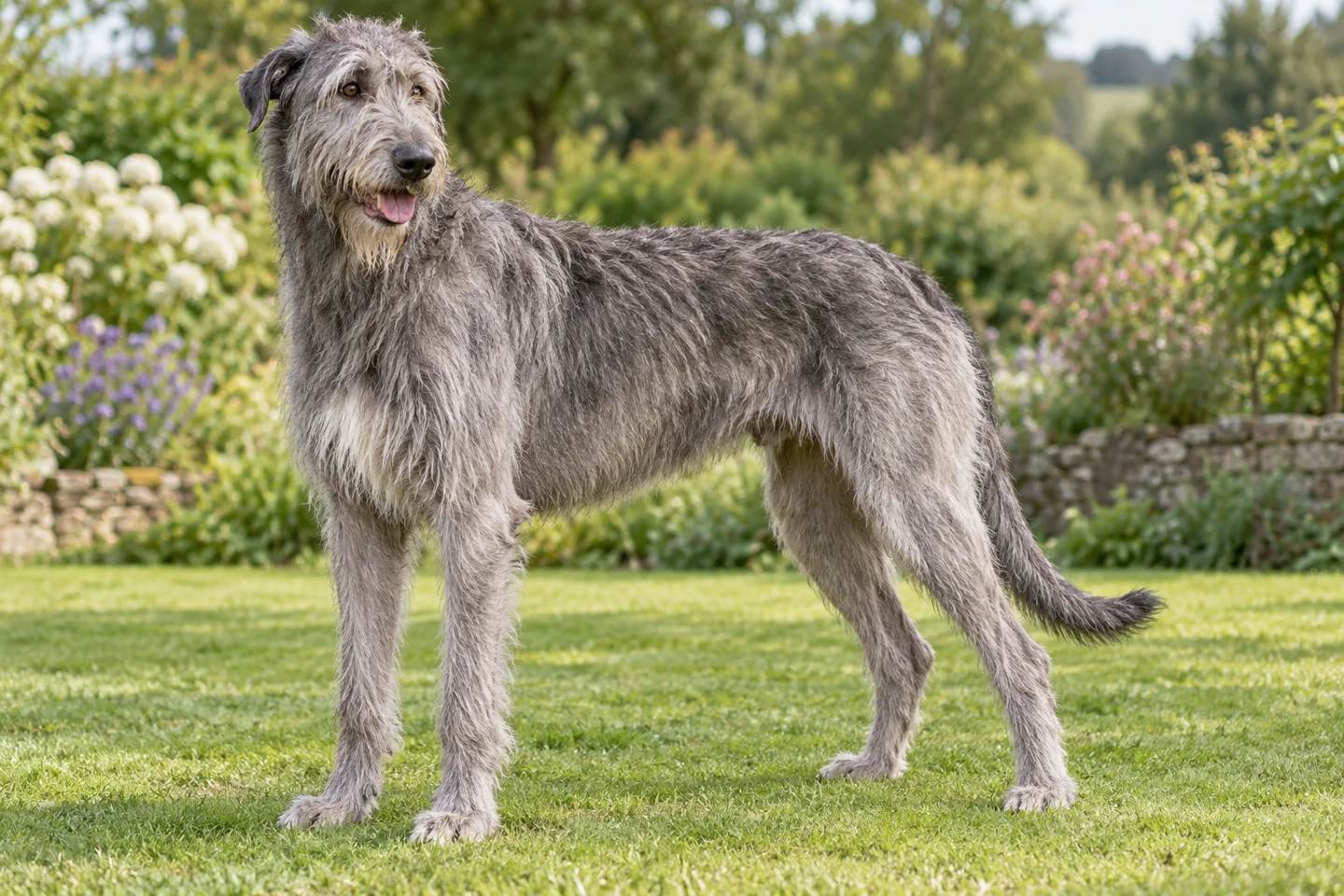
- Origin
- Ireland
- Adult standard size
- Desired minimum males 79 cm/54.5 kg; females 71 cm/40.5 kg
- Illustrated coat
- Grey rough coat with wiry beard
General information for owners. These articles have not been reviewed by a veterinarian. Medical decisions need your dog's history and an examination.
Prepare for the adult before choosing the puppy
An Irish Wolfhound needs a household prepared for a very large adult. The decision involves vehicle space, resting areas, food storage, veterinary access, and someone able to help when the dog cannot move normally. A puppy can initially fit into arrangements that become impractical quickly. Walk through those plans before handover. An affectionate meeting is useful, but it cannot answer whether your stairs, transport, or backup care will work for a mature hound during illness or injury.
The FCI describes a rough-coated Irish sighthound with a historical role hunting wolves and other large game. The breed's documented modern standard and club history provide context without making every old reference to an Irish hound identical evidence about today's population. For companion placement, ask about the current family, adult behavior, and health information. Meet mature relatives where possible and discuss how they live between outings. A source should help you assess the ordinary commitment, including the parts that are inconvenient, rather than presenting giant size itself as a reason the dog will suit you.
Current size references and a functional giant outline
The FCI standard updated in April 2026 gives desired minimum heights of 79 cm for males and 71 cm for females. It pairs those sizes with minimum mature weights of 54.5 kg and 40.5 kg respectively, with proportional increase as size increases. These are conformation references, not feeding instructions or goals for making a puppy grow faster. The standard describes a strong, long-legged hound with rough hair, small rose ears, and a long low-carried tail. Our illustrations show grey.
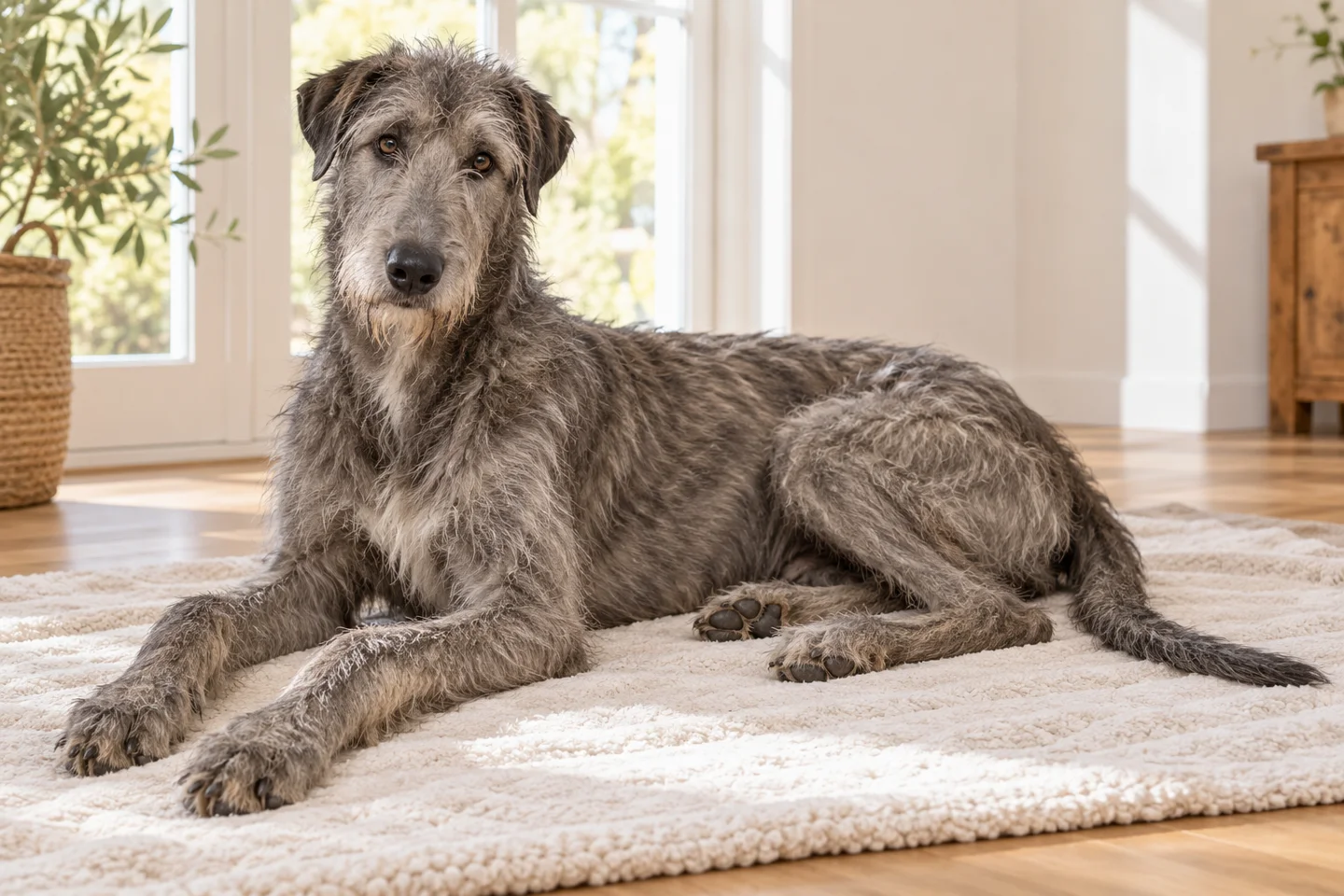
An individual needs comfortable movement and an appropriate body condition, assessed with veterinary guidance. Do not feed toward maximum bulk because a large image seems impressive. Watch the dog rise, walk, turn, and negotiate the surfaces it will use. Plan a sufficiently large bed away from busy routes and check that the adult can turn and rest in its travel restraint area. A photograph cannot assess structural comfort, pedigree, or clinical health. Good planning concerns the real hound's function and access rather than reproducing an exaggerated giant silhouette.
Household access and emergency transport
Look at entrances, floor traction, and the route to a resting area. If the main bed is upstairs, consider how the arrangement would change if stairs became difficult. A convenient ground-level option may prevent a rushed reorganization during illness. Ask your veterinary team about suitable support and loading methods rather than attempting an improvised lift of a distressed adult. Make sure more than one capable person understands the plan and that the receiving clinic can prepare for the dog's size and handling needs.
Prepare travel before the urgent journey. Measure the actual available space, fit appropriate restraint, and practice calm loading with suitable assistance. Keep doors controlled until the dog is secured at the destination. A hound unable to stand may require a different arrangement from its ordinary trip, so discuss that possibility early. Keep clinic numbers accessible and know where out-of-hours care is available. Giant size should not become the reason a concerning symptom is left until morning because nobody has considered how to move the dog safely or who can help.
Temperament without a guarantee of harmlessness
A gentle response to people is part of the breed's desired temperament, but no label can guarantee an individual animal's behavior. Ask what the hound does when interrupted at rest, approached over food, or faced with unfamiliar dogs. An adult's height can make ordinary movements imposing even when its intention is friendly. Teach a simple place to wait during busy household moments and arrange space so people do not repeatedly step over the animal. Comfortable rest should be available without constant social demands.
Observe recovery after activity and unexpected events. Does the dog return to quiet behavior, seek distance, or remain unable to settle? Specific descriptions help an instructor or veterinarian assess a difficulty. A source should explain the adults' ordinary routines and known limitations. If persistent distress appears during absence, review the schedule and seek appropriate help instead of assuming a large calm-looking dog needs little support. Teach independence gradually and prepare backup carers who have met the animal. Household companionship is a daily arrangement, not an automatic consequence of a favorable breed reputation.
Training before strength makes mistakes harder
Begin with practical skills: approaching for equipment, standing briefly, moving with the handler, and pausing at an exit. Reward short successful responses and add difficulty in steps. A puppy's small pull or jump can become a substantial adult problem if repeatedly encouraged. Give the household an alternative greeting routine that keeps all feet and bodies manageable. Avoid asking a visitor to hold the dog steady while another person experiments with control. A qualified instructor can help set up lessons that remain safe for both learners.
AVSAB recommends reward-based methods. Physical confrontation is unnecessary for ordinary learning and can make handling more difficult. Practice a return cue in a secure setting and do not assume indoor reliability transfers to moving animals outdoors. Explain established cues to carers and write down the settings in which they work. A long lead, where suitable, needs careful handling rather than simply more length attached to a fast animal. Use physical boundaries to support training so that one missed response does not expose the dog, a person, or another animal to an avoidable hazard.
Growth, exercise, and recovery
Discuss a growing Wolfhound's food and activity plan with your veterinary team. Avoid making a fit adult's routine the target for a young puppy. The breed club notes the practical vulnerability of rapidly growing youngsters, and the individual needs suitable movement without ambitious attempts to accelerate conditioning. Structured running, sport, or a substantial increase in workload deserves professional guidance. Keep observations of gait and comfort, including the day after an outing. Repeated reluctance, stiffness, or a changed stride needs attention rather than a demand to continue building stamina.
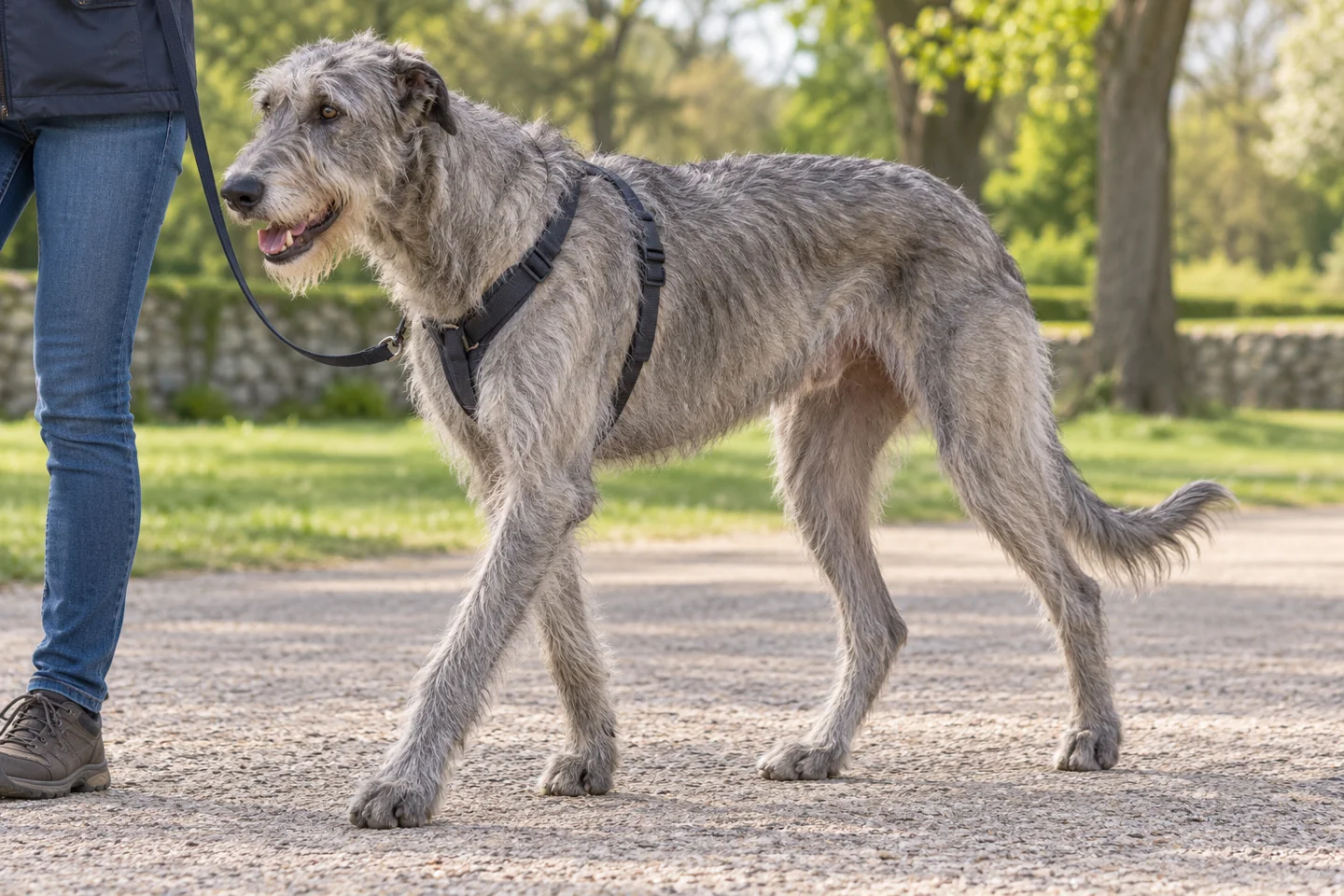
For an adult, combine appropriate exploration with chances to rest comfortably. Check any enclosure before allowing freer movement, including footing, obstacles, gates, and other users. Maintain control near wildlife, livestock, and roads. Adjust plans for weather and water access. A large dog that becomes distressed by heat or exertion needs the outing stopped and veterinary guidance where signs are concerning. Keep a shorter alternative for interrupted days. An owner should judge a routine by comfort and recovery as well as distance, rather than counting the animal's willingness to keep following as sufficient evidence of fitness.
Aggression, warning signals, and clinical changes
If the hound stiffens, growls, snaps, or lunges, make space and change management before repeating the situation. Document the approach, relevant resources, and opportunity to leave. Do not dismiss an incident because the dog is large and usually gentle, and do not repeat it with another person to prove a point. The animal's size increases the importance of preventing the next event. Keep visitors and children outside difficult situations while arranging assessment and explain restrictions clearly to other carers.
New behavior during touch or movement needs veterinary attention because discomfort may affect the response. A qualified behavior professional can help combine medical information, learning history, and environment into a workable plan. Leave meals undisturbed and teach exchanges with safe objects rather than forcing removal. Avoid punishing warnings. If basket-muzzle training is recommended, check size and ventilation and introduce it gradually with rewards. It remains an additional measure; the dog still needs comfortable handling and appropriate space. Share actual incidents with clinical staff before a visit so they can organize care safely.
Children and the space around a giant dog
A child and an adult Wolfhound should not have to negotiate a narrow passage without support. Keep routes clear and arrange a separate resting place that children cannot enter. Supervise contact actively, stopping climbing, hugging, ear pulling, and interference with meals or sleep. A dog walking away should be allowed to end the interaction. When attention is required elsewhere, use secure comfortable separation. The breed's gentle image does not make it reasonable to expect unlimited tolerance or to let young children manage boundaries themselves.
Ask about specific child experience before placement. Ages, setting, familiarity, and any warnings matter more than a single description such as family-friendly. An animal comfortable with an older child may have no experience of toddlers or a running group. Choose calm shared activities with an adult managing the dog, and stop before excitement produces chasing or collisions. The child's physical safety and the hound's ability to rest both belong in the plan. A large bed away from traffic and predictable access to quiet space can prevent repeated unnecessary pressure during an otherwise affectionate relationship.
Other dogs and smaller-animal questions
Arrange canine introductions with space and separate adult handlers. Begin with parallel walking and observe whether both animals can pause and disengage. Size differences can change whether a greeting or play session is comfortable, even without aggression. A smaller dog should not have to tolerate pursuit because the Wolfhound appears friendly. Provide breaks and notice whether both choose to return. At home, manage eating and resting separately while learning what the relationship requires. Repeated tension needs advice and a revised setup.
The breed's sighthound background makes smaller animals a separate placement question. Ask about observed responses to cats, birds, and wildlife, including running animals outdoors. A calm barrier encounter is useful information but cannot establish unrestricted safety. Keep secure separation where needed and provide protected routes for a household cat. Do not release the hound to discover whether pursuit can be interrupted. Some combinations need ongoing management or another placement. Choose a household arrangement that can maintain necessary boundaries when people are busy or away, rather than only during a carefully watched introduction.
Grooming, feet, and routine examination
A rough coat still needs gentle maintenance and skin access. Ask a groomer to demonstrate suitable tools and a practical routine for the individual. Check beard, feet, underside, and areas under equipment after outdoor activity. Remove visible surface debris without painful pulling or digging into tissue. Mats close to skin need skilled care rather than hurried scissors. Persistent irritation, odor, hair loss, or sensitivity warrants veterinary advice. A naturally rustic outline should not conceal an uncomfortable skin or coat problem.
Teach short cooperative handling sessions on secure footing. A foot touch, lip lift, or brief ear inspection can be rewarded and ended before resistance develops. Arrange necessary nail and dental care with your veterinary team and report changes in chewing or willingness to be touched. Do not probe deeply into an ear canal or reuse medication from an earlier episode without advice. If a familiar procedure suddenly becomes difficult, consider discomfort. Keep handling information available to another carer and tell the clinic about concerns before arrival so the examination can be planned for a large patient.
Health screening and puppy liver-shunt questions
The AKC's current list for Irish Wolfhounds includes hip and elbow evaluations, cardiac examination, ophthalmologist evaluation, and serum bile acids. The Irish Wolfhound Club of America discusses specialist heart and eye screening and recommends screening puppies for portosystemic shunt before placement. Ask the breeder to explain the actual reports, the ages and methods involved, and what follow-up is appropriate. A screening result is not interchangeable with a definitive diagnosis, and a routine examination cannot substitute for every named assessment.
Discuss significant conditions in parents, siblings, and other relatives, including later information from placed dogs. Ask how owners are kept informed. Screening cannot cover all health concerns or guarantee lifelong normality. A DNA panel tests selected variants rather than every possible cause of illness. With an adopted adult, keep missing history explicit and establish current care. A normal-looking youngster or strong walking demonstration does not provide the same evidence as identified reports. Have unfamiliar findings interpreted by the relevant veterinary specialists or health program before relying on them in a purchase or breeding decision.
Heart disease, cancer, and urgent illness
The breed club identifies heart disease, osteosarcoma, bloat and torsion, pneumonia, and liver shunt among important concerns. Those conditions are reasons for informed family questions and clinical vigilance, not diagnoses that can be made from breed identity. Persistent lameness, swelling, a new cough, or reduced exercise tolerance deserves veterinary assessment. Avoid assuming every limp is either a minor strain or cancer. Record the change and let examination and appropriate investigation determine the next step. The hound's quiet behavior is not proof that discomfort is absent.
Repeated unsuccessful retching, abdominal enlargement, serious breathing difficulty, collapse, or severe distress requires urgent veterinary contact. Call ahead and follow transport instructions. Ask your veterinarian what ongoing monitoring suits your dog's age, findings, and family history. Do not change prescribed medication or choose a treatment from another owner's experience. Keep records available across clinics, particularly when traveling. An emergency plan should include practical assistance and a receiving service, since the dog's size can make delay more likely if those details are left unresolved until it is already unable to move normally.
Feeding, costs, and mixes
Use complete food appropriate to life stage and review growth and condition with your veterinary team. Measure portions, include rewards in the record, and avoid supplements intended to increase size without clinical advice. A giant breed reference is not permission to push rapid growth or maintain excessive weight. Investigate unexpected appetite, drinking, digestive, or weight changes. Give carers clear instructions and keep prescribed diets distinct from ordinary feeding decisions. The plan should respond to the individual rather than an image of how massive a Wolfhound ought to look.
Obtain local quotations for food, prevention, medication, equipment, and suitable care. Read insurance limits and exclusions and consider how an urgent bill would be covered. A Wolfhound cross can retain substantial size and requires its own assessment; a mixed label cannot guarantee convenience or health. Ask what ancestry is documented and review relevant information for known parents. Current behavior and physical needs guide placement when history is limited. Discuss support and return arrangements with the source, and make sure competent backup care exists before relying on one person to manage every task indefinitely.
dogsDating outings that suit a giant sighthound
Describe the individual clearly on dogsDating, including walking pace, space needed around unfamiliar animals, and any restrictions associated with health or handling. Agree on a public meeting point using an approximate area and keep your home address and exact coordinates private. Each adult should manage their own dog, with equipment and a route that permit turning away. A crowded gate, narrow path, or immediate off-lead chase adds unnecessary pressure before the handlers know whether the animals are comfortable together.
Start with parallel walking at a manageable distance. Avoid shared food and toys, and watch both dogs' ability to disengage. Increase space or finish if either becomes rigid, repeatedly retreats, or cannot respond to its handler. A smaller companion's preferences deserve particular attention, including whether ordinary proximity feels imposing. Record a practical observation afterward and use it for another possible outing. A good match can mean calm walks with a familiar dog and no physical play. The Wolfhound's size, the other dog's comfort, and current clinical needs should shape the plan more than an expectation of instant friendship.
Sources and editorial notes
Sources checked October 21, 2026. Breed measurements describe reference ranges, not a diagnosis or an individual dog's ideal weight. Images are AI-generated breed illustrations and do not document a particular dog or health condition.
- AVSAB: Humane Dog Training Position Statement
- VCA Animal Hospitals: Food aggression in puppies
- VCA Animal Hospitals: Common emergencies in dogs
- Orthopedic Foundation for Animals: CHIC health screening programs
- VCA Animal Hospitals: Aggression toward unfamiliar dogs, diagnosis
- VCA Animal Hospitals: Grooming and coat care for your dog
- VCA Animal Hospitals: Ear infections in dogs (otitis externa)
- AAHA: Feeding plans for healthy, appropriate weight cats and dogs
- VCA Animal Hospitals: Heat stroke in dogs
- AVSAB: Puppy Socialization Position Statement
- VCA Animal Hospitals: Dog behavior problems, aggression toward children
- American Kennel Club: Hound group health testing requirements
- Irish Wolfhound Club of America: Wolfhound health and longevity
- Irish Wolfhound Club of America: Health testing
- Fédération Cynologique Internationale: Irish Wolfhound official breed standard
Keep getting to know dogs.
Read another guide or return to your dogsDating community.
Explore breed guidesBack to dogsDating