Japanese Akitainu
A substantial Japanese companion whose care includes precise breed naming, gradual social learning, dense-coat maintenance, and clearly interpreted health records.
How these guides are researched and reviewed
- Origin
- Japan; shared regional ancestry with American Akita
- FCI height reference
- Males 67 cm; females 61 cm; ±3 cm tolerance
- Illustrated color
- Red with pale urajiro markings; no black mask
- Health records
- Clinical screening plus the named enamel-hypoplasia DNA test
General information for owners. These articles have not been reviewed by a veterinarian. Medical decisions need your dog's history and an examination.
Choosing the Japanese Akitainu
The Japanese Akitainu is a substantial companion whose care requires more thought than choosing a curled tail and an expressive face. Look at the animal's background, the household it will join, and the people who will handle it every day. Ask how the proposed dog behaves on ordinary walks and what arrangements it needs around other animals. If the answer depends on an experienced person being present, decide how that person would actually fit into your routine. A manageable home is built from those details.
The Japanese Akitainu and American Akita share regional Japanese ancestors but developed along different paths. JACA's history describes that shared background and the preservation of the Japanese dog. UKC treats the Japanese Akitainu as a distinct breed. Ask a seller to identify which dog and registry its paperwork describes. An ambiguous advertisement saying Akita should prompt a discussion, particularly if you are comparing appearance, expected adult dimensions, or family health records. Neither identity provides a shortcut to assessing an individual's behavior or the quality of its care.
History without turning a story into a promise
JACA traces the breed to regional Matagi hunting dogs in northern Japan and describes later crossing, preservation efforts, and the development of the modern Japanese Akitainu. Its account also cautions that popular stories about the breed can outgrow their historical evidence. Read the history to understand why records and precise naming matter. Avoid using a story about a famous loyal dog to predict how a puppy will cope with separation, strangers, or life with children. Those questions require observations and teaching in the home where it will live.
When you meet a breeder or rescue, bring the conversation back to present circumstances. Ask what the dog has experienced, what routines it already understands, and what support is available if its behavior changes. Request descriptions of quiet weekdays as well as successful outings. Find out how the source records later health and behavior information from owners. A coherent explanation of the animal in front of you is more useful than a collection of heroic anecdotes. You should be able to leave the meeting with practical information to compare against your household's capacity.
Adult height, coat, and red urajiro markings
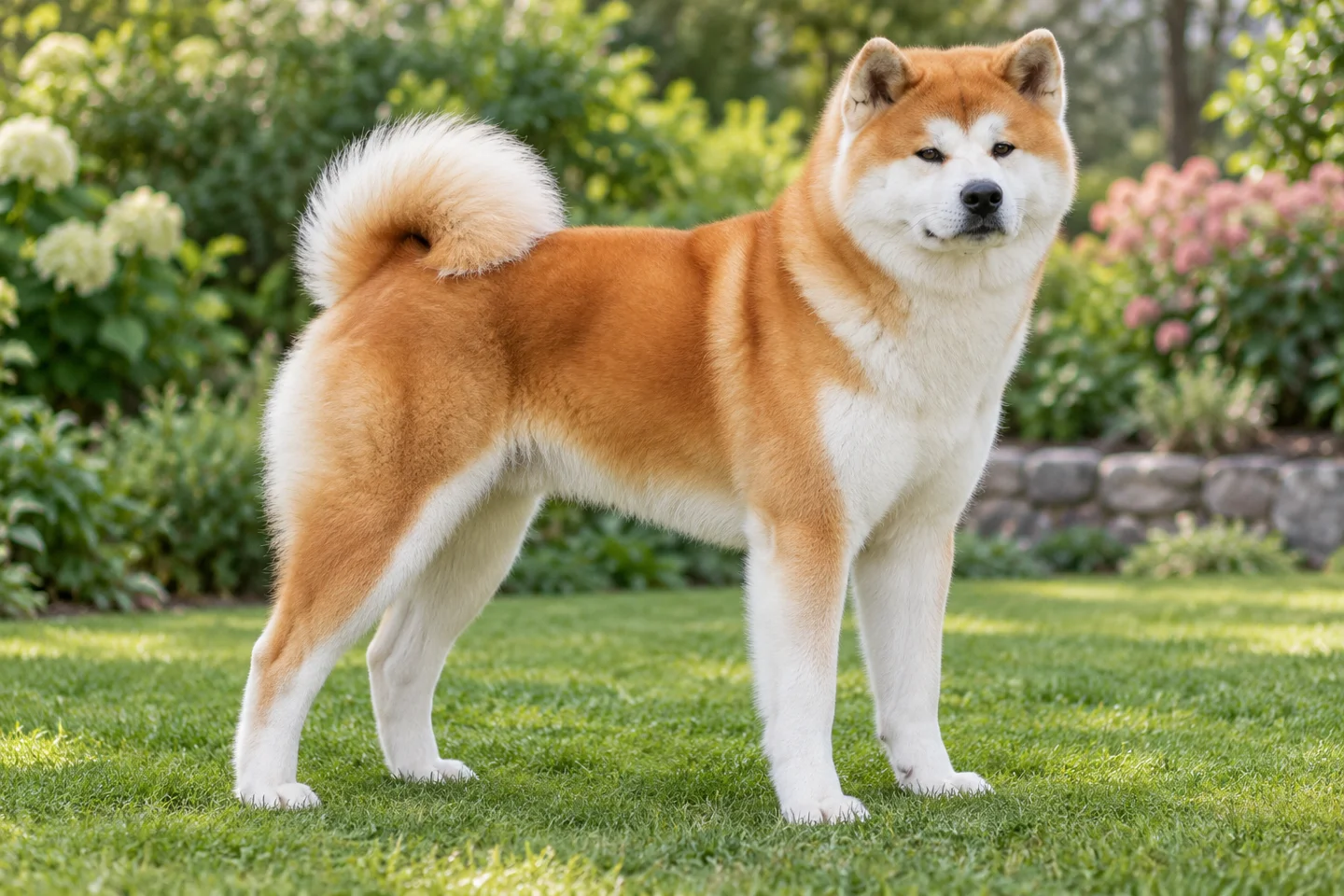
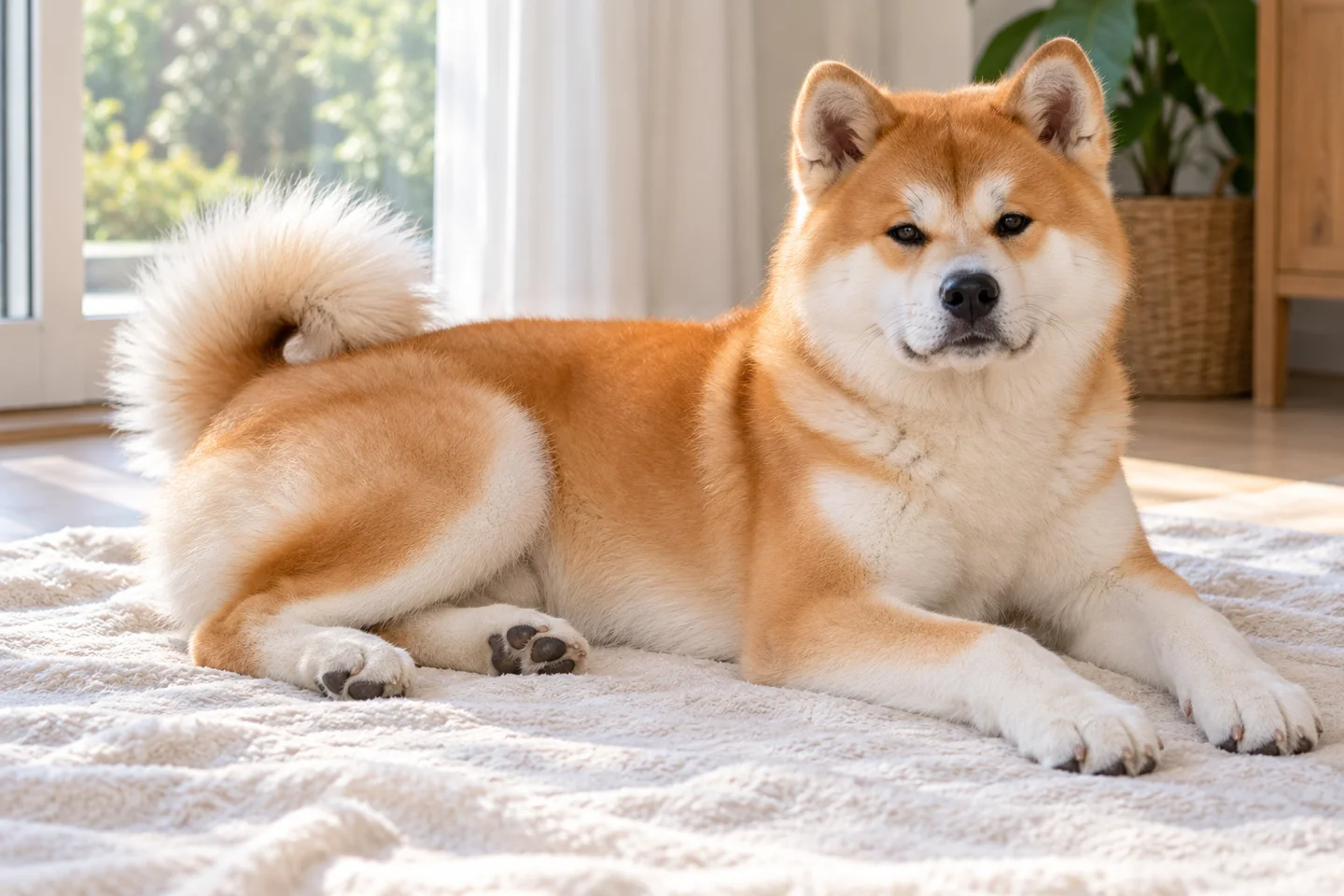
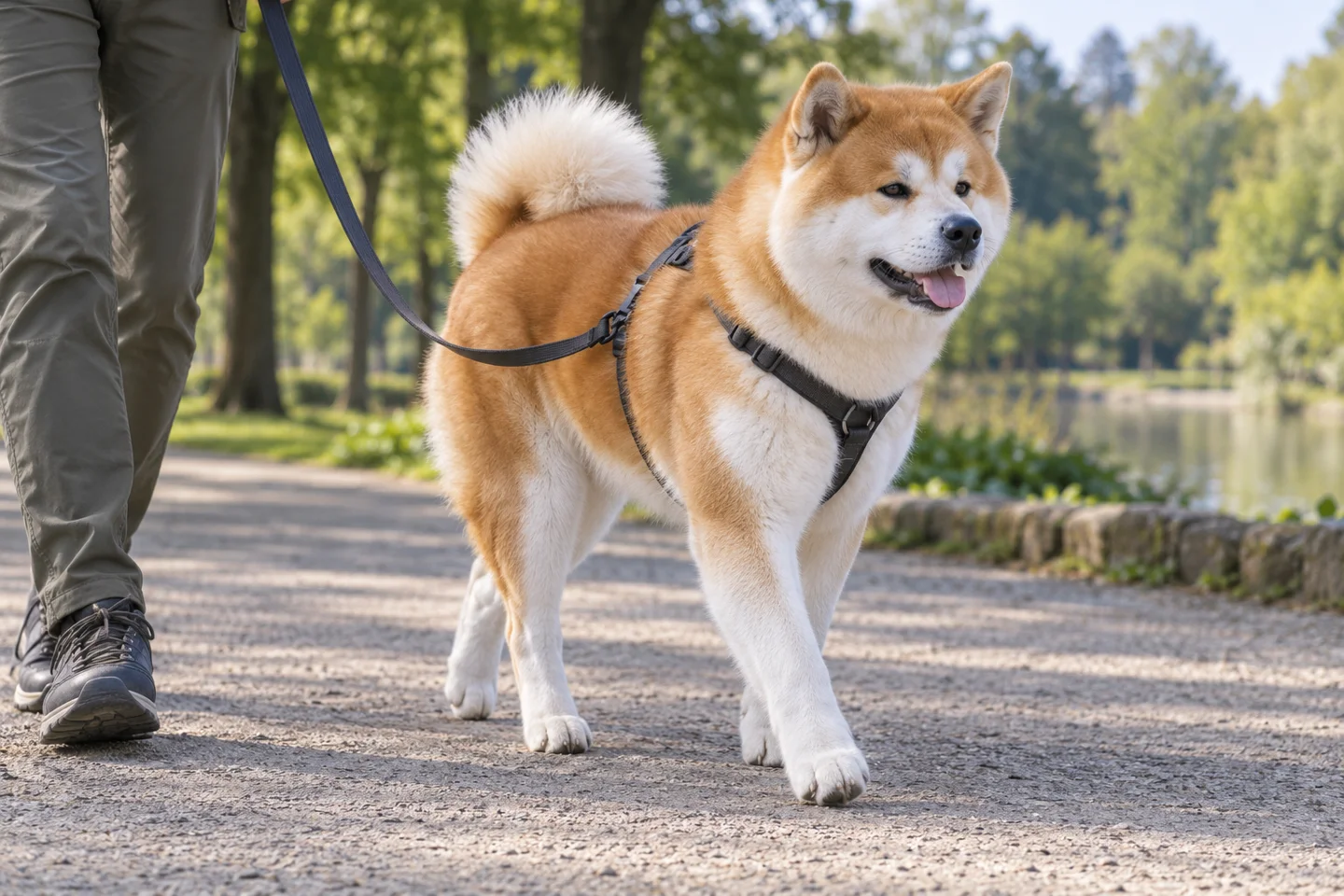
The FCI standard gives male height as 67 cm and female height as 61 cm, each with a tolerance of 3 cm above or below. It describes a sturdy dog with small forward-inclining erect ears, dark eyes, and a thick tail curled over the back. The illustrations here use red coloring with pale urajiro areas on the cheeks and underside. The standard also permits other listed colors. These pictures are generated examples, not a record of a particular pedigree or a way to assess movement and health.
A larger outline is not automatically a better one. Observe comfortable movement, check the condition beneath the coat, and ask your veterinarian about appropriate growth and weight. Plan equipment using the actual dog rather than a photograph's impression of scale. A developing puppy may need several harness adjustments before adulthood. Look at the route into your vehicle and the space available for turning and lying down. If you intend to use professional care, confirm that the provider can accommodate the adult size and the individual's handling requirements before you rely on that arrangement.
Temperament is seen across situations
UKC's description includes independence and reserve around strangers. Give those terms a concrete meaning when evaluating a dog. Does it prefer a visitor to ignore it at first? Can it rest while that person moves around the room? What happens when someone reaches toward its face or equipment? Avoid requesting intrusive demonstrations. Ask the familiar carer to describe previous experience and show ordinary routines the animal can manage comfortably. A quiet first meeting may be useful, but it cannot answer questions about every other setting.
Prepare for the first days with a new dog by keeping access and expectations clear. Choose a resting place away from busy passages and let the animal learn where food, water, and exits are. Introduce necessary handling in small steps. Do not schedule repeated visits simply because people are excited to meet it. Record what the dog finds easy and what requires more distance or time. If difficulties recur, those notes give a professional something specific to work with instead of a broad claim that the animal has become unpredictable.
Training a return, a turn, and a calm pause
Select a few skills that will help outside the house. A turn away from a distraction, a return over a short distance, and a brief pause while a harness is checked can each make an outing more manageable. Teach the movement where little else is happening and reward the response you want. Then practice in a slightly different place. Keep the step small enough that the dog can succeed. A cue learned beside the sofa needs more practice before it is useful at the entrance to a busy park.
AVSAB recommends reward-based methods for training and behavior treatment. Choose help that explains the teaching process clearly and changes the task when the dog is struggling. Avoid a plan based on forcing compliance through pain, intimidation, or repeated confrontation. Keep sessions short enough to notice whether the animal is learning. If the dog cannot turn away at the current distance, move farther from the distraction and make the next repetition easier. Increasing the pressure on the lead does not tell it what successful participation should look like.
Socialization that leaves room to decline
Discuss appropriate puppy exposure with your veterinarian while vaccinations are underway. Choose experiences the puppy can observe without being overwhelmed. A calm person standing at a distance may be a suitable start; a line of strangers leaning over it may not. Let it investigate and retreat. Good social learning does not require physical greeting with everybody present. Pay attention when the animal repeatedly turns away, freezes, or cannot recover after a surprise. Change the arrangement and seek professional guidance if ordinary exposure consistently produces distress.
Continue thoughtful exposure as the dog grows and circumstances change. A familiar route at a quieter hour can help you teach a new skill before trying the same route when it is crowded. For an adopted adult, obtain a history of travel, household activity, and animal contact. Missing history means you need a cautious introduction, not a dramatic test. Agree within the household on how to respond when the dog needs space. Consistent handling helps prevent one person's attempt to speed the process from undoing a plan another carer is trying to maintain.
Aggression assessment starts with the event
Treat threatening behavior as something to investigate and manage. Describe what happened before a growl, snap, lunge, or bite, including the location and distance involved. Notice whether the dog was resting, holding an object, being touched, or trying to move away. Stop recreating the encounter while help is arranged. Do not tell someone to take a bowl or approach a guarded bed to prove that the animal accepts them. The immediate priority is to prevent another incident and give a professional a factual account.
Tell your veterinary team about a sudden change, especially if handling or movement has become uncomfortable. Medical findings can affect the behavior plan. VCA explains that reactions toward unfamiliar dogs may have different motivations; pulling toward an animal is not a reliable invitation to release the lead. A qualified behavior professional can help assess the pattern and define safe arrangements. Disclose previous bites and near misses to anyone taking responsibility for the dog. A confident description of the breed cannot compensate for withholding information another carer needs to prevent a repeat.
Children need supervision and clear limits
Plan where the dog will rest during children's activities and how adults will prevent unwanted contact. Children should not climb onto the dog, hug its head, disturb sleep, or handle its food. Give them a way to enjoy the animal that does not require controlling it. An adult might manage a quiet training game while a child helps prepare the space. If play becomes fast or crowded, end the activity and separate comfortably. Supervision means being able to intervene early, not simply hearing the children from another room.
Ask precise questions about a dog's previous contact with children. Age and behavior of the children, the setting, and the help provided by adults all matter. A puppy that tolerated a brief visit has not been assessed in every family situation. Discuss changes such as a new baby, a visiting child, or a house move before they occur when possible. Keep an inaccessible resting area available. If an adult cannot supervise effectively, a closed gate or separate room should already be part of the routine rather than an emergency response after the dog becomes upset.
Other dogs, cats, and space at home
Evaluate compatibility through observed behavior and an introduction plan suited to the individuals. Do not assume that two Japanese Akitainu will prefer each other because they share a breed name, or that choosing opposite sexes resolves every concern. Ask what contact each dog has had and whether any conflict involved food, resting places, or movement through narrow areas. Prepare separate resources. Professional assessment is especially valuable when either animal has a history of serious threats or bites. A social application cannot replace that assessment.
Cats and smaller animals need secure escape and separation during evaluation. A still animal behind a barrier presents a different situation from one running across a garden. Prevent chasing instead of waiting to see where it ends. Keep the resident animal's routines intact where possible, including access to its food and familiar people. When dogs share a home, watch whether one repeatedly yields a doorway or loses access to a bed. Compatibility includes being able to rest and move comfortably around one another, not merely the absence of an obvious fight.
Exercise that can be adjusted
Use the dog's response to build an activity routine. Combine suitable walks with exploration and brief lessons, then allow time to recover. Ask your veterinarian about growth, existing joint findings, or a major change such as beginning running. Avoid setting a universal distance for every Japanese Akitainu. A fit adult and a recently adopted dog may need different starting points. Keep records of recurring stiffness or altered gait, including when it appears after an outing. Continued interest in going outside does not establish that a painful movement can be ignored.
Have an alternative for days when the usual route is crowded, hot, or inaccessible. A quieter outing and a simple indoor search can make the schedule easier to sustain. On warm days, reduce intensity and watch recovery carefully. If the dog shows heat distress, stop and contact a veterinarian for advice immediately. Water, shade, and a sensible route need to be planned before the walk. Coat thickness, country of origin, and past experience cannot guarantee that the individual will tolerate today's weather or the pace chosen by a human companion.
Grooming beneath a dense coat
Teach the dog to accept the position and tools used for grooming before a prolonged session is necessary. Work through the coat in manageable areas and ask a groomer to demonstrate how to reach loose hair without scraping or pulling the skin. Check under equipment, around the limbs, and other places where hair can trap moisture or debris. A smooth-looking outer surface can hide a problem underneath. Seek skilled help for tight mats and avoid cutting against skin you cannot see clearly through the coat.
Choose bathing and drying arrangements that the animal can tolerate safely. A slippery surface and a rushed attempt to restrain a large wet dog can make future care harder. Keep the route into the washing area uncomplicated, introduce it gradually, and reward cooperation. Record any product that appears to irritate the skin and discuss persistent trouble with the clinic. A practical care routine should let you notice changes in body condition, skin, and comfort. It should also be teachable to another carer so maintenance continues during your absence.
Health screening and the 2025 club statement
The AKC's Japanese Akitainu list includes patella, hip, elbow, thyroid, eye, and teeth assessments. JACA's 2025 statement explains the tooth component as a DNA test for amelogenesis imperfecta, also called familial enamel hypoplasia. Request the actual results for the relevant dogs and ask how the source follows its chosen programme. An entry saying health checked could refer to a routine examination rather than the named assessments. Dates and identifiers are important when a family has several related animals with similar names.
Ask what follow-up each result requires and what the breeder has learned from owners of older dogs. OFA explains that CHIC certification records completion and public disclosure of the required screenings. The individual findings still need to be read. Selected examinations and genetic results cannot promise lifelong health or explain every later symptom. With an adult whose earlier records are absent, document what remains unknown and arrange a current assessment. JACA gives a general life expectancy of ten to twelve years; an individual's course depends on its own health and circumstances.
Skin, eyes, and dental enamel
JACA names sebaceous adenitis and uveodermatologic syndrome among autoimmune concerns and states that no genetic tests for those conditions were available when its 2025 statement was written. Discuss unusual coat loss, scaling, or persistent skin changes with a veterinarian. Do not assume every patch of missing hair has the same cause. Painful eyes, squinting, cloudiness, or a change in vision need prompt assessment. A published Japanese Akita case report describes uveodermatologic disease, but a report of one patient cannot supply a prevalence rate or an outcome guarantee.
The enamel condition answers a different question. Research identified an ACP4-related recessive form of amelogenesis imperfecta in Akita dogs. A test for that variant does not exclude every dental problem or substitute for examining the mouth. Ask your veterinarian about discomfort, damaged teeth, or reluctance to chew and follow an appropriate dental-care plan. Keep genetic paperwork and clinical records distinct so their purposes remain clear. Avoid selecting treatment, supplements, or a breeding decision from an online symptom comparison. The clinician needs the animal's history and findings to judge what is relevant.
Feeding, meals, and valuable objects
Choose an appropriate complete food with your veterinary team and measure the amount actually offered. Include rewards and chews in the daily total rather than treating training food as invisible. AAHA advises keeping treats and other extras within ten percent of calories for a healthy feeding plan. Review condition over time, particularly when the routine becomes less active. A thick coat makes a hands-on assessment useful. Ask for a demonstration so the household can notice change consistently rather than relying on the apparent size of a fluffy outline.
Give meals a quiet arrangement. Feed dogs separately when needed and keep children away from bowls and chews. Teach a voluntary exchange for safe objects using rewards instead of repeatedly removing valued items to demonstrate control. If guarding has already appeared, involve qualified help and prevent confrontations while a plan is made. Write down feeding instructions for sitters, including any prescribed diet. Report a persistent appetite change, repeated vomiting, altered drinking, or unexplained weight loss to the clinic, even if the animal still appears interested in a favorite treat.
Mixes, long coats, and evidence of parentage
A long coat can fall outside a conformation standard without establishing that a dog is a crossbreed. Likewise, a curled tail and red coloring do not prove documented Japanese Akitainu ancestry. Ask what the source knows, which records support the description, and what it has inferred from appearance. A mix involving a Japanese Akitainu is not a predictable smaller or easier version of the parent. Plan from the animal's actual size, care needs, and behavior, with more allowance for uncertainty when those features are still developing.
When both parents are known, discuss relevant records for each family. Crossbreeding does not demonstrate that all inherited risks have disappeared. Marketing names cannot provide a reliable forecast of sociability, coat maintenance, or adult strength. For a rescued adult, good observations from a foster home may answer practical questions that pedigree information cannot. Ask how it rests, eats, travels, and responds to routine handling. Make the distinction between documented ancestry and useful everyday evidence clear in your own notes and in any profile shared with a future carer.
Costs, support, and dogsDating introductions
Before placement, obtain current local costs for veterinary prevention, food, suitable training support, grooming assistance, insurance, and care during absences. Confirm that the people expected to help can meet the dog's actual needs. Check the source's written return and support arrangements, and discuss any household restrictions directly. Include travel and emergency transport in the plan. A purchase price tells you little about the sustained cost of providing competent care when the normal routine changes or the animal develops a health problem.
On dogsDating, describe observed preferences and restrictions honestly. Keep exact home coordinates private and use an approximate location while finding a possible walking partner. Agree on a wide public route, with one adult responsible for each dog and room to leave. Start apart, walk in the same direction, and avoid shared food or toys. Increase distance or finish if either dog cannot relax or repeatedly tries to withdraw. A successful outing can consist of calm parallel walking. Contact and play are optional, and previous bite concerns should be addressed with a professional before arranging casual introductions.
Sources and editorial notes
Sources checked October 21, 2026. Breed measurements describe reference ranges, not a diagnosis or an individual dog's ideal weight. Images are AI-generated breed illustrations and do not document a particular dog or health condition.
- AVSAB: Humane Dog Training Position Statement
- VCA Animal Hospitals: Food aggression in puppies
- VCA Animal Hospitals: Aggression toward unfamiliar dogs, diagnosis
- VCA Animal Hospitals: Grooming and coat care for your dog
- AAHA: Feeding plans for healthy, appropriate weight cats and dogs
- VCA Animal Hospitals: Heat stroke in dogs
- Orthopedic Foundation for Animals: CHIC health screening programs
- AVSAB: Puppy Socialization Position Statement
- VCA Animal Hospitals: Dog behavior problems, aggression toward children
- FCI: Akita standard 255, Japanese breed
- United Kennel Club: Japanese Akitainu breed standard
- Japanese Akitainu Club of America: Breed history
- AKC: Miscellaneous Class and FSS health testing requirements
- Japanese Akitainu Club of America: 2025 health statement for AKC
- Hytönen and colleagues: Canine models of amelogenesis imperfecta, ENAM and ACP4 variants
- Charlotte C. Pye, Canadian Veterinary Journal: Uveodermatologic syndrome in an Akita
Keep getting to know dogs.
Read another guide or return to your dogsDating community.
Explore breed guidesBack to dogsDating