Lapponian Herder
A Finnish reindeer-herding breed with a longer athletic body, a dense coat, and a working voice that matters when choosing a home.
How these guides are researched and reviewed
- Origin
- Finland
- Ideal adult height
- Males 51 cm; females 46 cm, tolerance ±3 cm
- Original role
- Reindeer herding
- Coat
- Straight harsh outer hair over a dense undercoat
General information for owners. These articles have not been reviewed by a veterinarian. Medical decisions need your dog's history and an examination.
A reindeer herder needs a household that enjoys teaching
The Lapponian Herder, or Lapinporokoira, is a Finnish herding breed. Its practical appeal lies in an athletic dog that can work with people, rather than simply in a northern appearance. Before choosing one, picture the weekday routine in detail. Consider who will provide suitable exercise, how a dog will learn about passing movement, and where it can rest when people remain busy. A garden can support that routine but cannot supply the whole relationship. Meet mature dogs and ask about the learning behind their apparently easy behavior.
A thoughtful placement begins with honest descriptions. Ask the source about the individual's response to visitors, noises, unfamiliar dogs, and separation. Ask what changes after an exciting outing and how long it takes to settle. A puppy's behavior will still be developing, while an adult may need time to transfer familiar skills to a different home. Choose the dog whose known needs fit your available time and environment. A working label does not require constant sport, but it does ask the household to provide meaningful activity and clear expectations rather than leaving the dog to invent all of its own work.
Sámi herding history and modern breed separation
The FCI standard describes a long association with reindeer herding and records the start of breed registration in the 1950s. The modern Finnish Lapphund and Lapponian Herder were initially treated together, before the Lapponian Herder became a separate breed in 1966. Their shared regional background should not erase their separate identities. In particular, the Lapponian Herder's longer outline and coat should not be replaced in an illustration or description by a generic fluffy spitz with a tightly curled tail. Recognizing the actual breed helps owners ask more relevant questions about function and care.
History can explain the value placed on useful movement and responsiveness, but it cannot give every pet an identical temperament. Ask what the current family has been selected and observed to do. Livestock work belongs with skilled instruction that protects the animals involved. A suburban owner need not recreate it to justify owning the breed. Instead, consider controlled searches, appropriate training, and walking environments that give the dog something worthwhile to investigate. If a source says a particular dog needs a working placement, take that assessment seriously rather than assuming a general exercise plan will meet a specific animal's established needs.
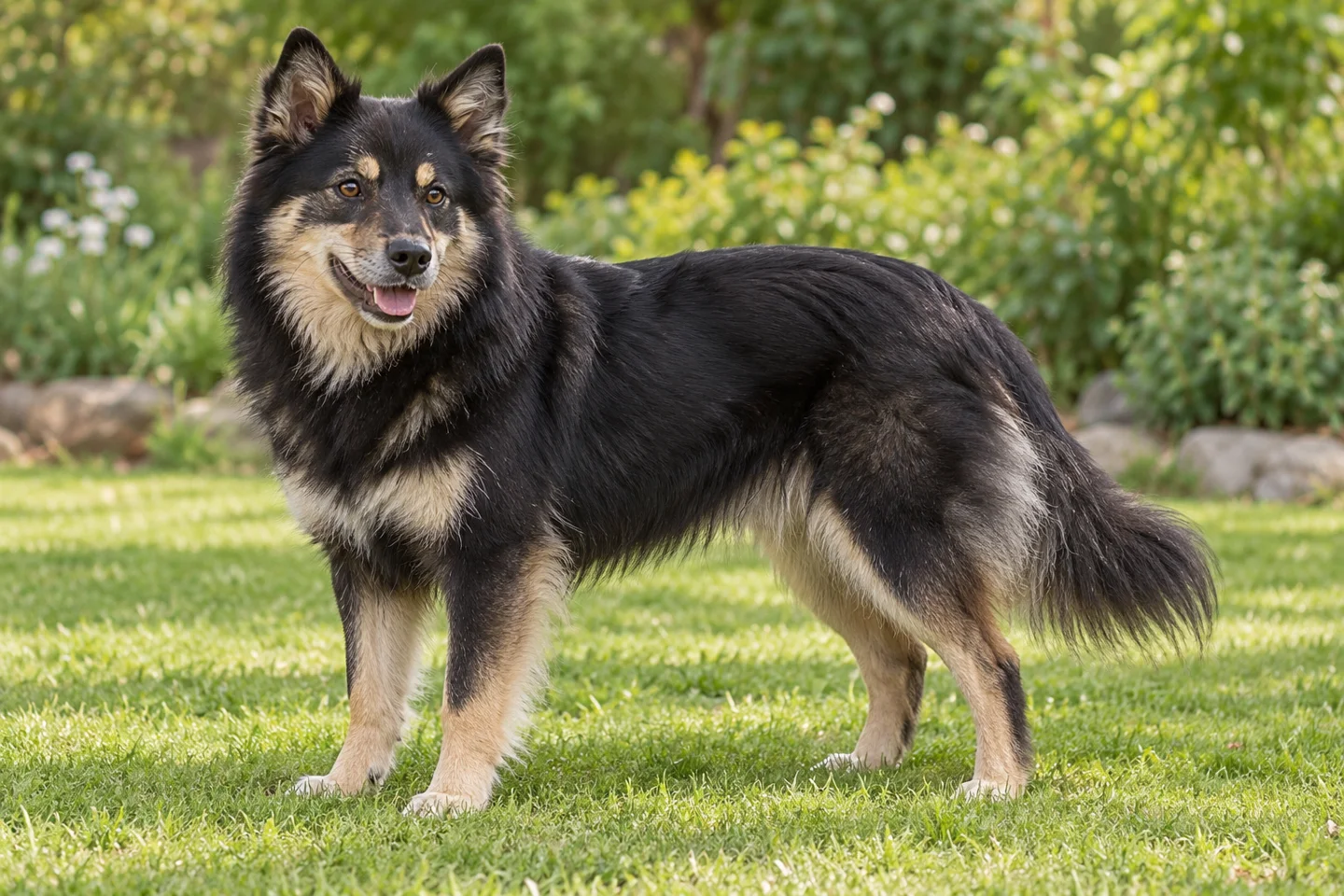
The longer body, pointed ears, and low natural tail
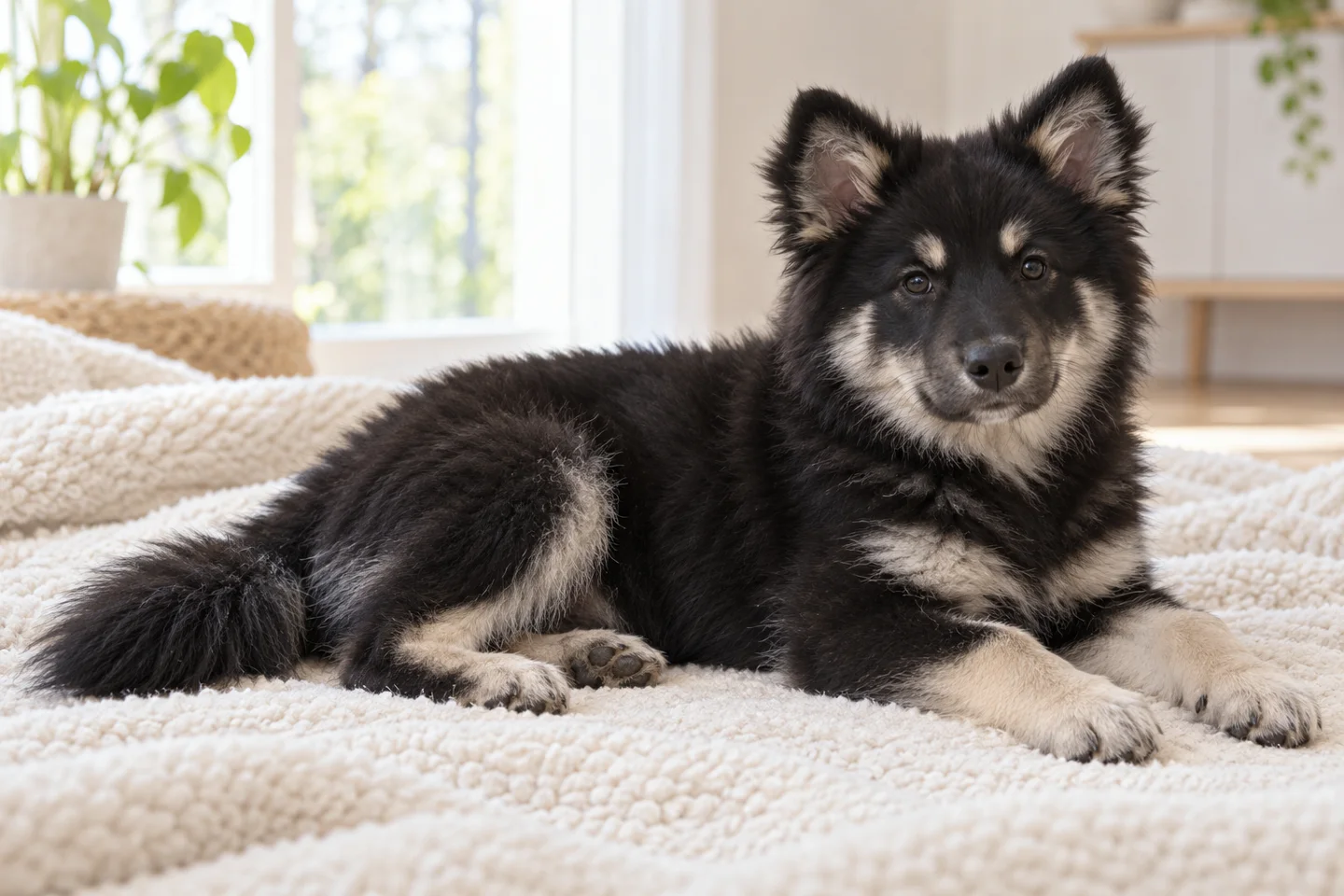
The FCI ideal height is 51 cm for males and 46 cm for females, with a tolerance of 3 cm either way. The body is clearly longer than tall, strong and muscular without a heavy impression. Natural erect ears and an elongated head contribute to the outline. The dense straight coat is adapted to northern conditions, while the tail should not curl over the back. The illustrations show a black dog with lighter grey-brown markings, retaining a full bushy tail and ordinary athletic proportions.
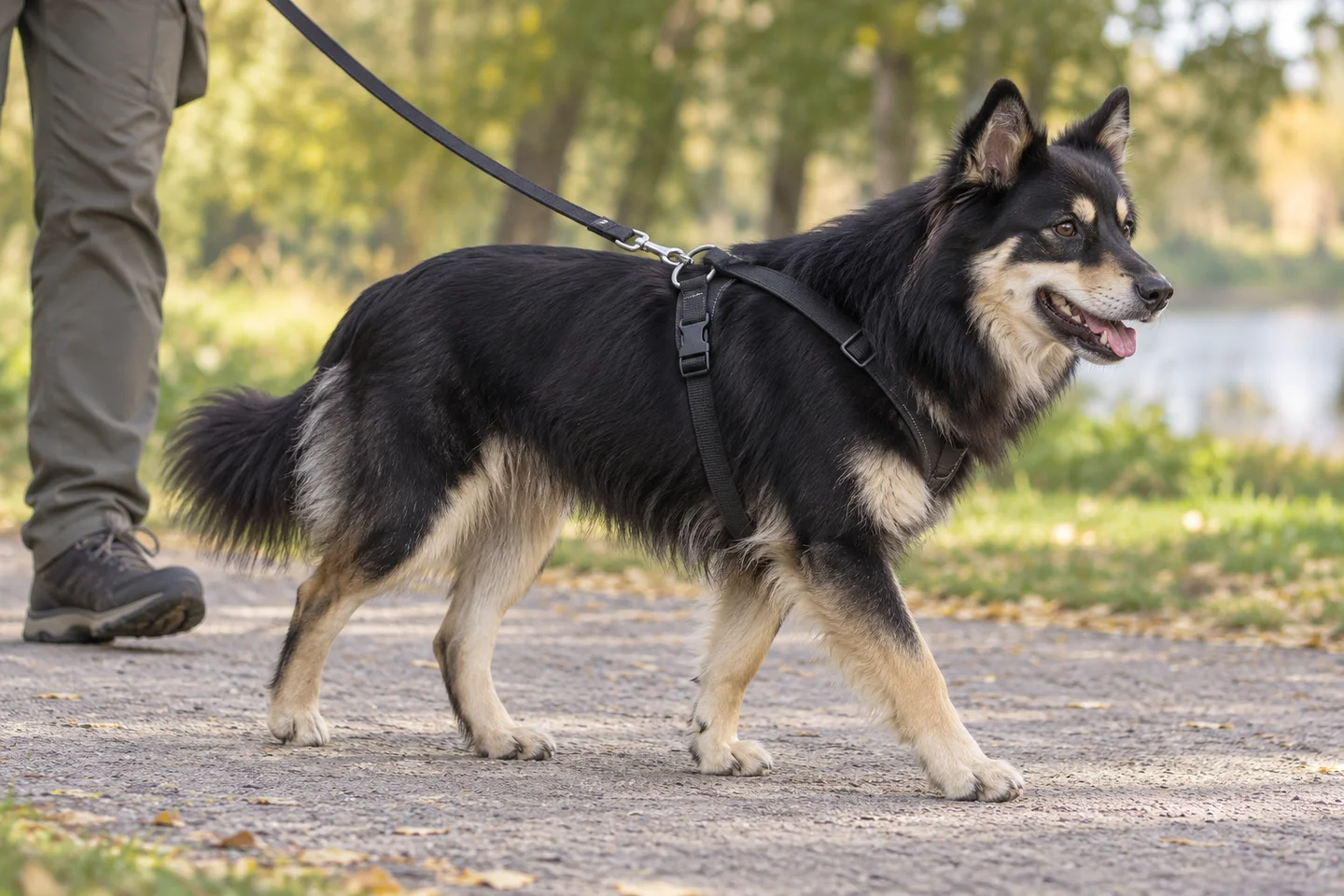
A standard is a description of intended breed type, not a feeding chart. Ask your veterinarian to assess the individual's weight and condition beneath the coat. Use your hands gently and regularly so a change is not hidden by seasonal hair. A harness should fit the dog's current frame and allow free shoulder movement; check again after coat changes or growth. Consider the adult outline when choosing transport and resting spaces. A dog that fits comfortably into a vehicle as a puppy may later need a different arrangement, particularly if it must turn, lie down, or travel safely for a longer journey.
Voice needs an honest conversation before placement
The standard explicitly notes that the Lapponian Herder barks readily when working. For an owner, that makes sound a relevant question before arrival. Ask what starts the individual's barking: play, movement beyond a fence, visitors, or difficulty being left. Different triggers need different plans. Speak candidly about nearby households and the places where the dog will spend its day. Do not accept a promise that a working voice will simply disappear once the dog learns a command. A useful plan changes circumstances as well as teaching responses.
Start by preventing long rehearsals at a busy boundary. Provide a comfortable place away from constant visual disturbance and reward settling when the dog can genuinely relax. Teach a simple response to the arrival of a person before expecting the dog to handle repeated deliveries. If noise appears during distress or an unfamiliar behavior change, investigate that cause with appropriate help. Avoid devices that suppress sound through pain or fear. The goal is a dog that can cope with ordinary household events, while the owners understand which environments remain unsuitable. That is more sustainable than relying on complaints to reveal a problem after the placement has already become difficult.
Training that makes work and rest predictable
Use rewards to teach orientation to the handler, a practical recall, and moving to a resting place. Begin where distractions are modest, then change one part of the task at a time. A dog that can turn toward you indoors still needs careful practice around moving bicycles or unfamiliar animals. Use secure equipment outdoors while the skill develops. Make the response worth offering and notice when a distance is too close for the dog to participate. Repeated failure is information about the setup, rather than proof that the animal needs a harsher lesson.
Teach an ending to activity as deliberately as the activity itself. Put equipment away, offer an appropriate quiet option, and reward settling without immediately starting another challenge. A dog learning to enjoy instruction also needs to cope when instruction stops. Keep sessions short enough that the owner can deliver clear feedback, and let other household members practise the same cues. If you intend to try a sport, ask the instructor about prerequisites and physical readiness. Success in an exciting venue should not be allowed to displace the quieter skills needed for veterinary care, waiting in a vehicle, or sharing a home during an ordinary evening.
Exercise for an athletic individual rather than a mileage rule
A Lapponian Herder benefits from a routine that uses its body and attention without demanding the same workload from every individual. Consider age, current fitness, previous activity, and health. A walk with room for investigation can be paired with learning and rest. Increase demands gradually if the dog is beginning a new pursuit, and ask the veterinary team about appropriate preparation. Young dogs still growing and adults returning after illness need particular care. Enthusiasm at the sight of equipment does not provide a clinical assessment of readiness.
Plan outings around conditions rather than the image of a dog adapted to the north. Shade, water, surface temperature, and the ability to shorten the route matter in warm weather. A dense coat does not remove the risk from a hot journey or intense activity. Observe movement during the walk and recovery later at home. Report repeated stiffness, altered gait, or unexplained loss of stamina instead of solving it by pushing harder. An owner should be able to describe when a change began and what preceded it. Appropriate activity leaves the dog comfortable enough for normal eating, resting, and interaction afterward.
Aggression deserves a specific account, not a breed excuse
A reactive event needs a record of what happened. Note the approach, distance, available space, objects involved, and any handling or pain. A threat toward an unfamiliar dog is different from a snap when someone touches a sore area. Prevent repeats while obtaining qualified advice. Sudden changes call for veterinary attention, and a person should not repeat the incident for a demonstration. Breed history cannot make a bite harmless or establish that it was inevitable. The individual's behavior and the surrounding circumstances determine what management is needed.
Keep resources protected and teach exchanges through safe practice. Children should obtain adult help if a dog has something it should not keep. During unfamiliar canine encounters, maintain the distance and equipment needed for control. A qualified professional can help determine whether closer interaction is appropriate at all. Carers need the current plan before accepting responsibility, including a truthful account of bites and close calls. If muzzle conditioning is recommended, obtain instruction and retain the other safeguards. A device does not replace a suitable environment, and punishment of a warning can remove useful information while leaving the source of discomfort unresolved.
Children, family dogs, and animals that move quickly
Protect quiet rest and meals when children are present. An adult should supervise contact with enough attention to intervene before the dog is crowded, chased, or handled roughly. Teach children to stop when the animal turns away and to call for help instead of grabbing a collar. Do not organize chasing games around the idea of a herding breed doing its job. Choose calmer shared activities and use comfortable separation when the household becomes too busy for active supervision. Ask the source about actual child experience, including ages and circumstances, rather than accepting a broad family-friendly label.
Other animals need their own assessment. An adult dog's relationship with a familiar companion does not establish compatibility with every visitor. Begin introductions with enough space for handlers to leave, then manage food and rest separately indoors. Ask what is known about cats, livestock, or smaller pets and keep uncertain encounters physically protected. A safe arrangement should not depend on the smaller animal never running. Consult appropriate professionals before attempting access where pursuit or conflict has already occurred. If a household cannot maintain the needed management, a different placement may better protect the welfare of all the animals involved.
Grooming the dense coat without overlooking the skin
A straight outer coat over dense undercoat needs inspection as well as surface brushing. Ask an experienced groomer to demonstrate how to work through the coat without pulling. Give particular attention to areas affected by equipment or movement and adjust the routine during shedding. The dog should still be able to move comfortably when grooming is finished. Do not make the coat a test of endurance. Break work into manageable sessions and obtain help if tangles or handling problems have already become substantial. A neat outline alone does not establish skin comfort.
Inspect feet and nails, and use a veterinary-approved dental routine. Persistent scratching, odor, discharge, or sensitivity deserves assessment rather than repeated changes of grooming product. Keep details of any reaction so the clinician knows what touched the coat and when signs developed. Ear care should remain gentle and appropriate to this dog; do not insert tools into the canal or use leftover medication. Explain handling limitations to a groomer or sitter before care begins. This allows the person to arrange time and a method the dog can manage, instead of discovering an avoidable difficulty while holding unfamiliar equipment.
Health decisions need the current Lapponian programme
Lappalaiskoirat ry publishes detailed Lapponian Herder breeding criteria addressing eyes, hips, and family disease information. Its eye guidance distinguishes clinical findings and particular forms of progressive retinal atrophy rather than treating one generic DNA result as complete eye clearance. Its hip recommendations also differ from a universal rule that every unscreened dog is automatically excluded. Ask the breeding adviser to explain the current programme and any exception affecting the proposed combination. Do not borrow the Finnish Lapphund's requirements merely because the breeds share regional history and a club.
The criteria also address epilepsy and hypothyroidism through family information. A buyer can ask how diagnoses in close relatives are recorded and included in advice, rather than requesting a fictional test that excludes every possible case. Obtain identified examination reports and the actual interpretation of relevant DNA findings. Missing information should remain visible. For a pet with new signs, the veterinarian needs its own history and examination even if parental records look reassuring. Keep a dated account of episodes, treatment, and recovery and pass significant diagnoses back through the appropriate confidential route. A practical medical file supports care while also helping future family assessments become more complete.
Nutrition and the difference between feeding work and feeding an image
Plan a complete diet with the veterinary team for the individual's life stage and body condition. Coat and a working reputation can make it tempting to assume the dog needs a large amount of food. Measure intake, include rewards, and assess the body beneath the hair rather than judging appetite as a complete guide. Workload changes should lead to a deliberate review. Avoid adding supplements without a clear clinical reason. In a multi-dog household, separate meals can reduce pressure and make it easier to know what this dog consumed.
Keep feeding instructions simple enough that a carer can follow them. Include the product, quantity, schedule, medication, and any known problem requiring contact. A new dog may need time to adjust, but persistent appetite or digestive changes deserve advice rather than an indefinite explanation that it is settling in. Write down the dates of changes before the veterinary visit. That account is more useful than trying to remember several unrecorded diet switches afterward. The aim is steady, suitable nutrition that supports comfortable activity and recovery, with medical investigation when the individual's pattern changes unexpectedly.
Mixes and an honest ownership budget
A Lapponian Herder mix may have a longer or shorter coat, different ears, and an activity pattern that cannot be predicted from a northern appearance. Ask which parentage details are documented and retain uncertainty when they are not. If parents are known, obtain relevant records about both. No cross carries a general guarantee against inherited illness or behavioral difficulty. Choose handling, exercise, and social expectations from what the animal actually demonstrates, while leaving room for a puppy's mature needs to develop beyond its current size or coat.
Cost planning should include local veterinary care, transport, secure equipment, coat maintenance, and help when the owner is unavailable. Ask a prospective sitter how they manage movement, voice, and any current restrictions. Suitable care may take more planning than simply finding a free kennel space. Clarify a breeder or rescue's support and return provisions in writing. Arrange emergency funding or suitable insurance before an urgent event. A placement must remain workable when schedules change or a dog needs reduced exercise, so avoid a plan that depends on constant strenuous activity being the only way the household can manage its companion.
dogsDating walks that allow both dogs to disengage
On dogsDating, explain the individual's pace, response to fast movement, and comfort around unfamiliar dogs. Share a general area and keep exact coordinates and the home address private. Agree on a public meeting point that provides open space before any narrow path. Tell the other handler about restrictions in advance, including whether greetings are currently unsuitable. Each person should retain control of their own dog and be able to turn away. A clear practical profile is more valuable than promising compatibility from the names of two herding breeds.
Begin with enough distance for parallel walking and allow calm investigation. Leave shared toys and food games for another context, since unfamiliar dogs should not have to negotiate a valued resource during a first meeting. Watch for repeated withdrawal, stiffness, or rising excitement that prevents comfortable disengagement. Increase distance or finish when needed. Afterward, note which route, pace, and separation worked. Quiet repeated company can be a useful match even if neither dog seeks close play. The owners' responsibility is to keep the outing manageable and respond to the animals they have in front of them that day.
Sources and editorial notes
Sources checked October 22, 2026. Breed measurements describe reference ranges, not a diagnosis or an individual dog's ideal weight. Images are AI-generated breed illustrations and do not document a particular dog or health condition.
- AVSAB: Humane Dog Training Position Statement
- VCA Animal Hospitals: Food aggression in puppies
- Orthopedic Foundation for Animals: CHIC health screening programs
- VCA Animal Hospitals: Aggression toward unfamiliar dogs, diagnosis
- VCA Animal Hospitals: Grooming and coat care for your dog
- VCA Animal Hospitals: Ear infections in dogs (otitis externa)
- AAHA: Feeding plans for healthy, appropriate weight cats and dogs
- VCA Animal Hospitals: Heat stroke in dogs
- AVSAB: Puppy Socialization Position Statement
- VCA Animal Hospitals: Dog behavior problems, aggression toward children
- Official breed standard: Lapponian Herder
- Lappalaiskoirat ry: Lapponian Herder breeding recommendation criteria
Keep getting to know dogs.
Read another guide or return to your dogsDating community.
Explore breed guidesBack to dogsDating