Large Münsterländer
A black-and-white German gundog whose field, woodland, and water background calls for a carefully matched placement.
How these guides are researched and reviewed
- Origin
- Germany
- Adult height
- Males 60–65 cm; females 58–63 cm
- Standard weight
- Approximately 30 kg
- Role
- Versatile pointing and retrieving gundog
General information for owners. These articles have not been reviewed by a veterinarian. Medical decisions need your dog's history and an examination.
A working placement question before an appearance question
The Large Münsterländer is a German versatile gundog. Anyone considering one should begin by asking what kind of placement the source expects and what work the particular family has been bred and prepared to do. The Large Munsterlander Association of America states that its breeders place puppies in hunting homes. That is a concrete condition of that programme, not a reason to assume every source has the same policy. Be candid about your intentions before arranging a visit. A successful match requires agreement about the dog's future, rather than hoping the source will overlook an unsuitable routine after you have chosen a puppy.
For the household, describe a normal week, including transport, time at home, access to appropriate activity, and the ability to teach quiet behavior. An athletic black-and-white dog may look appealing in a family photograph while needing a life the family cannot provide. Ask how adults from the line behave when they are off duty as well as in the field. A source able to discuss limitations is helping you make a better decision. The objective is a placement that meets the needs of this individual through ordinary weekdays and changing seasons, rather than a promise based solely on enthusiasm for the breed.
A separate breed with a specific German history
The FCI history places the Large Münsterländer among German longhaired pointing dogs. It describes the exclusion of black coloring from German Longhair breeding in 1909, the formation of a black-and-white breeding club in 1919, and planned breeding from a foundation list in 1922. The Small Münsterländer is a separate breed, so neither its size nor its appearance should be treated as a puppy version of the Large. Ask a source to identify the breed and registry clearly. Shared regional names can conceal important differences in the records and expectations being discussed.
The standard's working description includes field, woodland, and water work before and after the shot. That background makes controlled searching, cooperation, and retrieval relevant subjects for an owner to investigate. It does not license untrained pursuit of animals or unsafe entry into water. If you intend to work a dog, obtain appropriate instruction and understand the conditions where you will train. If you are considering a different kind of placement, discuss that openly with the source and seek an individual whose needs genuinely fit it. Historical versatility should not become an excuse to assume any available activity will automatically satisfy any member of the breed.
Adult measurements and the black-and-white coat
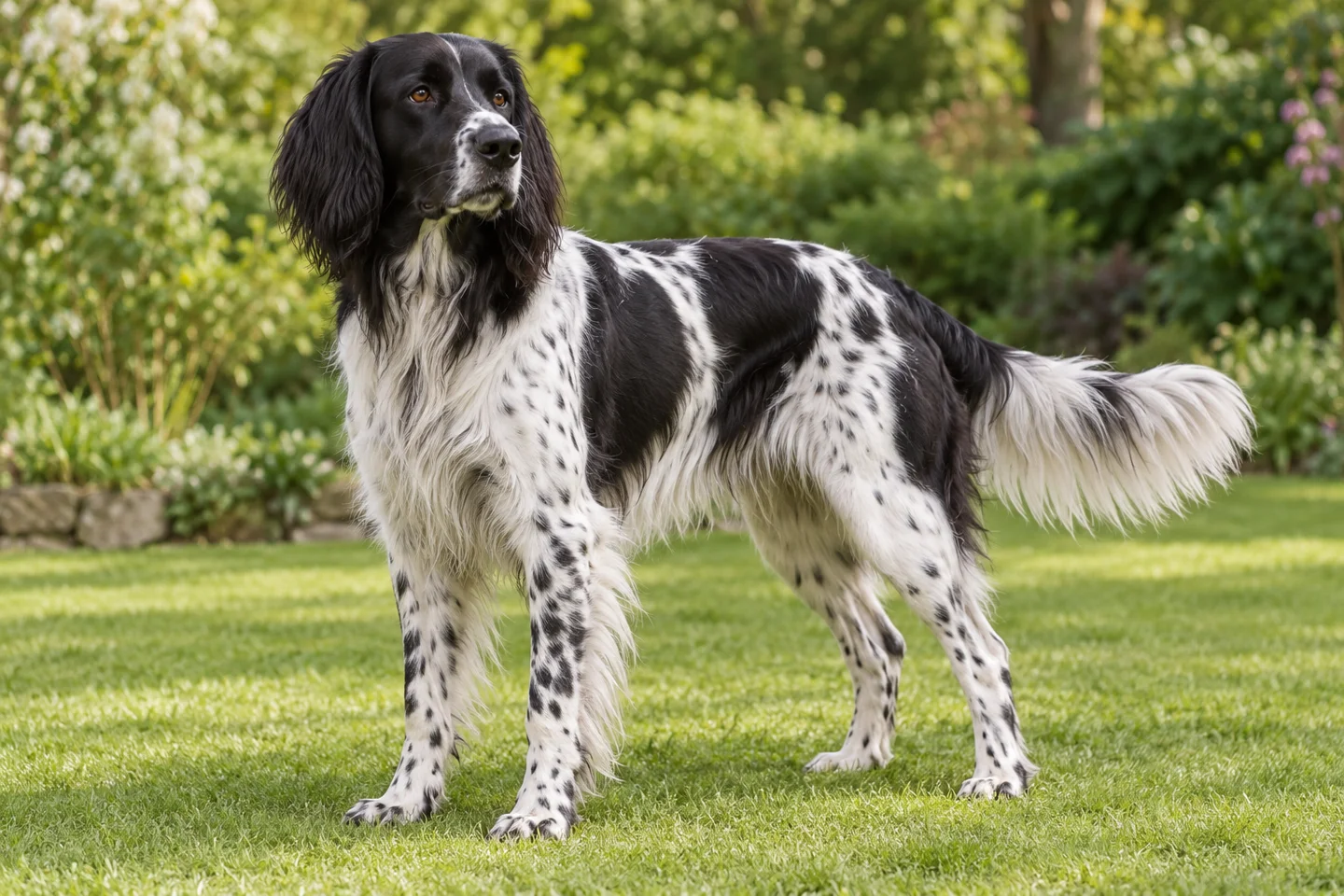
The FCI standard lists male height at 60–65 cm and female height at 58–63 cm, tolerating 2 cm above the specified range. Weight is approximately 30 kg. The outline combines strength with athletic movement, a long head, hanging ears, and a full feathered tail. The coat is long and dense, with black-and-white patterning that can include roan. The head is black, sometimes with a white snip or blaze. The illustrations show a patched and ticked example, retaining natural ears and full tail instead of altering anatomy for presentation.
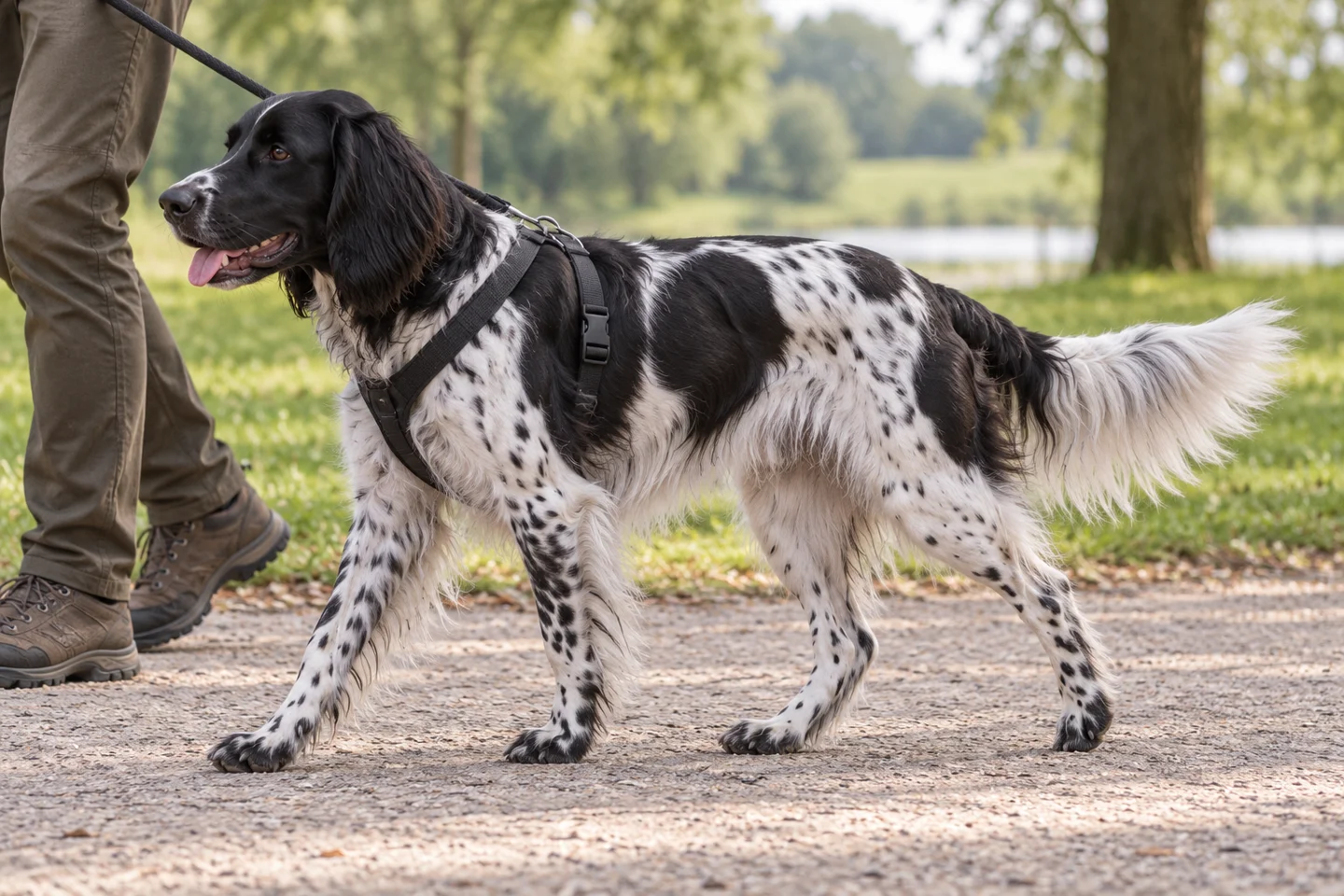
These figures describe breed type rather than an instruction to make every adult weigh the same amount. Ask the veterinary team to assess the individual frame and condition. Long hair can conceal a change around the waist or a sore patch under equipment. Make gentle inspection part of ordinary care and check a harness during movement. Consider the adult body when arranging safe vehicle travel and a place to dry after wet outings. The dog's ability to stretch out comfortably matters more than selecting a crate from a photograph of a smaller related-looking breed. Equipment should support the actual animal and the work it is ready to undertake.
Training cooperation before adding field excitement
A practical training plan starts with orientation to the handler, recall, waiting, and a comfortable handover of suitable objects. Build those skills where distractions are modest. Reward clearly and finish an exercise before the dog becomes unable to participate. Searching and retrieving can be rewarding in themselves, so teach how to stop and return as well as how to begin. A dog that retrieves an object in a quiet garden still needs further preparation before it can work reliably in an exciting unfamiliar area. Secure equipment helps prevent an unfinished skill from becoming a dangerous test.
Choose instruction that explains welfare, equipment, and readiness. Ask how an instructor responds when the dog is confused or worried, rather than judging a class only by its most polished demonstration. Avoid pain and intimidation as shortcuts. If the individual guards retrieved objects, obtain advice and reduce opportunities for conflict while teaching a safer exchange. A household should use consistent cues and limits so family members do not accidentally create competing rules. Useful cooperation includes everyday tasks such as resting during a meal, waiting at an open vehicle door, and tolerating a clinical examination, even when the owner's main ambition lies in working activity.
Exercise should include suitable recovery and water judgment
Match physical demands to age, current fitness, health, and previous preparation. A dog with an energetic working background still needs a gradual introduction to a new workload. Ask your veterinarian about readiness for demanding sport or work and about return after an injury. Combine movement with investigation and learning rather than simply extending a route until the animal is exhausted. Watch the next day's recovery as well as enthusiasm at the start. A sustainable routine should leave room for quiet rest and comfortable participation in ordinary home life.
Water adds its own decisions. Assess access and exit, conditions, supervision, and the dog's current experience before encouraging entry. An interest in retrieving does not establish safety in every body of water. Keep an alternative activity available when a location is unsuitable. During warm weather, shorten demands, provide water and shade, and avoid a hot vehicle journey becoming part of an already strenuous day. Repeated stiffness, unusual fatigue, or changes in movement need veterinary attention. Bring a precise account of what happened rather than explaining every reluctance as a training problem. A practical handler changes the plan when conditions change instead of treating completion as proof of commitment.
Socialization is preparation for varied settings
Early experiences should be small enough for the puppy to remain comfortable. Discuss vaccination-safe outings with the veterinary team, then introduce ordinary surfaces, vehicles, people, and sounds at manageable distances. A quiet observation from the edge of an activity can be more useful than a crowded greeting. Keep room to retreat and notice whether the dog recovers after a surprise. A rehomed adult may have extensive field experience and very little experience of an urban lift or a busy café. Ask about actual settings rather than assuming broad confidence from work in another environment.
Prepare the handling associated with the life you plan. Teach standing for a gentle foot check, entering transport, resting on a familiar mat, and accepting the sight and sound of grooming equipment. Reward small cooperative steps and end before a preventable struggle. Tell the clinic or groomer which parts remain difficult so they can plan accordingly. If avoidance, freezing, or threatening behavior persists, obtain guidance instead of relying on physical strength to complete every routine task. The dog's size makes early cooperation useful, but the underlying goal is predictable care that protects comfort for the animal and safety for the people responsible.

Aggression, resources, and honest incident histories
An individual Large Münsterländer must be assessed from its own behavior. A working reputation cannot establish safety around children, strangers, or other dogs. If a threat or bite occurs, record the sequence: what approached, how close, what object or handling was involved, whether contact occurred, and what injury resulted. Prevent repetition while seeking professional help. Sudden intolerance of touch or movement deserves veterinary attention. Do not recreate the event to show a trainer that the dog can be provoked, and do not punish a warning without addressing the circumstances that produced it.
Protect meals, chews, and rest from unwanted interference. Teach exchanges through safe controlled practice and keep unsuitable objects inaccessible. Maintain space around unfamiliar dogs rather than testing friendliness through a forced greeting. A qualified behavior professional can help design a realistic plan if guarding or threatening behavior persists. Give carers that plan and a factual history before they agree to take the dog. Where muzzle conditioning is recommended, learn appropriate fit and comfortable gradual teaching. Retain distance and supervision. Protective equipment reduces one part of risk; it cannot make crowding, rough handling, or competition over a valued object a suitable experiment.
Children and other animals require planned supervision
Adults should manage the lead, equipment, food, and any attempt to recover an object from the dog. Teach children to invite contact and accept a dog choosing to leave. Provide a protected bed and separate the animal comfortably when a gathering becomes too busy for active supervision. A large moving dog can create difficulty without intending harm, so choose spaces where the child and dog do not continually collide. Ask the source about the ages and circumstances actually observed. Avoid making a brief affectionate encounter carry the weight of a promise about every future situation.
Assess animal relationships separately. A dog comfortable with a familiar household companion may react differently to a visitor or to a smaller animal running. Ask for a detailed account of experience with cats, livestock, and small pets. Maintain physical separation where safety is uncertain and never release a vulnerable animal to test pursuit. Introduce new canine companions with enough room for both owners to withdraw, then arrange separate resources indoors. The household layout must support whatever management is necessary. If it cannot, discuss a better placement before arrival rather than expecting training to erase an immediate environmental risk that the owner cannot reliably prevent.
Grooming after field, woodland, and wet outings
Long feathering needs inspection after activity. Check the feet, ears, underside, and areas around equipment for tangles and material collected outside. Work gently rather than pulling through a dense knot because the dog is accustomed to active work. Ask an experienced groomer which tools and techniques suit the coat and what the owner should do between appointments. Give the dog a comfortable place to dry and inspect the skin beneath the hair when something seems sore. A working day does not finish simply because the dog has returned to the vehicle.
Ear pain, discharge, odor, or repeated head shaking calls for veterinary advice. Avoid inserting tools into the canal or treating a new problem with leftover medication. Maintain nails and dental care through routines the individual can manage. Cooperative practice can make inspection easier, especially when a foot is muddy or a feathered area needs attention. Tell a professional about previous skin reactions and handling difficulty. If the dog suddenly resists a previously easy task, consider discomfort before assuming a behavioral challenge. A useful care record includes what was found, what treatment was advised, and whether follow-up was completed, so a future carer does not have to reconstruct the history from memory.
Health screening for joints, eyes, and urinary risk
The British Large Munsterlander Club directs attention to hip scoring, elbow scoring, hereditary cataract eye screening, and DNA testing for hyperuricosuria, or HUU. Its current health page distinguishes the Royal Kennel Club's categories and asks club breeders to complete the full best-practice testing. Ask for the actual parents' reports and the interpretation of the proposed combination. If results were obtained through a different recognized scheme, request those reports rather than assuming absence from one database means no examination occurred. The assessment method and identity matter when comparing documents.
HUU affects uric acid handling and can lead to urinary stones. A DNA result is relevant to that particular risk; it cannot diagnose every urinary problem or replace clinical investigation when a dog develops signs. The club's breeding information also considers genetic diversity and collects health survey information. Ask how family findings and relatedness informed the mating rather than reducing the decision to one clear test. For an adult placement, obtain urinary treatment history, any dietary instructions, and follow-up plans directly from the medical record. New difficulty urinating needs prompt veterinary contact. Do not assume a pedigree, working qualification, or reassuring parental certificate makes the individual's present problem safe to watch indefinitely.
Nutrition and practical records for an active household
Use a complete diet appropriate to life stage and review amounts with the veterinary team as activity changes. Measure food and account for rewards, training days, and quieter periods. Feeding to a fixed breed weight ignores variation in frame and condition. Avoid adding supplements to a growing dog's diet without professional guidance. If there is a diagnosed urinary problem or another condition affecting nutrition, follow the veterinarian's individual plan rather than adopting a recommendation from a healthy working dog. Write the instructions clearly for other carers so the plan survives holidays and changes of responsibility.
Separate meals where competition makes intake or comfort difficult to assess. Keep water available and record persistent changes in appetite, drinking, digestion, or body condition for the clinician. A clear timeline is more useful than several rapid food changes with no record of what happened. Include medication and known reactions in the dog's handover file. Good records do not need to be public: the relevant professional or carer needs accurate information, while social profiles can remain limited to what is necessary for a suitable meeting. The aim is consistent care for this individual through both demanding and quieter phases of life.
Mixes and a source willing to explain the whole commitment
The Large Münsterländer is not a named mix of a large breed and a Small Münsterländer. It is a distinct breed. A dog advertised as a Large Münsterländer cross needs its own parentage account, and black-and-white feathering alone cannot supply it. Ask what is documented about each parent and what remains uncertain. Mixed ancestry does not guarantee freedom from inherited disease or a predictable compromise in activity. Assess the actual animal's health, behavior, coat, and experience, while allowing a puppy's mature needs to develop beyond what is apparent at collection.
Review costs with the planned lifestyle in mind. Local veterinary care, suitable transport, equipment, training instruction, coat care, and help during absences all matter. A person covering a weekend needs to understand containment and handling rather than simply enjoy dogs. Clarify the source's placement expectations, support, and return provisions in writing. If a programme requires a hunting home and you cannot provide one, use that information to find a better match rather than conceal your circumstances. A good decision should remain workable when a season ends, a person becomes ill, or the dog's abilities change and the routine must adapt.
dogsDating outings built around an individual working dog
Use dogsDating to explain this dog's ordinary pace and comfort around canine company. State any limits on direct greetings or play before arranging a meeting. Share an approximate area and keep exact coordinates and your home address private. Select a public route with room to move apart and a starting point that does not force both animals through a narrow gate. Each adult should manage their own dog and agree that either can end the outing. A breed's cooperative working description cannot replace a plan for the actual animals meeting that day.
Begin in parallel and let the dogs investigate without pressure for contact. Keep retrieving games, shared toys, and food between the dogs out of the first meeting. If either stiffens, repeatedly withdraws, or becomes too excited to disengage, increase distance or leave. Record useful conditions afterward, including route, separation, and duration. A calm walking partnership can be a valuable outcome without off-lead play or close greetings. Continued meetings should follow evidence of comfort rather than an owner's wish to progress quickly. The dog benefits when the handler responds to its current needs instead of using a social profile as a promise of automatic compatibility.
Sources and editorial notes
Sources checked October 22, 2026. Breed measurements describe reference ranges, not a diagnosis or an individual dog's ideal weight. Images are AI-generated breed illustrations and do not document a particular dog or health condition.
- AVSAB: Humane Dog Training Position Statement
- VCA Animal Hospitals: Food aggression in puppies
- VCA Animal Hospitals: Common emergencies in dogs
- Orthopedic Foundation for Animals: CHIC health screening programs
- VCA Animal Hospitals: Aggression toward unfamiliar dogs, diagnosis
- VCA Animal Hospitals: Grooming and coat care for your dog
- VCA Animal Hospitals: Ear infections in dogs (otitis externa)
- AAHA: Feeding plans for healthy, appropriate weight cats and dogs
- VCA Animal Hospitals: Heat stroke in dogs
- AVSAB: Puppy Socialization Position Statement
- VCA Animal Hospitals: Dog behavior problems, aggression toward children
- Official breed standard: Large Münsterländer
- Large Munsterlander Club: Breed health, HUU, and screening guidance
- Large Munsterlander Association of America: Finding a Large Munsterlander
Keep getting to know dogs.
Read another guide or return to your dogsDating community.
Explore breed guidesBack to dogsDating