Löwchen
A small sturdy companion with a wavy coat and a traditional lion clip, best chosen for its individual character rather than its hairstyle.
How these guides are researched and reviewed

- Origin in FCI standard
- France
- Adult height
- 26–32 cm, tolerance ±1 cm
- Standard weight
- Approximately 6 kg
- Coat
- Long silky waves without an undercoat
General information for owners. These articles have not been reviewed by a veterinarian. Medical decisions need your dog's history and an examination.
The companion beneath a distinctive haircut
The Löwchen is a small companion dog, also called the Little Lion Dog. Its traditional show trim is immediately recognizable, but the haircut should not be the main reason for choosing one. Spend time with adults and notice how they interact when people stop offering attention. Ask how the dog rests, responds to a visitor, and copes with a change of routine. Those observations help you decide whether the individual fits your household. A companion role still involves teaching, activity, medical care, and predictable support; it does not make ownership an effortless addition to a busy schedule.
The source should explain why a particular puppy or adult is proposed for your circumstances. Describe your working hours, available carers, children, other animals, and grooming plans honestly. A good match requires more than affection at a first meeting. It requires a routine that remains workable when an appointment runs late or the usual owner is ill. Ask about the dog's less convenient needs as well as its appealing qualities. That information allows you to prepare a suitable home without expecting the animal to solve every practical problem through a naturally cheerful personality.
Historical images and a modern breed identity
The FCI standard assigns origin to France and discusses old representations of small lion-trimmed dogs, including examples in European art. It records the founding of the French breed club in 1947. Such references describe the historical account associated with the breed; they do not provide an unbroken pedigree from every pictured animal to a puppy offered today. Keep claims about ancestry proportionate to the records available. The modern Löwchen has its own standard, and its name should not be used as a general term for any small dog wearing a lion clip.
That distinction matters when choosing a source or identifying a rescue dog. Ask what documentation supports the breed name and what remains uncertain. A similar trim can make unrelated dogs look alike. In conversation with a breeder, focus on the current family, the medical records, and how adults behave in ordinary homes. Historical rarity or a familiar painting cannot answer those questions. If you want to show, discuss the required presentation and registration with an appropriate club. If you want a companion, ask how a practical pet coat and ordinary routine can be maintained comfortably for the actual dog.
A square sturdy outline and a full plumed tail
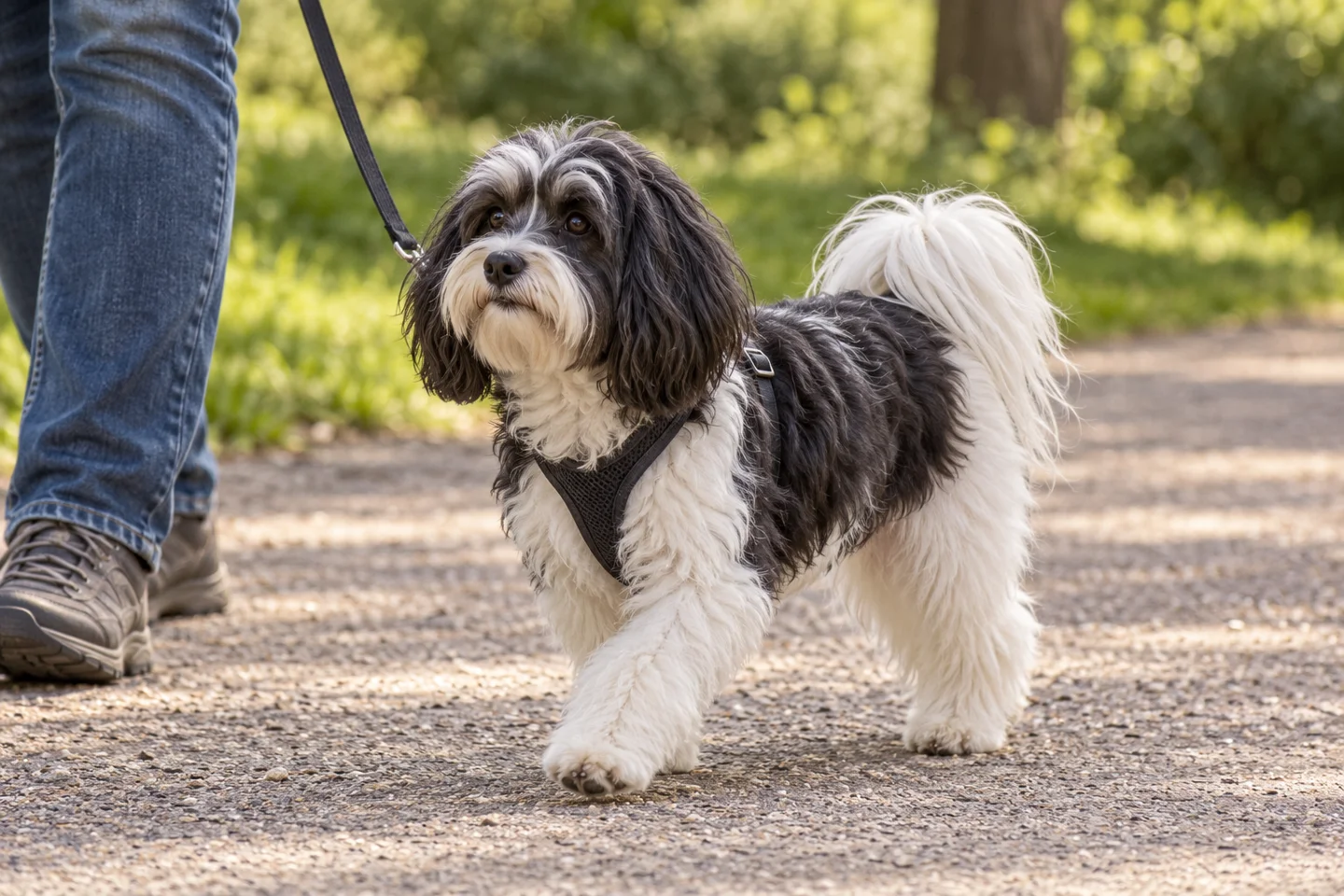
The FCI standard gives a shoulder height of 26–32 cm with a 1 cm tolerance, and an approximate weight of 6 kg. The outline is square and sturdy, with good bone, a relatively short broad head, a formed muzzle, and natural hanging ears. The coat is long, silky, and wavy without an undercoat. The full natural tail carries a plume. All colors and color combinations are permitted. The illustrations here use black and white in a practical pet trim, with unshaved hindquarters rather than the traditional show arrangement.
Look for comfortable ordinary movement beneath whichever presentation you prefer. The dog should be able to see, eat, toilet, and investigate without its hair interfering. A standard weight is not a target to impose regardless of frame, so have the veterinary team assess condition. Small dogs can gain or lose a meaningful amount without a dramatic visual change through their furnishings. Gentle handling helps the owner notice. Fit equipment to the actual body, check freedom of movement, and review it as a puppy grows. A decorative collar alone may not be the appropriate walking arrangement for an individual that can slip backward when worried.
Grooming choices should be comfortable and sustainable
The lion clip is required for FCI showing, but a companion household can discuss a different practical trim with its groomer. Whatever the style, wavy hair still needs care. Ask for a demonstration of how to inspect near the skin and maintain the coat between visits. Pay attention to friction areas, ear furnishings, and hair around the feet. Do not wait until a coat is tightly tangled and then expect the dog to tolerate a prolonged painful rescue of a hairstyle. A shorter comfortable plan may better serve the individual when routine care has become difficult.
Book enough time to discuss handling, not only the finished appearance. Tell the groomer about skin concerns, previous reactions, and any area the dog finds painful. Practise standing on a secure surface and accepting a brief touch or tool nearby before expecting a full appointment. Reward cooperation and allow breaks in ordinary training. If the dog suddenly resists familiar care, investigate discomfort rather than dismissing the change. Grooming should make useful inspection easier. It should also leave the animal able to rest comfortably afterward, with the owner understanding what was done and what needs attention before the next scheduled visit.
Training a companion for the tasks companions actually face
Teach coming when called, waiting away from a door, and going to a comfortable place while people eat or receive visitors. Begin in easy circumstances and reward the response you need. A dog that enjoys attention may find a busy greeting difficult to control without practice, so prepare a manageable version before a gathering. Use barriers to prevent access when the skill is unfinished. Every family member should know the same simple cues and rewards. The household becomes easier to manage when the dog understands what to do instead of being told only that its current behavior is wrong.
Small size can lead people to bypass training by lifting or moving the dog. Necessary handling still deserves preparation and careful support. Teach a predictable cue before lifting and keep it within the individual's comfort whenever possible. Practice safe exchanges for suitable objects rather than grabbing things from the mouth. A qualified reward-based trainer can help with situations that have become confrontational or confusing. Learning should preserve the relationship while solving a practical problem. Long sessions or repeated correction are not evidence of greater commitment; a short clear lesson that the dog can repeat tomorrow is often the more useful outcome for an ordinary companion household.
Exercise, play, and the opportunity to stop
A Löwchen needs movement and investigation as well as company. Plan walks at a pace suited to the individual, with opportunities to explore safely. Short learning games can add variety without making every day a sequence of intense activities. Ask the veterinary team about suitable demands for a puppy, an older dog, or one returning after illness. The fact that a dog wants to follow its owner does not establish that every proposed distance or sport is appropriate. Build from what it can do comfortably and observe recovery after the outing.
Choose play with a clear ending. Put equipment away, offer a quiet option, and help the dog learn that the household sometimes rests. If an activity repeatedly leaves it frantic, review the setup instead of assuming exhaustion is the only solution. Weather, hot surfaces, traffic, and crowding can make even a short route demanding. Keep an alternative exit and ready access to water when needed. Persistent stopping, altered gait, or unusual fatigue deserves veterinary advice. A precise account of what changed is useful; calling the dog stubborn or dramatic does not help the clinician assess discomfort or decide what examination is required.

Company and learning to cope with brief separations
Discuss the proposed daily schedule with the source before deciding that a companion breed will fit it. Ask what the individual has experienced when left and how it behaves during an ordinary absence. Teach comfortable time apart in small steps after its needs have been met, using a familiar resting area. Check whether the dog genuinely settles rather than treating silence as complete evidence. A recording can help describe a problem to a professional. When the current limit is shorter than your schedule, arrange support instead of repeatedly pushing beyond what the dog manages.
Introduce changes gradually where possible. A new carer, different room, and much longer absence all arriving together may make it hard to understand which part is difficult. Keep a simple record and adjust from observation. If the dog shows persistent distress, seek appropriate advice and plan how to prevent repeated overwhelming experiences during training. Do not rely on another pet to resolve the issue automatically. The goal is a household routine that supports a social animal while allowing practical independence to develop, with realistic human help when learning and daily obligations do not yet align.
Socialization should build confidence without compulsory handling
A puppy can gain useful experience through watching and investigating at a manageable distance. Ask the veterinarian how to arrange safe early exposure while vaccinations progress. Introduce everyday people, surfaces, transport, and sounds in small amounts, then allow recovery. A crowd of admirers touching a small puppy is not automatically a better lesson than a quiet outing. Ask visitors to wait for appropriate contact and give the dog a route away. An adopted adult needs unfamiliar settings introduced from its current experience rather than being expected to adapt instantly because it is mature.
Handling preparation is another part of confidence. A brief chin rest, paw touch, or pause near a brush can be rewarded separately before those steps become a full procedure. Record what is easy and what remains difficult for the groomer or clinic. Avoid interpreting immobility during restraint as proof of relaxation. Repeated avoidance, freezing, or threats indicate that the plan needs reassessment and possibly professional help. Useful socialization leaves the dog more able to cope with ordinary events, with an owner who understands its limits. It does not require a sociable-looking breed to accept every approach from every person in every place.
Aggression and the protection of a small dog’s space
A Löwchen's size and companion history cannot rule out biting. Describe any incident through the immediate events rather than a flattering or alarming label. Note who approached, what resource or handling was involved, whether the dog had a way out, and any contact or injury. Prevent repetition while obtaining qualified advice. Sudden changes in tolerance deserve veterinary assessment, particularly around touch or movement. Do not punish a warning or repeat an unsafe approach to demonstrate the behavior. The purpose of investigation is to reduce conflict and protect everyone involved.
Keep meals and resting places free from interference. Teach safe object exchanges in planned practice and ask children to obtain adult help when something needs retrieving. Maintain distance around unfamiliar dogs if the individual cannot cope with closer contact. A behavior professional can help the household agree on manageable restrictions. Give carers an accurate account of bites and near misses before they accept responsibility. If muzzle conditioning is advised, learn a comfortable approach and correct fit without abandoning barriers or supervision. Equipment supports a plan, but it cannot transform rough handling or repeated crowding into an acceptable social experience.
Children and household animals need their own arrangements
Adults should manage interactions with children closely enough to notice when the dog wants to leave. Teach children to invite contact, avoid disturbing sleep or meals, and ask for help rather than reaching into the mouth or pulling a collar. Do not let a child carry the dog around because it looks manageable in size. Necessary lifting belongs with a capable adult using suitable support. Provide a protected bed and use comfortable separation when supervision becomes divided. Ask a source about actual ages and situations observed, not only whether the dog has ever met a child pleasantly.
Resident dogs, cats, and smaller pets require separate consideration. A successful outdoor walk with one dog does not establish safe access to another animal's food or sleeping space. Introduce new canine companions with room to withdraw and organize individual resources indoors. Keep uncertain relationships physically protected, especially where a smaller pet could be harmed. Do not use release as a test of compatibility. A suitable placement needs a home layout that can support the management required. If that is not available, discuss another match before expecting the animals to tolerate a situation the people cannot reliably control.
Health evidence for eyes, hips, and patellas
The Löwchen Club of America recommends specialist eye examination, hip assessment, and patellar luxation evaluation. Its health guidance asks for results to be available to buyers and the breed health committee. Request the actual reports for the proposed parents and ask how the source interpreted them when planning the litter. A broad statement that a dog has been health tested should not replace the identity, date, method, and findings. The club's participation in a DNA programme does not make a general commercial panel a substitute for these clinical assessments.
Read results rather than relying only on a CHIC number. CHIC recognizes completion and publication of the relevant protocol, rather than guaranteeing normal findings or lifelong freedom from disease. Ask about later diagnoses in relatives and how owners can send significant information back through an appropriate confidential route. An adult with incomplete family records still deserves a current clinical plan. Bring previous treatment details and describe new changes accurately. A parent with reassuring screening does not determine the cause of a pet's current lameness or eye discomfort. The veterinary team must investigate the individual patient, while the breeder maintains a family account that becomes more useful as information accumulates.
Routine care and nutrition beyond a clean coat
A complete food should fit life stage and the individual body condition assessed with the veterinary team. Measure portions and include treats, particularly when several people enjoy rewarding a small companion. Recheck the amount when activity changes. Do not select supplements merely because a product promises a better coat. Ask what problem it is intended to address and whether it fits the current diet. Separate meals if another pet creates pressure and keep a clear account of intake when appetite or digestion changes. Persistent problems call for advice before a succession of food switches blurs the history.
Keep nails, teeth, skin, and ears in the routine alongside hair care. A dog with a beautiful trim can still have a sore mouth or an inflamed ear. Ask the clinic to demonstrate appropriate home care and report odor, discharge, repeated scratching, or new sensitivity. Avoid instruments in the ear canal and do not use leftover prescriptions for a new problem. Write medication and feeding instructions for alternate carers, including the contact to use if something changes. These simple records help maintain consistent care when the usual owner is absent, rather than expecting every helper to reconstruct a medical routine from informal messages or memory.
Mixes, realistic promises, and the ownership budget
A Löwchen mix needs an ancestry account separate from its haircut. Ask what is documented about both parents and preserve uncertainty where a rescue label rests on appearance. Neither a lion trim nor a wavy coat proves a particular cross. Mixed ancestry does not guarantee fewer health problems, predictable coat care, or a temperament halfway between two descriptions. Evaluate the individual and allow for a puppy's mature needs to change. If allergies matter to the household, assess contact with real dogs rather than accepting a low-shedding label as a medical promise.
Obtain local prices for grooming, veterinary care, transport, and sitting before collection. Include the time needed to teach cooperative care and the cost of suitable help if the owner cannot do it alone. A source should explain ongoing support and return arrangements in writing. The American club's ethics guidance emphasizes educating buyers about care, grooming, activity, and training, making those discussions part of choosing responsibly rather than an afterthought. Arrange emergency funding or appropriate insurance and understand the terms. A workable ownership plan remains useful during travel, illness, and later-life medical needs instead of depending on every week being easy.
dogsDating companionship with a quiet first step
Use dogsDating to describe this Löwchen's walking pace, comfortable distance, and restrictions on close greetings. Share a general area while keeping exact coordinates and the home address private. Agree on a public place with room for separate approaches and an easy route to leave. Each adult should manage their own animal and know any current limits before the meeting. Do not arrange the first encounter through a narrow doorway where both dogs are suddenly within reach. A useful profile prepares the outing; it cannot guarantee compatibility from two breed names.
Start with parallel walking and let both dogs investigate without being held together for a photograph. Keep shared toys and food games out of the first encounter. If either animal repeatedly withdraws, stiffens, or becomes too excited to disengage, increase separation or finish. Discuss the conditions afterward rather than deciding every dog must want close play. Repeated comfortable company may be exactly the right outcome. Choose future meetings from what helped the animals remain relaxed and manageable, and retain the option to change course. A social outing should serve the dogs' comfort as well as the owners' wish for company.
Sources and editorial notes
Sources checked October 22, 2026. Breed measurements describe reference ranges, not a diagnosis or an individual dog's ideal weight. Images are AI-generated breed illustrations and do not document a particular dog or health condition.
- AVSAB: Humane Dog Training Position Statement
- VCA Animal Hospitals: Food aggression in puppies
- Orthopedic Foundation for Animals: CHIC health screening programs
- VCA Animal Hospitals: Aggression toward unfamiliar dogs, diagnosis
- VCA Animal Hospitals: Grooming and coat care for your dog
- VCA Animal Hospitals: Ear infections in dogs (otitis externa)
- AAHA: Feeding plans for healthy, appropriate weight cats and dogs
- VCA Animal Hospitals: Heat stroke in dogs
- AVSAB: Puppy Socialization Position Statement
- VCA Animal Hospitals: Dog behavior problems, aggression toward children
- Official breed standard: Löwchen
- Löwchen Club of America: Breed health and recommended tests
- Löwchen Club of America: Code of ethics and buyer education
Keep getting to know dogs.
Read another guide or return to your dogsDating community.
Explore breed guidesBack to dogsDating