Majorca Mastiff
The Ca de Bou is a powerful Balearic mastiff whose size, guardian background, and individual behavior call for capable, realistic ownership.
How these guides are researched and reviewed

- Origin
- Spain, Balearic Islands
- Adult height
- Males 55–58 cm; females 52–55 cm
- Adult weight
- Males 35–38 kg; females 30–34 kg
- Natural features
- Rose ears and a full tapering tail
General information for owners. These articles have not been reviewed by a veterinarian. Medical decisions need your dog's history and an examination.
A placement that starts with capability and honest information
The Majorca Mastiff, also called Ca de Bou, is a powerful dog with a guardian background. A suitable owner needs to manage the actual individual in ordinary life, including visitors, veterinary care, transport, and encounters outside the home. Decide who can handle the dog safely when the usual person is unavailable. Ask the source about its experience in real situations, including anything that currently requires barriers, distance, or specialist help. An impressive appearance is not enough reason to accept a commitment whose practical demands the household cannot reliably meet.
A calm meeting with the owner present gives useful information but cannot answer every question about future behavior. Request a detailed account of routine care, incidents, and the reasons this dog is proposed for your home. Describe children, other animals, work schedules, and visitor patterns candidly. A source willing to discuss a poor match is providing a service, not obstructing ownership. Avoid pressure to prove that you can control a strong dog. The decision should be based on a workable plan and the welfare of everyone involved, rather than confidence expressed during a short visit.
Balearic history should be described without romanticizing conflict
The FCI account traces the breed through exchanges of mastiff-type dogs in the Mediterranean and later crossing in the Balearic Islands. It describes historical bull baiting and fighting as part of the background to the Ca de Bou name. Those activities belong in an accurate history, without becoming an owner's modern training goal or a measure of an individual dog's worth. The standard also records the breed's appearance in the Spanish stud book during the twentieth century. Keep historical descriptions distinct from claims about every present-day animal.
A guardian origin makes response to strangers, boundaries, and conflict relevant questions. It does not establish that a puppy will know which visitor is welcome or which event is harmless. Owners must teach usable routines and prevent avoidable confrontation. Do not encourage suspicion to make a dog appear more authentic. Ask how the source prepares its adults for ordinary handling and how it assesses temperament beyond a posed display. A dog living safely in a modern household needs cooperation, comfortable rest, and predictable management even when its historical description emphasizes courage or protective work.
Measurements and anatomy without exaggeration
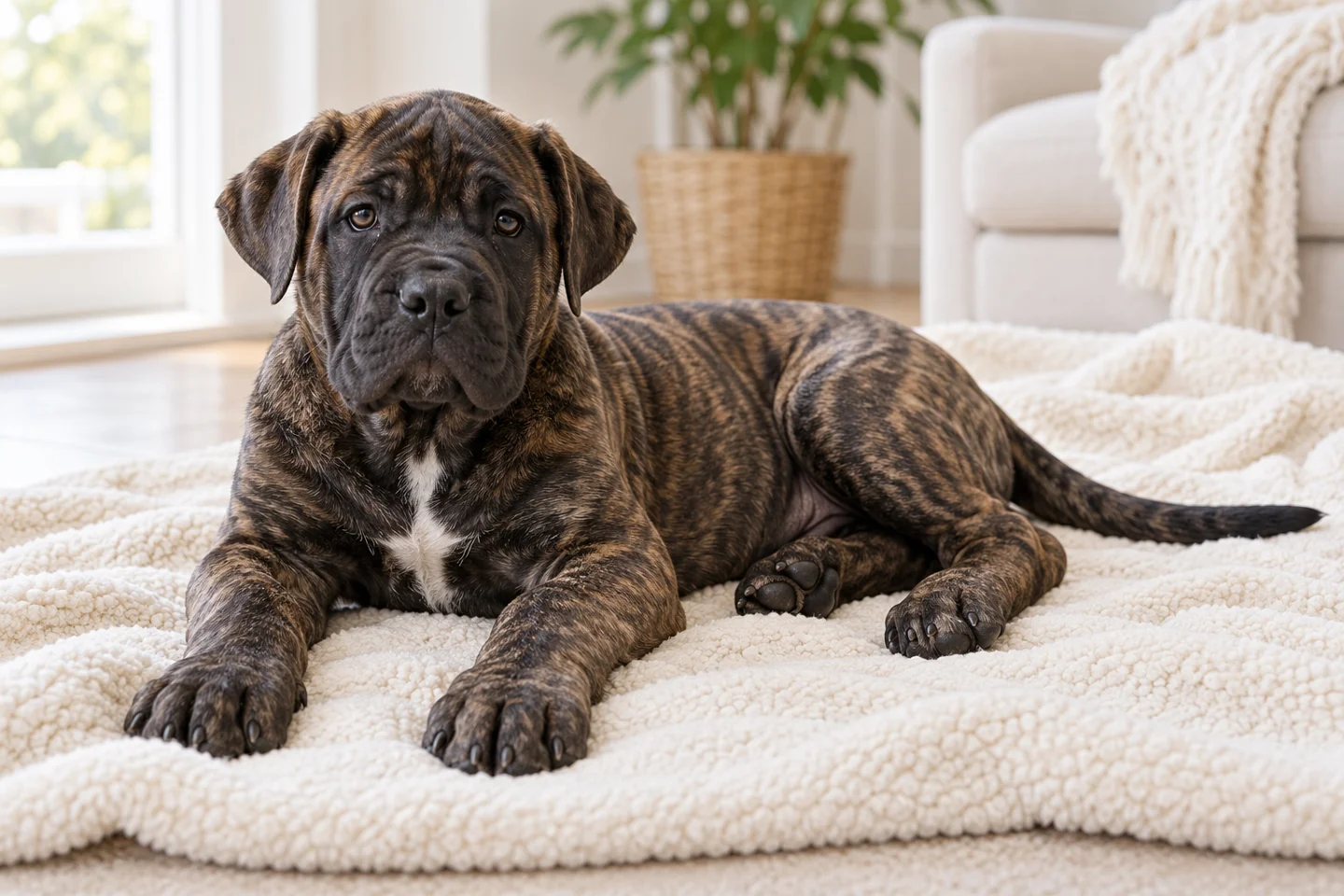
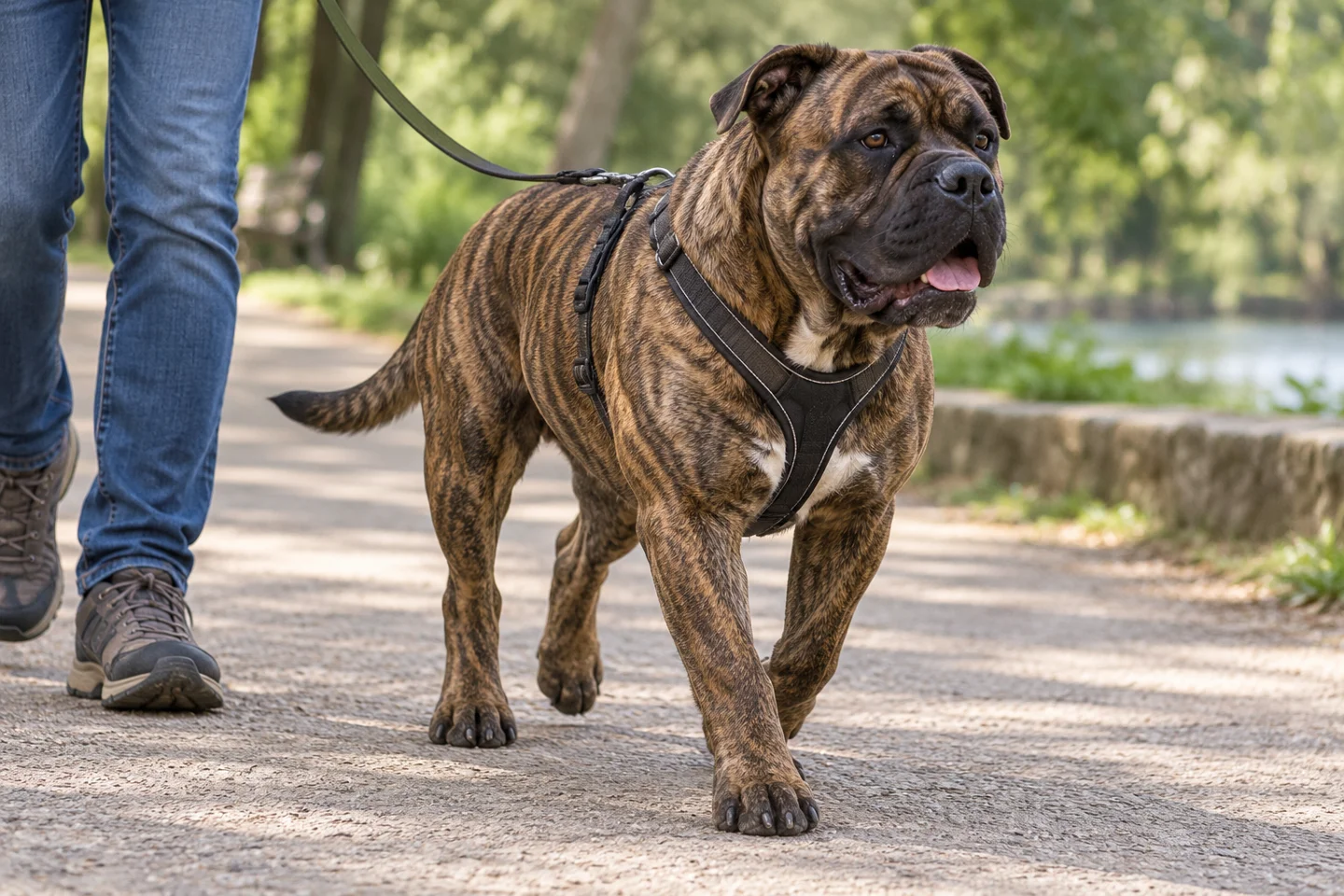
The FCI range is 55–58 cm at the shoulder for males and 52–55 cm for females. Listed weights are 35–38 kg and 30–34 kg respectively. The body is powerful and broad-chested, with a large head, short broad muzzle, natural rose ears, and a full low-set tail tapering to the tip. The coat is short, with brindle, fawn, and black recognized. The illustrations show dark brindle and a small white chest mark, retaining natural anatomy rather than cropped ears, a screw tail, or exaggerated folds.
A muscular outline should preserve comfortable movement, open breathing, and normal access to food and water. A show description is not a reason to pursue more bulk or a more extreme head. Ask the veterinarian to assess body condition and observe how the individual moves and recovers from ordinary activity. Equipment should fit the current frame securely without restricting the shoulders. Plan transport before collection, including the possibility that an adult cannot jump into a vehicle. A strong dog unable to walk needs practical help, so emergency arrangements should be more concrete than assuming someone will lift it when the moment arrives.
Training the household arrival routine
A useful early goal is a dog that can remain behind a secure barrier while a person opens the front door. Start with a quiet practice, reward the resting place, and introduce one part of the arrival sequence at a time. A delivery is not the ideal first lesson. Keep access controlled while the skill develops and explain the routine to every household member. The visitor should know where to wait before the dog is involved. This gives the owner an alternative to trying to restrain a powerful animal in an already crowded doorway.
Use reward-based instruction for recall, leaving an object, walking with manageable equipment, and returning to a resting place. A dog learning in a quiet room needs gradual preparation for more distracting settings. Reduce difficulty when it cannot respond rather than treating confusion as a challenge to authority. Choose an instructor who explains how to keep people and animals safe without relying on pain or intimidation. The owner should be able to describe what the dog has learned and what still requires management. A practiced routine is more useful than a collection of commands delivered loudly after a situation has already become unsafe.
Aggression assessment must consider the whole event
No owner's confidence and no breed reputation can replace assessment of an individual warning or bite. Record what preceded the event, the space available, who approached, what resources or handling were involved, and whether contact caused injury. Prevent another exposure while arranging veterinary and behavior advice. Sudden changes around touch, movement, or rest deserve investigation for discomfort. Do not repeat the event to show that the dog can be made to react. Demonstrations can injure people and leave the animal rehearsing a situation the household should instead be preventing.
Protect meals, chews, and quiet rest from interference. Teach exchanges only in safe planned practice, with professional help where guarding is established. Keep unfamiliar dog encounters at a distance the handler can manage, without using close contact as a test of courage or friendliness. A qualified professional can help decide which restrictions are necessary and whether the proposed home can maintain them. Give carers factual incident information before they agree to take responsibility. If a muzzle is recommended, learn gradual comfortable conditioning and correct fit while retaining barriers and supervision. A muzzle is one tool within a broader plan and cannot make unsuitable interactions acceptable.
Children and guests need adults who can enforce boundaries
A child should never be responsible for moving this dog, recovering an object, managing the lead, or deciding whether a visitor can approach. Adults need to organize those situations. Provide a protected resting place and keep meals away from interference. Teach children to stop when the dog turns away and to seek help rather than pull a collar or reach into the mouth. Close supervision requires attention; use comfortable separation when a gathering becomes too busy for that attention. The plan should exist before a visit, not be improvised after children are already running through the dog's space.
Ask a source what child experience has actually been observed, including ages, duration, and management. One calm older child is not evidence about a crowded afternoon with younger visitors. The same care applies to adult guests who want to reach toward or lean over the dog. Give instructions early and do not allow someone to override them to prove an affinity with animals. A suitable home protects the dog's ability to remain apart and the visitor's safety. If a household cannot maintain those boundaries consistently, discuss whether another placement better meets the needs of both the dog and the people who will share its environment.
Animal compatibility is an individual question
Ask about the dog's actual relationships with other animals. Separate evidence about a familiar companion from assumptions about every unfamiliar dog. Resource sharing, play intensity, sex, age, and the setting may all affect what the household needs to manage. Begin any proposed canine introduction with enough distance and professional support where indicated. Do not remove equipment to see whether a difficult greeting improves. A dog does not need close play with every visitor to have suitable activity and company, and some meetings may be inappropriate for a particular individual.
Cats, small dogs, and other vulnerable pets deserve protection where safety is uncertain. Keep physical separation rather than releasing an animal as a test. Indoors, arrange individual food and resting spaces and review access deliberately. A quiet first encounter does not establish unrestricted future sharing. Ask whether the household layout can preserve the required barriers when people are distracted or away. Management that depends on every person never forgetting one step may need redesign. If safe arrangements are not possible, choose a different placement before taking a risk that neither ordinary supervision nor hope can reliably control.
Socialization should create coping skills rather than compulsory contact
Discuss safe early experiences with the veterinary team during puppy vaccinations. Allow observation of ordinary people, vehicles, sounds, and surfaces at distances where the dog remains able to participate comfortably. A calm look from across an open space can be more useful than forced handling by a crowd. A newly adopted adult needs unfamiliar experiences introduced from its actual starting point. Ask previous carers which settings are known, which are difficult, and which have never been tried. Do not make the first weekend a public test of adaptability.
Prepare examination and equipment in short cooperative sessions. Reward a brief relaxed touch, a pause on a mat, or an easy step onto a stable surface before asking for longer handling. Tell the clinic what the dog already tolerates and what remains difficult so the team can plan. Repeated avoidance, freezing, or threats deserve reassessment and qualified guidance. Physical power should not become the method for completing every routine task. Learning that handling is predictable can improve care for a strong dog while protecting the people involved, especially when a later medical problem makes the animal less comfortable than usual.
Exercise and recovery for a powerful body
Choose activity for this dog's age, condition, and current health. A broad muscular body is not proof of endurance or readiness for a demanding new sport. Build gradually and ask the veterinarian about appropriate preparation. Include investigation and learning alongside movement, with quiet recovery afterward. A puppy should not be pushed to match an adult's workload. An older dog or one returning from injury may need a revised plan. The owner should observe the whole day, including how the animal rises after rest, rather than judging fitness only by excitement when the lead appears.
Warm conditions require practical changes: access to shade and water, reduced demands, and a route that can be shortened. Avoid treating noisy or effortful breathing as a harmless feature of appearance. Ask the veterinary team about any concern and follow urgent instructions when distress appears. Keep transport and clinic contacts ready if the dog cannot move normally. Persistent lameness, unusual fatigue, or a change in recovery needs assessment rather than tougher exercise. Comfortable daily function is a better goal than completing an arbitrary route or encouraging weight gain because an owner wants the dog to look more imposing.
Grooming and routine inspection under a short coat
A short coat still benefits from gentle care and inspection. Brush appropriately, check the skin under equipment, and look at the feet after outings. Introduce these tasks before they are medically necessary, using brief comfortable practice. Maintain nails and teeth with advice from the veterinary team. Avoid assuming a powerful dog should tolerate painful restraint for routine work. If the dog suddenly resists an area it previously accepted, stop and consider discomfort. A clear observation can help the clinician investigate before the household turns a medical change into a conflict over cooperation.
Ear odor, discharge, redness, or repeated scratching needs advice. Do not push tools into the canal or use leftover medication. Keep product details if the skin reacts and tell a professional what changed before signs appeared. Routine care should also include a measured complete diet appropriate to life stage and condition. Count rewards and review intake as activity changes. A standard weight is not an instruction to feed every dog to one number regardless of frame. If appetite or digestion changes persist, keep a timeline and seek assessment before a succession of diet changes makes the clinical history harder to understand.
Health screening and the precise meaning of a credential
RSCE lists hip and elbow dysplasia tests for the Dogo Mallorquín, or Ca de Bou, within the PedigreeRSCE Plus programme. That is a defined credential with its own requirements. It should not be described as a universal rule applying to every dog worldwide or as proof that any pedigree automatically includes the tests. Ask whether the proposed parents hold that credential and obtain the underlying identified results. If the source follows a different programme, ask it to name the programme and explain the assessments actually performed.
RSCE's joint guidance explains why apparently sound movement cannot replace screening: some structural changes are visible on radiographs before they are obvious in everyday walking. At the same time, a parental report cannot diagnose a pet's new discomfort. Keep the individual's injury, treatment, and recovery history available to the veterinarian. Ask how significant later diagnoses in relatives are recorded and communicated back to the breeding adviser. Avoid assigning invented disease frequencies to a less common breed or importing another mastiff's complete panel without evidence. A useful medical conversation distinguishes family screening, current examination, and what remains unknown, so decisions rest on the actual records rather than an impressive certificate heading. Request copies in a language your receiving veterinarian can interpret, especially when the dog and its medical history move between countries.
Mixes, source claims, and lifetime costs
A Majorca Mastiff mix needs a documented parentage account if one is available. A broad head, brindle coat, or muscular build cannot identify the cross by itself. Keep uncertain rescue labels tentative and ask what was observed directly. When parents are known, review relevant information about both rather than assuming mixing removes inherited illness or makes guardian behavior easier. The actual animal's condition, handling, social history, and daily needs should guide the placement. A puppy's adult body and responses remain in development, even when its current appearance seems to support a confident prediction.
Budget for suitable veterinary care, transport, durable equipment, training support, and carers capable of following the dog's actual restrictions. Obtain local prices and confirm availability rather than assuming any boarding space will fit. Written source support and return arrangements should be clear before collection. Arrange emergency funding or appropriate insurance and understand the terms. The household also needs a plan if the usual handler is ill or the dog needs reduced activity. Ownership is more sustainable when the practical support exists in advance, rather than relying on one person's strength and uninterrupted availability to manage every difficult situation.
dogsDating meetings may require a conservative plan
Use dogsDating to describe the individual's comfort and restrictions accurately. A dog with established conflict may need professional guidance before any social meeting is proposed. Share only an approximate area and keep exact coordinates and the home address private. If an outing is suitable, choose a public open route, tell the other handler the necessary distance, and avoid narrow entrances. Each adult must be able to manage their own dog throughout. A profile should prepare a realistic walk rather than use a breed reputation to promise compatibility or invite someone to test the dog's limits.
Begin with parallel movement and maintain enough separation for both dogs to disengage. Keep toys, shared food, and close greetings out of the first encounter. Either person should be able to end the meeting without pressure to prove success. If a dog stiffens, repeatedly tries to leave, or becomes too aroused for manageable walking, increase distance or finish. Note the conditions afterward and follow the individual's professional plan where one exists. Quiet company at a suitable distance can be the useful outcome. The animals' safety and comfort should determine the next step, including deciding that a proposed partnership is not appropriate.
Sources and editorial notes
Sources checked October 22, 2026. Breed measurements describe reference ranges, not a diagnosis or an individual dog's ideal weight. Images are AI-generated breed illustrations and do not document a particular dog or health condition.
- AVSAB: Humane Dog Training Position Statement
- VCA Animal Hospitals: Food aggression in puppies
- VCA Animal Hospitals: Common emergencies in dogs
- Orthopedic Foundation for Animals: CHIC health screening programs
- VCA Animal Hospitals: Aggression toward unfamiliar dogs, diagnosis
- VCA Animal Hospitals: Grooming and coat care for your dog
- VCA Animal Hospitals: Ear infections in dogs (otitis externa)
- AAHA: Feeding plans for healthy, appropriate weight cats and dogs
- VCA Animal Hospitals: Heat stroke in dogs
- AVSAB: Puppy Socialization Position Statement
- VCA Animal Hospitals: Dog behavior problems, aggression toward children
- Official breed standard: Majorca Mastiff
- Real Sociedad Canina de España: Breed tests for the PedigreeRSCE Plus credential
- Real Sociedad Canina de España: Hip and elbow dysplasia screening
Keep getting to know dogs.
Read another guide or return to your dogsDating community.
Explore breed guidesBack to dogsDating