Mastiff
A giant British breed whose calm reputation must be matched by cooperative handling, sound growth, and realistic transport and medical plans.
How these guides are researched and reviewed

- Origin
- Great Britain
- AKC minimum height
- Males 30 inches; females 27.5 inches
- Build
- Very large, broad, deep, and powerfully boned
- Coat
- Short; fawn, apricot, or brindle with dark mask
General information for owners. These articles have not been reviewed by a veterinarian. Medical decisions need your dog's history and an examination.
The giant adult should be part of the first conversation
A Mastiff puppy becomes a very large dog, and the ownership decision should be made around that adult body. Think through vehicle access, doorways, resting space, veterinary visits, and who can provide safe care if the usual handler is unavailable. A calm reputation does not make those practical questions disappear. Meet adults and ask how they behave when a walk ends, a visitor arrives, or handling is needed. The household should understand the teaching behind a settled dog rather than assuming size and apparent gentleness will produce an effortless companion.
Choose a source willing to discuss inconvenient details. Ask about medical history, behavior around other animals, visitor routines, and any current restrictions. Explain the people, layout, work hours, and support available in your home. A placement should remain workable during an ordinary difficult week, not only during a relaxed first meeting. Confidence in one's ability to hold a lead is not a complete plan for a giant dog. Cooperative skills, suitable equipment, professional support, and an environment that prevents avoidable conflict matter throughout life, including when injury or age later changes what the animal can do comfortably. Before collection, ask your clinic about accessible entrances and available assistance, and practise the transport arrangement while the dog is comfortable. Checking those details early can reveal a practical problem that an attractive puppy photograph never shows.
British history and the difference between a breed and a broad type
Mastiff is both the name of this breed and a word often used loosely for a group of powerful dogs. Keep the distinction clear. A Majorca Mastiff, Bullmastiff, and Tibetan Mastiff have separate identities; their names do not make them varieties of the British Mastiff. The FCI account describes the long British association with mastiff-type dogs and a severe reduction in numbers around the Second World War, followed by imported stock. Historical references to earlier dogs should not become claims that every modern feature existed unchanged across all those centuries.
For an owner, the current family and individual matter more than an imposing historical story. Ask how the source assesses soundness and temperament and how adults cope with contemporary household demands. A guardian background does not teach a puppy which stranger is welcome. Encourage predictable visitor routines rather than suspicion for effect. The dog should not be expected to demonstrate courage through confrontation. A suitable modern companion needs comfortable care, manageable boundaries, and people who can make practical decisions when a situation is beyond the animal's present coping ability.
Height guidance and a body that must remain sound
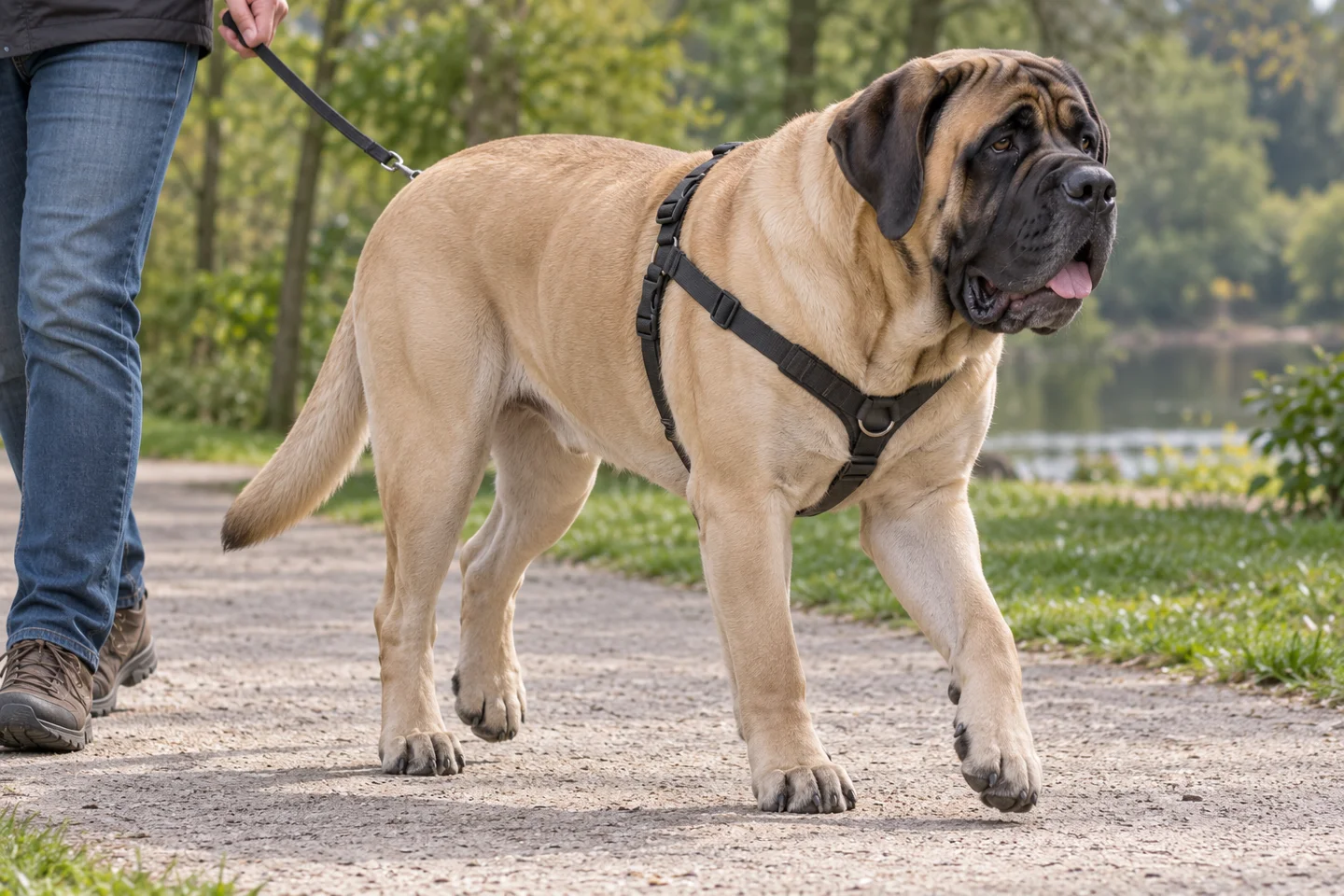
The AKC standard sets minimum shoulder heights of 30 inches for males and 27.5 inches for females. These are minimums, not complete expected ranges. The current FCI standard emphasizes proportion and soundness without supplying the same numerical height limits. The broad deep body is longer than tall, with a large square head, small natural hanging ears, and a full tapering tail. Fawn, apricot, and brindle coats carry a dark mask. The illustrations show fawn, open eyes and nostrils, and natural anatomy without excessive folds or an artificially shortened tail.
The standard's size language should never become a reason to pursue extra weight regardless of condition. Ask the veterinarian to assess the individual frame and growth. A massive appearance can be achieved in an unhealthy way, while a photograph cannot show all aspects of comfort. Watch ordinary movement and recovery, including rising from rest and entering transport. Fit equipment to the current animal and recheck during growth. Space should permit the dog to lie naturally rather than remain folded into a convenient corner. The practical goal is a sound body the animal can use comfortably, not the highest number the owner can report.
Training is essential before strength becomes inconvenient
Teach waiting behind a barrier, coming toward the handler, and moving onto a bed while the dog is still easy to guide through an ordinary space. Reward the useful response and add distraction in manageable steps. A delivery or crowded visit is a difficult place to introduce an unfinished skill. Keep access controlled while learning and tell household members how to follow the same routine. A giant dog that pauses before a gate opens has learned something more useful to daily safety than a dramatic demonstration performed only when the environment is quiet.
Teach transport and care tasks separately. Entering a vehicle, standing for inspection, and turning away from an object can be practised briefly with appropriate rewards. Do not wait for pain or an urgent appointment to make all those steps unfamiliar at once. A reward-based professional can help when the animal is worried, guarding, or struggling to respond. Ask how the instructor handles those circumstances before choosing a class. Cooperation should be explained rather than imposed through intimidation. A dog able to resist several people benefits from early clear learning, but physical power is not the only reason to preserve predictable, humane handling.
Aggression and the practical importance of preventing repeats
A Mastiff can cause serious harm, and a calm reputation must not obscure an individual's warning or bite. Record the actual sequence: who approached, what handling or resource was involved, how much space existed, whether contact occurred, and any injury. Prevent another exposure while arranging professional assessment. Sudden changes in tolerance, especially around touch or movement, need veterinary attention. Do not recreate the event for a demonstration or allow a visitor to test the dog. Understanding the circumstances should lead to a safer plan, not another opportunity for the conflict to happen.
Protect food, chews, and rest from interference, and teach exchanges through suitable planned practice. Around unfamiliar animals or people, maintain the space and barriers the dog needs. A qualified behavior professional can help determine realistic restrictions and whether the home can sustain them. Give carers the plan and a factual incident history before they accept responsibility. If muzzle conditioning is recommended, obtain instruction on fit and comfortable introduction while retaining other safeguards. Equipment is one part of prevention. It cannot make crowding, rough handling, or competition over a valued resource a suitable way to prove that the animal is usually friendly.
Children and visitors need a calm enforceable routine
Adults should organize contact with children and visitors. A child must not manage the lead, move a resting dog, retrieve an object from the mouth, or decide who can approach. Teach children to invite contact, stop when the dog leaves, and leave sleep and meals undisturbed. Provide a protected resting place and use comfortable separation when supervision cannot remain attentive. Even an affectionate giant can create difficulty through ordinary movement in a crowded space, so plan the layout rather than relying only on intention. Guests need clear instructions before the interaction becomes busy.
Ask the source about actual child experience, including ages, duration, and the management involved. A calm meeting with one visitor cannot answer every future family occasion. Do not allow people to lean over the dog or insist on a greeting to demonstrate their confidence. The owner needs to enforce boundaries consistently. If the household cannot provide a secure comfortable area during a gathering, resolve that before placement. A good arrangement gives the dog and people predictable ways to remain apart, instead of leaving them to negotiate discomfort in the middle of a long visit when the adults' attention is already divided.

Other dogs and smaller pets require individual evidence
A familiar canine companion does not establish that the Mastiff can share space with every unfamiliar dog. Ask about actual interactions and distinguish walking company from close play or indoor resource sharing. Begin proposed introductions with enough room for both handlers to leave and seek professional help where a history of conflict exists. Avoid removing equipment to see whether the animals resolve a difficult greeting themselves. A dog does not need unrestricted play with strangers to receive suitable company and activity, and a particular pairing may remain unsuitable.
Smaller dogs, cats, and other pets deserve protection where safety is uncertain. A mismatch in size or play intensity can create risk even when the interaction begins without threatening behavior. Maintain physical separation as needed and never release a vulnerable animal as a test. Indoors, arrange separate food and resting spaces and review access deliberately. Ask whether the home can maintain boundaries during ordinary distractions and absences. Management should be practical for everyone responsible, rather than depending on one strong handler being present at all times. If the arrangement cannot be maintained reliably, a different placement may better protect all the animals involved.
Socialization and the preparation for clinical care
Discuss safe early experiences with the veterinary team while puppy vaccinations progress. Introduce ordinary people, surfaces, sounds, and transport in small amounts that let the dog investigate and recover. Crowded compulsory greetings are not the only way to learn. Let an uncertain puppy watch from a comfortable distance, and give a newly adopted adult the same room to begin from its actual experience. Ask previous carers which settings are known and which remain untested. Do not make the first week an examination of everything the household eventually hopes the dog will tolerate.
A stable mat and brief rewarded handling can prepare the dog for routine examination. Teach one small step before expecting a complete procedure, and tell the clinic what remains difficult. Repeated freezing, avoidance, or threats require a revised plan and qualified support. An animal becoming still under restraint is not necessarily comfortable. If pain or urgent illness is already present, seek care rather than delaying for training; the team can choose an appropriate method based on the history. Cooperative preparation remains valuable when the dog is well, allowing future care to begin from familiar steps instead of an avoidable struggle.
Exercise and rest without a race toward adult bulk
A growing Mastiff needs activity and nutrition suited to its stage, not a campaign to become as large as possible quickly. Ask the veterinary team about an appropriate plan and build demands gradually. Use suitable walks and gentle learning with time for rest. A young animal should not be pushed to match the workload of a mature trained dog. Adults returning after injury also need preparation. Look at movement and next-day recovery rather than assuming willingness to follow proves every proposed distance is safe.
Provide comfortable resting surfaces and consider how the dog gets up, turns, and enters transport. Adjust outings for heat, water access, and available shade. A short coat and a calm pace do not remove weather risk or make a hot vehicle safe. Persistent stiffness, lameness, unusual fatigue, or a breathing change deserves assessment. Record what happened and when it began instead of treating discomfort as stubbornness. Complete nutrition and measured portions should support body condition appropriate to the individual. Adding weight or supplements to create an impressive outline can undermine the ordinary function that a responsible owner should value more highly.
Health testing needs careful reading of protocols
The Mastiff Club of America Health Committee distinguishes clinical screening from DNA tests and separates CHIC protocol items from additional recommended assessments. Its published CHIC list includes hips, elbows, specialist eyes, and cardiac evaluation, while other assessments include thyroid and cystinuria work. Ask the source to explain the current applicable protocol and provide identified results for both parents. Do not treat every optional test, club award, and registry requirement as interchangeable. A completed protocol or CHIC number means results are available; the actual findings still need to be read.
The committee's cystinuria guidance distinguishes a urine test used for intact males from an associated DNA marker. Ask the veterinarian what a result does and does not establish for the individual. A generic claim that all urinary disease is excluded would be misleading. Obtain family information beyond the parents when available and ask how later diagnoses are recorded. For an adult, collect its own previous injuries, medication, restrictions, and follow-up instructions. New signs require clinical investigation despite reassuring family records. Screening can inform decisions, but it cannot determine the cause of today's patient's discomfort without an appropriate examination and history.
Health planning includes knowing when bloat is an emergency
Gastric dilatation-volvulus, often called GDV or bloat, is a life-threatening emergency involving stomach distension and twisting. Cornell identifies large deep-chested dogs as an at-risk group. Repeated unsuccessful attempts to vomit, a swollen or painful abdomen, marked restlessness, drooling, weakness, or collapse need immediate veterinary contact. Do not wait for every sign or attempt an internet remedy before calling. Tell the clinic what you see and follow its instructions while arranging transport. Everyone providing care should know the emergency number and how the dog can reach help.
Discuss preventive gastropexy with your veterinarian rather than assuming a universal feeding rule eliminates risk. The American College of Veterinary Surgeons explains that the operation aims to prevent twisting; it does not make every future abdominal problem harmless or remove the need to respond to concerning signs. Ask about the individual's risk, possible benefits, timing, limitations, and recovery. Keep any procedure in the medical handover so another clinic or carer knows what was done. A giant dog's emergency plan must also address practical movement and vehicle access. Preparation is useful precisely because the owner may have little time to solve those logistics during a sudden illness.
Grooming, nutrition, and costs that scale with care
The short coat needs suitable gentle brushing and inspection rather than elaborate styling. Check skin under equipment, feet after outings, nails, and the mouth through routines advised by the veterinary team. Ear odor, discharge, redness, or persistent scratching deserves advice rather than tools pushed into the canal or leftover medication. A sudden change in tolerance of touch should prompt consideration of pain. Keep product and treatment details when a reaction occurs. A dog described as robust still needs regular care and observations precise enough for someone else to act on.
Measure complete food appropriate to life stage, count rewards, and review condition with the clinic as activity changes. Plan local costs for veterinary care, food, transport, equipment, training help, and suitable cover during absences. Confirm that a sitter can manage the actual dog's routines rather than assuming acceptance of large breeds is enough. Clarify written support and return arrangements with the source and arrange emergency funding or appropriate insurance. The commitment needs to remain workable if the usual handler is ill or the dog requires reduced exercise and extra care. A giant animal's needs should not depend on one person's uninterrupted availability.
Mixes and dogsDating plans should follow the actual animal
A Mastiff mix needs an honest parentage account where one is available. A large square head cannot establish the cross by itself, and uncertain rescue labels should remain tentative. Consider relevant information about both known parents without assuming mixing guarantees better health or a predictable middle temperament. On dogsDating, describe the individual's pace, greeting restrictions, and any professional plan relevant to a safe outing. Share an approximate area while keeping exact coordinates and the home address private. A dog with established conflict may need advice before a proposed meeting is suitable at all.
For an appropriate walk, choose a public open starting point, keep enough distance for parallel movement, and ensure each adult can manage their own dog. Avoid shared toys, food between unfamiliar animals, and pressure for close greetings. Increase separation or finish if either dog repeatedly withdraws, stiffens, or cannot disengage comfortably. Compare conditions afterward rather than judging success by play. A quiet walking partner can be valuable, while some pairings will remain unsuitable. The owners should respond to the actual animals and retain an easy route to leave, without letting a social profile become a promise that overrides comfort or safety.
Sources and editorial notes
Sources checked October 22, 2026. Breed measurements describe reference ranges, not a diagnosis or an individual dog's ideal weight. Images are AI-generated breed illustrations and do not document a particular dog or health condition.
- AVSAB: Humane Dog Training Position Statement
- VCA Animal Hospitals: Food aggression in puppies
- VCA Animal Hospitals: Common emergencies in dogs
- Orthopedic Foundation for Animals: CHIC health screening programs
- VCA Animal Hospitals: Aggression toward unfamiliar dogs, diagnosis
- VCA Animal Hospitals: Grooming and coat care for your dog
- VCA Animal Hospitals: Ear infections in dogs (otitis externa)
- AAHA: Feeding plans for healthy, appropriate weight cats and dogs
- VCA Animal Hospitals: Heat stroke in dogs
- AVSAB: Puppy Socialization Position Statement
- VCA Animal Hospitals: Dog behavior problems, aggression toward children
- Official breed standard: Mastiff
- American Kennel Club: Official Mastiff standard and minimum heights
- Mastiff Club of America Health Committee: Health testing protocols
- Cornell University: Gastric dilatation volvulus or bloat
- American College of Veterinary Surgeons: Preventive gastropexy
Keep getting to know dogs.
Read another guide or return to your dogsDating community.
Explore breed guidesBack to dogsDating