Miniature Schnauzer
The Miniature Schnauzer combines a compact, sturdy body with an alert manner and a beard that needs practical care. Good routines address barking, coat maintenance, food choices, and the breed’s specific health screening.
How these guides are researched and reviewed
- Origin
- Germany
- Adult standard size
- Both sexes 30–35 cm; approximately 4–8 kg
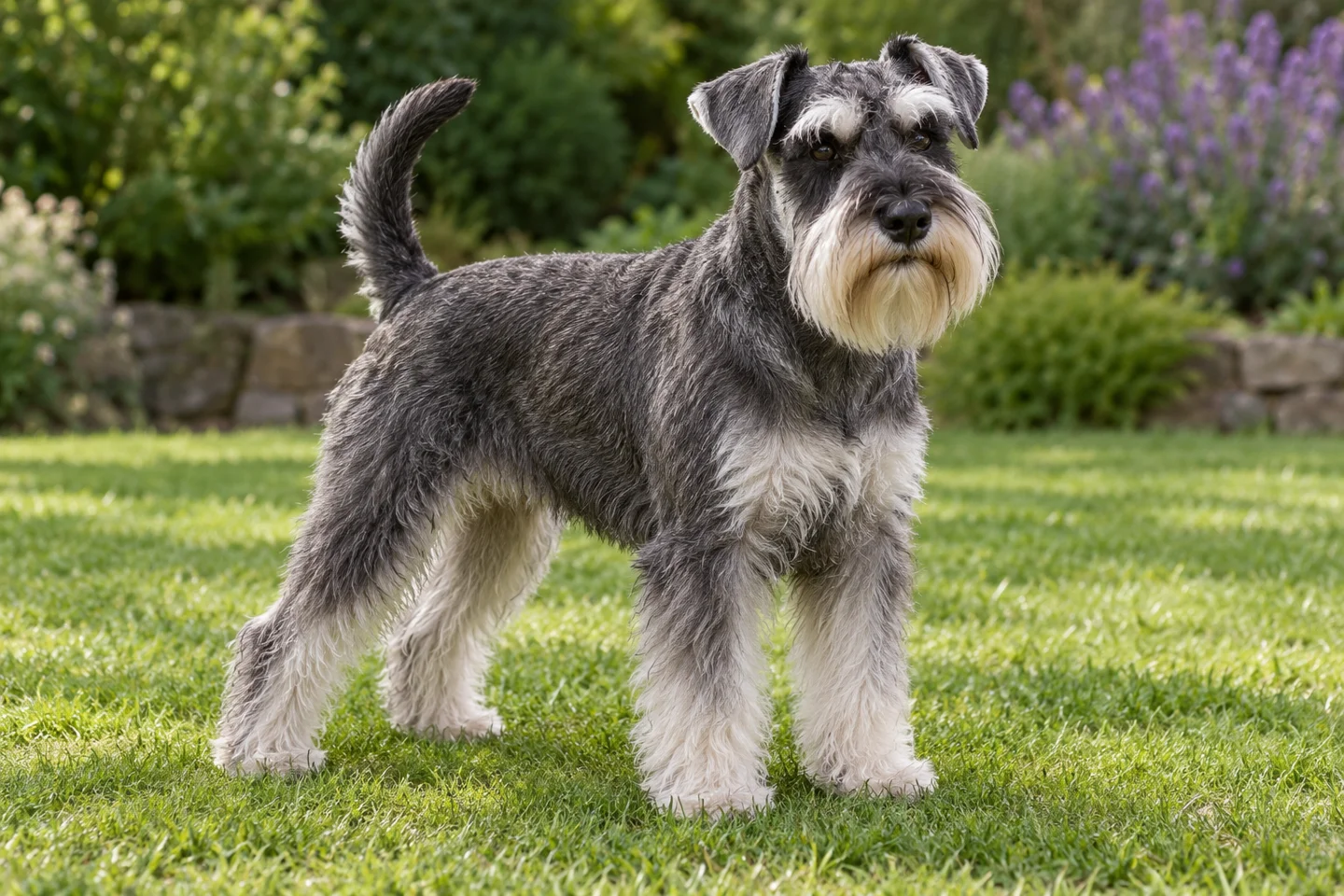
- Illustrated coat
- Salt-and-pepper wiry coat
General information for owners. These articles have not been reviewed by a veterinarian. Medical decisions need your dog's history and an examination.
A separate Schnauzer breed
The Miniature Schnauzer is a distinct German breed, known in its country of origin as Zwergschnauzer. It belongs to the Schnauzer family, alongside the Standard and Giant Schnauzers, but those names do not describe interchangeable sizes of one registration entry. Its square frame, wiry coat, eyebrows, and beard give it a recognizable outline. Ask a source to identify the registered parents and the relevant standard when an advertisement uses informal size labels.
A compact dog can fit into a small home while having a considerable interest in the activity outside it. Before choosing one, consider the sounds at your entrance, access to walking routes, and where grooming will happen. A beard collects water and food; a watchful dog may comment on people using a communal corridor. These are manageable details when planned for, but they deserve attention before the puppy arrives. Meet adults and observe ordinary behavior instead of choosing solely from an appealing portrait with freshly trimmed furnishings.
History, purpose, and current life
The FCI account describes small rough-coated dogs around Frankfurt and the work involved in establishing a consistent miniature Schnauzer type. The modern breed retains the strong, substantial appearance of a Schnauzer in a small frame. Its history as a watchful companion provides context for alert behavior, without predicting how a particular animal will react to an unfamiliar person. Ask what the parents actually do when they hear the doorbell and how quickly they settle afterward.
In a modern household, useful work can be simple. Searching for a hidden reward, learning a route around a training cone, or walking somewhere with new smells gives the dog something to do with its attention. A yard used only for barking at a fence is a limited substitute for shared activity. Consider whether you enjoy teaching small skills repeatedly. If you need a dog that remains quietly in the background through every change of routine, assess an individual adult carefully and ask about its history in a home similar to yours.
Size, colors, and coat identity
The FCI height range for both sexes is 30–35 cm at the withers, with an approximate weight of 4–8 kg. These are adult conformation references. They should not be used to restrict a puppy's growth or to excuse excess body fat in a dog that happens to fall inside the range. A veterinarian can assess the frame and condition beneath the furnishings and explain a useful weight-monitoring plan.
The standard describes a harsh double coat and recognizes several colors, including salt and pepper, black, black and silver, and white. This guide's AI-generated illustrations select salt and pepper, with natural folded ears and a full tail. They cannot document ancestry or provide evidence about a real dog's skin, gait, or health. Ask a groomer to explain how the apparent silhouette changes with trimming. A lavish skirt or sculpted beard is a presentation choice, while sound movement, comfortable skin, and a coat that can be maintained at home are practical ownership concerns.
Personality and sharing household attention
An individual Miniature Schnauzer may be interested in visitors, sounds, and whatever its family is doing. Help it learn that watching a person does not always begin a game. Keep a comfortable resting place where the dog can see enough to feel included without supervising the entrance continuously. Reward spontaneous quiet pauses. Repeatedly calling a resting puppy over to entertain people can make it harder to establish a calm rhythm.
Prepare for absences with steps the dog can manage, and use direct observation or a camera to understand its response. Noise heard by a neighbor may reflect several different problems, including distress or environmental triggers. Avoid assuming that a second dog will solve the cause. Discuss persistent difficulty with a veterinarian and a qualified behavior professional. If you work from home, practice ordinary brief separations too. The eventual need for an appointment, hospital visit, or family trip is easier to manage when the dog has experienced safe care beyond constant access to one person.
Barking and reward-based training
An alert bark can become a rehearsed routine when the dog repeatedly sees people at the window and they eventually disappear. Change the environment as well as teaching a response. Use a quieter resting location or an appropriate visual barrier, then practice coming away from a mild sound for a reward. Begin with an intensity the dog can handle. Trying the hardest version at a crowded front door offers little opportunity to learn.
Teach the behaviors you will use every day: walking without pulling, releasing a found object, waiting behind a barrier, and going to a mat when asked. Keep rewards ready before practice begins and increase difficulty gradually. A dog that cannot respond around another animal may need distance rather than a louder cue. Choose a trainer who can explain a reward-based plan and who considers fear, pain, and the environment. Physical or frightening corrections can create new difficulties with the things present during the correction, including other dogs and unfamiliar people.
Aggression and protecting the dog's choices
A Schnauzer's alert expression does not tell you whether it is comfortable with an approaching hand. Consider the context. A dog may object to someone reaching over its head, pulling a tangled beard, or removing a valued chew. Prevent those situations where possible, teach cooperative alternatives, and take warning signals seriously. Growling is information that an interaction needs to change. Suppressing it without addressing the problem can make future behavior less predictable to the person involved.
If the dog has bitten or repeatedly snapped, involve the veterinarian and an appropriately qualified professional. Explain what preceded the incident and whether the dog had a way to leave. New aggression during grooming or touch warrants investigation for discomfort. Separate the dog safely from situations it cannot currently manage rather than testing its tolerance with visitors. A small dog can still injure someone, and an individual should never be described as safe because a breed profile calls the breed friendly. Management should reflect what that particular animal has shown you.

Children and comfortable contact
Children should learn how the dog invites contact and how it ends an interaction. A beard is not a handle, and eyebrows should never be pulled aside for amusement. An adult can demonstrate gentle stroking on a willing dog and then pause so the dog can choose whether to stay. Avoid crowded lap sessions in which several children lean over it. Floor-level training games with clear adult supervision often provide a more comfortable way to spend time together.
Use physical separation when the household is too busy for close supervision. Meals, sleep, and valued chews need protected space. Visiting children require guidance even when the dog lives happily with familiar ones. Watch for retreat, a stiff body, repeated avoidance, or hiding beneath furniture, and stop before the dog has to escalate. If a child is frightened, do not use the dog as a forced confidence exercise. Choose an arrangement that allows both to feel secure. Their relationship should develop through manageable experiences rather than a demand that either tolerate unlimited contact.
Other animals and introductions at home
A new dog should not immediately share every resource with a resident Miniature Schnauzer. Arrange separate food stations, sleeping areas, and time with people. Begin meetings in a place where both handlers can move easily, then supervise the transition into the home. Friendship on a walk does not automatically establish comfort around a favorite chair or bowl. Look for the contexts that change behavior and adjust the arrangement accordingly.
Cats need protected routes and time away from the dog. Reward the Schnauzer for noticing the cat and disengaging, using reliable separation while assessing its response. Never make a cat remain still for inspection. Small pets require secure housing beyond the dog's reach, and pursuit can occur despite a companion-dog label. If another dog plays roughly, protect the Schnauzer from being overwhelmed while also preventing it from repeatedly pestering an unwilling partner. Good play includes the ability to pause. Choose companions according to observed interactions instead of assuming that matching size or breed will create a reliable friendship.
Exercise and using the mind
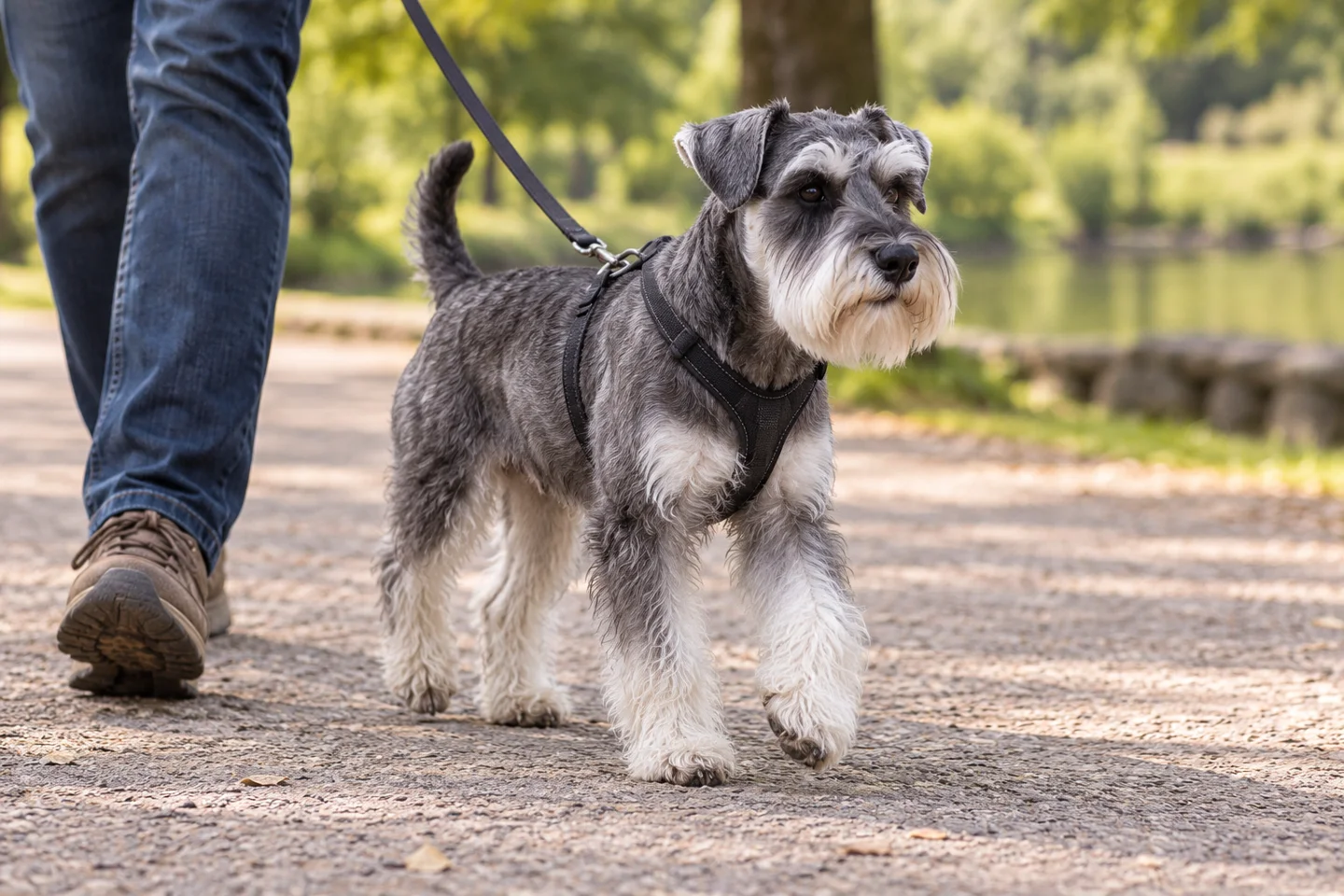
A Miniature Schnauzer benefits from regular walks, exploration, and interactive play. Adjust the amount to the individual dog's condition and stage of life. A steady walk with time to smell can be useful on a day when a busy training venue would be too stimulating. Combine activity with recovery, and avoid turning every evening into an attempt to exhaust the dog into silence. Arousal and physical fitness are different aspects of the routine.
Build new activities gradually and check footing before running or jumping. In heat, choose cooler times and provide water and shade. After wet or muddy activity, inspect paws and furnishings and dry the dog appropriately. Notice changes in willingness to move, recovery, or gait instead of explaining them away as stubbornness. The veterinary team can help assess a dog whose normal routine has suddenly become difficult. During injury recovery, ask which quiet activities are suitable rather than improvising energetic games indoors that may defeat the purpose of restricted exercise.
Grooming the coat, beard, and furnishings
Comb furnishings far enough to find tangles close to the skin without scraping. Work gently around the legs, chest, and beard, where food, water, and friction can create hidden knots. A brush moving smoothly over the surface does not prove that the layers beneath are clear. Use short sessions that keep the dog comfortable, and ask a groomer to demonstrate suitable tools on your actual dog's coat.
Discuss clipping and hand-stripping with someone experienced in Schnauzer care. Coat texture, skin condition, your maintenance routine, and any show plans affect the appropriate approach. Severe matting may require removal rather than prolonged pulling. Keep the beard clean and dry enough to inspect the skin, and report irritation. Check nails and introduce dental brushing as separate skills. Examine the outside of the ears and obtain advice about repeated odor, discharge, or scratching. Avoid inserting cotton buds or instruments into the canal. A neatly shaped head should never conceal discomfort that makes the dog avoid touch.
Choose a practical location for washing the beard after meals. Keep suitable towels and tools nearby, and teach the dog the routine before it is urgently needed. A stable surface and predictable sequence help prevent a daily cleaning task from becoming a struggle around the face.
Health testing and the report behind a label
The American Miniature Schnauzer Club recommends annual specialist eye examination and specified cardiac evaluation. Its published recommendations also identify optional but recommended DNA tests for myotonia congenita, MAC, and PRA Type B HIVEP3. Ask exactly which examinations and variants were assessed and obtain the reports linked to the right dog. The designation of the PRA test matters; a broad statement that a dog had a DNA panel is inadequate detail.
Use those records to discuss the particular mating or adult dog with an informed veterinarian. Clinical screening and a genetic result address different questions, and neither predicts every later diagnosis. Ask how a breeder shares new information about relatives after puppies leave. If stiffness, weakness, or vision changes occur in your dog, arrange clinical assessment rather than assuming the cause from an online breed description. The veterinarian may need history and examination beyond any inherited-disease result. Keep copies when moving practices so the next clinician can see the original evidence instead of an owner's recollection of a reassuring phrase.
Pancreatic and urinary health in daily life
The breed club includes pancreatitis and urinary stones among its health topics. These are reasons to pay attention to clinical signs and feeding history, not reasons to diagnose every stomach upset or urinary change at home. If a dog becomes painful, vomits repeatedly, or seems unwell, contact the veterinary team with a clear account of what happened and what it ate. An animal struggling to pass urine needs urgent veterinary attention.
Discuss dietary management according to an actual diagnosis. Urinary stones differ in composition, and a product sold for urinary health may be inappropriate for a particular condition. Likewise, do not independently prescribe a restrictive diet because a relative had pancreatitis. Keep an accurate food record that includes treats, chews, table scraps, and access to bins. If testing is planned, follow the clinic's instructions about preparation rather than guessing. For a dog with previous episodes, obtain a written plan explaining which changes require a prompt call and how routine follow-up will be arranged.
Food, mixes, and ownership costs
Measure a complete life-stage-appropriate food and review body condition beneath the coat. Several people rewarding the dog can unintentionally provide far more than the recorded meal. Agree how training food is allocated. A change in appetite or thirst deserves attention rather than an automatic switch to richer food. Your veterinarian can help connect the feeding plan to activity, age, and any treatment the dog already receives.
A Schnauzer cross may have different coat maintenance, size, and behavior from either parent pictured in an advertisement. Crossbreed names do not establish a predictable health outcome or freedom from allergies. Ask about both parents where possible and evaluate the individual. Budget for professional grooming as well as home tools, preventive care, dental treatment, and emergency assessment. Obtain local prices and read insurance exclusions carefully. Consider who will maintain the coat if your schedule changes or you cannot brush for several weeks. A manageable routine depends on available help as well as enthusiasm at the start.
A dogsDating meeting that suits this dog
Explain the dog's real preferences on dogsDating. A profile can say that it walks comfortably beside calm dogs but dislikes rapid approaches near its face. Choose a public location where both handlers have space, and begin with movement rather than a stationary confrontation at a narrow gate. Leave bowls and highly valued toys out of the first encounter if competition is a concern. Let both dogs take breaks before considering closer play.
Exact user coordinates should remain private. An approximate discovery area can support planning without exposing the household address, and the agreed meeting place can be a public landmark. Avoid profile photographs that reveal address labels or veterinary documents. If your Schnauzer remains rigid, repeatedly barks while retreating, or cannot disengage despite more space, leave calmly. Record what helped and use it to improve the next arrangement. You can decline loose play while still enjoying a short shared walk. An app connection creates an opportunity for discussion, while the observed dogs determine the appropriate pace.
Sources and editorial notes
Sources checked October 22, 2026. Breed measurements describe reference ranges, not a diagnosis or an individual dog's ideal weight. Images are AI-generated breed illustrations and do not document a particular dog or health condition.
- AVSAB: Humane Dog Training Position Statement
- VCA Animal Hospitals: Food aggression in puppies
- Orthopedic Foundation for Animals: CHIC health screening programs
- VCA Animal Hospitals: Aggression toward unfamiliar dogs, diagnosis
- VCA Animal Hospitals: Grooming and coat care for your dog
- VCA Animal Hospitals: Ear infections in dogs (otitis externa)
- AAHA: Feeding plans for healthy, appropriate weight cats and dogs
- VCA Animal Hospitals: Heat stroke in dogs
- AVSAB: Puppy Socialization Position Statement
- VCA Animal Hospitals: Dog behavior problems, aggression toward children
- American Miniature Schnauzer Club: canine health topics and recommended testing
- American Miniature Schnauzer Club: pancreatitis
- American Miniature Schnauzer Club: urolithiasis
- Fédération Cynologique Internationale: Miniature Schnauzer official breed standard
Keep getting to know dogs.
Read another guide or return to your dogsDating community.
Explore breed guidesBack to dogsDating