Neapolitan Mastiff
The Neapolitan Mastiff is a giant Italian guardian whose size, skin care, and response to visitors require serious planning. Choose functional movement and comfortable eyes, and teach cooperation before handling depends on physical strength.
How these guides are researched and reviewed
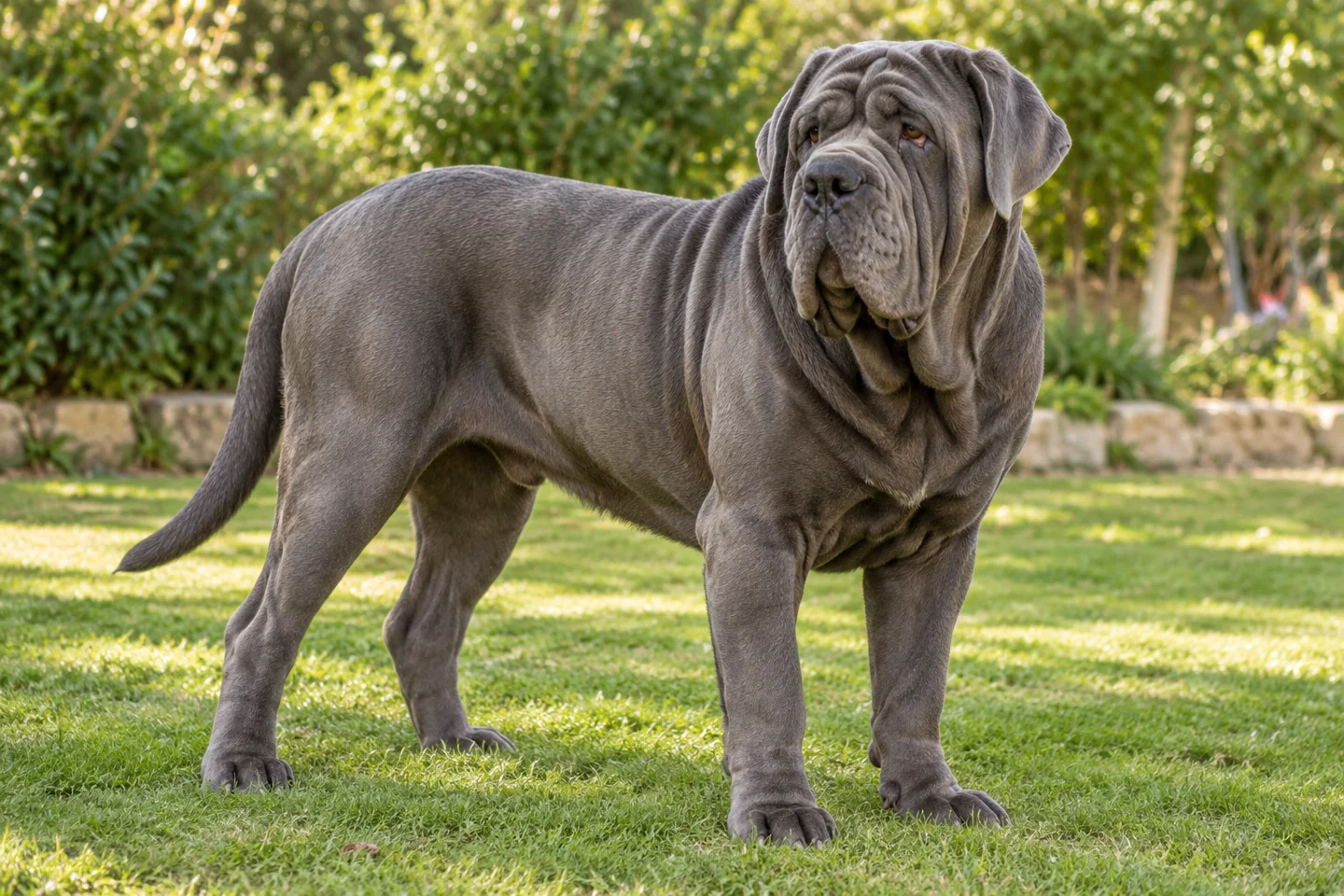
- Origin
- Italy
- Adult standard size
- Males 65–75 cm, 60–70 kg; females 60–68 cm, 50–60 kg
- Illustrated coat
- Slate-grey short coat
General information for owners. These articles have not been reviewed by a veterinarian. Medical decisions need your dog's history and an examination.
A giant guardian with specific needs
The Neapolitan Mastiff, or Mastino Napoletano, is a distinct Italian breed. It differs from the breed commonly called the English Mastiff, and an advertisement using only mastiff may refer to several possibilities. Ask for the full registered identity and parentage. This guide concerns the massive, loose-skinned Italian guardian, with a short coat and a broad head. Its imposing outline should never be selected at the expense of comfortable movement, breathing, skin, or eyes.
Ownership begins with practical questions. Can the dog move through your home safely, rest somewhere cool, and travel to a clinic if it cannot walk? Can every person who handles it manage the planned walking and visitor routine? A giant puppy becomes a physically powerful adult while still learning. Arrange help, training, and appropriate equipment early. A household that relies on lifting the dog out of difficult situations will soon need another method, so cooperation and environmental management belong at the center of the plan.
Italian history and present-day selection
The breed's modern development is closely tied to Italy and the Naples region. The FCI account records renewed selection from 1947. Older historical connections appear in breed accounts, but a dramatic ancestry story offers little evidence about the health or behavior of a puppy available today. Ask about the particular parents and the choices behind the mating. Their clinical records, functional movement, and ordinary reactions to people are more useful than claims that a line preserves ancient fierceness.
Spend time with adults before deciding. Observe how they approach or avoid a visitor, whether they can settle once the visitor is seated, and how their handler moves them through a doorway. Do not provoke a guarding display for a demonstration. For an adult placement, request details of its previous household and any incidents. A responsible discussion should include situations the dog finds difficult. Strong attachment to familiar people may coexist with a need for careful management around visitors, and a calm first meeting cannot answer every question about life at maturity.
Adult dimensions and functional appearance
The FCI ranges are 65–75 cm and 60–70 kg for males, and 60–68 cm and 50–60 kg for females. These are adult conformation references, not goals for rapid growth or excess bulk. A veterinarian should help assess development and body condition. More weight does not automatically mean better substance. Watch how the dog rises, walks, turns, and lies down, and ask about discomfort or previous treatment rather than judging quality by a photograph of a large head.
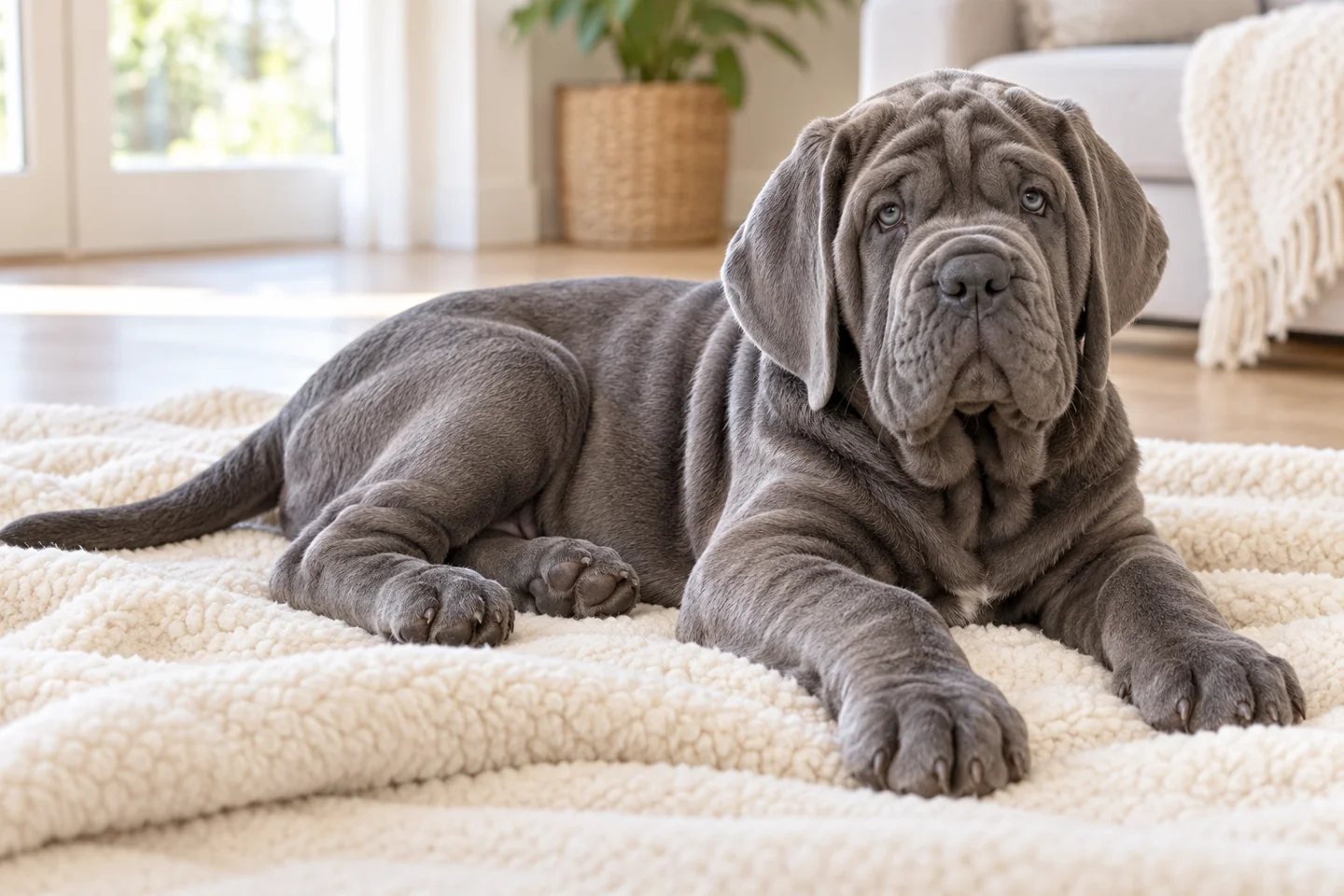
The standard describes loose skin while explicitly limiting it where health and welfare would be affected. Folds should not interfere with the eyes. This guide's AI-generated illustrations show a slate-grey dog, natural small drop ears, and a full tail, with moderate characteristic folds and visible eyes. They cannot establish health in a real animal. Avoid advertisements that praise extreme wrinkling or an obstructed face as a virtue. Ask a veterinary professional to assess any concern about eye comfort, skin irritation, or movement before committing to the individual.
Temperament and control of the environment
A Neapolitan may be strongly involved with its familiar people and home. That makes a clear visitor plan essential. Do not assume the dog understands that a contractor, visiting child, or delivery driver has permission to enter. Use secure separation during arrivals and introduce people only under conditions the dog can manage. The resting space should allow comfort and sufficient distance from the entrance, rather than leaving the animal to supervise every movement through the house.
Teach relaxation as part of ordinary life. Reward resting while you move around, then gradually include manageable household activity. Provide an arrangement for safe care when you are absent, including a carer the dog already knows. Persistent difficulty being alone deserves assessment rather than a conclusion that attachment makes it inevitable. If the dog remains tense around a particular event, reduce pressure and seek help. An adult's apparent stillness can conceal close attention; read the whole situation instead of assuming that a heavy dog lying down is uninterested in what happens next.
Aggression and guardian responsibility
Guarding identity does not justify threatening behavior toward ordinary visitors or allow an owner to disregard warnings. Assess the individual and prevent situations it cannot handle safely. If the dog fixes attention on a person, stiffens, blocks access, or repeatedly warns, create separation. Do not invite someone closer to prove that the dog will eventually accept them. Its size makes the consequences of a mistake substantial even when the person believes the intent is only protective.
Work with the veterinarian and a qualified behavior professional when aggression or serious fear appears. Pain should be considered when reactions change, especially during handling. Disclose bite history and difficult situations to carers with specific details. Teach cooperative skills and an appropriate muzzle routine when advised, while recognizing that a muzzle does not resolve distress or make unrestricted exposure sensible. Avoid physical confrontations framed as establishing authority. The useful objective is reliable behavior and management that the household can sustain, not a contest that depends on overpowering a giant dog when something goes wrong.
Children, visiting friends, and physical space
Even a friendly Neapolitan can knock over a young child with its body or tail. Arrange contact where the adult can supervise without a narrow passage or crowded sofa making movement difficult. Children should invite interaction and allow the dog to leave. Riding, climbing on, hugging around the neck, or disturbing the dog's bed are inappropriate. A large dog lying still is not consenting to unlimited handling.
Visiting children introduce another issue: running games, shouting, and unfamiliar people entering the property. Separate the dog during activity you cannot supervise closely, rather than expecting it to interpret every interaction correctly. A comfortable secure room can be part of the plan, provided the dog has learned to relax there. Ask about the individual dog's experience with different ages and seek professional advice when the history is uncertain or warnings occur. No breed reputation creates a childcare role. Adults remain responsible for both the dog and the children, including ending an interaction before either becomes overwhelmed.
Other dogs and household animals
Select animal companions carefully and consider the individual adult's preferences. The breed club specifically cautions prospective owners about dog compatibility, including difficulties that can become more evident with maturity. This does not mean every Neapolitan will fight, but it makes a casual assumption of lifelong dog-park sociability unwise. Ask about actual relationships and previous conflict before adding another dog to the home.
Provide separate meals, resting areas, and controlled access to valued objects during introductions. An outdoor greeting answers only part of the question of sharing a house. A giant dog can injure a smaller animal during either conflict or rough play, so interrupt persistent pursuit and protect escape routes. Cats need secure areas the dog cannot access. Do not force face-to-face contact or hold a cat in place. If there has been a serious incident, obtain professional guidance before another trial. Household safety should depend on reliable arrangements rather than an expectation that familiarity will eventually erase every incompatibility.
Training before the dog reaches adult strength
Teach the puppy to walk with you, wait at openings, enter its travel space, and rest behind a barrier. Reward useful choices in ordinary moments, then practice in manageable new places. A puppy allowed to drag a person toward every greeting is rehearsing a routine that becomes much harder when it weighs several times as much. Keep the task easy enough to succeed and increase distraction gradually.
Cooperative handling is equally valuable. Practice standing, brief paw contact, and comfortable examination of the head with rewards and release. A basket muzzle can be introduced positively as a useful care skill when appropriate. Select a trainer who understands large guardian dogs and can explain a reward-based plan without provoking defensive behavior. Ask how they respond to fear and refusal. Physical intimidation can make a procedure more threatening and complicate future care. The aim is a dog that understands what earns a reward and a household that prevents dangerous situations while learning develops, rather than relying on force after the dog is already distressed.
Exercise, heat, and surfaces under a giant dog
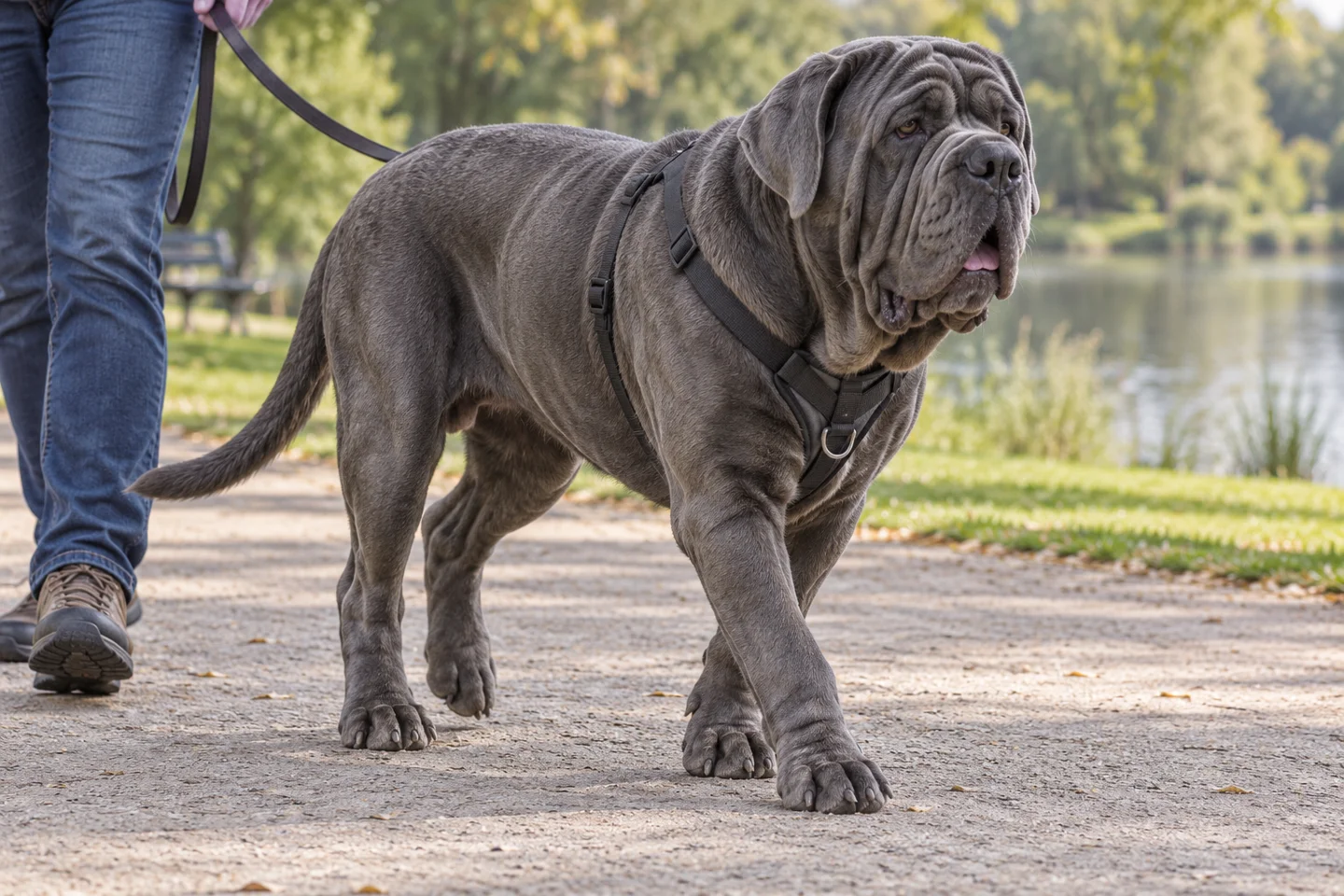
Plan regular comfortable movement rather than encouraging inactivity because the dog is heavy. Build exercise according to age, condition, and veterinary advice. Avoid asking a growing puppy to perform strenuous repetitive tasks simply because it appears strong. Use secure footing at home and consider the routes between the bed, water, garden, and car. A slippery floor or difficult stairway can turn an ordinary daily journey into a problem, particularly during recovery from treatment.
Heat deserves particular planning. Provide a cool resting space, choose suitable walking times, and shorten or postpone activity when conditions are unsuitable. Carry water and watch recovery. Difficulty breathing, collapse, or marked distress needs prompt veterinary attention. Do not leave the dog in a vehicle while errands are completed. Before a longer outing, consider how you would transport an injured animal of this size. A practical emergency arrangement made in advance is more useful than discovering that the dog cannot fit safely into the available vehicle when urgent care is needed.
Grooming and care of skin folds
The coat is short, but the skin requires regular attention. Look between folds for trapped moisture, redness, or odor, and ask the vet to demonstrate a suitable cleaning and drying routine. Skin-fold dermatitis can involve infection and discomfort. Avoid assuming that a persistent smell is simply part of owning the breed. Products suitable for one condition may be inappropriate around eyes or on a different skin problem.
Make care comfortable through practice before the skin is sore. Support the head gently, reward cooperation, and examine small areas rather than holding the dog through a long first session. Report irritation or resistance that suggests pain. Keep bedding clean and dry and inspect contact areas after wet outings. Nail care, ear checks, and dental brushing also matter; short hair does not make them automatic. A professional plan may be needed when essential care is difficult. Regular inspection is intended to find problems early, not to replace clinical treatment with repeated home cleaning when the skin remains inflamed.
Eye comfort and health screening
The United States Neapolitan Mastiff Club recommends hip, elbow, cardiac, and specialist eye evaluations. Obtain the actual reports and confirm the current protocol with the relevant organization. The combination matters because different assessments address different concerns. A favorable result in one area does not explain all future lameness, heart symptoms, or eye irritation, and a completed scheme should not be treated as a promise that a puppy can never become ill.
Observe the eyes directly as well as reading records. The FCI standard requires folds not to interfere with them. Squinting, persistent rubbing, discharge, or a visibly uncomfortable eye needs veterinary assessment. Do not normalize discomfort because a dog has a characteristic heavy head. Ask about previous eye treatment and obtain operative reports when relevant. During development, follow the clinic's advice about monitoring rather than guessing from a photograph how the eyelids will change. Good sourcing includes an honest account of treatment and affected relatives, together with ongoing communication if new information becomes available after placement.
Emergency planning and gastric dilatation-volvulus
A giant, deep-bodied dog warrants a conversation about gastric dilatation-volvulus, commonly called GDV or bloat. The stomach can distend and twist, and suspected GDV requires urgent veterinary care. Unproductive retching with distress or abdominal enlargement is a reason to contact emergency care immediately, rather than trying home remedies or waiting to see whether the dog settles. Obtain directions and contact arrangements for a clinic capable of receiving the animal.
Ask the veterinarian about individual risk, family history, feeding arrangements, and whether preventive gastropexy is appropriate. It is a clinical decision with benefits and limitations, not a guarantee against every form of stomach distension. Give any sitter a written emergency plan and a way to transport the dog. Older online articles may offer confident, conflicting prevention rules. Discuss practical recommendations with your treating vet instead of adopting restrictive routines from a historical list. Prompt recognition and access to treatment remain essential even when a preventive procedure or carefully planned feeding routine is already in place.
Feeding, mixes, and recurring costs
Use a complete diet appropriate for growth and the size of the dog, guided by the veterinary team. Avoid pushing rapid gain to produce an impressive puppy. Assess body condition throughout development and include treats in daily intake. Do not add mineral supplements or large quantities of extra food without understanding how they alter the diet. A medical condition may require a tailored plan, so tell the clinic about everything the dog receives.
A Neapolitan cross can inherit a large frame, different skin, and a different behavioral profile from either parent. A nickname cannot predict the result or guarantee improved health. Evaluate the individual and the evidence available. Obtain local estimates for food, preventive medication, procedures, transport, boarding, and emergency treatment for a giant dog. Read insurance terms closely. Budget also for time spent on skin care, teaching, and suitable handling help. If the practical requirements exceed what your household can sustain, that is useful information to recognize before a placement rather than after the dog has formed attachments.
A careful dogsDating introduction
A Neapolitan does not need to greet every dog it encounters. On dogsDating, describe the specific individual and any need for distance, a familiar handler, or a quiet route. Choose a public meeting place with wide paths and room to leave. Begin at a distance with both handlers moving, and postpone closer interaction if either dog is tense. Avoid a first meeting inside the home, at a narrow gate, or around valuable objects.
Keep exact user coordinates private. Use an approximate discovery area and agree on a public landmark without exposing the home address or the location of a private enclosure. Check profile images for identifying details. If the dog repeatedly blocks, fixes on the other animal, or cannot respond to its handler, finish the encounter and review the plan. Seeking professional advice may be appropriate before trying again. A digital match does not create an obligation to allow contact, and physical size makes it especially important that both people can implement the agreed safety arrangements throughout the walk.
Sources and editorial notes
Sources checked October 22, 2026. Breed measurements describe reference ranges, not a diagnosis or an individual dog's ideal weight. Images are AI-generated breed illustrations and do not document a particular dog or health condition.
- AVSAB: Humane Dog Training Position Statement
- VCA Animal Hospitals: Food aggression in puppies
- VCA Animal Hospitals: Common emergencies in dogs
- Orthopedic Foundation for Animals: CHIC health screening programs
- VCA Animal Hospitals: Aggression toward unfamiliar dogs, diagnosis
- VCA Animal Hospitals: Grooming and coat care for your dog
- VCA Animal Hospitals: Ear infections in dogs (otitis externa)
- AAHA: Feeding plans for healthy, appropriate weight cats and dogs
- VCA Animal Hospitals: Heat stroke in dogs
- AVSAB: Puppy Socialization Position Statement
- VCA Animal Hospitals: Dog behavior problems, aggression toward children
- United States Neapolitan Mastiff Club: health screening
- United States Neapolitan Mastiff Club: ownership considerations
- PDSA veterinary guidance: skin fold dermatitis in dogs
- Fédération Cynologique Internationale: Neapolitan Mastiff official breed standard
Keep getting to know dogs.
Read another guide or return to your dogsDating community.
Explore breed guidesBack to dogsDating