Polish Tatra Sheepdog
A large white Polish guardian whose calm appearance should be paired with secure management, cooperative care, and a realistic assessment of the proposed home.
How these guides are researched and reviewed
- Origin
- Poland
- Adult height
- Males 65–70 cm; females 60–65 cm
- Original name
- Polski Owczarek Podhalański
- Coat
- Uniform white, with a profuse undercoat and neck ruff
General information for owners. These articles have not been reviewed by a veterinarian. Medical decisions need your dog's history and an examination.
A large guardian needs a prepared environment
The Polish Tatra Sheepdog is a substantial white guardian associated with Poland's mountain regions. A prospective home should be chosen around the actual dog's needs rather than its quiet appearance in a photograph. Ask about visitors, boundaries, handling, other animals, and the role the source expects the individual to have. Describe your property, work hours, children, and available support honestly. A large garden or enthusiasm for white mountain dogs does not by itself establish a suitable placement. The household must be able to maintain safe predictable routines during ordinary busy days.
Meet adults where possible and ask how they behave when their usual person is not directing the encounter. What happens when a delivery arrives, care is needed, or another dog appears at a boundary? Those details help turn a broad guardian description into practical responsibility. A puppy will develop beyond its first affectionate visit, while an adult moving homes may need support in unfamiliar circumstances. Choose a source willing to explain inconvenient needs as well as appealing traits. A placement works better when people know what they are agreeing to and have identified capable help before a difficult event requires it.
Carpathian work and an organized modern breed
The FCI history connects the breed with livestock-keeping communities of the Carpathians and the Tatra region. It records organized surveys and breeding efforts in the twentieth century, including a first standard drafted in 1937 and later recovery after the war. This is more informative than assuming the present pedigree population has remained unchanged across every earlier century. Keep the historical account proportionate and distinguish documented organized breeding from broader regional dog traditions. The current standard gives a defined modern identity, while individual family records remain necessary for a particular placement.
The Tatra should not be confused with the much smaller shaggy Polish Lowland Sheepdog. Shared English words do not make their bodies or working expectations interchangeable. Nor does the Tatra's resemblance to another white guardian establish an identical medical or behavioral programme. Ask a knowledgeable source how its adults have been selected and what daily arrangements they need. If livestock work is planned, obtain appropriate instruction and supervise learning. A guardian background cannot make a puppy ready to protect vulnerable animals without preparation, and a modern companion placement should also be assessed individually rather than justified by appearance alone.
Adult height and natural mountain-dog proportions
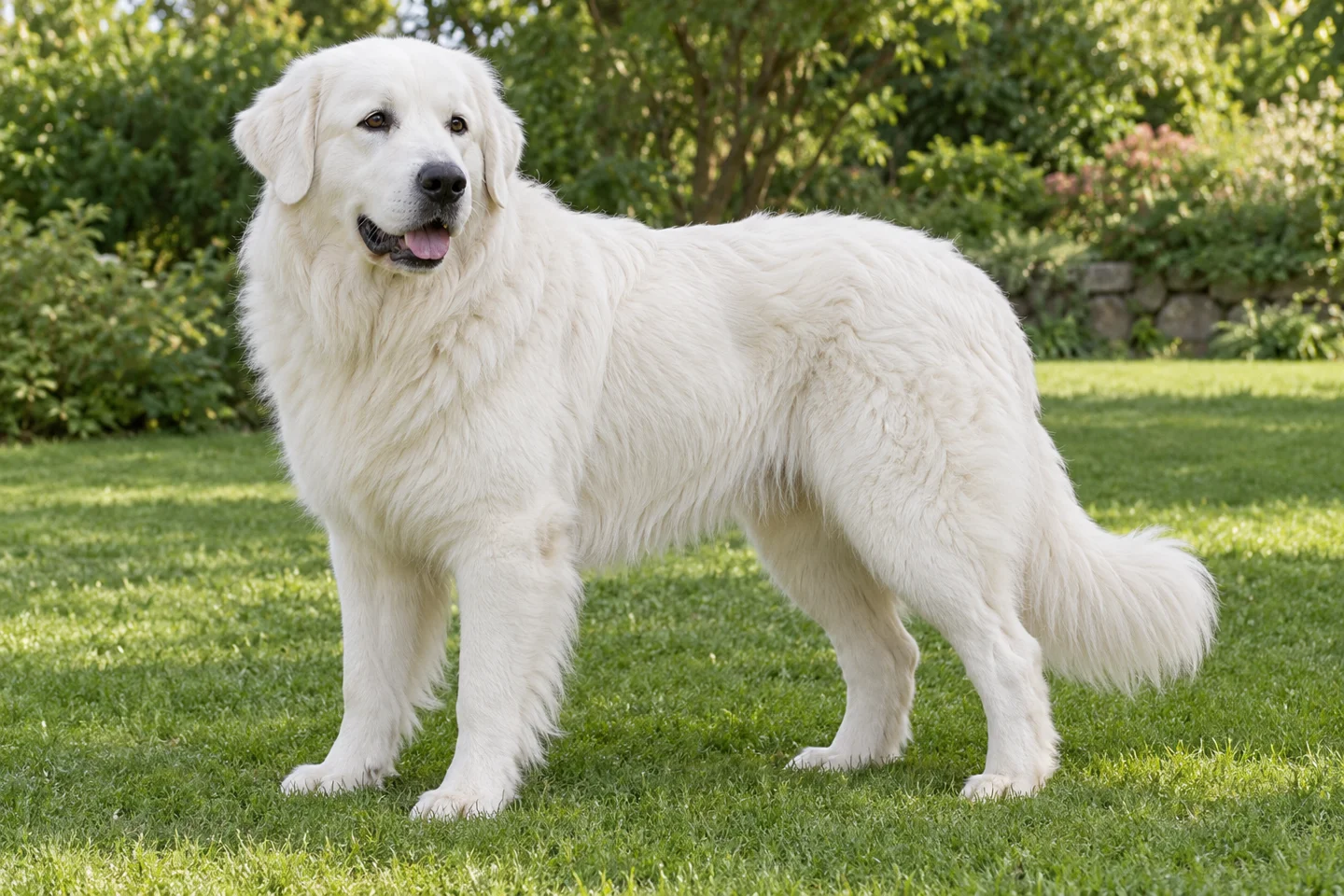
The FCI height range is 65–70 cm for males and 60–65 cm for females. The body is strong and rectangular, the head lean in proportion, and the muzzle clearly formed. Natural triangular hanging ears, dark brown eyes, black pigmentation, and a full heavily haired tail contribute to the outline. The coat is uniformly white with a rich neck ruff and profuse undercoat. The illustrations retain those features and natural anatomy, without cropping the ears, shortening the tail, or adding exaggerated bulk to create a more imposing image.
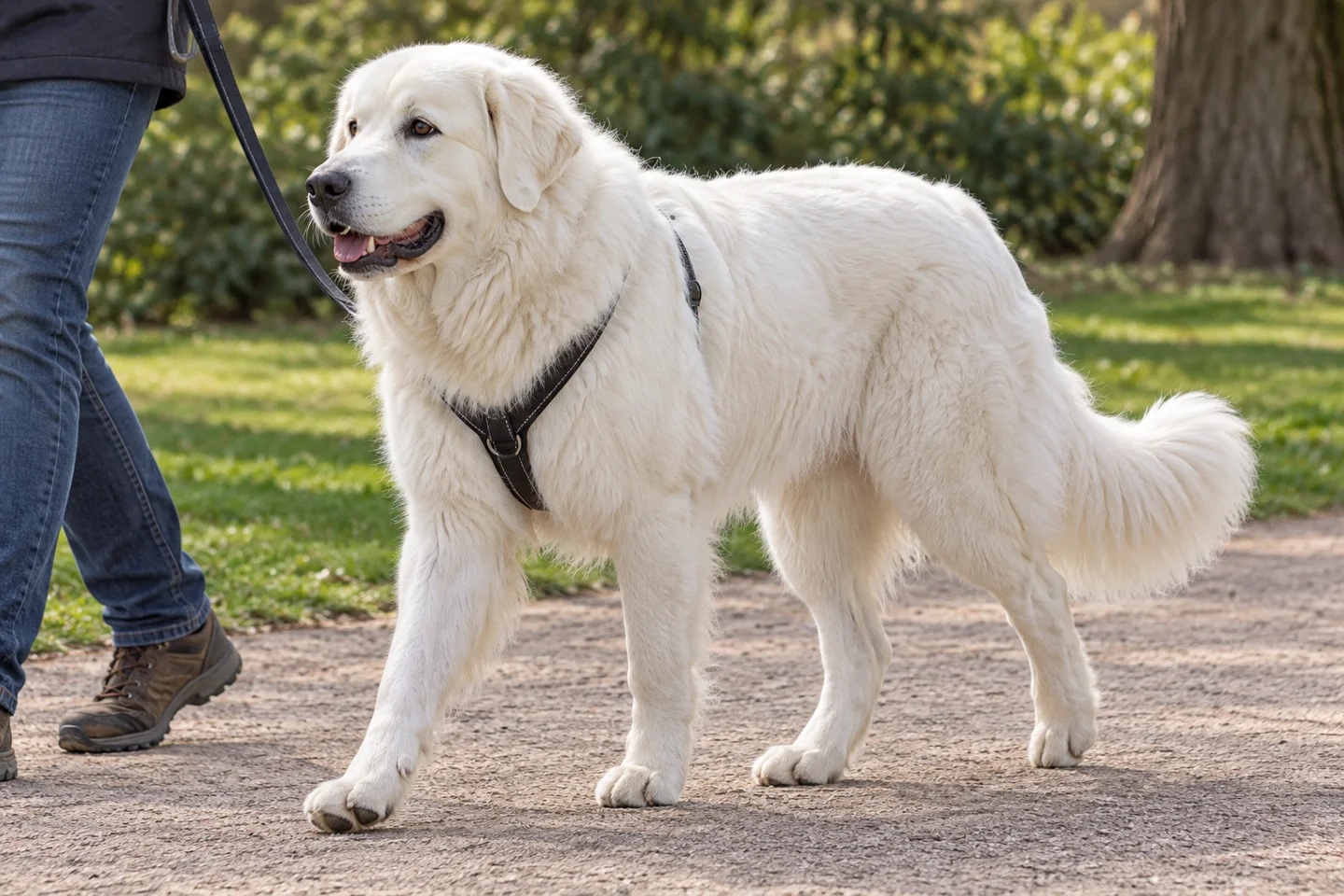
A thick coat makes assessment by sight alone incomplete. Use gentle regular handling and veterinary guidance to monitor condition underneath it. A standard height range does not establish an exact healthy weight for every frame. Look at comfortable movement and recovery instead of choosing the largest-looking dog automatically. Equipment and transport must fit the mature animal and allow ordinary function. Check security and shoulder freedom when the dog walks and turns. Plan a place to rest with room to stretch out, and consider how an injured or older dog would reach it if steps or jumping later became difficult.
A boundary plan should be ready before a visitor arrives
Decide how people enter the property and where the dog will be during that process. A secure comfortable separate area gives the owner a practical option while receiving a delivery or allowing a worker access. Teach the routine in quiet practice and reward settling before expecting it during an unfamiliar arrival. Everyone opening a gate needs the same instructions. A fence helps only when its gaps, gates, and daily use fit the actual dog. Do not rely on a tracker to prevent an escape or an unsafe encounter beyond the property.
Visitors should know whether approach or touch is suitable before contact occurs. Do not let someone override the plan to prove a special ability with dogs. A guardian does not arrive knowing which person carrying equipment is welcome. The owner needs to prevent unnecessary confrontation while teaching manageable responses. If the individual already has a conflict history, obtain professional advice about restrictions rather than inviting a demonstration. A good environment supports comfortable choices and safe separation; it should not force the dog to negotiate repeated unwanted approaches because the people expect a calm breed description to resolve every uncertainty.
Training for care, recall, and moving through ordinary spaces
Use rewards to teach coming toward the handler, walking with suitable equipment, waiting at a doorway, and moving to a resting place. Start where the animal can understand and participate, then change one part of the difficulty at a time. A response learned in the house still needs preparation around a boundary or unfamiliar dog. Keep access managed while skills remain unfinished. If the dog cannot respond, reduce the challenge and ask for guidance instead of relying on greater force. A large animal benefits from clarity early, before strength makes an improvised solution difficult.
Teach medical and transport tasks separately. A relaxed pause on a stable surface, a brief paw inspection, or an easy entry into the vehicle can be rewarded through small steps. Give the clinic an accurate account of what the dog accepts and what remains difficult. A reward-based instructor should be able to explain how the plan protects people and the animal when worry or guarding appears. A working role does not make cooperation during care optional. Useful skills remain valuable when illness, injury, or a new handler changes the routine, and they make daily life easier even when advanced obedience is not the owner's main interest.
Aggression deserves an individual history
A threatening event needs a factual record. Note who approached, what handling or resource was involved, available space, contact, and injury. Prevent another exposure while arranging veterinary and behavior advice. Sudden changes around touch, movement, or rest should prompt investigation for discomfort. Do not recreate the event to demonstrate a guardian response or punish the warning as the complete answer. The useful task is understanding what happened and reducing risk, rather than deciding that a reaction must be acceptable because it seems consistent with the breed's historical role.
Protect meals, chews, and sleep from interference. Practise exchanges only in safe planned situations and have children obtain adult help when an object needs recovering. Maintain distance around unfamiliar dogs or people where needed. A qualified professional can help decide what management the home can sustain and whether the proposed environment remains suitable. Carers need an honest account of bites and near misses before accepting responsibility. If muzzle conditioning is recommended, learn appropriate fit and gradual comfortable introduction while retaining barriers and supervision. Equipment supports prevention but cannot turn rough handling, competition over resources, or repeated crowding into an appropriate test of the animal's tolerance.
Children and household animals need their own safeguards
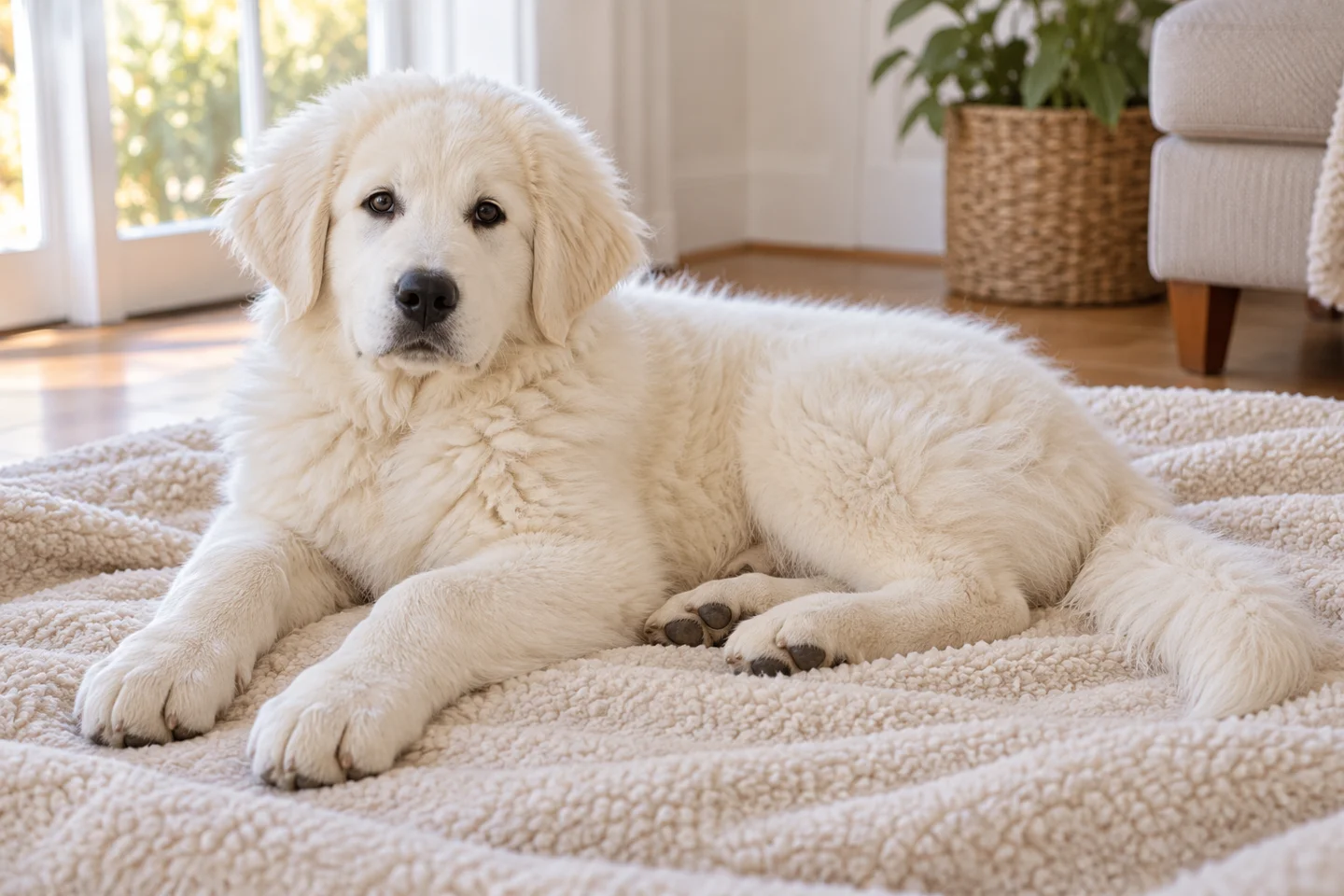
Children should not manage this dog's lead, move it from rest, recover objects from the mouth, or decide whether visitors may approach. A capable adult needs to organize those tasks. Teach children to invite contact and accept the animal choosing to leave. Keep meals and rest undisturbed and provide a protected area when supervision cannot remain attentive. Ask the source about actual child experience, including ages, duration, and management. A calm interaction with one older child does not answer how a puppy or adult will cope with every noisy gathering that later takes place.
A guardian's experience with particular livestock or a familiar dog does not establish compatibility with every animal. Ask separately about dogs, cats, poultry, and other vulnerable pets, including what was observed rather than inferred. Maintain physical protection wherever safety is uncertain. Never release an animal to test the dog's response. For a proposed canine companion, seek advice when indicated and begin with enough room for handlers to withdraw. Indoors, individual resources and secure separation need to be practical during ordinary distractions. A placement should be reconsidered if the layout cannot support necessary boundaries without depending on perfect attention at every moment.
Socialization can respect reserve while improving coping
Discuss safe early experiences with the veterinary team during vaccinations. Let a puppy observe people, vehicles, surfaces, and ordinary activity at distances where it can investigate and recover. Touch from every stranger is not the measure of success. A mature dog new to a setting also needs experience assessed rather than presumed. Ask previous carers which environments are familiar and which have never been tried. A rural background may not include lifts, crowded pavements, or frequent close pedestrian traffic, so introduce those demands deliberately if they will be part of the dog's life.
Notice how the individual recovers after surprise and whether it can settle afterward. Repeated avoidance, freezing, or threats mean the setup needs reassessment and perhaps professional support. Stillness under restraint is not complete evidence of comfort. Prepare handling through short cooperative steps and tell the clinic what helps. If urgent illness or pain is already present, seek care rather than delaying while attempting a full training programme. A useful owner gives the professional a clear history and lets the team choose a suitable immediate approach, while continuing predictable practice when the dog is comfortable enough to learn.
Exercise that accounts for a large body and daily recovery
Activity should fit age, health, current condition, and the work actually performed. A large mountain dog is not automatically ready for every long route. Build gradually and ask the veterinary team about puppies, demanding pursuits, and return after injury. Provide suitable investigation and learning alongside movement, with comfortable rest afterward. A guardian may spend time observing rather than continually running, so constant action is not the only measure of a useful routine. A sustainable plan should still function when weather or medical advice temporarily changes the day's activities.
Warm conditions, surface temperature, water access, and the journey affect the real workload. The white coat is not a guarantee against heat risk or a reason to leave the dog in a hot vehicle. Keep an easy option to shorten outings and a practical transport plan if the animal cannot walk normally. Persistent stiffness, altered gait, or unusual fatigue deserves assessment. Record when signs began and what preceded them instead of interpreting every reluctance as independence. Ordinary comfortable movement and recovery matter more than completing a route chosen to match someone else's account of what the breed can do.
Grooming through the dense white coat
Ask an experienced professional to demonstrate how to inspect and maintain the coat down toward the skin. Pay attention to friction areas, feet, and the hair affected by equipment. Surface brushing can miss a tangle or a changing body condition beneath the volume. Adjust the routine during heavier shedding and break work into comfortable sessions. If neglect has created tight mats, seek help and choose a humane recovery plan. A rustic-looking animal still needs regular maintenance, and a desired outline should never become the reason for painful prolonged pulling.
Include nails, teeth, and ears in the veterinary-advised routine. Redness, odor, discharge, pain, or persistent scratching needs clinical attention rather than a series of random products. Do not push tools into the ear canal or use leftover medication for a new episode. Keep treatment details and tell an alternate carer about handling limits and what changes require contact. Sudden resistance to a previously comfortable task deserves consideration of pain before the household treats it as defiance. Good care includes observations specific enough for another person to follow, rather than a broad assurance that the dog has always been tough and needs little help.
Health records: a qualifying grade is not the same as every hip being normal
ZKwP's published Appendix 10 lists acceptable hip results A, B, or C for Polish Tatra breeding, with a general rule that where C is permitted the paired dog must have an A or B result. That is a defined breeding framework, not a promise that every qualifying hip is identical or that all future joint problems are excluded. Request the actual parents' reports and have the source explain the pairing under the current rules. A working record or a brief video of movement cannot substitute for the relevant medical assessment.
The Dutch Tatra club also identifies hip dysplasia among conditions its breeding policy addresses. Ask what programme the source follows and how family findings are collected after puppies leave. Preserve uncertainty where records are missing instead of borrowing a universal panel from another white guardian. For an adult, obtain its own injury, medication, previous workload, and follow-up history. A new symptom needs assessment of the actual patient even when parental records look reassuring. Readable copies are useful when a dog moves countries, since the receiving veterinarian needs more than a vaccination booklet or a translated phrase saying that the animal was checked. Confirm which clinician will complete any outstanding investigation after the move and when that appointment is due.
Nutrition, mixes, and the costs of a lasting placement
Feed complete nutrition appropriate to life stage and condition, with portions reviewed by the veterinary team. Measure intake, include rewards, and adjust deliberately when work changes. Do not add bulk or supplements simply because the animal is a large guardian. Separate meals where another pet creates competition and record persistent changes in appetite, digestion, or drinking. A Tatra mix needs the same individualized approach. Ask what is known about both parents and retain uncertainty for rescue labels based on appearance. Crossing does not guarantee easier management, a predictable coat, or freedom from inherited illness.
Budget for local veterinary care, transport, secure fencing and equipment, grooming help, instruction, and capable cover during absences. Confirm that a sitter can follow visitor and animal-management rules before assuming an available place is suitable. Clarify written support and return arrangements with the source and arrange emergency funding or appropriate insurance. A household needs a plan if the usual handler is ill or the dog requires reduced activity and extra care. Ownership becomes fragile when everything depends on one person's uninterrupted availability. Practical support identified early is part of choosing responsibly, not an optional expense to consider only after a problem appears.
dogsDating outings should begin with suitability
A guardian does not need every kind of social activity an app can suggest. Before arranging a dogsDating meeting, consider the individual's role, restrictions, and any professional advice. Describe limits honestly and share an approximate area while keeping exact coordinates and the home address private. Do not invite unfamiliar animals onto a working property as a test. If a public walk is suitable, choose an open route, agree on enough separation beforehand, and ensure each adult can manage their own dog and leave without relying on the other person to control the situation.
Begin with parallel movement and avoid shared toys, food between the dogs, or pressure for a close greeting. Repeated withdrawal, stiffness, or excitement that prevents comfortable disengagement calls for more distance or an early finish. Compare the route, pace, and separation afterward rather than deciding success requires play. Quiet walking company may be a useful outcome, and some pairings will remain unsuitable. Let evidence about these animals guide any further meeting. A social invitation should preserve the owner's ability to change the plan while it remains safe and manageable, rather than becoming a promise that overrides the dogs' actual needs.
Sources and editorial notes
Sources checked October 22, 2026. Breed measurements describe reference ranges, not a diagnosis or an individual dog's ideal weight. Images are AI-generated breed illustrations and do not document a particular dog or health condition.
- AVSAB: Humane Dog Training Position Statement
- VCA Animal Hospitals: Food aggression in puppies
- VCA Animal Hospitals: Common emergencies in dogs
- Orthopedic Foundation for Animals: CHIC health screening programs
- VCA Animal Hospitals: Aggression toward unfamiliar dogs, diagnosis
- VCA Animal Hospitals: Grooming and coat care for your dog
- VCA Animal Hospitals: Ear infections in dogs (otitis externa)
- AAHA: Feeding plans for healthy, appropriate weight cats and dogs
- VCA Animal Hospitals: Heat stroke in dogs
- AVSAB: Puppy Socialization Position Statement
- VCA Animal Hospitals: Dog behavior problems, aggression toward children
- Official breed standard: Polish Tatra Sheepdog
- Związek Kynologiczny w Polsce: Additional breeding requirements, Appendix 10
- Dutch Polish Tatra breed club TOP nl: Health information
Keep getting to know dogs.
Read another guide or return to your dogsDating community.
Explore breed guidesBack to dogsDating