Pomeranian
A small alert spitz with a full double coat whose care should protect normal movement, comfortable breathing, and the ability to make ordinary canine choices.
How these guides are researched and reviewed
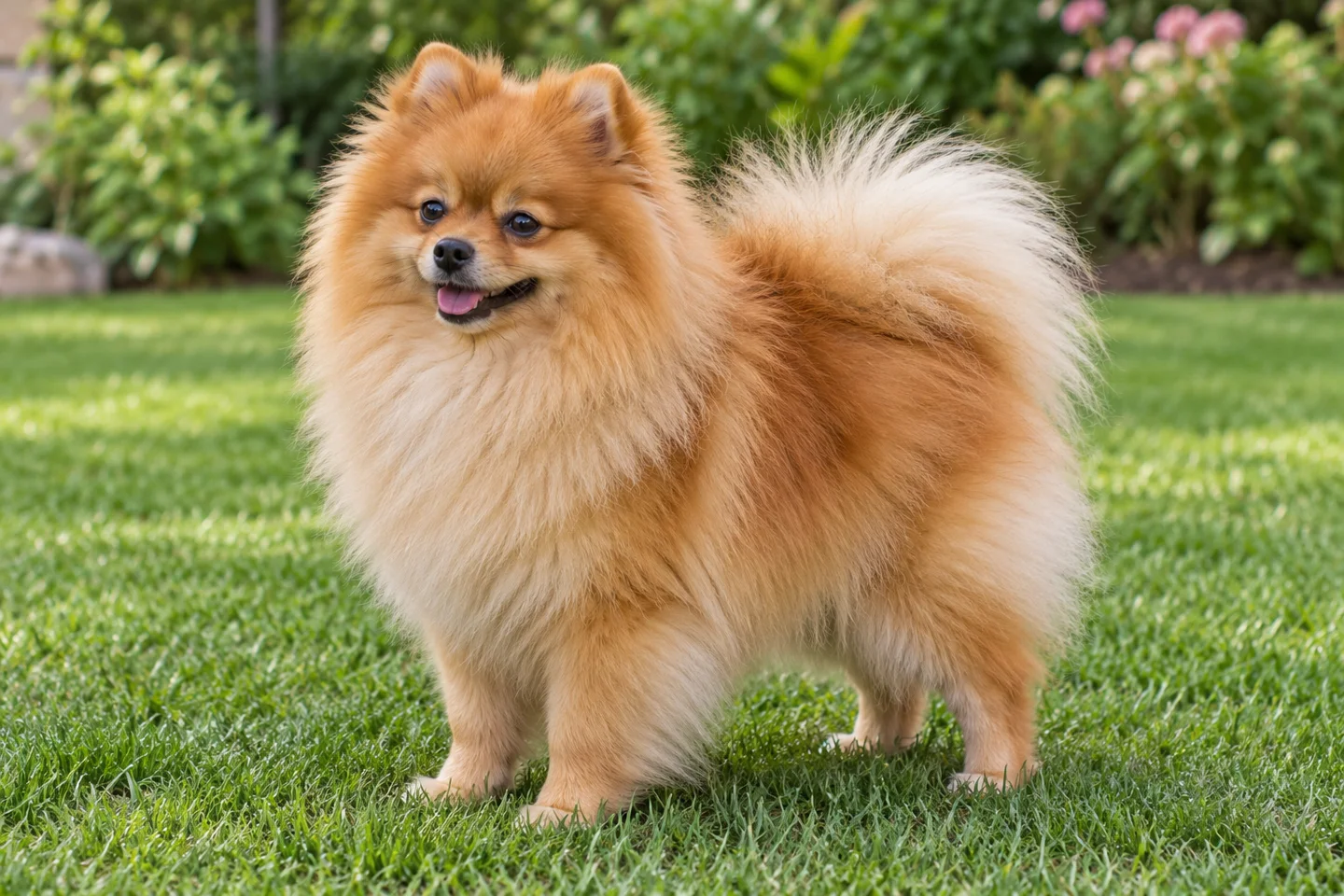
- FCI origin
- Germany, within German Spitz
- FCI height
- 21 cm ±3 cm
- Coat
- Stand-off straight outer coat over soft dense undercoat
- Illustrated color
- Orange, with a full natural plumed tail
General information for owners. These articles have not been reviewed by a veterinarian. Medical decisions need your dog's history and an examination.
A small spitz still needs a dog’s daily life
A Pomeranian is a small companion with a spitz outline and an alert response to its surroundings. Its size makes close company appealing, but the dog still needs movement, investigation, learning, and protected rest. Before choosing one, ask how the individual behaves at floor level when people are busy. A photograph in someone's arms does not show how it copes with visitors, handling, other animals, or a routine absence. Meet adults and ask about the care and teaching behind their relaxed moments, including the less convenient parts of ownership.
A good household plan respects the dog's choices while maintaining safety. People should not assume every small animal welcomes lifting or repeated touching. Prepare a comfortable secure resting area and agree on how contact, doors, and care tasks will be managed. Tell the source about working hours, children, other pets, and available help. A puppy will develop beyond its first visit, and an adult may need time to adjust to a move. Choose a placement supported by honest observations and practical resources, rather than expecting a sociable breed description to fill gaps in time or care.
The Pomeranian within the German Spitz family
The FCI describes the Pomeranian as German Toy Spitz within its German Spitz standard. That framework matters when comparing size and ancestry with other spitz dogs, including larger varieties. A fluffy dog is not automatically a Pomeranian, and a smaller advertised animal is not a separate officially defined breed merely because a seller gives it a fashionable name. Ask the source to identify the registry and ancestry clearly. For a rescue whose background remains uncertain, preserve that uncertainty while assessing the individual animal's needs directly.
Historical accounts and the breed's recognizable outline do not establish a complete behavior prediction. Ask about the current family and how adults respond when something unfamiliar appears. A watchdog role gives a reason to discuss barking and recovery, not a justification for encouraging alarm. The useful ownership conversation concerns a workable modern routine: appropriate company, clear household skills, clinical care, and the ability to rest when attention is elsewhere. An owner can appreciate the breed's history without turning a puppy into a demonstration of boldness or a decorative object expected to tolerate every person reaching toward it.
Adult size, muzzle, and the natural plumed tail
The FCI height for German Toy Spitz or Pomeranian is 21 cm with a 3 cm tolerance, and weight should correspond to size. The outline is compact with a distinct muzzle, small natural erect ears, and a full heavily plumed tail carried over the back. A dense undercoat supports straight stand-off outer hair and a neck ruff. The illustrations select orange in natural coat. They avoid an exaggerated flat face, protruding eyes, or a shaved teddy-bear silhouette presented as the only authentic version of the breed.
Size information should help preparation rather than become a contest to obtain the smallest possible animal. Ask a veterinarian about the individual's growth and condition instead of feeding toward an advertised micro weight. A compact dog still needs sound movement, comfortable breathing, and normal access to food and rest. Fit equipment to the actual body beneath the coat and check it during walking and backing away. Puppies need refitting as they grow. A source's photograph cannot show every aspect of health, and a tiny puppy's appealing appearance should never replace an honest account of its clinical assessment and any current concerns.
Grooming the full coat without treating hair as health evidence
A Pomeranian's double coat needs care through to the skin. Ask an experienced groomer to demonstrate how to inspect and maintain it gently, particularly around friction areas and where equipment presses. A brushed surface can hide a tangle underneath. Keep the face clear enough for normal sight and maintain hygiene around the rear and feet. A practical care schedule needs to be established before the coat becomes difficult. If neglect has created tight mats, obtain help and choose comfort over retaining an idealized outline through painful prolonged detangling.
Teach manageable handling steps when the dog is well. Reward a short pause on a stable surface, a brief brush touch, or an easy paw inspection before expecting a long appointment. Tell the groomer about skin changes and limits in handling. Unexpected thinning, persistent scratching, or a change in coat should be assessed rather than assigned a diagnosis from appearance alone. The AKC identifies coat-loss problems among breed health concerns, but that does not mean every bare patch has one cause. Record products and signs, then let the veterinary team investigate the individual before the household buys repeated unverified remedies.
Training a small dog without moving it instead of teaching
Begin with recall, going to a bed, and waiting away from an open door. Use rewards and an easy setup so the dog understands what earns a useful outcome. A secure barrier can prevent access while the response is still developing. Small size may make it tempting to pick up the Pomeranian whenever cooperation would be convenient, but ordinary skills remain valuable. Practise at the dog's level and make instructions consistent across the household. Add distraction gradually instead of expecting a kitchen lesson to work unchanged during a busy arrival.
Prepare necessary lifting with a predictable cue and careful body support. Do not pass the animal between unfamiliar people as a substitute for social experience. Teach safe exchanges for suitable objects and keep dangerous items inaccessible. If guarding, handling, or toileting routines repeatedly become frustrating, seek reward-based professional help. The instructor should explain how the dog will learn an alternative, not only how an unwanted behavior will be confronted. Brief clear practice often serves daily life better than a long argument. A small companion still deserves instruction it can understand and an owner able to prevent situations beyond its current ability.
Voice and time apart need separate questions
A Pomeranian watching a communal corridor may bark at each passing footstep, while the same dog may rest quietly in a rear room. Find out where alarm begins before trying to change it. Move the resting area, limit repeated lookout duty, and practise a simple response such as walking with the owner to a mat. Visitor arrivals can be rehearsed with a helper who remains far enough away for successful learning. Avoid turning an intense reaction into entertainment. The useful result is a dog able to recover from an ordinary event, rather than one repeatedly encouraged to announce it.
Absence needs a different investigation from door barking. Observe whether the dog sleeps, changes position comfortably, or remains tense while waiting. A short recording can help explain the pattern to a professional. Arrange help when the current work schedule exceeds the animal's ability to cope, and build manageable periods apart instead of testing endurance through a long absence. Consider how toilet access and ordinary company will be provided if the favored person becomes ill. Buying another pet is a separate commitment whose effect on this problem cannot be promised. Quiet independence develops through an appropriate routine and learning suited to the individual.
Exercise with attention to the world at a small dog’s height
Plan suitable walks, safe investigation, and short learning games around age, condition, and health. Carrying the dog through every outing automatically can remove opportunities for ordinary exploration, while forcing it to match a larger animal's pace can create another problem. Let the individual guide a sensible starting point and ask the veterinary team about a growing puppy, older dog, or return after illness. Include quiet rest and a clear ending to play. Activity should support comfort rather than become a constant attempt to obtain exhaustion.
Hot surfaces, fast feet, crowds, and narrow passages can make a short trip demanding. Choose places with room to pause and leave, provide water when needed, and shorten the route if conditions change. Observe movement and recovery afterward. Persistent coughing, unusual effort, altered gait, or loss of stamina deserves veterinary advice rather than a label such as dramatic or lazy. Keep a precise timeline and describe what preceded the change. A thick coat cannot tell you whether the body underneath is coping, and enthusiasm at departure is only one observation about the day's suitability.
Socialization should preserve an exit from unwanted contact
During vaccination, discuss safe early experiences with the veterinary team. Let the puppy observe people, vehicles, surfaces, and everyday sounds at manageable distances. A calm look from the edge of a busy area can be useful without being touched. Ask visitors to wait and let the dog retain a way to move away. An adopted adult also needs unfamiliar settings introduced from its actual experience. Ask previous carers what was observed directly and what remains unknown, rather than making physical maturity stand in for broad confidence.
Watch the whole response. Repeated avoidance, freezing, or threats mean the setup needs reassessment and perhaps professional guidance. A small animal being held still may not be relaxed. Prepare grooming and medical handling separately through rewarded steps and give professionals an accurate account of the current limits. If urgent illness or pain is already present, seek care rather than delaying until a complete training programme is finished. The long-term aim is predictable cooperation, while the clinician can select an appropriate immediate approach. Useful social experience makes ordinary life easier to manage without requiring every stranger to touch the dog.
Aggression and the risk of laughing at a warning
A Pomeranian can bite. Small size does not make threatening behavior harmless or a reason to film a provoked response for amusement. Record the actual event, including approach, space, resource or handling, contact, and injury. Prevent repetition while obtaining veterinary and behavior advice. Sudden changes around touch, movement, or rest need assessment for discomfort. Punishing the warning alone does not resolve what made the animal want distance. A friendly interaction earlier in the day cannot cancel a risk in a different setting or justify another person testing tolerance.
Keep meals and sleeping places free from interference. Children should obtain adult help rather than take something from the mouth. Practise appropriate exchanges with suitable objects before a confrontation develops. Maintain distance from unfamiliar dogs when needed and avoid holding the Pomeranian in place for a nose-to-nose test. A qualified professional can help establish realistic limits. Carers need an honest history of bites or close calls before accepting responsibility. If muzzle conditioning is advised, learn fit and comfortable introduction while retaining supervision and barriers. Equipment should support prevention rather than make rough handling or repeated crowding seem permissible.
Children, other dogs, and vulnerable household pets
Teach children to invite contact, stop when the dog leaves, and leave sleep and meals undisturbed. A capable adult should handle the lead, care tasks, and any necessary lifting. A child carrying a small animal may feel manageable to the child while remaining unsafe or unwanted for the dog. Supervise closely enough to intervene before pressure builds, and use comfortable separation when attention must be divided. Ask the source about actual child experience, including ages and settings. One affectionate meeting cannot answer every noisy gathering or younger visitor that may later occur.
Choose canine company from observed compatibility, including size, play intensity, and ability to disengage. Friendly intention alone does not remove injury risk during a mismatched interaction. Begin with space and retain control, then organize separate food and rest indoors. Cats and smaller pets also need protection where safety is uncertain. Do not use release as a test. The layout and daily routine must support required boundaries during ordinary distractions or absence. A suitable placement gives everyone a practical way to remain apart, rather than depending on animals to resolve a difficult interaction before harm occurs.
Health screening distinguishes a club recommendation from a CHIC choice
The American Pomeranian Club's current testing page lists cardiac and patellar assessment, with a health elective that can be specialist eyes or autoimmune thyroiditis evaluation. It also lists additional optional assessments. The AKC breed page recommends patella, heart, and specialist eyes. Ask which current protocol the source follows and request the actual parents' findings. A CHIC number means the applicable requirements were completed and published; it should not be taken as proof that every recommended optional test was performed or every result was normal.
That distinction makes records more useful than a general claim that the parents were checked. Ask what examinations occurred, when, and how the findings informed the pairing. Include family diagnoses and later owner information where available. A DNA panel cannot replace the relevant clinical assessment or rule out every future condition. For a rehomed adult, obtain its own medication, treatment, and follow-up history. A new symptom needs investigation of the patient even when the family has reassuring paperwork. Good evidence keeps current examination, breeding decisions, and unknown information separate without promising certainty that the records cannot support.
Health planning for a cough or breathing difficulty
Cornell identifies Pomeranians among the small breeds in which tracheal collapse occurs. The condition can cause chronic coughing, but an owner should not diagnose every cough from breed alone. Record when signs happen, what activity preceded them, and whether breathing or recovery changed, then obtain veterinary assessment. Respiratory distress needs urgent care. Do not wait for a precise online label or give a human cough product before contacting the clinic. The veterinarian must assess this individual's airway and other possible causes rather than rely solely on a familiar sound described in a video.
Ask about equipment and environmental changes suitable for the patient's actual diagnosis. A clinic can explain a plan for exercise, weight, irritants, medication, and follow-up without the owner inventing a universal protocol for all Pomeranians. Give alternate carers those instructions and the contact to use if signs worsen. Preserve readable reports when changing clinics or homes. A reassuring parental health record does not determine the cause of today's cough, and an old episode should not make a new breathing change seem safe to ignore. Practical preparation includes knowing how to reach help and transport the animal promptly when the clinician advises it.
Nutrition, mixes, and costs beyond a small food bowl
Feed complete nutrition appropriate to life stage and condition. Measure portions and count rewards, particularly when several people enjoy treating a small dog. Review intake with the veterinary team when weight or activity changes. A Pomeranian mix needs the same individual approach: ask what is known about both parents, retain uncertain ancestry labels, and avoid promising a predictable compromise in coat or behavior. Crossing does not guarantee freedom from inherited illness. A low-shedding claim also cannot establish whether a person with allergies will tolerate the animal; contact and appropriate advice matter more than a label.
Price local grooming, veterinary care, transport, secure equipment, training help, and appropriate care during absences. Confirm that a sitter can follow the handling and medical routine rather than assuming availability equals suitability. Clarify written source support and return arrangements, and arrange emergency funding or suitable insurance before urgent care is needed. The first fee does not describe the long-term commitment. A workable plan includes an owner becoming ill, a coat requiring extra attention, and later medical follow-up. More than one capable person should understand the essentials so the dog's care does not depend on uninterrupted availability from its favorite human.
dogsDating walks should keep a small dog’s choices visible
Use the dogsDating profile to explain how this Pomeranian prefers to meet: walking pace, room needed around larger dogs, and whether direct greetings are welcome. Keep exact coordinates private and give only an approximate meeting area publicly. Select an open public route after discussing size and play habits with the other owner. Each adult needs independent control and a way to leave. A busy entrance or narrow pavement leaves little room for a small dog to choose distance. The first arrangement should make an uneventful walk possible without relying on instant affection between the animals.
Set off with separation between the dogs, then observe whether the Pomeranian explores the ground and returns attention to its own handler. A larger companion must not repeatedly block, follow, or loom over it. End or increase space when relaxation gives way to freezing, escape attempts, or frantic arousal. Leave shared possessions out of this first outing and compare the practical conditions afterward. Another invitation can keep the same comfortable separation or change the route. Friendship can consist of calm walking, and the dog's willingness to participate matters more than obtaining a picture of close nose contact.
Sources and editorial notes
Sources checked October 22, 2026. Breed measurements describe reference ranges, not a diagnosis or an individual dog's ideal weight. Images are AI-generated breed illustrations and do not document a particular dog or health condition.
- AVSAB: Humane Dog Training Position Statement
- VCA Animal Hospitals: Food aggression in puppies
- VCA Animal Hospitals: Common emergencies in dogs
- Orthopedic Foundation for Animals: CHIC health screening programs
- VCA Animal Hospitals: Aggression toward unfamiliar dogs, diagnosis
- VCA Animal Hospitals: Grooming and coat care for your dog
- AAHA: Feeding plans for healthy, appropriate weight cats and dogs
- VCA Animal Hospitals: Heat stroke in dogs
- AVSAB: Puppy Socialization Position Statement
- VCA Animal Hospitals: Dog behavior problems, aggression toward children
- Official breed standard: Pomeranian
- American Pomeranian Club: Recommended screens and CHIC protocol distinctions
- American Kennel Club: Pomeranian care and health information
- Cornell University: Tracheal collapse in small and toy dogs
Keep getting to know dogs.
Read another guide or return to your dogsDating community.
Explore breed guidesBack to dogsDating