Poodle
An active, trainable companion in Toy, Miniature, and Standard varieties, with regular coat care and health screening that differs by size.
How these guides are researched and reviewed
- AKC varieties
- Toy, Miniature, Standard
- Coat care
- Regular brushing and clipping
- Daily life
- Learning, activity, and rest
General information for owners. These articles have not been reviewed by a veterinarian. Medical decisions need your dog's history and an examination.
Choosing the Poodle who fits your home
A Poodle can be a practical companion for someone who enjoys teaching skills, sharing activity, and maintaining a coat on a regular schedule. The elaborate haircut seen at a show is optional for an ordinary household. The time and money needed for comfortable grooming are part of ownership, whatever trim you choose.
Size changes the arrangements considerably. A Toy Poodle may need protection from accidental falls or rough contact. A Standard needs equipment, transport, and space for a substantially larger dog. A Miniature has its own individual needs rather than serving as a guaranteed midpoint in behavior. Ask about the dog, not simply the variety name.
Before choosing a puppy or adult, picture an ordinary week. Decide who will provide outings, grooming practice, meals, company, and care while you are away. Meet the dog where possible and ask about handling, strangers, children, separation, and other animals. Intelligence and a friendly appearance do not establish that every living arrangement will be easy.
Water-retrieving history and present-day activity
The Poodle has a history as a water retriever. The American Kennel Club's account connects the breed's name with the German word for splashing in water, while acknowledging uncertainty about its distant origins. A familiar association with France does not require presenting a single precise origin story as settled fact.
That working background offers useful ideas for everyday activity. Some Poodles enjoy retrieving, searching, learning a sequence of tasks, or accompanying a person on suitable outdoor trips. You can meet those interests through ordinary recreation without needing a formal working role. Start with tasks the dog understands and increase difficulty gradually.
Water enthusiasm varies, and a breed history cannot guarantee safe swimming. Introduce suitable conditions carefully, supervise, and check an easy exit before the dog enters. Medical needs, temperature, currents, water quality, and fatigue all affect the decision. A search on dry land is a reasonable alternative when the setting or the individual makes water activity unsuitable.
Toy, Miniature, and Standard varieties
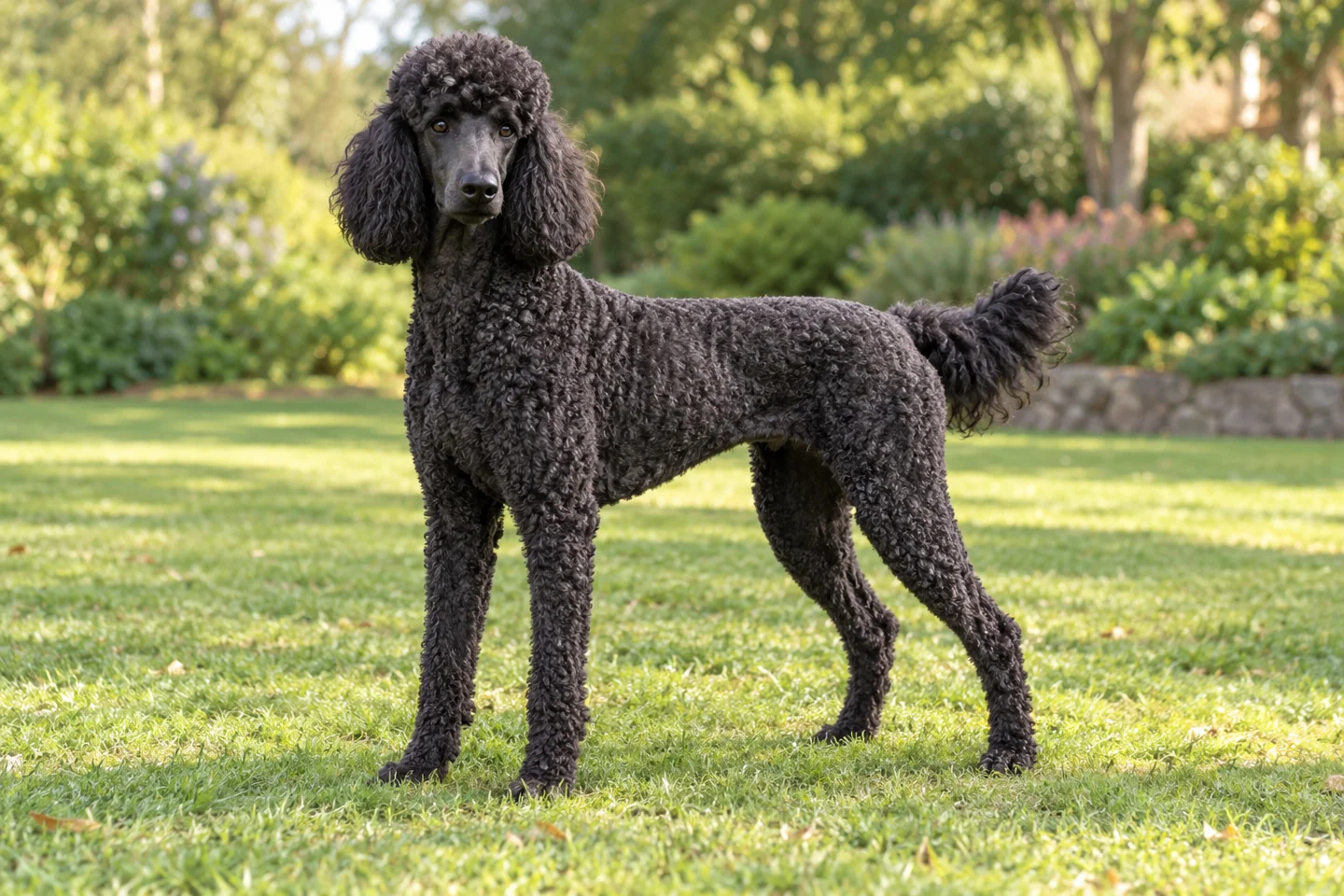
Under the AKC standard, a Toy stands no more than 10 inches at the shoulder. A Miniature stands over 10 inches and no more than 15 inches. A Standard stands over 15 inches. Other registries classify sizes differently, so ask which system is being used when reading an advertisement or discussing an imported dog.
The AKC weight chart gives broad reference figures of about 4 to 6 pounds for Toys, 10 to 15 for Miniatures, and 40 to 70 for Standards across the sexes. These figures do not set an individual dog's healthy weight. Frame, body condition, muscle, growth, and medical needs require a separate assessment.
Terms such as teacup and royal are not additional varieties in the AKC standard. Ask a seller to explain the expected adult size using actual parents and records. Avoid paying for a reassuring label without useful evidence about health and development. Tiny size does not make an animal maintenance-free, and greater height does not promise a particular temperament.
Coat, color, and human allergies
Poodles have a curly coat that generally leaves less loose hair around the home than many heavily shedding breeds. The coat still requires care, and hair that remains in it can contribute to tangles. A household should choose a manageable maintenance routine before choosing a long style for its appearance.
No breed can be promised to cause no human allergy symptoms. VCA explains that allergens are not limited to visible loose hair. A Poodle or Poodle cross may be more manageable for some people, but that is not a guarantee for a particular person. Discuss significant allergies with the appropriate clinician before making a long-term commitment.
Color also cannot establish temperament, trainability, or health. Ask for relevant records and observations regardless of whether the dog is black, white, apricot, brown, or another color. A carefully arranged photograph can show a haircut and expression. It cannot establish skin condition beneath a dense coat or how the dog feels about being brushed.
Household behavior, sensitivity, and settling
Some Poodles notice household changes quickly and enjoy responding to a person. That can make clear teaching rewarding. It can also mean a busy room, repeated interruptions, or unclear expectations becomes difficult. Watch what the dog actually does around noise, visitors, movement, and unfamiliar handling instead of assigning a personality from its breed alone.
Prepare a quiet resting location and practice moving there before a demanding event. Teach a predictable greeting routine. For a small dog, avoid making every interaction an approach from above or an unexpected lift. For a larger dog, arrange space so excitement does not repeatedly lead to jumping on visitors.
Build independence in manageable steps. A dog who panics or injures itself when left needs assessment and a suitable care arrangement. More toys or another dog cannot be promised to fix the cause. Describe the timing, signs, and recovery to your veterinary or behavior professional so advice can address the actual difficulty.
Children, other dogs, and safe handling
A Toy or small Miniature can be hurt by a fall, a rough game, or being picked up incorrectly. Children should interact under close adult supervision, with the dog on a secure, comfortable surface. Give the dog a retreat and let it move away. Do not ask a child to carry a small dog simply because lifting seems easy.
A Standard can knock a child down during enthusiastic movement. Teach calm approaches and separate the dog from active play when needed. Across varieties, protect meals, chews, sleep, and resting areas from interference. An adult needs to be attentive enough to intervene, rather than merely present somewhere in the house.
Introduce other dogs according to behavior and physical compatibility. A tiny dog does not have to tolerate wrestling with a larger companion. Use barriers and escape routes for cat introductions and prevent chasing. A pleasant first interaction offers limited information about sharing beds, food, doorways, and human attention later. Plan continued supervision and separate resources during adjustment.
Aggression and resource guarding
Poodles can bite, including dogs who are affectionate with familiar people. Freezing during brushing, growling over a chew, or snapping when lifted deserves attention. Consider the circumstances and possible pain. Small size should not turn a warning into entertainment, and a larger dog should not be confronted to prove obedience.
Manage valued items so conflict is less likely. Feed animals separately, keep children away from bowls and chews, and prevent access to dangerous objects. If the dog already guards, ask for individual guidance rather than repeatedly removing its possessions. A professional can help develop a plan that fits the household and the observed behavior.
Report sudden changes to your veterinarian and describe bite incidents accurately, including injuries. Use gates and distance while help is arranged. A dog who resists one part of grooming may have discomfort that is invisible beneath the coat. Addressing the cause and preventing another difficult encounter is more useful than relying on the breed's reputation for learning quickly.
Training useful skills without constant pressure
The American Veterinary Society of Animal Behavior recommends reward-based training. Start with skills that improve daily life: returning when called, walking calmly, waiting at an exit, exchanging a toy, and resting while people are occupied. A Poodle's capacity to learn does not mean it already understands what a person expects.
Make the lesson clear and brief. Reward promptly, then offer a pause. Use food from the daily allowance where appropriate, a suitable toy, or access to something the dog values. For very small dogs, deliver rewards without encouraging repeated jumps. For a Standard, consider the space needed to move comfortably through the task.
Avoid turning every waking moment into a test. A dog can learn to relax and explore without continual instructions. If a skill breaks down, reduce the distraction or duration and check that the reward still matters. A few successful repetitions provide a better starting point for the next session than a long argument at the end of a tiring day.

Exercise, enrichment, and water safety
Provide activity matched to the dog's age, fitness, health, and interests. Size alone cannot prescribe a schedule. A young Standard and a senior Toy may both enjoy searching for a familiar object, but the distance, surface, duration, and recovery needed will differ. Ask for veterinary guidance when growth or medical conditions affect the plan.
Build new activities gradually. A dog who likes a ball may continue after a sensible stopping point, so include pauses and a clear finish. Choose toys that cannot easily be swallowed and inspect them for damage. Avoid using physical exhaustion as the main way to obtain calm behavior at home.
For swimming or boating, discuss medical suitability, supervise closely, and consider an appropriate canine flotation aid. Check exits and avoid dangerous currents or questionable water. Regular rest matters on land too. A quiet place to sleep and a predictable end to play allow the dog to recover, rather than leaving it dependent on continuous entertainment.
Grooming that prevents painful mats
Choose a coat length you can maintain between professional appointments. Ask a competent groomer to demonstrate how to check through the coat to the skin without hurting the dog. Pay attention to friction areas, behind the ears, around the legs, and beneath equipment. A coat can look fluffy on top while tangles tighten underneath.
Begin brushing and combing lessons with a few comfortable touches. Reward cooperation and extend the session gradually. If the dog repeatedly objects, look for pain, skin disease, difficult mats, or fear before adding restraint. Ask for an adapted plan when needed. A shorter trim may be more comfortable and manageable than a long style that the household cannot maintain.
Do not cut a tight mat close to the skin with household scissors. Skin can be drawn into the tangle, and an attempted trim can cause injury. Contact a groomer or veterinary team for safe removal. Discuss how to prevent recurrence, including the tools, coat length, and appointment schedule that fit this dog and its caregivers.
Ears, teeth, nails, and skin changes
Include ear checks, dental care, and nails in the regular routine. Ask the veterinary team to demonstrate appropriate techniques and products. Ear odor, discharge, pain, or repeated head shaking needs assessment. Do not assume hair in an ear means every dog needs the same plucking or cleaning procedure.
Skin discomfort can affect grooming tolerance and behavior. VCA identifies Standard Poodles among breeds predisposed to sebaceous adenitis, a condition involving the skin's oil glands. Persistent scaling, hair loss, coat changes, or irritation deserves investigation. A biopsy may be needed for diagnosis, so choosing a shampoo cannot settle the cause by itself.
Tell a groomer about medical findings, handling reactions, and current treatment before the appointment. Older dogs and dogs with pain may need shorter sessions or support for standing. Keep a record of changes rather than waiting until the next full haircut to mention a problem. Comfortable maintenance should leave the dog able to participate in care over time.
Health screening by variety
The Poodle Club of America's December 2024 statement recommends prcd-PRA DNA testing, annual specialist eye examinations, and patella evaluation for Toys. Miniatures have those recommendations plus hip evaluation. Ask for results that match the parents' registered identities and the particular variety you are considering.
For Standards, that statement lists hip and eye evaluation, autoimmune thyroiditis evaluation, and testing or qualifying parentage information for neonatal encephalopathy with seizures and type I von Willebrand disease. It lists cardiac evaluation and sebaceous adenitis biopsy as optional or elective. Older summaries may differ, so use the dated statement and discuss current guidance with the breeder and veterinarian.
Testing informs decisions without guaranteeing lifelong health. Read the findings rather than treating a list of tests as proof that all results are normal. A general puppy examination, a DNA result, and a specialist assessment answer different questions. Ask what was evaluated, what remains uncertain, and how the source responds when a problem appears after placement.
Addison's disease, bloat, and medical changes
Standard Poodles are among breeds identified by veterinary sources as more commonly affected by Addison's disease. The condition involves inadequate production of important adrenal hormones. Its signs can be vague, including episodes of vomiting, diarrhea, lethargy, or weakness. Those signs have other causes, so they need investigation rather than a diagnosis based on breed.
Severe weakness, collapse, or a rapidly worsening illness requires urgent veterinary contact. Keep medication records available and follow a prescribed plan if a condition is already diagnosed. Do not stop or alter long-term medication because an online account describes what worked for a different dog.
The breed club also lists gastric dilatation-volvulus, commonly called bloat, among health concerns. A painful swollen abdomen or repeated unsuccessful retching warrants urgent contact. Ask your veterinarian about individual risk and any preventive options relevant to a Standard. Do not wait for a home remedy to work. Routine screening and sensible care cannot remove every medical risk, so knowing where to obtain urgent help remains part of preparation.
Feeding, growth, and body condition
Feed a complete diet appropriate to life stage and medical needs. Measure consistently and count food given in training, chews, and enrichment. The range of Poodle sizes makes a generic breed feeding amount particularly unhelpful. Ask the veterinary team to assess the individual dog's condition and growth instead of borrowing a portion from another owner's dog.
With small dogs, even modest extras can become a substantial part of intake. With a growing Standard, discuss a suitable growth diet and avoid adding calcium or other supplements without a defined reason. Record weight trends and body condition rather than judging only the outline of a freshly clipped coat.
Report appetite changes, persistent digestive signs, unusual thirst, or unexplained weight loss or gain. A tidy haircut can make a change easier to see, but it cannot explain its cause. Bring a clear record of food, treats, medication, and possible scavenging to the appointment. Follow a specific plan rather than repeatedly changing several variables at once.
Poodle mixes and coat expectations
Labradoodle and Goldendoodle commonly refer to Poodle crosses with Labrador and Golden Retrievers respectively. Cockapoo usually refers to a Cocker Spaniel and Poodle cross. Names can leave important details unstated, including the Poodle variety, the other parent's identity, and whether the dog has several generations of mixed ancestry.
A cross can inherit different combinations of coat, build, size, behavior, and medical risk. A curly appearance does not guarantee low grooming needs or freedom from human allergy symptoms. Ask to see the actual coat maintenance involved and plan for adult care. Do not assume a mix will combine only the features a seller describes as desirable.
Known parents should have relevant screening for their own breeds and varieties. For an adult with uncertain ancestry, use medical findings and observed behavior to guide the decision. Discuss handling, meals, visitors, separation, children, and other pets. A precise percentage is less important to daily care than an accurate account of what the dog can manage comfortably.
Choosing a dogsDating companion
Describe the Poodle's variety, approximate adult size, preferred play, and relevant limits. A Toy and a Standard may share a breed name while needing very different physical arrangements. Include guarding, chasing, or handling concerns that affect a meeting. Ask whether the other dog can pause and move away when its companion needs space.
Choose a calm location with room to separate, suitable footing, and an easy exit. A parallel walk can be enough for an initial outing. Keep valued food and toys out if they create competition, and discuss recent illness and veterinary precautions. Share meeting information without giving exact home coordinates to an unfamiliar person.
Continue watching after the first greeting. End repeated pursuit of an unwilling dog, freezing, hiding, or attempts to escape. Some Poodles enjoy active play; others prefer a familiar walking partner. Let the dogs' behavior guide the plan, and reconsider it when health, age, or circumstances change. Comfortable company does not require every encounter to become physical play.
Sources and editorial notes
Sources checked October 21, 2026. Breed measurements describe reference ranges, not a diagnosis or an individual dog's ideal weight. Images are AI-generated breed illustrations and do not document a particular dog or health condition.
- AAHA: Canine hypoadrenocorticism, Addison’s disease
- VCA Animal Hospitals: Hypoallergenic dog breeds
- American Kennel Club: Is the Poodle right for you?
- VCA Animal Hospitals: Common emergencies in dogs
- VCA Animal Hospitals: General feeding guidelines for dogs
- VCA Animal Hospitals: Food aggression in puppies
- Poodle Club of America: Health statement dated December 11, 2024
- American Kennel Club: Poodle history
- VCA Animal Hospitals: Aggression toward unfamiliar dogs, diagnosis
- PetMD: Cockapoo health and care
- VCA Animal Hospitals: Sebaceous adenitis in dogs
- Poodle Club of America: AKC breed standard
- AVSAB: Humane Dog Training Position Statement
- VCA Animal Hospitals: Water sports for dogs
- American Kennel Club: Breed weight chart
Keep getting to know dogs.
Read another guide or return to your dogsDating community.
Explore breed guidesBack to dogsDating