Portuguese Podengo Pequeno
A small Portuguese rabbit-searching dog with upright ears and an active independent mind, illustrated in its wire coat and cared for as a capable dog with appropriate safeguards.
How these guides are researched and reviewed

- Origin
- Portugal
- FCI small variety
- 20–30 cm; 4–6 kg
- Coats
- Smooth or wire, both without undercoat
- Illustrated form
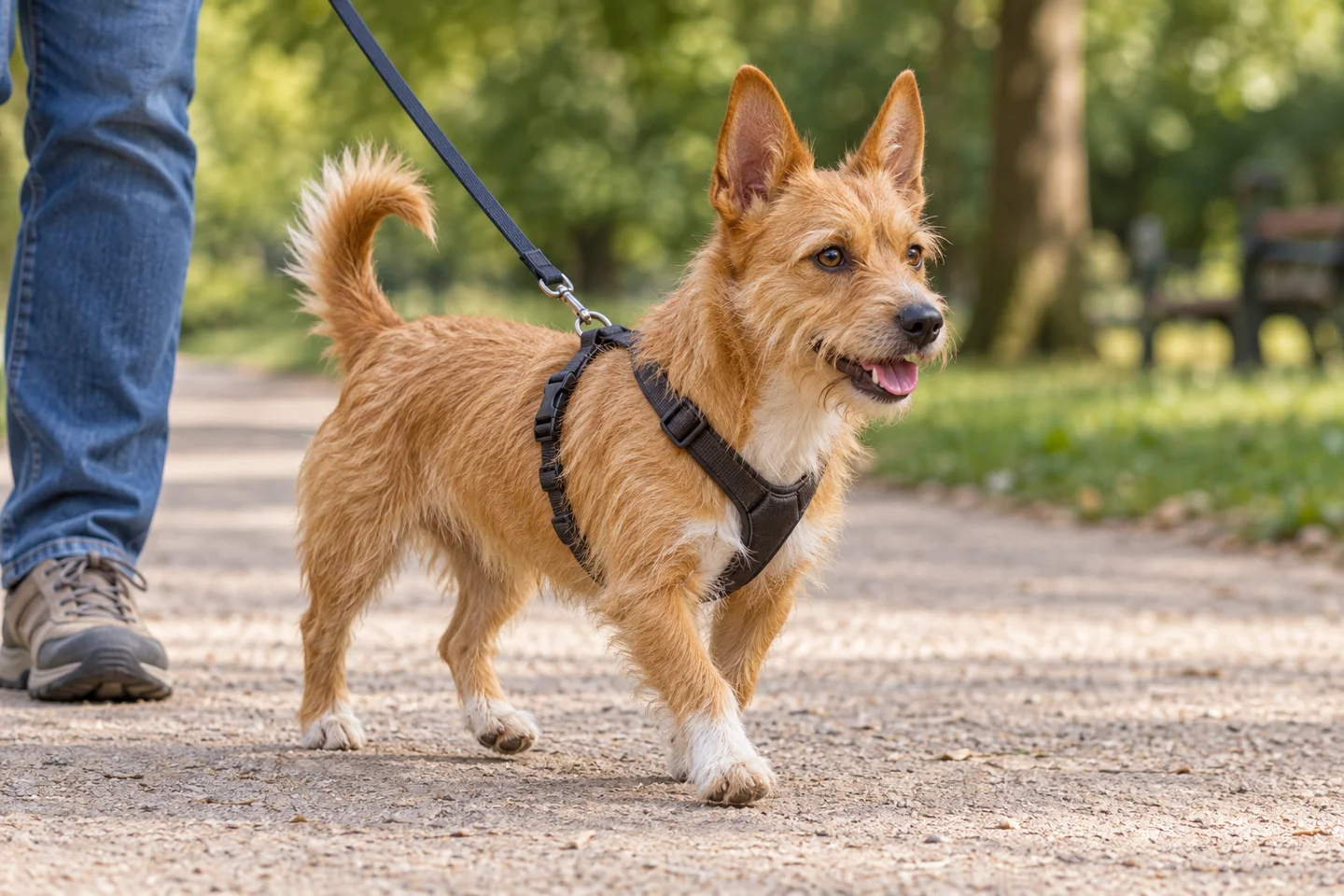
- Small wire-coated yellow-fawn dog with white chest
General information for owners. These articles have not been reviewed by a veterinarian. Medical decisions need your dog's history and an examination.
Small size belongs to an active hunting dog
The Portuguese Podengo Pequeno is the small member of Portugal's Podengo family, with an upright-eared outline and a history of searching for rabbits in tight ground. A compact body does not remove the need for movement, investigation, and learning. This is a useful point to establish before choosing a puppy because it fits under an airline seat or looks appealing beside a sofa. The home must also provide safe daily activity, managed exits, comfortable handling, and help during absences. A small dog can have a substantial interest in what happens beyond a garden boundary.
Ask to meet adults and discuss actual routines. How does the dog respond when a rabbit runs, a stranger bends toward it, or a larger dog approaches? What arrangements allow it to rest after activity? A source should be able to describe difficult moments and the support used, rather than supply only affectionate photographs. Prepare a calm arrival and give a new dog time to learn the house. An adult may have useful established habits, while a puppy needs developmentally appropriate teaching. Neither should be expected to fit every aspect of the household simply because its physical size seems convenient.
Pequeno, Médio, Grande, and different registry names
The FCI recognizes three Podengo sizes within one standard, each in smooth and wire coat. Pequeno means small; Médio and Grande identify medium and large. The AKC separates the Portuguese Podengo Pequeno from its Portuguese Podengo entry, which covers medium and large dogs. This guide concerns the small form, illustrated in wire coat. Be precise when discussing registration, health records, and an expected adult. A generalized Podengo label on a rescue record may not establish variety or ancestry, so retain uncertainty where the evidence is incomplete.
The FCI's history describes the small variety's use in rabbit searching and its historical role as a ratter on Portuguese ships. Those functions explain why investigating holes, rocks, and movement can be rewarding. They do not establish that every small Podengo behaves identically or that a modern puppy comes ready to work safely around wildlife. Ask how contemporary parents live and what the source does to prepare puppies for household life. Registered breed identity, a plausible ancient account, and an individual temperament assessment answer different questions. Each deserves an accurate description without being used as a substitute for the others.
Size, wire hair, and an unaltered hunting outline
The FCI small-size range is 20–30 cm and 4–6 kg. The small Podengo is somewhat longer than tall, with a lean wedge-shaped head, pointed muzzle, large mobile erect ears, and full natural tail. Both coat varieties lack undercoat; the wire form has longer hair and a beard. Yellow and fawn with or without white are permitted characteristic colors. The pictures here show a yellow-fawn wire-coated small dog with a white chest and natural tail. They are labeled AI illustrations and do not document a particular registered individual or available litter.
A show range helps identify the variety but should not become a reason to feed too little or buy a deliberately undersized puppy. Ask about normal growth and assess the individual with a veterinarian. Equipment should fit securely without pressing into the throat or allowing the dog to reverse out. Check this in a safe enclosed place. Small paws, a narrow gap in a fence, and a door opened during a delivery can combine quickly, so examine the environment at the animal's level. A compact dog deserves the same deliberate prevention of escape that an owner would provide for a much larger hunter.
Alert behavior and a workable indoor routine
Pequenos can be lively and quick to notice activity. Teach a response to household events instead of assuming barking will disappear once the dog has more exercise. Reduce access to a window that repeatedly triggers alarm, reward returning to a resting place, and make visitor arrivals predictable. Do not force a wary dog into a stranger's lap. Brief neutral experiences at a suitable distance can be more useful than overwhelming close contact. Watch recovery and voluntary engagement. Quiet observation is valid progress, even when a person expected instant sociability from an appealing small face.
Plan company and separation as skills and practical resources. Begin with short comfortable absences, observe the response, and increase gradually. Another pet cannot be assumed to solve distress. An owner working away from home needs reliable toilet access and a carer who understands the dog, including its door routine. A newly arrived adult may need time to learn a household different from its previous environment. Keep the first days predictable rather than arranging repeated introductions. Sleep and undisturbed rest matter alongside activity, and a dog should have a place where it can settle without hands continually reaching toward it.
Training without lifting the dog out of every problem
Teach the dog to move with you, come when called, wait at a threshold, and release an object. Small size makes physical removal tempting, but repeatedly scooping the animal up can prevent it learning a useful response and may become unwelcome handling. Practice in a quiet setting and reinforce manageable steps. If lifting is necessary for safety or care, teach a predictable cue and comfortable support in advance. Do not suspend the dog by its front legs or force an unprepared interaction to prove that it tolerates being handled by everyone.
Recall deserves careful management around scent and movement. Use an appropriate harness and safely handled long line while training, and reserve off-lead opportunities for secure suitable areas. Reward returning generously and often allow a return to investigation when safe. Short scent searches and cooperative tasks can engage the mind without constant high-arousal throwing. Practice trades for found items rather than chasing the dog around the house. Guarding or distress calls for a revised setup and qualified help. A useful lesson ends with understandable success, not exhaustion or a contest over whether the animal will submit to being picked up.
Exercise and choosing safe companions for a small body
Provide regular varied outings matched to age, fitness, health, and weather. Small size does not mean a garden alone supplies enough interest, but it also does not justify an adult endurance target for a puppy. Let exploration, brief training, and rest balance one another. Build new demands gradually and check comfort later in the day. Notice a shortened stride, repeated stopping, or reluctance to jump rather than dismissing them as attitude. Changes in movement or recovery deserve veterinary assessment. No single distance or duration can replace observation of this animal's condition.
Choose walking and play settings with size and pursuit in mind. A larger dog repeatedly chasing a small animal can cause fear or injury even when someone calls it friendly. Interrupt when roles do not change or the Pequeno cannot leave. Avoid crowded gates and small pens where speed becomes the main interaction. Inspect fences for low gaps, and secure vehicle transfers before opening doors. Carry water, provide shade, and adjust to heat or cold rain. The absence of undercoat makes individual weather comfort worth checking, rather than assuming a rustic-looking wire coat protects against every condition.

Aggression, boundaries, and listening to warnings
A small dog can cause a bite and can also be injured when its warnings are ignored. Do not laugh at growling, deliberately provoke it for a video, or assume it is harmless because the dog is easy to lift. Watch for freezing, withdrawal, a hard stare, and tension during handling or around valued items. Reduce the pressure and create space. Punishing warnings leaves the cause unresolved. A new reaction may have a medical contribution, especially if touching a limb, mouth, ear, or back has become difficult, so arrange veterinary assessment.
Use barriers and routines to prevent repeated confrontations while obtaining appropriate behavior support. Keep resting and feeding areas protected, and make sure visitors understand that contact requires the dog's willing participation. Positively introduced basket-muzzle training may help a professional safety plan, but it does not permit forced interaction. Record the trigger, distance, preceding activity, and response to management so progress can be evaluated. The goal is a comfortable manageable dog whose needs are understood. Suppressing every sound while continuing unwanted touching can make the household less informed about a developing problem, rather than safer.
Children, other dogs, and small pets
Children should sit or stand calmly for supervised contact and allow the dog to approach. Adults must prevent carrying, chasing, squeezing, ear pulling, and interruption of sleep. Give the Pequeno a resting area children cannot enter and separate during noisy running games or meals. A small puppy needs protection from accidental drops and rough handling, but so does an adult that does not welcome being held. A child cannot be responsible for judging every warning or managing an excited dog near a road. Supervision means active intervention and a safe arrangement, not merely an adult somewhere in the building.
Introduce a dog companion with room to move independently and capable handlers at both leads. Similar size alone does not establish compatibility, and the first outing should not depend on close play. Cats, rabbits, rodents, and birds require their own safeguards because hunting interest can be engaged by movement. Familiarity with one household animal does not generalize automatically to another. Secure barriers and gradual supervised exposure may be appropriate, while some combinations need lasting separation. Never allow a chase as an experiment. Honest information about previous behavior helps the new home plan, including information that makes an appealing placement less convenient.
Grooming the wire coat and protecting the mouth
The wire coat needs gentle regular brushing and combing through tangles, especially around the beard and areas rubbed by equipment. The AKC describes a natural coat that does not require clipping or scissoring. A groomer familiar with the variety can demonstrate suitable maintenance without reshaping the animal into another breed. The smooth variety needs a simpler approach to loose hair, but both need skin and foot inspection. Remove food debris from the beard and dry it comfortably. Painful matting is a care problem requiring assistance, not an opportunity to force the dog through a prolonged combing session. Check the beard after meals so dried food does not make the next combing uncomfortable.
Establish dental care with the veterinary team and teach comfortable mouth handling in small steps. Do not assume chewing a toy replaces examination or all home care. Look at nails, pads, and the visible outer ears too. Ear odor, discharge, head shaking, or pain needs advice rather than deep cleaning with improvised tools. A cooperative routine can begin with seconds of contact and a reward, then gradually add useful steps. A dog that can choose a comfortable position for care is easier to inspect accurately than one struggling to escape. Keep grooming tools clean and stop when a problem requires clinical assessment.
Health screening: three specific areas to review
The American parent-club statement lists hip evaluation, specialist eye examination, and patellar evaluation for the Pequeno's CHIC programme. Its breeder-referral agreement also specifies an eye examination registered with OFA CAER within one year of breeding. Ask for the actual parental records with matching identification and dates, and check the current applicable programme before a breeding decision. A CHIC number records completion and publication of programme information; it should not be treated as a blanket promise that every result is normal or that a puppy cannot develop a medical problem.
These evaluations address different structures and should not be compressed into a phrase such as all tests clear. A patella assessment concerns kneecap stability, hip imaging assesses the hips under its reporting system, and an ophthalmologist examines the eyes. Ask the source to explain results and family history in plain language. A commercial DNA panel does not replace those physical assessments. For a rescue without parental information, arrange the individual's clinical examination and maintain honest limits about ancestry and inherited risk. Missing documents create uncertainty, but the next useful action is a practical assessment rather than assuming either a disease-free or inevitably unhealthy dog.
Clinical follow-up is different from a parental certificate
The AKC identifies eye disorders, hip dysplasia, and patellar luxation as screening concerns in this breed. That supports vigilance without supplying a population rate for any condition. Repeated skipping steps, a limb held up, or changed willingness to move should be discussed with the veterinarian rather than diagnosed from a short video. Record when the problem occurs and whether the dog appears painful. Keep body condition appropriate and follow a patient-specific activity plan if an orthopedic problem is found. A small dog that can be carried still needs a diagnosis and comfortable independent movement.
A painful, red, closed, or suddenly altered eye needs prompt veterinary advice. An old normal parental or individual eye result does not explain today's symptom. Avoid leftover eye medication because different causes need different care. Keep reports and treatment instructions readable for another carer or clinic. The same practical approach applies to changes in appetite, drinking, skin, or behavior: describe what changed, when it began, and any relevant travel or treatment. Reliable observation and timely assessment serve the dog better than collecting a longer list of possible conditions that have not been established in this individual.
Nutrition, mixes, and the household budget
Use complete food appropriate to growth, adulthood, or medical needs and measure portions rather than judging from bowl size. Training rewards can form a meaningful share of a small dog's intake, so include them in the daily total. Ask the clinic how to assess ribs and body condition beneath wire hair. A mix needs equally individual care. Ask what is known about both parents and preserve uncertainty when ancestry is guessed. A beard or upright ear cannot confirm a Pequeno cross, and crossing does not promise a particular adult size, quieter behavior, or freedom from inherited disorders.
Include routine veterinary care, dental care, suitable insurance or emergency funds, training help, secure equipment, transport, and reliable sitting in the budget. Small food portions do not guarantee a small overall commitment. Clarify the source's support and return arrangements in writing, and ask who can advise after collection. Plan for a period when the main carer is unwell and for changes in the dog's mobility later in life. Choose the animal because the whole routine is sustainable, including calm indoor days and necessary supervision, rather than because a small size seems to make every difficult part of ownership disappear.
dogsDating introductions should respect a small hunter’s space
On dogsDating, describe the individual's pace, preferred distance, size, and response to chasing or larger dogs. Give an approximate area while keeping exact coordinates and the home address private. Choose a public open place with a clear route away and have a capable adult manage each dog. Begin by walking in parallel with space between them. Keep shared toys and food bowls out of the first meeting. Avoid a small enclosure where a faster or larger animal can turn the outing into pursuit while its handler remains at the gate.
Watch whether the Pequeno can sniff, look away, and move without repeatedly being followed or trapped. Increase distance or finish if either animal shows tension, withdrawal, or excitement that prevents comfortable disengagement. Quiet repeated walks can provide companionship without wrestling or close greetings. Review what worked, including route and duration, before planning another meeting. Do not post precise location details or another owner's identifying information in public photographs. A useful connection respects the dogs' limits and the owners' ability to change plans, even when an anticipated friendship develops more slowly than a profile description suggested.
Sources and editorial notes
Sources checked October 22, 2026. Breed measurements describe reference ranges, not a diagnosis or an individual dog's ideal weight. Images are AI-generated breed illustrations and do not document a particular dog or health condition.
- AVSAB: Humane Dog Training Position Statement
- VCA Animal Hospitals: Food aggression in puppies
- VCA Animal Hospitals: Common emergencies in dogs
- Orthopedic Foundation for Animals: CHIC health screening programs
- VCA Animal Hospitals: Aggression toward unfamiliar dogs, diagnosis
- VCA Animal Hospitals: Grooming and coat care for your dog
- VCA Animal Hospitals: Ear infections in dogs (otitis externa)
- AAHA: Feeding plans for healthy, appropriate weight cats and dogs
- VCA Animal Hospitals: Heat stroke in dogs
- AVSAB: Puppy Socialization Position Statement
- VCA Animal Hospitals: Dog behavior problems, aggression toward children
- Official breed standard: Portuguese Podengo Pequeno
- American Kennel Club: Portuguese Podengo Pequeno care and recommended health evaluations
- Portuguese Podengo Pequenos of America: Hip, eye, and patella CHIC statement
- PPPA: Breeder referral screening agreement, version October 2025
Keep getting to know dogs.
Read another guide or return to your dogsDating community.
Explore breed guidesBack to dogsDating