Prague Ratter
The Pražský krysařík is a small Czech dog with a distinct muzzle and erect ears, needing normal canine choices, careful physical protection, and clear interpretation of patella and DNA records.
How these guides are researched and reviewed

- Origin
- Czech Republic
- FCI height
- 21–23 cm, with 1 cm tolerance
- FCI optimal weight
- About 2.60 kg
- Illustrated form
- Short-haired black and rich red-tan, with natural full tail
General information for owners. These articles have not been reviewed by a veterinarian. Medical decisions need your dog's history and an examination.
A very small dog still needs a full canine life
The Prague Ratter, or Pražský krysařík, is a small Czech dog with an alert outline and a clear muzzle. Its size makes physical protection important, but it should still have opportunities to walk, sniff, learn, and choose comfortable contact. Constant carrying is not a complete life plan. Before choosing one, consider the home at dog level: feet in a busy kitchen, gaps beneath gates, a child's reach, and the movement of larger pets. A suitable placement provides both normal canine experience and safeguards proportionate to a small body.
Meet adults and ask about ordinary routines. How does the dog behave when set down in an unfamiliar safe place, when a person reaches toward it, or when another dog passes? Can it rest while people work, and what helps with necessary absences? An attractive animal sitting in someone's hands cannot answer those questions. A puppy is still developing, and an adult changing homes may need time to show its preferences. Prepare predictable rest, toilet access, secure equipment, transport, and veterinary care. Choose a source willing to describe problems and practical support as clearly as it describes a charming appearance.
Czech identity and a name with a working association
Pražský krysařík is the Czech name, while Prague Ratter is the English label. The breed's historical association with catching small rodents should not become a reason to test a pet against live animals or use an uncontrolled encounter as entertainment. A modern dog's interests and safety need direct assessment. Distinguish it from a Miniature Pinscher, Chihuahua, or an unknown small black-and-tan mix. Similar coloring and erect ears do not establish ancestry. Registered records and an individual behavior history serve different useful purposes, and both should be represented accurately.
The Czech parent club provides current breeding-condition information and links to its registration rules. If choosing a registered litter, ask which organization issued the documents and how the parents qualified under the applicable programme. A foreign registry or rescue may use different paperwork, so keep the original identification and a readable explanation. Do not invent a pedigree for an unknown animal merely because it fits a visual expectation. Rarity can make travel and source communication more complicated, but it does not justify pressure to commit before records, support, and a realistic household fit have been considered.
Height, weight, head shape, and natural ears
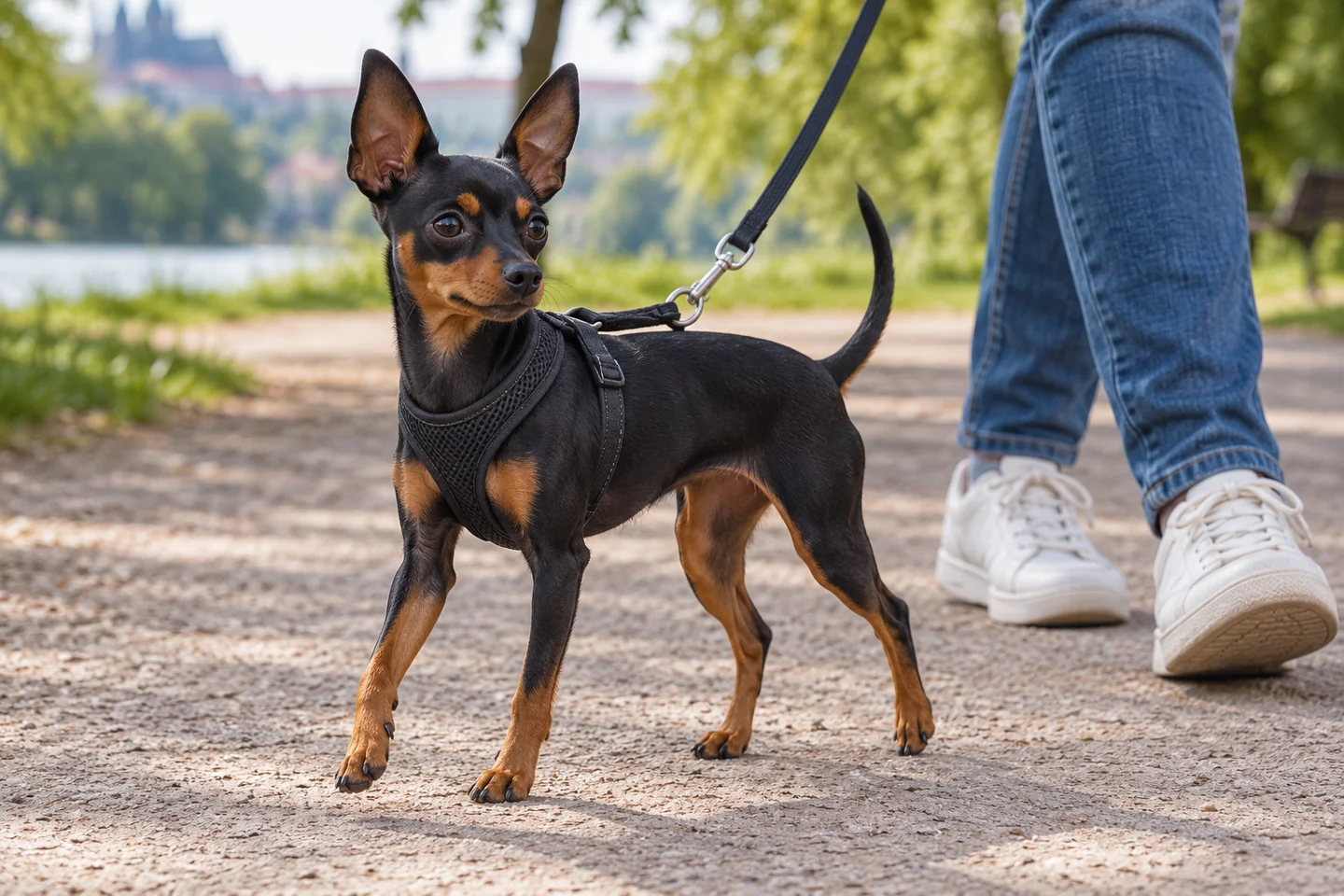
The FCI standard gives a height of 21–23 cm with a 1 cm tolerance and an optimal weight around 2.60 kg. The head has a pear-like form with a distinct muzzle rather than an extremely short compressed face. Erect triangular ears contribute to the alert outline. Short and moderately long coat forms are recognized. The illustrations here use short black hair with rich red-tan markings, natural ears, and a full tail. They are labeled AI illustrations and are not proof of a particular dog's registration, size, or future health.
Treat an optimal weight as a standard description, not permission to restrict food in pursuit of a smaller animal. Assess growth and body condition with a veterinarian. Avoid advertisements that imply deliberate extreme smallness is an additional recognized breed. Look for comfortable ordinary movement and ask about injuries, difficulty jumping, or changed stride. Fit equipment to the actual body and check whether the dog can back out in a safe area. A light animal can still escape in a moment of fear. At home, prevent falls from furniture or arms rather than assuming a quick small dog will always land safely.
Confidence at floor level and respect for contact choices
A dog can appear calm while held because it has little ability to leave. Give the Prague Ratter safe opportunities to explore at its own pace and watch how it recovers from mild novelty. Visitors should not surround it, loom, or reach from several directions. Brief invitations and a pause give the animal a chance to choose continued contact. A retreat deserves space rather than pursuit. Small size can make unwanted handling easy for people, so owners need to be especially clear that access to the dog is not automatic. Confidence grows through manageable experiences, not repeated demonstrations of tolerance.
Arrange indoor life with uninterrupted rest and a predictable schedule. Prevent constant surveillance of a busy window if it repeatedly triggers barking, and teach a useful alternative such as returning to a mat. Build short comfortable absences gradually and observe the response. Another dog does not guarantee separation comfort, and a carrier does not make every long appointment an appropriate outing. A household should have reliable care when the main person is unavailable. Newly arrived adults may need simpler routines at first, with familiar food and cues where possible, rather than a crowded welcome designed to show how sociable the animal can be.
Training useful movement instead of relying on physical control
Teach coming when called, following a hand or movement cue, waiting at exits, and walking comfortably on a lead. Practice at a level where the animal can succeed before adding distractions. Because lifting is easy, people may skip teaching these skills and later find handling becomes a source of conflict. Establish a predictable cue for necessary lifting and support the body comfortably. Never lift by the front legs or treat restraint as a substitute for learning. A dog that can move voluntarily into position has more choices and often makes practical care and transport easier.
Use short lessons with rewards appropriate to a small daily intake. Teach an exchange for an object and prevent unsafe items from being available. Chasing a dog to retrieve something can turn possession into a game or create pressure. If stiffness or guarding occurs, change the setup and seek qualified advice. Recall needs safe management around roads and moving animals even in a tiny companion. Use suitable secure equipment and enclosed opportunities while reliability develops. Cooperative paw, mouth, and ear handling should also begin in small comfortable steps, so the first clinical or grooming need does not become the animal's first prolonged experience of touch.
Exercise, cold weather, and safe surfaces
Offer regular walks and investigation matched to age, fitness, health, and weather. A small dog should not be expected to obtain all activity inside a carrier, but its individual stride and endurance need consideration. Introduce routes gradually and check recovery later that day. Persistent limping, repeated skipping, or reluctance to move deserves veterinary assessment. Puppies need exploration and coordination without forced adult endurance or repeated leaps from furniture. Provide non-slip surfaces where needed so normal movement is comfortable. An owner should be able to change the plan when the animal is tired, frightened, cold, or unwell.
Short hair and small size make it sensible to assess comfort carefully in cold wet conditions. Use suitable protection where helpful, keep outings appropriate, and dry comfortably afterward. Clothing should not restrict movement or be used to keep an uncomfortable dog outdoors for longer. Warm weather still requires water, shade, and safe timing. Check pavements and routes before committing to a walk, and avoid crowded areas where the animal is difficult for others to see. A capable handler plans enough room and an easy exit. Physical protection and opportunities to behave like a dog should work together, rather than one permanently replacing the other.

Aggression and the risk of dismissing a small dog’s warnings
A small dog can bite and can be harmed when people ignore its attempts to avoid contact. Do not provoke growling for entertainment or assume it is harmless because the animal can be picked up. Stiffening, freezing, withdrawal, and a hard stare deserve attention before a bite occurs. Reduce pressure and give space. Punishing the warning while continuing the same handling does not resolve fear or pain. A sudden change in tolerance should prompt a veterinary discussion, particularly when lifting, touching a limb, or examining the mouth has become difficult.
Use a safety plan appropriate to the situation while obtaining help. Protect food and sleeping places, prevent uninvited lifting, and use barriers for visitors when needed. Every adult should follow the same approach. A bite or credible bite risk warrants suitably qualified behavior support and clinical assessment. A positively introduced basket muzzle may be useful when advised, but it does not permit rough handling or forced greetings. Keep concrete notes about triggers and successful arrangements. Improvement means a more comfortable animal with manageable choices, not merely one that has learned to remain silent while unwanted pressure continues.
Children, large dogs, and small household animals
Adults must supervise children's contact and protect this small dog from accidental drops, squeezing, chasing, and interruption of sleep. A child should not carry the animal around the house or treat it as a toy that belongs in a lap whenever requested. Arrange a resting place children cannot enter, and separate during noisy games. Teach an invitation to brief contact followed by a pause. A dog that leaves should be allowed to leave. A child's good intentions cannot replace active adult attention or a physical arrangement that remains safe when excitement makes a remembered rule difficult to follow.
Choose dog companions carefully by behavior and size, not by a claim that a large animal is friendly. Repeated pursuit or rough body contact can injure or frighten a small dog without aggressive intent. Start with parallel movement and ensure both can disengage. Rodents, birds, and other small pets need secure barriers and individual assessment; a ratter name is a reason for thoughtful management, not a prediction of every encounter. Some combinations require lasting separation. Never arrange a chase to discover whether affection or prior training outweighs interest in a moving small animal. The cost of that experiment falls on the animals.
Grooming, nails, and comfortable mouth care
The short coat needs gentle brushing or wiping as appropriate, with regular inspection of skin and equipment contact areas. A moderately long coat may need more attention to tangles and feathering. Bath when needed with suitable products and dry comfortably. Check nails and feet rather than assuming a small body creates little wear or discomfort. Teach a paw offered willingly for seconds, then build the task gradually. If a nail is injured or the dog appears painful, seek advice instead of forcing a first full session. Care should become predictable rather than a series of surprise captures.
Discuss dental care with the veterinary team and introduce comfortable mouth handling. Small size does not make oral pain less significant, and a toy should not be assumed to replace all home care or examination. Inspect the outer ears for redness, smell, discharge, or sensitivity and obtain guidance for problems. Avoid deep probing and leftover medication. Keep grooming supplies and bedding clean, and watch changes in appetite, chewing, or tolerance of touch. A dog that participates calmly is easier to inspect accurately. Repeated struggling can hide useful information about whether discomfort comes from the procedure, an underlying problem, or both.
Health: the Czech club specifies a patella examination
The Czech Prague Ratter club identifies examination for patellar luxation as one condition for entry into breeding under its rules. Its information describes a clinical assessment and grading, rather than a DNA test or routine requirement for anesthesia and radiographs. Ask for the named parental results and confirm the current applicable breeding rules before a breeding decision. A condition in one club programme should not be presented as an identical worldwide legal requirement. Equally, a claim that a dog looks active does not replace the documented assessment the source says it has performed.
A grade needs interpretation, not merely a photograph of a certificate. Ask the source and veterinarian what each result means for the pairing and what family information is available. A parental examination informs one aspect of breeding risk; it does not guarantee the puppy's future movement. Repeated skipping, holding up a hind limb, lameness, or pain in the individual warrants clinical attention. Do not attempt to manipulate a kneecap at home or diagnose the grade from a video. Follow the patient's actual treatment and activity plan, maintaining an appropriate condition and adapting the environment where the clinician advises it.
A DNA identity profile is not a health clearance
The Czech club also explains DNA profiling as a breeding-condition record. An identity profile is a genetic fingerprint used to distinguish an individual and support parentage comparisons. The club explicitly separates that function from statements about health, temperament, or appearance. This matters when an advertisement says only DNA tested. Ask what test was performed, which question it answers, and whether the report matches the parent's identification. A parentage profile and a disease-variant result are different documents, even when both were produced from a cheek swab by a genetics laboratory.
Keep access to original reports after purchase or adoption, including any documentation needed for future parentage verification. Ask separately about clinical diagnoses, surgery, inherited concerns in relatives, and the reasons close family members died when known. These questions gather useful information without inventing a long list of established Prague Ratter predispositions. A veterinarian can help decide what additional assessment is relevant. For an adult without records, begin with its own examination and a clear description of uncertainty. A missing pedigree does not diagnose disease, while a complete pedigree cannot promise that the animal will never need medical care.
Nutrition, mixes, and costs that do not shrink with the dog
Use complete food appropriate to life stage and medical needs, with measured portions and rewards included in total intake. Ask the veterinary team how to evaluate condition and respond to feeding problems in a small puppy. Do not restrict nutrition to preserve an unusually tiny advertised size. A mix needs individual assessment and consideration of both known parental backgrounds. Black-and-tan coloring and erect ears cannot confirm Prague Ratter ancestry. Keep uncertain labels honest. Crossing does not guarantee a predictable adult frame, easier temperament, or freedom from inherited risk, and an appealing small face should not substitute for realistic information about care.
Budget for routine and urgent care, dental care, secure equipment, training, transport, and reliable sitting. Small food portions do not establish a low overall commitment. Obtain local estimates and arrange suitable insurance or an emergency reserve before treatment is needed. Clarify source support and return terms in writing. A sitter must understand handling, door security, and introductions to larger dogs, rather than simply be willing to keep a tiny animal in their arms. Plan for human illness, travel, and later mobility changes. The right home can meet ordinary needs consistently, including quiet days, without relying on novelty or convenience to justify the choice.
dogsDating meetings at a safe scale
Describe the dog's actual pace, greeting distance, size, and comfort around larger animals on dogsDating. Share an approximate area while keeping exact coordinates and the home address private. Choose an open public starting place with space to leave, and have one capable adult manage each dog. Begin with parallel walking at a suitable separation. Keep valued toys and shared food out of the first meeting. Do not begin in a crowded enclosure where a fast larger dog can turn an introduction into pursuit before either owner has assessed the interaction.
Watch whether the Prague Ratter can sniff, look away, and move without being repeatedly followed or trapped. Increase separation or end if either animal shows tension, withdrawal, or excitement that prevents comfortable disengagement. Calm repeated walks can provide companionship without close play. Review duration, route, pace, and spacing afterward and adjust the next invitation from those observations. Avoid public photographs revealing precise addresses or another person's private details. A useful meeting protects the smaller animal while respecting both dogs' choices, including the possibility that comfortable company will develop slowly or remain limited to separate movement on shared walks.
Sources and editorial notes
Sources checked October 22, 2026. Breed measurements describe reference ranges, not a diagnosis or an individual dog's ideal weight. Images are AI-generated breed illustrations and do not document a particular dog or health condition.
- AVSAB: Humane Dog Training Position Statement
- VCA Animal Hospitals: Food aggression in puppies
- Orthopedic Foundation for Animals: CHIC health screening programs
- VCA Animal Hospitals: Aggression toward unfamiliar dogs, diagnosis
- VCA Animal Hospitals: Grooming and coat care for your dog
- VCA Animal Hospitals: Ear infections in dogs (otitis externa)
- AAHA: Feeding plans for healthy, appropriate weight cats and dogs
- VCA Animal Hospitals: Heat stroke in dogs
- AVSAB: Puppy Socialization Position Statement
- VCA Animal Hospitals: Dog behavior problems, aggression toward children
- Official breed standard: Prague Ratter
- Czech Prague Ratter club: Current breeding conditions and registration-rule links
- Czech Prague Ratter club: Patellar luxation examination and grading
- Czech Prague Ratter club: DNA identity profiles, parentage, and their limits
Keep getting to know dogs.
Read another guide or return to your dogsDating community.
Explore breed guidesBack to dogsDating