Presa Canario
A practical guide to Presa Canario handling, visitor routines, health records and carefully managed social contact.
How these guides are researched and reviewed

- Origin
- Canary Islands, Spain
- FCI adult height
- Males 61–66 cm; females 57–62 cm
- FCI weight reference
- Males 45–57 kg; females 40–50 kg
- Daily planning
- Capable handling and secure visitor routines
General information for owners. These articles have not been reviewed by a veterinarian. Medical decisions need your dog's history and an examination.
Presa Canario identity and working background
The Presa Canario is a powerful Spanish dog associated with guarding and cattle work in the Canary Islands. Its history and physical strength affect the practical questions a prospective owner should ask. Can the adults in the household manage it safely on a lead? Can visitors enter without passing a loose dog at the door? Is there a workable plan when someone else needs to provide care? Those questions deserve answers before choosing a puppy on appearance.
The FCI standard traces the breed to Tenerife and Gran Canaria. Older material may use Dogo Canario or Perro de Presa Canario, so check which registry and standard a source follows. Similar mastiff-type dogs are not interchangeable, and a brindle coat cannot establish ancestry. For a registered puppy, ask for identified parental records. For an adopted adult with uncertain ancestry, start with its observed behaviour, medical history and physical needs instead of treating a guessed breed label as a complete assessment.
Size, natural ears and functional movement
The October 2023 FCI standard gives adult male height as 61 to 66 centimetres and female height as 57 to 62 centimetres. Its weight reference is 45 to 57 kilograms for males and 40 to 50 kilograms for females. Individual care should follow body condition and clinical assessment. Deliberately adding weight to make a dog more imposing can reduce comfort and make daily handling harder. A useful adult should be able to rise, turn and walk without obvious difficulty.
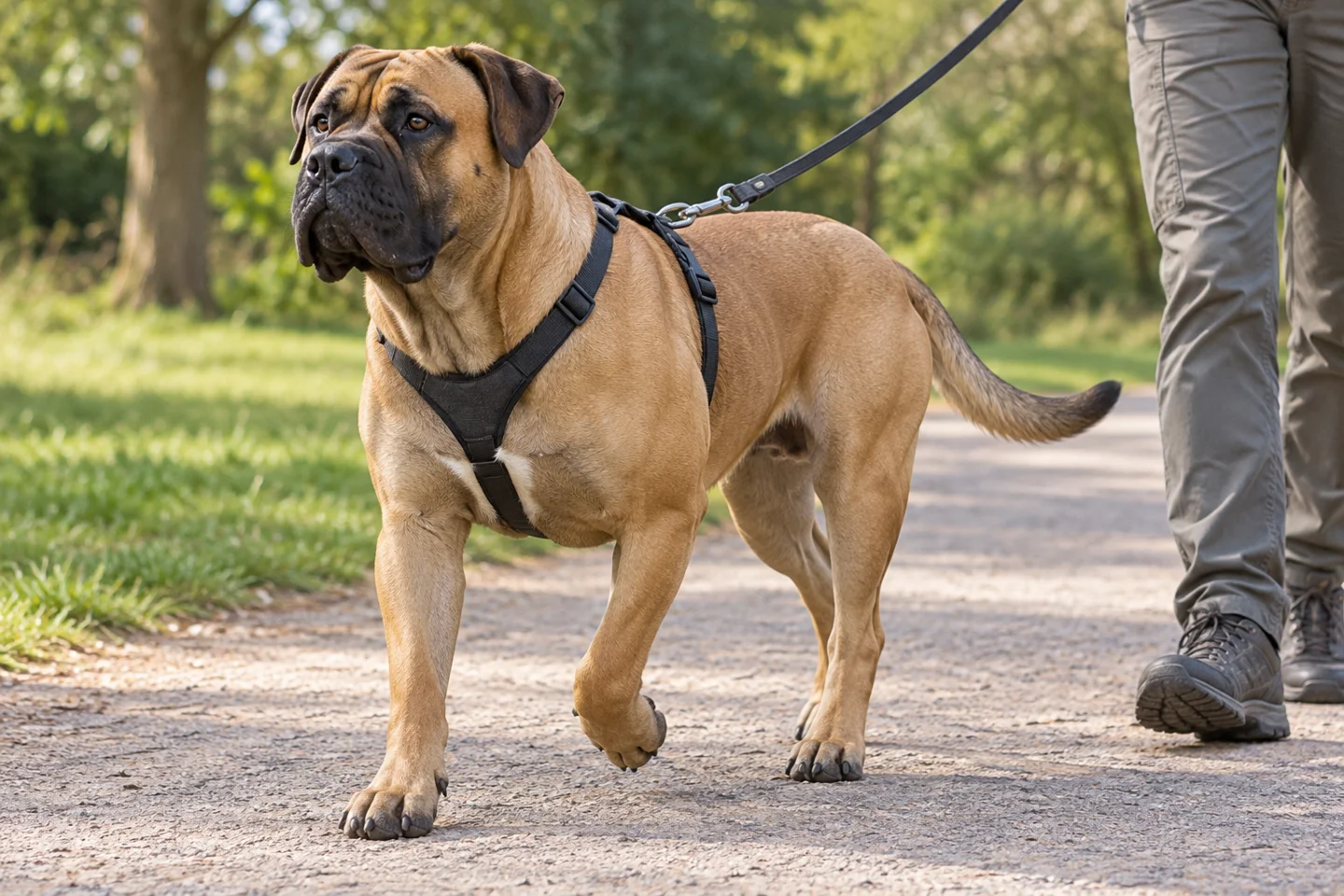
The breed has a short coat, a broad head and a full tapering tail. The illustrated dog is fawn with a dark mask and natural folded ears. The standard also allows other colours, including black. These pictures are labelled AI-generated illustrations, showing an adult, a younger puppy and a controlled walk. They do not document a specific animal or prove soundness. When meeting a real dog, look beyond a posed stance and ask to see ordinary movement and comfortable rest.
Temperament and a workable household
The Swedish Kennel Club describes a breed with pronounced guarding tendencies and suspicion of strangers, and advises knowledgeable ownership. That description is a reason to plan introductions and boundaries carefully. It does not establish how an individual will respond to every visitor. Ask a source to describe actual events: a repair appointment, a guest arriving after dark or a familiar person entering while the owner is absent. Specific examples help reveal what management the dog already needs.
Close attachment to the family does not make an adult dog responsible for deciding who belongs in the home. Adults should manage access. A suitable resting room, secure gate and consistent visitor routine let the dog avoid repeated confrontations. If your household has constant unplanned arrivals, consider how separation would work in practice. A promise to train later cannot substitute for a safe arrangement on the first day. Everyone who lives there needs to understand and be able to follow the same plan.
Doors, fencing and daily containment
Walk around the property before bringing the dog home. Check gates, latches and any weak point a large dog could push through. A physical boundary needs to work when a visitor is distracted or a delivery arrives unexpectedly. Use an additional indoor barrier while the front door is open. Post clear instructions for household members and explain the routine directly to people providing services. A person outside should never have to improvise a way past a loose dog.
Choose walking equipment for fit and control, and practise using it somewhere quiet. The handler should be able to turn and move away without depending on a painful correction. Teach waiting at a door, moving behind a barrier and stepping into a travel area as separate rewarded skills. Check equipment for wear and adjust it as the puppy grows. Secure containment does not mean leaving the dog outside to patrol all day. It should support safe exercise and normal household life, with suitable shelter, rest and human contact.
Training for strength, cooperation and everyday control
Teach useful responses before the dog reaches adult strength. A hand target can help it move away from an entrance. A mat cue can create a predictable place to wait while a meal is prepared. Reward loose-lead movement in small manageable stretches and practise a turn away from distractions. Begin where success is likely, then add difficulty gradually. Repeated practice of ordinary tasks matters more than a display of obedience in one quiet room.
Cooperative veterinary handling also deserves attention. Reward the dog for standing on a stable surface, accepting brief touch and allowing equipment near its body. Introduce a basket muzzle gradually with suitable rewards if it may support future care. It should allow the functions appropriate to its design and fit, and a professional can demonstrate its use. Avoid intimidation, physical confrontation and methods built around forcing submission. If you cannot manage a behaviour safely, seek qualified help and improve barriers while a training plan is developed.

Exercise and development without forced effort
Give the dog regular opportunities to walk, investigate scent and use its body comfortably. Choose routes with room to pass others at a distance. A narrow busy path can turn an ordinary outing into repeated difficult encounters. Keep the dog under effective control and change direction before it reaches a situation it cannot handle. Sniffing and short problem-solving activities can add interest without relying on increasingly exhausting exercise to produce quietness at home.
Puppies need activity suited to their development. Ask the veterinarian about appropriate movement and any reason to restrict impact. Avoid forced running or repeated demanding jumps simply because a young dog is enthusiastic. For adults, build unfamiliar activity gradually and watch recovery afterward. Conditions such as heat, slippery surfaces and painful joints change what is suitable. Rest is part of the schedule. If the dog repeatedly becomes stiff, slows unexpectedly or has unusual breathing effort, investigate the cause rather than trying to improve fitness by pushing through it.
Aggression and decisions about safety
Breed identity cannot determine an individual bite risk, but the consequences of losing control of a large powerful dog can be serious. Assess behaviour in context. Does the dog guard food, block access to a room, react to handling or become difficult to move away from another dog? Prevent further exposure while those questions are investigated. A safe plan should protect household members, visitors and the dog without relying on everyone noticing a warning at the last moment.
Growling, freezing and attempts to move away are reasons to change the situation, rather than invitations to challenge the dog. Punishment may suppress a warning while leaving discomfort unresolved. Seek a veterinary assessment for a sudden change and a qualified behaviour professional for ongoing aggression or fear. Share a clear account of triggers and previous incidents. Do not conceal a bite history during rehoming or a dogsDating introduction. Training goals should be realistic, with physical management continuing for as long as it is needed.
Children and visiting households
Adults need to supervise every interaction between the dog and children. Strength alone can cause a fall during excited movement, even when no bite occurs. Keep running games, rough play and crowded entrances separate from the dog. Children should not hold its lead, interrupt meals or approach while it rests. A calm response on one occasion cannot guarantee a safe response when the dog is tired, startled or uncomfortable on another day.
Use barriers when attention is elsewhere. A visiting child may not recognise a warning, and an adult explaining a rule from across the room may be too late to prevent contact. Arrange a comfortable separate space before visitors arrive and check that the dog can settle there. If a family cannot provide reliable separation and supervision, that practical limitation belongs in the choice of dog. A breed description or a photograph of another dog with children does not resolve the situation in this household.
Other dogs, household pets and introductions
Learn about the individual dog's previous animal interactions. Comfort with a familiar housemate is different from tolerance of unfamiliar dogs approaching closely. Start an introduction with separate handlers and generous space. Parallel walking can provide information without demanding immediate play. If either dog repeatedly fixes its attention on the other, pulls toward it or tries to escape, increase distance. Some dogs need a carefully managed routine and will never be suitable for casual group play.
Protect cats and smaller animals with physical separation while compatibility is assessed. Do not use the animal itself to test the dog's response. Separate bowls, chews and resting places can reduce competition within a multi-dog household. Consider how feeding and access will work when one adult is absent. If conflict has already occurred, seek advice before allowing another encounter. A muzzle or a strong lead does not make an otherwise unsuitable introduction acceptable, and friendly intentions from the owners cannot keep animals safe by themselves.
Health records and specific breeding programmes
The Danish Kennel Club's Presa page publishes a defined registration framework involving hip and elbow status and a behavioural description, with additional provisions for foreign dogs. That is a named national programme, rather than a worldwide promise about every Presa. Ask the breeder which current framework applies to the litter and request the original parental results. The page contains conditions and exceptions, so a shortened checklist should not replace reading the applicable rules with the source.
Clinical joint assessments, behavioural observations and DNA identification answer different questions. A favourable result in one area does not establish that all other concerns have been excluded. Link every report to the correct registered dog and check when it was performed. For an adopted adult, collect its own treatment and injury history. Information from the parents can inform a conversation, but the adult's present examination guides current care. Discuss unfamiliar grades with a veterinarian instead of treating a seller's qualifying label as a complete explanation.
Health evidence and changes that need examination
The Swedish Kennel Club cautions that its small local population does not allow a confident overall assessment of breed health. That limit should remain visible. Rarity is not evidence that disease is absent, and an undocumented internet list cannot supply a reliable prevalence figure. Ask about the actual family: repeated diagnoses, movement problems, previous operations and conditions reported by owners of older relatives. A source who acknowledges missing information gives you a clearer basis for planning than one who promises that no illness occurs.
Keep an account of appetite, activity and comfortable movement so a new problem is easier to describe. Refusal to rise, difficulty entering a vehicle or sudden intolerance of touch can be reasons for a clinical examination. Collapse, severe breathing trouble, substantial bleeding or repeated unsuccessful retching warrants urgent veterinary contact. Prepare transport arrangements before an emergency, including how adults could help a dog that cannot walk. Do not give human pain medicine while waiting for advice. The right next step depends on the patient and the clinician's assessment.
Making veterinary care manageable
Tell the clinic in advance if the dog struggles with close handling or unfamiliar people. Ask how to arrange arrival and waiting so another animal does not unexpectedly appear beside it. Practising a calm station and a well-fitted muzzle at home can support a planned visit. Necessary clinical care may also require medication or a different handling approach chosen by the veterinary team. Disclose what has happened before so staff can prepare instead of discovering a problem during examination.
Keep medication instructions readable for everyone providing care. If a procedure is planned, ask about preparation, pain management and the expected recovery routine for this individual. Follow the clinic's directions instead of using another owner's fasting schedule. Set up a quiet space with secure separation from pets and visitors, suitable footing and an easy route outside. Contact the team when the dog's recovery differs from the instructions. A large dog's ability to stand and move safely matters to both its comfort and the people helping it.
Grooming, skin and comfortable handling
The short coat makes surface care relatively straightforward, but it does not remove the need to inspect the dog. Use a gentle brush and check areas beneath collars and harnesses. Look at paws after suitable outdoor activity and keep nails at a comfortable length. Introduce care when the dog feels well, so a painful injury is not its first experience of having a foot handled. Reward cooperation in small steps and ask for help before a task becomes a struggle.
Persistent odour, skin redness, discharge or repeated ear discomfort needs an examination rather than stronger cleaning products. Avoid deep tools in the ears and do not reuse medicine from an earlier problem without advice. Gentle tooth brushing should become part of the routine with a method the dog accepts. Tell a groomer about sensitive areas and handling limits. A clean coat and a muscular outline cannot prove health; hands-on observation and appropriate veterinary assessment provide information a photograph cannot.
Nutrition and body condition for a heavy dog
Choose a complete food appropriate to life stage and ask the veterinarian to guide growth and body-condition checks. A growing Presa should not be fed to achieve the largest possible frame as quickly as possible. Record meals and treats, particularly when training involves frequent rewards. Weigh the dog periodically using a safe method and compare condition over time. Feeding decisions should respond to the individual, rather than a breed weight range treated as an obligation.
Provide a quiet eating space without competition from children or other animals. Put sensible management around chews and valued food rather than repeatedly removing them to test the dog's tolerance. Teach a rewarded exchange separately. Discuss supplements and homemade diets before relying on them, especially during growth. A list of attractive ingredients cannot establish a balanced ration. If appetite, drinking or digestion changes persistently, seek advice and bring a record of food and medicines so the investigation starts with useful detail.
Presa Canario mixes and uncertain labels
A Presa mix can differ widely in size, guarding behaviour, activity and tolerance of handling. Crossing two breeds does not guarantee that the puppy will inherit whichever traits an owner prefers. Ask for identified information about both parents when considering a deliberately bred litter. The relevant health questions come from both sides, while clinical assessment remains necessary for the puppy itself. Do not assume a large DNA-panel count answers every medical question.
For a rescue with uncertain parentage, ask for practical observations from its current carers. How does it cope with a lead change, a visitor at the gate or separation from another dog? What management is already in place? A description such as mastiff mix may help communicate appearance, but it cannot replace those answers. Be honest about uncertainty in future profiles and introductions. Assigning a dramatic breed name on appearance alone can distract from the behaviours and care needs that are actually documented.
Costs, backup care and choosing responsibly
Budget for appropriate equipment, secure boundaries, training support, food and routine veterinary care. Ask local providers about transport and emergency treatment arrangements for a dog of this size. Backup care may require more preparation than booking an unfamiliar sitter at short notice. The person needs to meet the dog safely and demonstrate that they can follow the home routine. Consider what happens if the usual handler is ill or temporarily unable to manage a lead.
Meet adult relatives where possible and discuss ordinary life rather than only posed photographs or competition achievements. Ask how the breeder selects for temperament and receives later health information. A rescue placement should describe known incidents and restrictions candidly. Choose according to the home and care you can provide now. Waiting while boundaries or support are arranged is a practical option. An impressive appearance cannot compensate for an arrangement that repeatedly leaves visitors exposed or the dog unable to settle.
Meeting owners through dogsDating
Write a dogsDating profile that describes the actual Presa. Explain whether it prefers parallel walking, needs distance from unfamiliar dogs or has restrictions that affect introductions. Share only an approximate area and keep exact home coordinates private. Agree on a quiet public location with a wide route and a clear way to leave. Each dog needs a capable adult handler. Do not arrange a surprise introduction at a house, a crowded gate or a small enclosure.
Begin farther apart than you expect to need and let the handlers assess relaxed movement before reducing distance. Keep toys and food out of the introduction. The dogs do not have to touch or play for the owners to meet successfully. End promptly if one animal becomes tense, repeatedly avoids the other or cannot recover from excitement. Another parallel walk may be suitable, while a different pairing may serve both dogs better. Owners can build a friendly connection while respecting the limits of the dogs beside them.
Sources and editorial notes
Sources checked October 22, 2026. Breed measurements describe reference ranges, not a diagnosis or an individual dog's ideal weight. Images are AI-generated breed illustrations and do not document a particular dog or health condition.
- AVSAB: Humane Dog Training Position Statement
- VCA Animal Hospitals: Food aggression in puppies
- VCA Animal Hospitals: Aggression toward unfamiliar dogs, diagnosis
- VCA Animal Hospitals: Grooming and coat care for your dog
- VCA Animal Hospitals: Ear infections in dogs (otitis externa)
- AAHA: Feeding plans for healthy, appropriate weight cats and dogs
- VCA Animal Hospitals: Heat stroke in dogs
- VCA Animal Hospitals: Common emergencies in dogs
- Orthopedic Foundation for Animals: CHIC health screening programs
- AVSAB: Puppy Socialization Position Statement
- VCA Animal Hospitals: Dog behavior problems, aggression toward children
- FCI Standard 346, October 2023: Presa Canario structure, origin and temperament
- Swedish Kennel Club: Presa Canario household needs and limits of local health evidence
- Danish Kennel Club: Presa Canario breeding requirements and foreign-dog provisions
- American Kennel Club: Presa Canario background and everyday care
Keep getting to know dogs.
Read another guide or return to your dogsDating community.
Explore breed guidesBack to dogsDating