Pudelpointer
A practical guide to the Pudelpointer's working background, daily training, coat care, health records and suitable play partners.
How these guides are researched and reviewed
- Origin
- Germany
- FCI adult height
- Males 60–68 cm; females 55–63 cm
- Coat
- Rough protective coat with beard
- Daily planning
- Searching, controlled activity and rest
General information for owners. These articles have not been reviewed by a veterinarian. Medical decisions need your dog's history and an examination.
Pudelpointer identity and working purpose
The Pudelpointer is an established German pointing breed developed for work in fields, woods and water. Its name reflects Poodle and Pointer ancestry, but it is not a generic name for any new cross between those breeds. That distinction matters when looking at puppies, registration and working records. Ask what the parents actually are and which breeding programme applies. A wire coat and a seller's label alone cannot establish that a dog belongs to this breed.
The working background also matters when deciding whether the dog fits your routine. Plan opportunities for searching, movement, training and calm recovery before choosing one. A garden can support daily life, but simply opening the door does not necessarily provide the engagement an individual needs. Discuss ordinary weekdays with a breeder or rescue, including the periods when no field activity is possible. The right arrangement should work when the owner is busy and the weather is unhelpful, as well as on an enjoyable outdoor weekend.
Size, coat and the natural tail
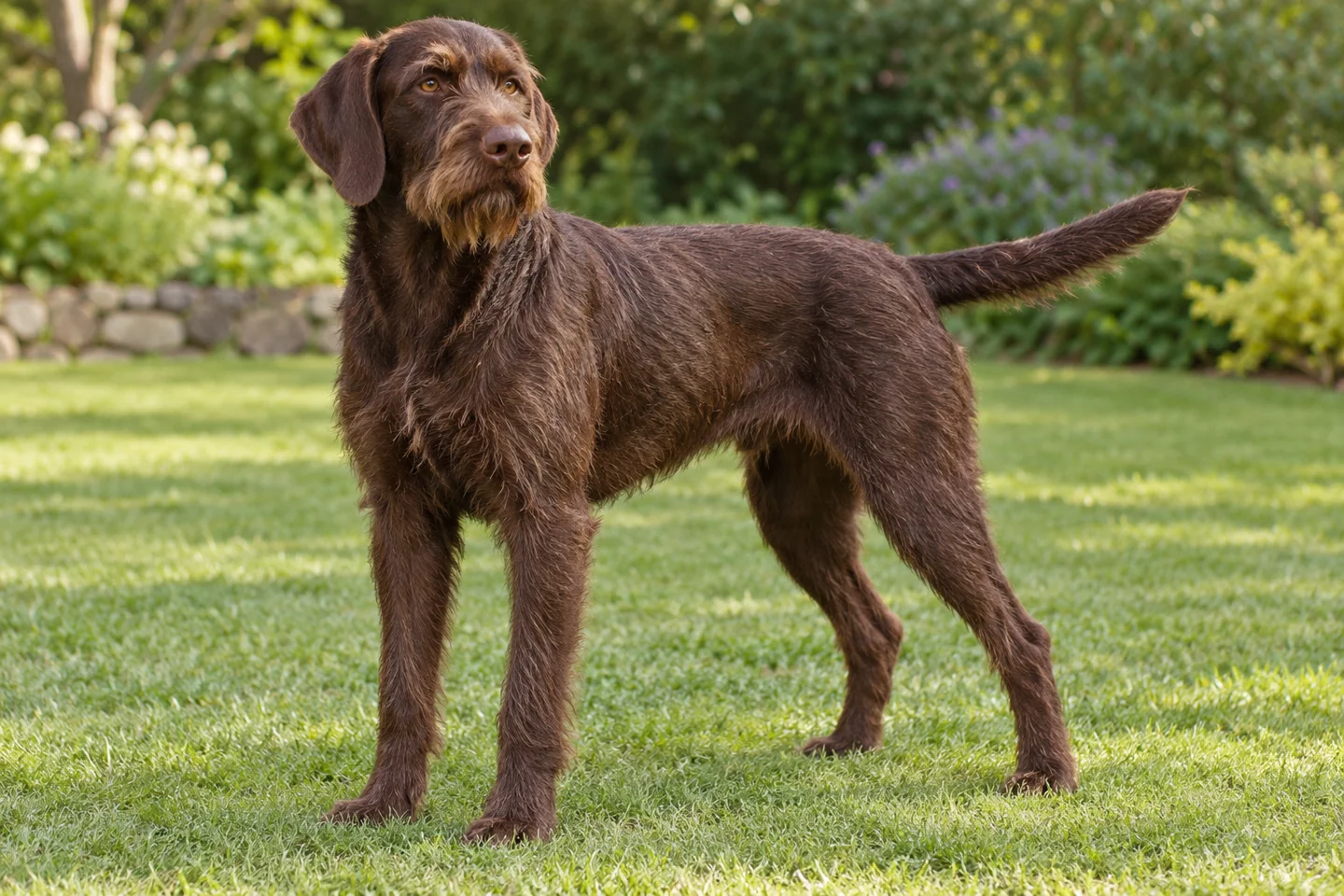
The FCI standard gives male shoulder height as 60 to 68 centimetres and female height as 55 to 63 centimetres. It describes a rough protective coat with a beard and forelock. Brown, dead-leaf tones and black are included, with small white markings permitted. The coat should not be confused with the dense curls of a Poodle. A breed name describes ancestry and selection, rather than a promise that every descendant will resemble either founding breed in an equal proportion.
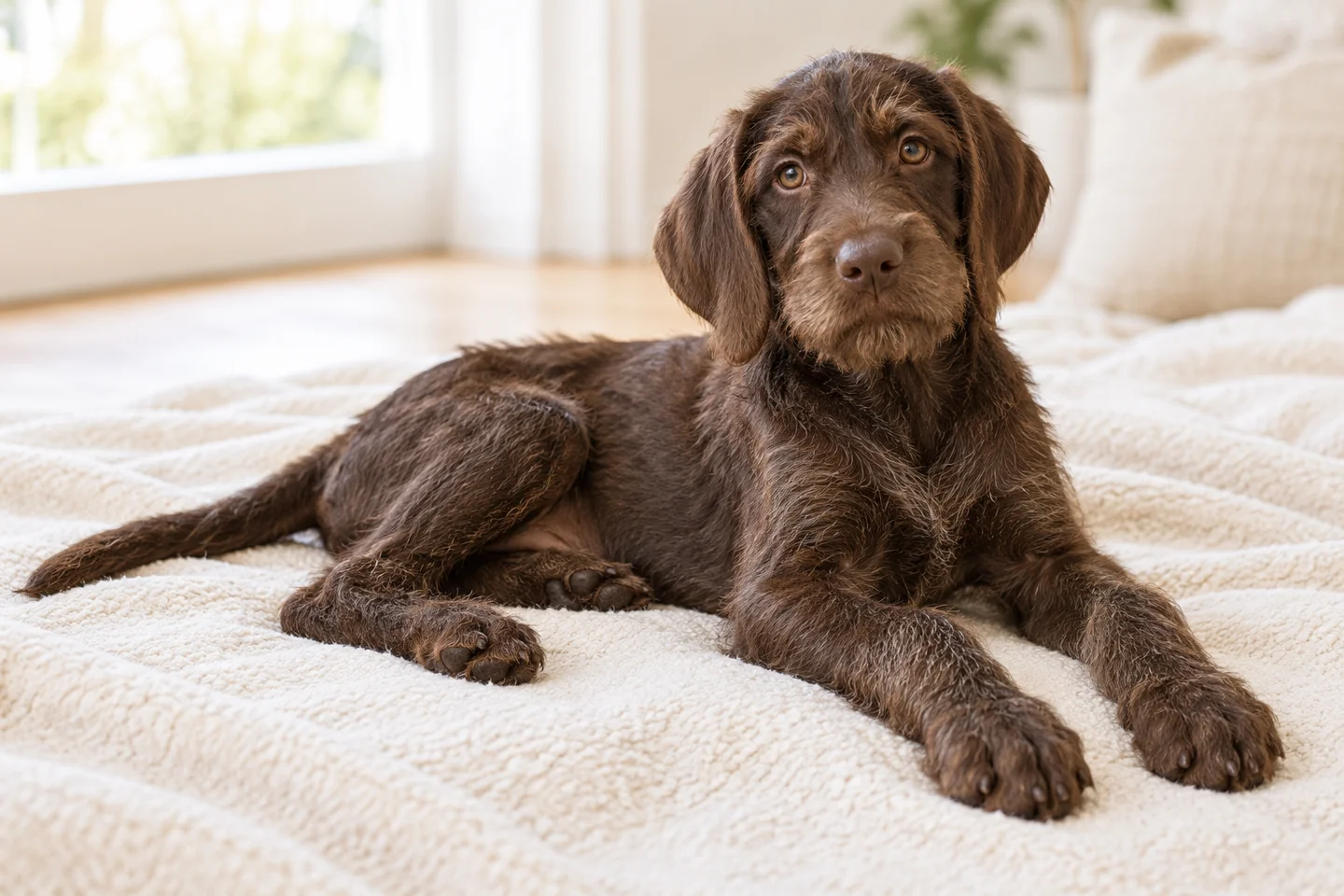
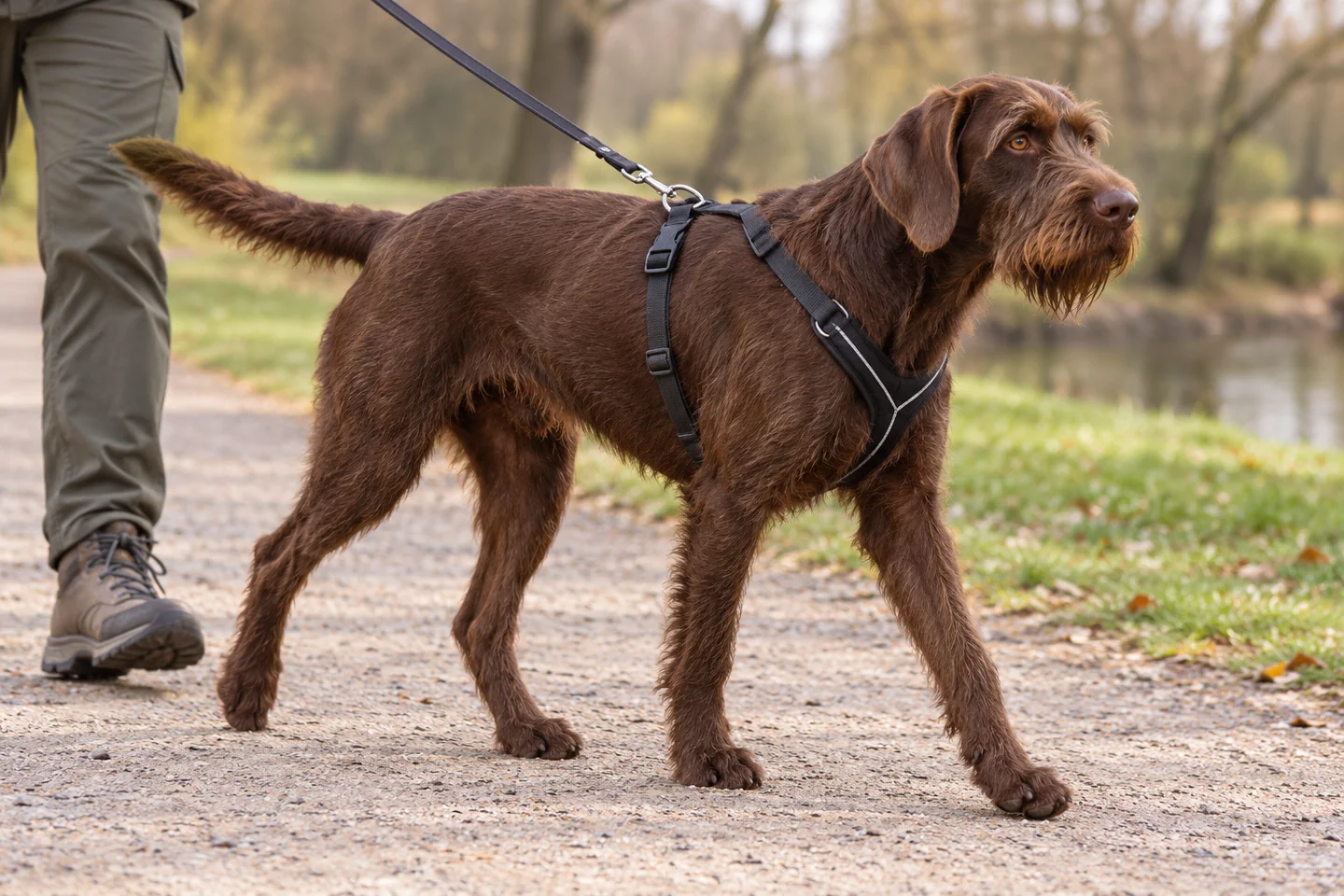
The accompanying illustrations show a brown example with natural ears and a full tail. The standard describes the natural tail as an option where docking is prohibited, but this guide does not recommend altering a dog to imitate a particular picture. All three pictures are labelled AI-generated illustrations. They show an adult outline, a younger resting puppy and a quiet harness walk. For a real dog, assess comfortable movement, body condition and clinical findings rather than assuming that an accurate-looking coat proves sound health.
Temperament at home and outdoors
A Pudelpointer may be attentive to its person while becoming strongly absorbed in scent or moving wildlife. Those are situations to train for, rather than reasons to assume it will always stay close because it enjoys company at home. Ask about the actual parents and the dog's current routines. How does it settle after activity? What happens when visitors arrive? Can it rest while another dog is working? Concrete examples are more useful than a promise that the breed is universally calm.
Provide a resting place where the dog can recover without being repeatedly called into activity. A household can unintentionally keep an energetic dog alert all day through constant games and attention. Alternate useful engagement with quiet periods. If settling is difficult, review sleep, comfort and the environment with a suitable trainer or veterinarian. Increasing physical effort indefinitely is not a dependable solution. An individual may need clearer routines, a less stimulating place to rest or help with a specific source of distress.
A routine that works beyond hunting days
Build a schedule around the needs you can meet consistently. A morning walk with time to sniff, a short training session and appropriate rest can form part of that plan. Add activity gradually according to the dog's response and health. Keep a few manageable indoor tasks for days when outdoor work is limited. Searching for a hidden safe object or practising a useful household cue can engage attention without requiring a crowded environment or a long journey.
Prepare for the practical side of field equipment and muddy returns. Have a place to remove a harness, check feet and dry the dog before it moves through the house. Teach waiting on a mat as a rewarded skill instead of trying to restrain an excited wet dog while searching for a towel. Store training objects and food where the dog cannot take them unsupervised. Consistent arrangements make everyday care easier and reduce the number of situations in which an owner has to improvise under pressure.
Training recall, delivery and calm waiting
Teach returning to you first in an easy setting, rewarding generously before distractions increase. Practise a turn away and a hand target as well, so you have several ways to guide movement. A long line can support controlled exploration where it can be used without tangling people, dogs or obstacles. Attach it to suitable equipment and learn to handle it safely. It should not become a way to allow the dog to hit the end at full speed.
For retrieving games, begin with an object the dog can carry comfortably and keep the session short. Reward returning and exchanging instead of chasing the dog to take the item. Avoid turning every object into a contest. Teach waiting while you place equipment or open a vehicle door. If you want formal field work, choose a knowledgeable reward-based instructor and discuss welfare, safety and the individual's readiness. A working goal does not justify frightening a dog or using pain to force an apparent result.
Socialization and unfamiliar environments
Give a puppy carefully managed opportunities to see different people, safe dogs, surfaces and ordinary household events. Ask the veterinarian about infection protection when planning classes and locations. The puppy should have room to move away and an owner who notices when an experience is becoming too demanding. A brief calm observation of bicycles at a distance can be more useful than standing beside a busy route until the puppy stops responding.
Include experiences that support care, such as standing on a stable surface, comfortable vehicle travel and brief handling around the feet and face. Reward cooperation without holding the puppy in place through a prolonged struggle. If an adult dog has an uncertain history, introduce the same tasks gradually. Confidence in one outdoor activity does not guarantee comfort with every sound or touch. A trainer can help you choose a smaller step when the dog repeatedly avoids a situation or becomes too aroused to engage.
Exercise, searching and comfortable recovery
Offer movement that reflects the dog's condition and stage of development. Walks with scent investigation, suitable searching tasks and carefully managed retrieves can contribute to a useful day. Check the environment before letting speed or excitement increase. Roads, livestock and wildlife can make a seemingly open space unsuitable for off-leash activity. Secure boundaries and a realistic assessment of recall matter more than an owner's confidence that the dog normally comes back.
Build endurance gradually and assess recovery, including how the dog moves after rest. Puppies need appropriate free movement and rest rather than being taken on forced adult-distance runs. Heat and humidity can change the plan even for an enthusiastic dog. Carry drinking water and choose a route with shade and an easy return. Repeated slowing, stiffness or unusual breathing effort deserves assessment. A dog can remain eager to search while experiencing discomfort, so enthusiasm should be one observation among several rather than proof that more activity is harmless.
Water work and safe swimming choices
A breed history that includes water work does not make every Pudelpointer a prepared swimmer. Introduce safe shallow access without throwing or forcing the dog into water. Consider footing, the exit route and the conditions beyond the edge. A strong current, steep bank or uncertain water quality can make a location unsuitable. Choose another activity when you cannot establish a safe plan. An appealing photograph of a swimming breed cannot assess the body of water in front of you.
AVMA travel guidance recommends a properly fitted pet flotation device around water even for animals that can swim. Introduce equipment before relying on it during an outing, and maintain supervision. Avoid repeated demanding retrieves that continue after the dog tires. Dry it appropriately and inspect feet and skin after the session. If coughing, weakness or breathing difficulty follows a water incident, contact a veterinarian promptly. Make transport and communication possible before travelling to a remote training place, rather than discovering afterward that help is difficult to reach.
Aggression, arousal and handling problems
An individual Pudelpointer can react defensively or guard resources, and a working description does not rule out those behaviours. Identify what happened before an incident. Was a person reaching for an object, restraining the dog near another animal or touching a painful area? Prevent a repeat while the cause is investigated. Do not repeatedly reproduce the trigger to decide whether the dog was serious. A calm account of the circumstances gives a professional more useful information than an interpretation based on pride or embarrassment.
Punishing a warning may make the next incident harder to anticipate. Use distance, barriers and a safe exchange where appropriate, then seek help from the veterinary team and a qualified behaviour professional. Sudden changes in tolerance deserve medical consideration. High excitement during retrieving or play can also make control harder, so include breaks before the dog becomes frantic. A well-fitted muzzle introduced through rewards may support a safety plan, but it should never be used as permission to continue an unsuitable encounter.
Children and an active dog in the home
Adults need to supervise contact and provide separation when attention is elsewhere. Keep children out of retrieving lanes and avoid games in which they run while the dog chases them. Teach a calm greeting with enough space for the dog to leave. Children should not take chews, reach into the bed or attempt to restrain the dog by its collar. An affectionate relationship does not remove the possibility of a startled or painful reaction.
Consider the household's normal noise and movement when choosing a dog. A puppy can become excited by children playing even when no one intends to involve it. Set up gates and a quiet resting area before that pattern begins. For visits, explain the rules to the supervising adults as well as the children. The dog can rest separately while a party or energetic game takes place. It does not need to join every family activity to be included in a well-managed home.
Cats, small animals and other dogs
Discuss the dog's actual history around cats and small animals. A pointing and retrieving background should prompt practical management, while it cannot predict the exact response of an individual. Protect vulnerable pets with secure separation and do not use them as test subjects. A cat needs escape routes the dog cannot follow. Comfortable behaviour indoors with a familiar animal is useful evidence for that setting, rather than a guarantee that chasing will never happen elsewhere.
For dog introductions, start with parallel walking and enough distance for each animal to look away. Keep retrieves, bowls and valued equipment out of the first meeting. Watch for mutual breaks and voluntary returns to interaction instead of relying only on energetic movement as a sign of enjoyment. If one dog becomes overwhelmed, create space and finish. Some dogs share walks successfully while remaining unsuitable playmates. That can still provide company for both owners without demanding a closer relationship from the animals.
Health screening and the limits of a working record
The North American Pudelpointer Society publishes breeding requirements that include hip certification, working qualifications and temperament expectations. These belong to a named programme. Ask which current association or registry governs a breeder's decisions and request the actual parental reports. A successful field result shows performance in a defined assessment; it cannot replace an orthopedic examination or establish that all inherited illness has been excluded. Read each document according to the question it was designed to answer.
NAVHDA explains that its registry records can include pedigree, test results, available hip certification and DNA information. Registration supports lineage records and identity, rather than supplying an unlimited health guarantee. Check that names and identification match the animals being discussed. Ask how later diagnoses from owners are recorded and shared appropriately. For a rescued adult, collect its own treatment, injuries and current restrictions first. Missing family information should remain an acknowledged limit while a veterinarian plans care for the dog in front of them.
Epilepsy questions and responding to seizures
The FCI standard specifically names hip dysplasia and epilepsy as prevention priorities in the breed's country of origin. That supports asking about affected relatives and documented clinical investigations. It does not provide a current worldwide prevalence figure or justify a promise that one general DNA panel rules out every seizure disorder. Ask what is known in the actual family, including older animals outside the breeding programme. Keep an original report distinct from a secondhand description that a dog once had a funny turn.
If a seizure occurs, keep the surroundings as safe as possible, time the event and contact the veterinary team. Do not put hands or objects in the mouth. Cornell describes a seizure lasting more than five minutes, or repeated seizures in a day, as an emergency concern. Seek advice promptly rather than waiting to decide whether the cause is inherited. Many possible causes require clinical investigation. Once a veterinarian provides an individual management plan, keep it accessible to other carers and follow the prescribed directions instead of adjusting medicine independently.
Clinical health, injuries and evidence gaps
The Swedish Kennel Club notes that its small local Pudelpointer population limits a confident overall health assessment. Do not turn that uncertainty into a claim that the breed has no problems. A useful placement conversation includes previous wounds, recurrent ear disease, lameness and current medication. Ask what follow-up remains unfinished. A dog moving from a working environment into a new home may need records transferred from more than one clinic, not just a vaccination booklet.
Inspect the dog after outdoor activity, particularly where vegetation, equipment or rough ground may have caused trouble. A new limp, reluctance to enter the vehicle or painful reaction to touch needs an explanation. Collapse, major bleeding, severe breathing difficulty or rapidly worsening distress requires urgent veterinary contact. Keep a route and transport plan available for remote outings. Human pain medicines and an improvised remedy can create additional problems, so ask the clinician what to do while arranging assessment. Record the eventual findings to support future care and family health information.
Grooming the rough coat and checking ears
Brush and inspect the coat gently, working through friction areas rather than only tidying the visible outline. Ask a groomer familiar with rough coats to demonstrate appropriate maintenance. Check the beard after meals and water, and avoid leaving damp tangled hair against sore skin. A practical trim or coat-care plan should protect comfort and function. The dog needs clear vision and freedom of movement, while retaining a particular appearance should never require painful handling.
Look at paws after field activity and maintain nails and teeth through short familiar routines. Inspect the ears as advised without using deep tools. Repeated head shaking, discharge, odour or discomfort warrants veterinary advice, especially if an outdoor foreign body is possible. Do not put leftover medicine into an unexplained problem. Tell the groomer about skin changes, injuries and handling limits. A dog that normally accepts brushing but suddenly avoids one area may need an examination before more training around that task.
Nutrition for growth and changing workload
Choose a complete diet appropriate to the dog's life stage and measure what is offered. A growing puppy needs a suitable growth ration, while an adult's requirements can change with activity and body condition. Ask the veterinarian how to monitor ribs, waist and weight beneath the coat. Include training rewards in the discussion, particularly during a period with frequent practice. Do not assume that a hunting breed must always receive the richest food available.
Keep clean drinking water available and offer meals in a quiet space without competition. If appetite or digestion changes persistently, investigate rather than repeatedly switching products on the assumption that enthusiasm will return. Give the clinic a record of food, supplements and medications. Homemade diets and additional supplements need a proper nutritional assessment. An appealing ingredient list cannot show that the whole ration is balanced, and another working dog's feeding routine may not fit this animal's age, health or workload.
Pudelpointer mixes and founding ancestry
The established Pudelpointer's Poodle and Pointer origins do not mean that any present-day cross of those parents is automatically the same breed. Registration, selection and documented lineage are separate questions from a similar name. Ask for accurate parentage rather than accepting a convenient label. A Pudelpointer mixed with another breed can vary substantially in coat, size, activity and handling needs. Its care should respond to the individual rather than a promise of an exact blend.
Neither a rough coat nor Poodle ancestry guarantees suitability for every allergic household. Health questions relevant to both parents still deserve attention, and crossing does not guarantee protection from inherited disease. In rescue, observed behaviour, clinical findings and realistic grooming needs may be more useful than an uncertain ancestry estimate. Describe that uncertainty honestly when discussing the dog with trainers, carers or other owners. The practical aim is a suitable home and clear care plan, rather than making an undocumented label sound more certain.
Costs, backup care and dogsDating meetings
Budget for training, secure equipment, transport, food, grooming support and veterinary care alongside any purchase or adoption fee. Ask how a breeder or rescue will support a placement if the initial arrangement becomes difficult. Meet adult dogs where possible and discuss ordinary household routines in addition to working achievements. Backup carers need to understand containment, animal separation and the dog's activity limits. A capable owner should have a workable plan for periods when usual outdoor work is unavailable.
On dogsDating, describe the dog's actual play style and walking preferences. Keep exact home coordinates private and arrange an initial meeting in a quiet public place with room to move apart. Begin with separate sniffing and parallel walking before deciding whether closer contact is appropriate. Avoid shared retrieves during the first introduction, since excitement and competition can change the interaction. End while both dogs are comfortable. A relaxed walk can let owners meet in real life without requiring the dogs to chase, wrestle or become immediate companions.
Sources and editorial notes
Sources checked October 22, 2026. Breed measurements describe reference ranges, not a diagnosis or an individual dog's ideal weight. Images are AI-generated breed illustrations and do not document a particular dog or health condition.
- AVSAB: Humane Dog Training Position Statement
- VCA Animal Hospitals: Food aggression in puppies
- VCA Animal Hospitals: Aggression toward unfamiliar dogs, diagnosis
- VCA Animal Hospitals: Grooming and coat care for your dog
- VCA Animal Hospitals: Ear infections in dogs (otitis externa)
- AAHA: Feeding plans for healthy, appropriate weight cats and dogs
- VCA Animal Hospitals: Heat stroke in dogs
- VCA Animal Hospitals: Common emergencies in dogs
- Orthopedic Foundation for Animals: CHIC health screening programs
- AVSAB: Puppy Socialization Position Statement
- VCA Animal Hospitals: Dog behavior problems, aggression toward children
- FCI Standard 216: Pudelpointer origin, working purpose, structure and screening priorities
- American Kennel Club: Pudelpointer activity, training and everyday care
- North American Pudelpointer Society: breeding eligibility and hip certification
- NAVHDA registry: pedigree, performance and available health information
- Swedish Kennel Club: Pudelpointer care and limited local health data
- Cornell canine health information: recognising and responding to seizures
- American Veterinary Medical Association: travel preparation and water safety for pets
Keep getting to know dogs.
Read another guide or return to your dogsDating community.
Explore breed guidesBack to dogsDating