Russian-European Laika
A black-and-white hunting spitz whose independent search, alert voice, and activity needs require more than a casual interest in its appearance.
How these guides are researched and reviewed
- Origin
- Russia
- Adult standard size
- Males 52–58 cm; females 48–54 cm
- Illustrated coat
- Black and white dense double coat
General information for owners. These articles have not been reviewed by a veterinarian. Medical decisions need your dog's history and an examination.
A hunting spitz with its own name
The Russian-European Laika is a hunting spitz developed from dogs of northern European Russia. It is a distinct FCI breed, separate from the East Siberian and West Siberian Laikas. The name Laika appears in several contexts, so prospective owners should ask which breed and registry a source means. A photograph of a pointed-eared dog cannot establish that identity or describe the work its parents have been selected to do.
The FCI standard describes hunting use and well-developed senses. That background is central to an ownership decision. A dog chosen for searching independently may investigate wildlife with an intensity that is difficult to interrupt. The household needs secure ways to offer activity and realistic expectations about recall. Enjoying the black-and-white coat is a starting interest; it does not supply the time, containment, and training needed to live with the dog.
Ask the breeder or rescue what this particular dog has experienced. A puppy from active hunting lines, an adult that has lived in a kennel, and an established house companion may need very different transitions. Clarify whether the dog has traveled in a vehicle, stayed indoors overnight, met visitors, or spent time alone. These practical details help shape the first month and reduce the temptation to interpret every unfamiliar response as a fixed breed trait.
Adult outline, coat, and natural features
The FCI gives males a shoulder height of 52 to 58 centimeters and females 48 to 54 centimeters. The body is close to square, with a strong but athletic structure rather than a heavy, padded outline. Weight should be assessed against the frame and condition instead of an invented fixed standard figure. Growing dogs need a balanced diet and veterinary assessment, not extra feeding intended to make them resemble an impressive adult sooner.
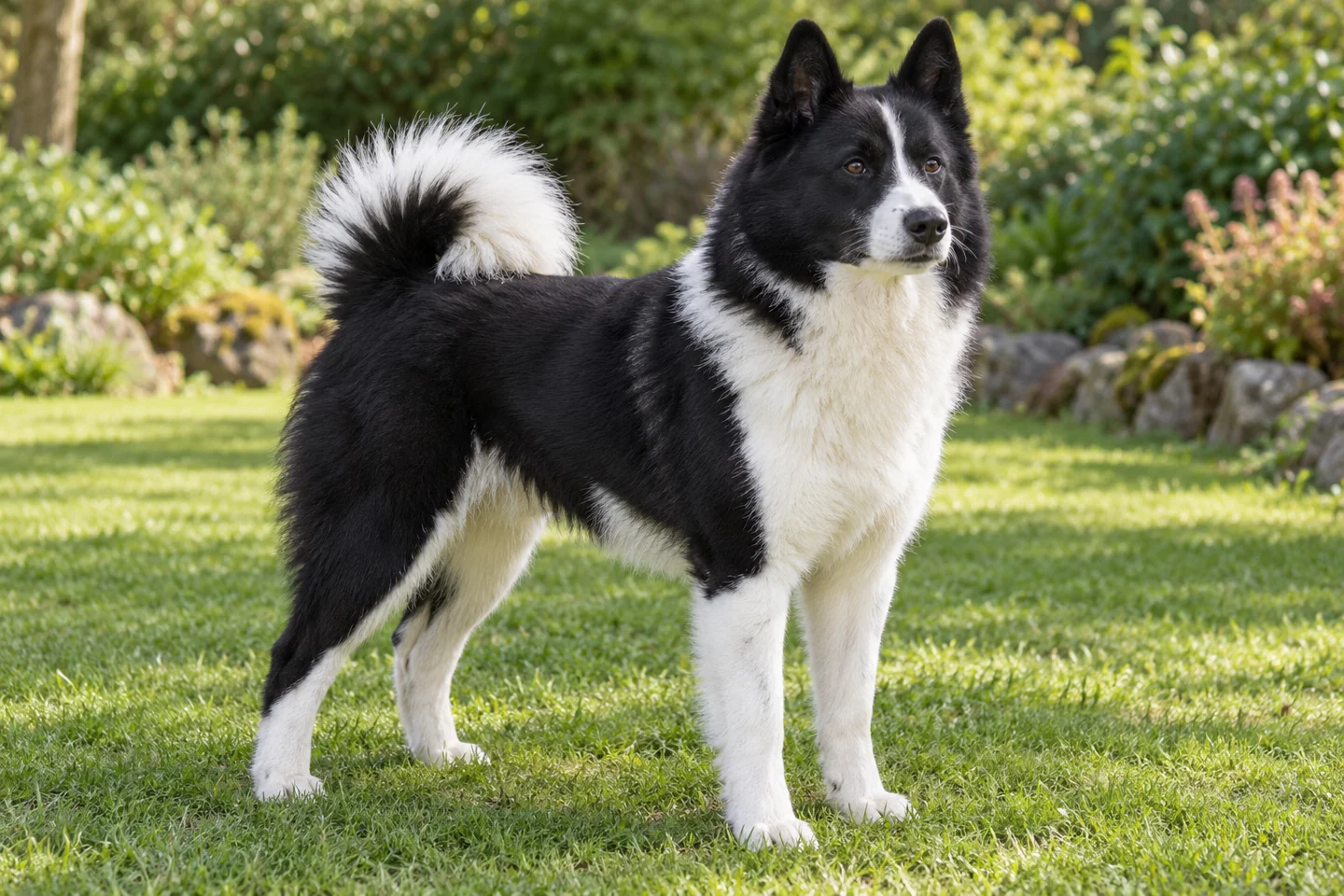
Black and white in different proportions is characteristic. The coat has a coarse straight outer layer and a dense softer undercoat, with fuller hair around the neck and shoulders. The natural ears stand erect and are triangular. The full tail curls over the back or toward the thigh. This combination distinguishes the intended outline from a smooth-coated dog with a loosely carried tail, although appearance alone still cannot prove registration or ancestry.
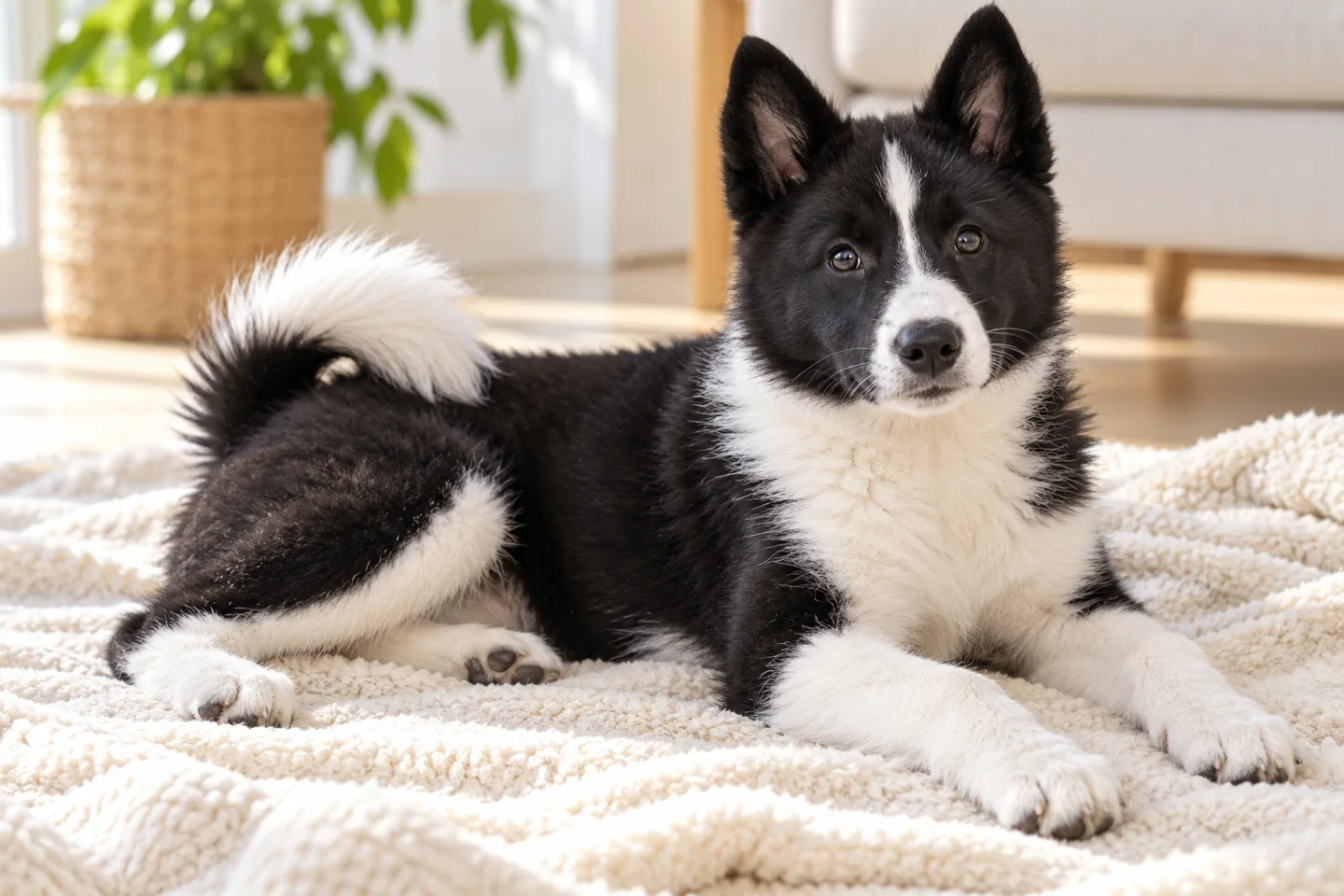
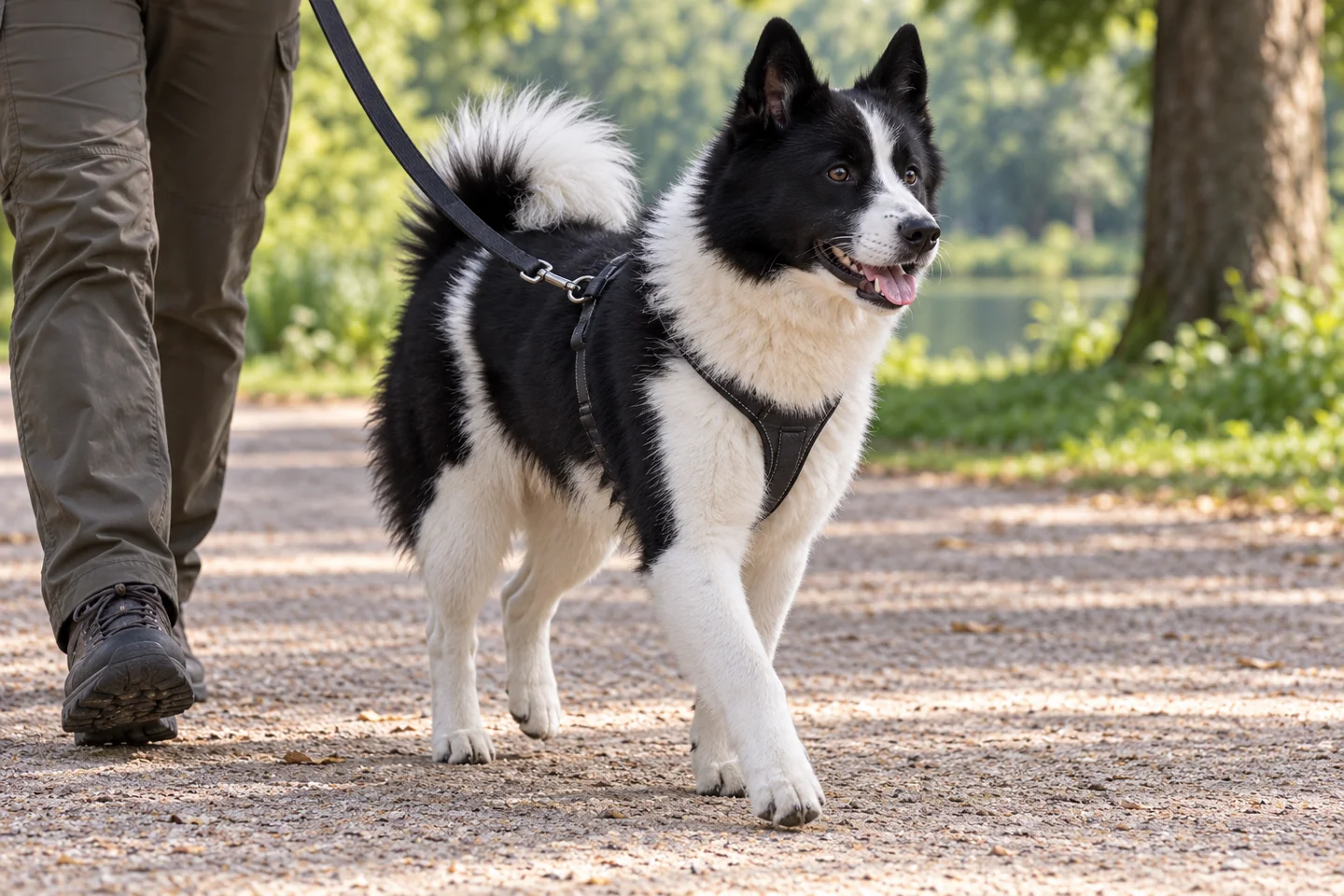
The illustrations show a black-and-white adult, a young puppy with a developing coat, and a safely managed walking scene. They are labeled AI-generated artwork. A puppy should not be expected to have the mature collar of hair or adult proportions visible in a breed-standard illustration. For equipment, measure the actual dog and check beneath the coat. Thick hair can disguise both pressure points and slack that becomes important when a dog backs away.
Independence in an ordinary household
A Laika may solve a problem by investigating it rather than waiting for direction. At home, that can mean checking a new sound, testing access to a garden corner, or following an odor away from the planned route. Owners can make cooperation worthwhile by providing clear cues and rewards that fit the task. Repeating an instruction more loudly does not make it easier to understand when the dog is absorbed elsewhere.
Set up the home so desirable choices are available. Store food securely, prevent access to unsafe objects, and offer resting places away from busy passageways. A dog that has just come from an outdoor working setting may need gradual practice with appliances, stairs, and household traffic. Use quiet observation and short sessions instead of inviting a crowd to welcome it on the first evening.
Check how the dog manages temporary separation from its people. Begin with a small, comfortable interval and observe the response. Repeated barking, pacing, or escape attempts should prompt a change in arrangements and professional advice when needed. They do not establish that the dog needs harder exercise until it is too exhausted to object. The pattern may involve distress, frustration, an unmet physical need, or several factors requiring different responses.
Training when the environment is rewarding
Start with useful actions in a quiet area: turning toward the handler, following a few steps, waiting at a gate, and releasing a safe toy. Reward the response promptly. Then practice in a slightly more interesting place while keeping the task easy. If a cue fails repeatedly, reduce difficulty and examine the reward or setup. A dog cannot learn a reliable response from a sequence in which it rarely succeeds.
For recall, use enclosed spaces and suitable line management. Reward arrival generously and avoid making every return predict the end of all exploration. Occasionally release the dog to investigate again when safe. Wildlife, livestock, roads, and legal restrictions still determine whether any off-lead access is appropriate. A successful training session with no animals present cannot certify the dog under conditions that have never been tested safely.
Handling practice should cover feet, ears, a brief mouth check, and wearing equipment. Teach the dog to approach rather than chasing it with a harness. A reward-based professional can help make these tasks practical for the household. Ask how they respond when the dog is frightened and how they avoid rehearsing unsafe pursuit. Training that relies on deliberately provoking the strongest reaction can create danger without teaching the cooperation the owner actually needs.
Exercise with purpose and boundaries
This is a hunting breed, so an owner should expect to devote meaningful time to activity. The exact amount depends on age, health, conditioning, and the work involved. A long slow exploration, a short demanding search, and sustained running place different demands on the body. Watch the dog during the activity and later at home. Stiffness after rest, changes in gait, or difficulty recovering mean the plan needs review.
Scent searches and structured exploration can provide work for the senses without exposing wildlife to pursuit. Begin simple tasks where the dog can understand what earns a reward. An appropriate instructor can help with organized scent activities. Check the location before using food in grass, especially where chemicals, litter, or other animals may be present. Mental work supplements physical care rather than replacing walks, comfortable rest, and daily social contact.
Fencing needs inspection at ground level, corners, and gates. Do not assume a rural setting makes an escape harmless. A loose hunting dog can reach roads, livestock, and wildlife. Plan how the dog is secured during arrival, vehicle unloading, and a gate opening. In warm weather, move demanding activity to cooler periods, provide water, and watch the individual dog. The double coat does not protect against every consequence of heat.
Socialization and an alert voice
Introduce ordinary sights at a distance where the dog can process them. A calm view of passing traffic may be useful; standing beside a noisy road until the dog stops responding may overwhelm it. Reward checking back with the handler and allow retreat. For a puppy, coordinate appropriate exposure with veterinary advice about infectious disease risk. Waiting until all novelty has become frightening also carries a cost.
Barking needs context. A dog may vocalize while watching an animal, responding to activity at the boundary, or struggling during an absence. Note the trigger and what happens afterward. If barking repeatedly drives a passerby away, the pattern can become easy to rehearse. Change access to that viewpoint and teach a different routine. Neighbors' tolerance, housing rules, and the distance sound travels should be considered before placement.
People should be able to greet the owner without immediately handling the dog. Ask visitors to leave space and let the owner decide whether closer contact is appropriate. A dog that watches quietly from a resting place is participating successfully in a managed visit. Requiring every visitor to touch its head adds a task with little practical value and can make future arrivals more difficult.
Aggression and preventing dangerous encounters
A hunting drive and aggression toward people are different questions. Neither a working description nor a friendly breed summary can establish an individual dog's safety. Investigate stiffening, guarding, lunging, or snapping in the context where it occurs. New sensitivity during handling also calls for a veterinary assessment. The immediate priority is arranging space and barriers so the event is not repeated while a plan is developed.
Avoid grabbing a guarded object or physically confronting the dog to prove control. Prevent access to likely stolen items and teach exchanges with low-value objects during calm practice. If guarding already creates risk, obtain qualified help rather than increasing the value of the test object. Feeding arrangements should allow each animal to eat without being approached by children or another pet. Nobody benefits from rehearsing a conflict at every meal.
When another person will walk or board the dog, disclose known triggers and incidents precisely. Include the distance that is currently manageable and the equipment the dog accepts. A handler should never discover a serious reaction for the first time beside livestock or at a narrow entrance. Where an individual plan includes a basket muzzle, introduce it positively and retain the management that prevents close unwanted contact.
Children and the chase question
Children need adult-led routines around a Laika. Running, squealing, dangling toys, and sudden grabbing can increase excitement or worry. Adults should select activities with clear boundaries and stop before the dog becomes too aroused to respond. A child can help place a safe search while the dog waits elsewhere; physically holding the dog back is a different responsibility and may be unsuitable.
Protect meals and sleep. Children should not approach the dog to take a bowl, pull it off furniture, or hug it while it rests. A quiet retreat needs to remain genuinely available, including during visits from friends. Use a barrier when the supervising adult is cooking, answering the door, or otherwise occupied. Being in the same room does not necessarily mean anyone is observing the interaction closely enough to intervene.
A dog that lives comfortably with one household child may still find unfamiliar children difficult. Share that distinction honestly. If the dog avoids a child, repeatedly follows fast movement, or stiffens during contact, change the arrangement and seek advice. No child should be asked to deliver corrections or demonstrate that it can dominate the dog. Responsibility for safety remains with the adults who control the environment.
Other dogs and animals that may run
Assess relationships with other dogs individually. Arrange introductions with room to move and observe what happens around resources later at home. Playing once in an open area does not answer whether two dogs can share a narrow hallway or rest near the same person. Separate feeding and provide alternative sleeping places. If one dog repeatedly blocks or follows the other, intervene through management before pressure builds.
Small animals require particular protection with a hunting dog. Securely separate rabbits, rodents, and poultry unless a qualified individual assessment supports a different arrangement. A calm look through a barrier cannot establish what happens when an animal runs. Cats need secure escape areas and carefully managed introductions. Do not rely on a puppy's current size as protection while postponing the decisions needed for adulthood.
Outdoors, respect livestock and wildlife regardless of how well the dog has behaved elsewhere. Use appropriate physical control and follow local rules. An owner may enjoy the dog's hunting background without permitting uncontrolled pursuit. If the household's main goal is relaxed off-lead walking among abundant animals, discuss that expectation candidly with experienced breed owners before committing to a Laika.
Grooming and seasonal undercoat
Work through the double coat with suitable tools, paying attention to areas where loose undercoat collects. During heavier shedding, shorter frequent sessions may be easier than a single prolonged effort. Check skin and equipment-contact areas rather than judging the job only by the pile of removed hair. A groomer familiar with double coats can demonstrate technique without scraping or pulling at the skin.
After woodland or rough-ground outings, inspect feet, nails, and the spaces between toes. Remove ordinary surface debris gently, and obtain help for embedded material or a painful area. Check the ears without inserting implements into the canal. Redness, discharge, repeated head shaking, or a change in tolerance deserves veterinary advice. A naturally erect ear is not a guarantee against ear disease.
Keep tooth care and nail care on the schedule even when the coat looks tidy. Introduce brief handling with rewards and an easy stopping point. If the dog has learned that grooming predicts restraint and discomfort, work with the relevant professional on a gradual plan. Unexpected resistance should also prompt a check for pain. Better equipment and a slower session cannot by themselves resolve an injury or infection.
Health: a current program and honest uncertainty
The Norwegian Kennel Club's Laika breeding program took effect in April 2026. For Russian-European Laikas it requires known hip status and permits specified grades, with additional recommendations concerning elbow assessment and an ADAMTS10 glaucoma DNA test. The published rules distinguish requirements from recommendations. Ask a breeder which scheme applies to the proposed litter and request its actual reports; a Norwegian program should not be presented as a universal rule in every country.
The same NKK page states that Russian-European Laika health information is limited in its local population. Statistics it discusses for other Laika breeds should therefore not be reassigned to this breed. A small evidence base cannot justify either a disease-free promise or an invented list of common disorders. Discuss the family history and the interpretation of available results with a veterinarian familiar with screening.
Keep a record of injuries, medication, and changes in performance. A working dog that remains keen to search may still be uncomfortable. Clinical examination matters when gait or recovery changes, even if inherited-disease screening was satisfactory. A DNA result concerns the variant tested, and a joint report concerns that evaluation. Neither replaces ongoing care or a clear description of new symptoms.
Feed a complete life-stage diet and adjust measured intake to condition and workload. Activity can vary greatly across seasons, while extra food offered by several people is easy to miss. Ask the clinic to demonstrate body-condition assessment beneath the thick coat. A sudden change in weight, appetite, or thirst deserves investigation rather than an automatic increase or decrease in portions.
Mixes, ownership costs, and dogsDating meetings
A Laika mix may differ markedly from the illustrated breed. Ask whether the ancestry is documented and what is known about both parents. A pointed-ear outline, curled tail, or black-and-white coat cannot prove a particular cross. For an adult, observed behavior and clinical history are central to planning. For a puppy, retain uncertainty about eventual size, coat, and response to animals instead of trusting a crossbreed label to answer those questions.
Include containment, transport, veterinary care, training support, and suitable cover during absences in the budget. Obtain local prices and check whether a boarding service can manage a vocal, active hunting dog securely. A person who takes over walks should understand wildlife precautions and handover routines. Prepare that support before illness or travel makes it urgent. The acquisition price is only one part of the commitment.
On dogsDating, describe preferred activities and any need for space around animals. Select a public walking route with clear visibility and room to change direction. Begin with a comfortable gap between dogs and avoid a crowded enclosure as the first test. Keep exact user coordinates private; an approximate area and agreed public landmark are sufficient for planning. Note whether both dogs could disengage and recover before arranging a more demanding second meeting.
Sources and editorial notes
Sources checked October 22, 2026. Breed measurements describe reference ranges, not a diagnosis or an individual dog's ideal weight. Images are AI-generated breed illustrations and do not document a particular dog or health condition.
- AVSAB: Humane Dog Training Position Statement
- VCA Animal Hospitals: Food aggression in puppies
- Orthopedic Foundation for Animals: CHIC health screening programs
- VCA Animal Hospitals: Aggression toward unfamiliar dogs, diagnosis
- VCA Animal Hospitals: Grooming and coat care for your dog
- VCA Animal Hospitals: Ear infections in dogs (otitis externa)
- AAHA: Feeding plans for healthy, appropriate weight cats and dogs
- VCA Animal Hospitals: Heat stroke in dogs
- AVSAB: Puppy Socialization Position Statement
- VCA Animal Hospitals: Dog behavior problems, aggression toward children
- Norwegian Kennel Club: Laika breeding program, effective April 2026
- Fédération Cynologique Internationale: Russian-European Laika official breed standard
Keep getting to know dogs.
Read another guide or return to your dogsDating community.
Explore breed guidesBack to dogsDating