Saarloos Wolfdog
A practical guide to the Saarloos Wolfdog's reserved temperament, secure housing, health screening and gradual introductions.
How these guides are researched and reviewed
- Origin
- Netherlands
- FCI adult height
- Males 65–75 cm; females 60–70 cm
- Daily planning
- Secure boundaries and patient handling
- Coat
- Seasonal double coat
General information for owners. These articles have not been reviewed by a veterinarian. Medical decisions need your dog's history and an examination.
Saarloos Wolfdog identity and history
The Saarloos Wolfdog is an established Dutch dog breed with a wolf-like outline and a reputation for caution around unfamiliar people. Its appearance attracts attention, but choosing one requires a practical look at daily life. A household needs secure outdoor space, patient handling and enough time to build confidence without forcing social contact. A dog that retreats from a visitor needs an escape route and understanding, rather than a public demonstration of friendliness.
Leendert Saarloos developed the breed using German Shepherd Dog and wolf ancestry. The FCI history describes his breeding work and the later recognition of a distinct breed. That history does not make every dog advertised as a wolfdog a Saarloos. Ask for verifiable parentage and registration when breed identity matters. Avoid treating an unfamiliar animal as predictable because a seller gives it this name or describes an impressive percentage of wolf ancestry.
Size, coat and natural appearance
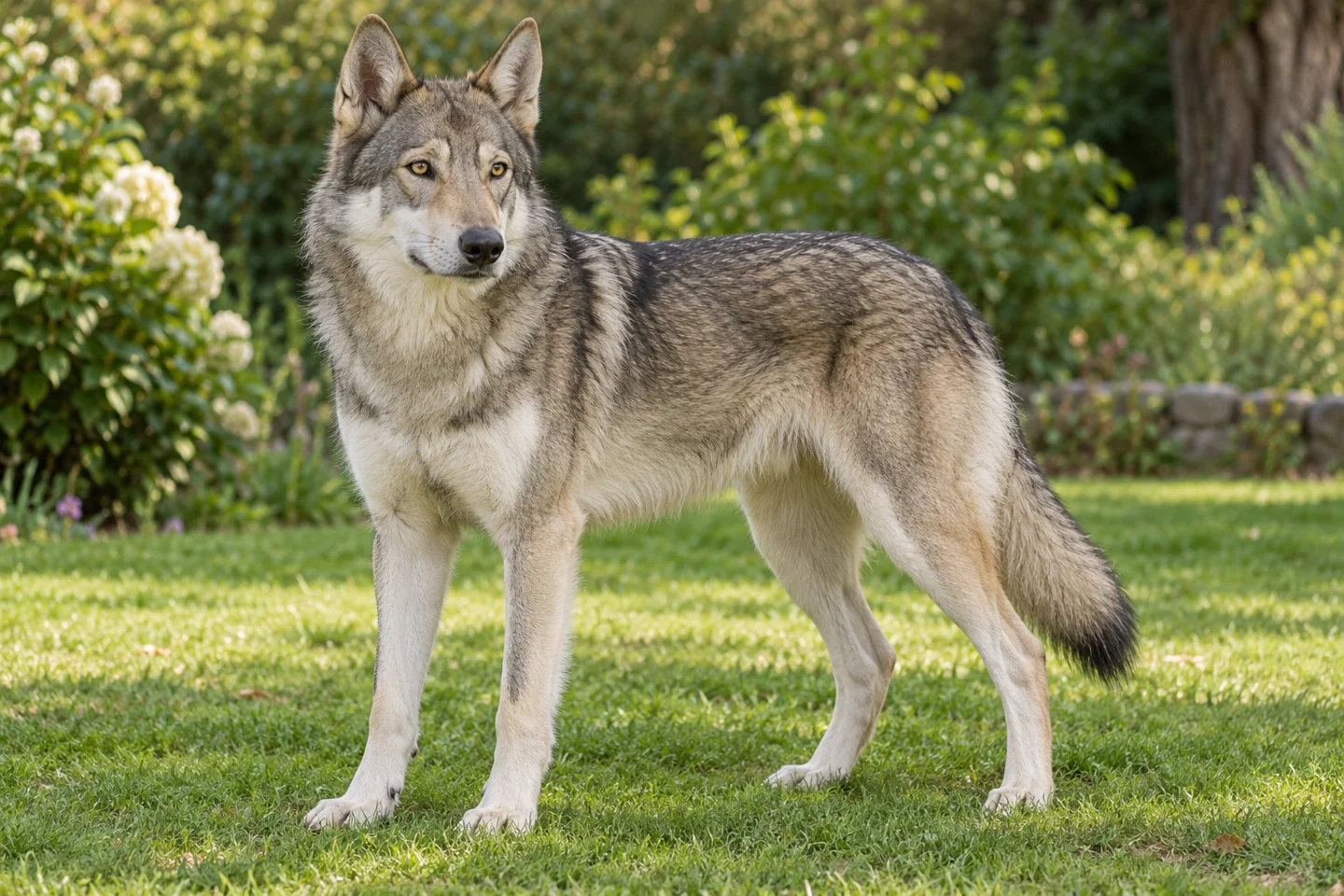
The FCI standard gives males a shoulder height of 65 to 75 centimetres and females 60 to 70 centimetres. The outline is slightly longer than tall. Upright ears, almond-shaped yellow eyes and a full tail contribute to its recognisable appearance. The standard describes wolf-grey and brown-toned colour patterns with lighter areas. A defined dark saddle is undesirable in that standard, so a generic German Shepherd picture can misrepresent the breed.
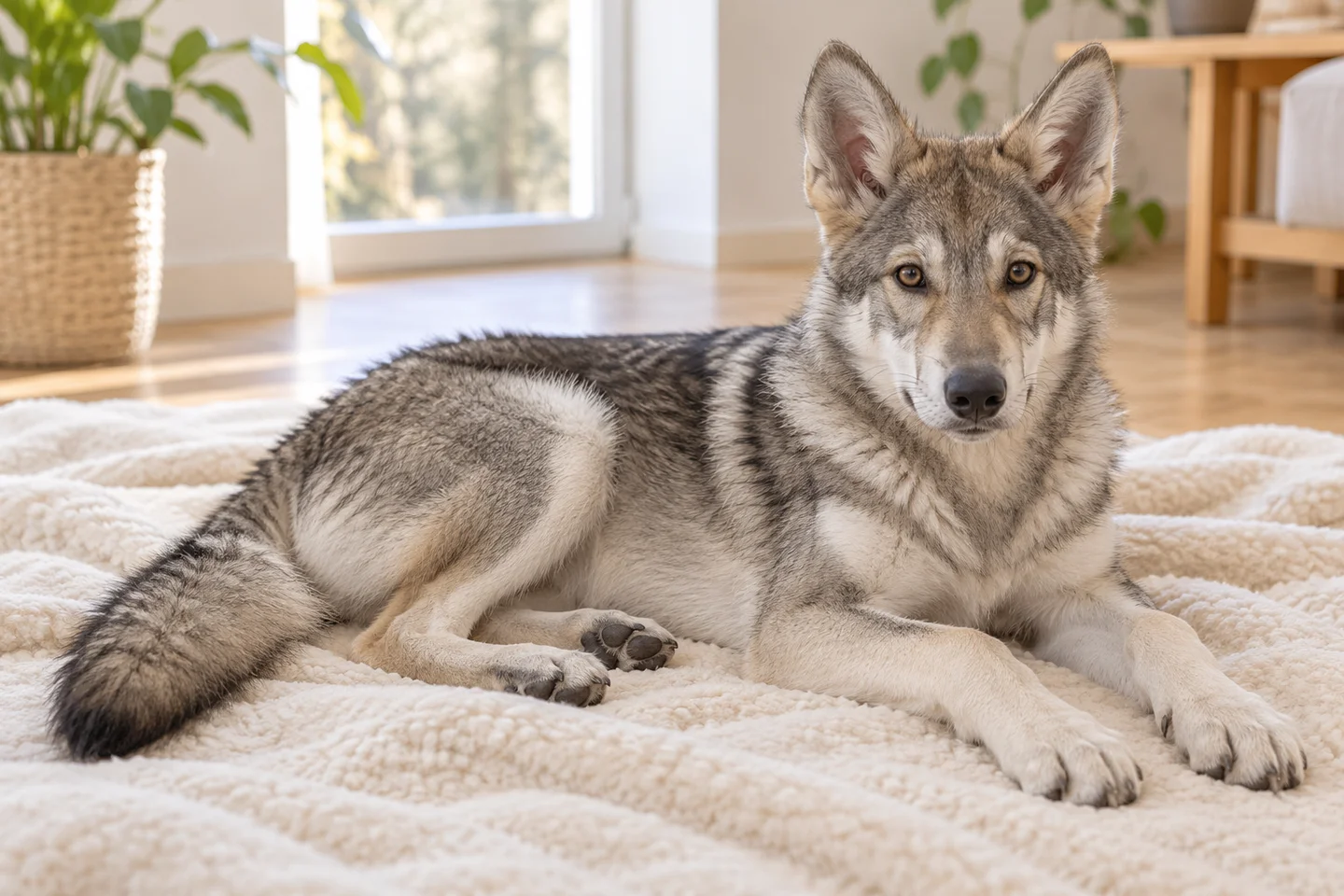
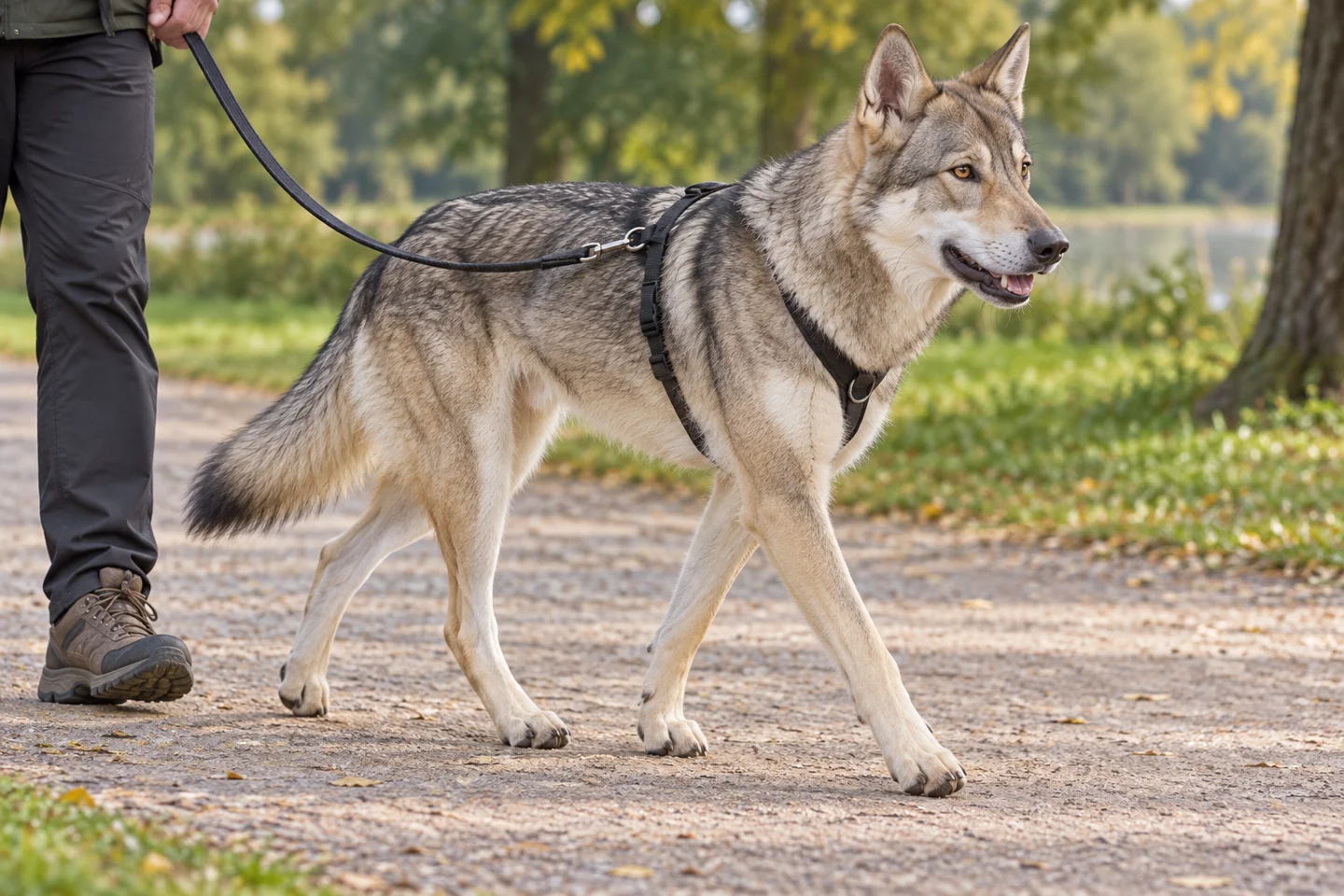
Appearance should never make discomfort acceptable. A dog should be able to move freely, recover from ordinary activity and rest without strain. Individual body condition matters more than a photograph of a show dog. The illustrations accompanying this article show an adult, a younger puppy and an ordinary outdoor walk. They are labelled AI-generated illustrations because they show a visual example, rather than documenting a particular breeder, animal or health assessment.
Temperament and everyday expectations
A Saarloos can form a close relationship with familiar people while remaining reluctant to approach strangers. The Dutch registry explains that contact should happen on the dog's terms. This affects ordinary arrangements such as deliveries, a pet sitter arriving or relatives staying overnight. Set up a quiet room before visitors arrive. Let the dog observe from a comfortable distance, and tell guests to leave it alone if it chooses not to approach.
There is no useful promise that every Saarloos will enjoy a busy family schedule or a crowded café. Ask about the actual adult dogs in the family and the circumstances in which they relax. If adopting an adult, learn how it behaves during handling, travel and time apart from its usual person. A candid description of avoidance, barking or escape attempts helps you prepare. A claim that the dog only needs a stronger owner does not explain what support it needs.
Housing, boundaries and escape prevention
Plan containment before the dog comes home. Inspect the whole boundary, including the ground below fencing, spaces beside gates and objects that could provide a step over it. A fenced area should allow safe access without leaving the dog dependent on constant outdoor supervision as its only protection. Use a separate indoor barrier while people open the front door. Explain this routine to visitors and anyone responsible for repairs or deliveries.
Equipment needs a careful fit. A frightened dog may reverse out of a loosely fitted harness or collar, so ask a competent trainer to demonstrate a secure arrangement. Do not test that equipment beside traffic. Practise putting it on in a calm room, reward cooperation and check it as the puppy grows. For travel, introduce a suitable restraint or crate gradually. Identification and current microchip details support recovery after an escape, but they cannot replace a sound physical boundary.
Training through clear rewards and manageable steps
Teach skills that solve household problems: moving to a bed, following a hand target, waiting behind a gate and returning from a few steps away. Begin in a place where the dog already feels safe. Reward the specific action you want, then release the dog before it becomes frustrated. Gradually change one part of the situation, such as the distance from you. Practising an easy response successfully gives you a usable starting point in a more distracting place.
Force can be especially damaging when a dog already wants to escape a situation. Avoid leash corrections, intimidation and training that prevents retreat until the dog stops resisting. Quietness alone does not establish that fear has resolved. A qualified reward-based trainer can help separate an unfamiliar cue from an environment that is too difficult. Cooperative handling also matters. Teach brief comfortable contact with feet, ears and the body so routine examinations do not begin with an avoidable struggle.
Exercise, sniffing and recovery
Build the day around walks the individual dog can manage comfortably, opportunities to investigate scent and enough uninterrupted sleep. A route with room to turn around is more useful than a narrow path full of loose dogs. Introduce new walking places gradually. If the dog becomes increasingly watchful rather than settling, choose an easier route next time. Exercise should support daily function, rather than becoming a test of how much distance the dog can endure.
Off-leash access requires secure containment and a realistic assessment of recall. A response learned in the kitchen may disappear when wildlife moves across a field. Use a long line only where it can be handled safely, with room to avoid entangling people or other dogs. Puppies need developmentally appropriate movement rather than forced running. Weather and health change the plan too. Carry water, choose cooler conditions when necessary and stop for unusual fatigue, stiffness or breathing difficulty.
Aggression, fear and safe intervention
Breed ancestry does not determine whether an individual dog will bite. Assess the dog's behaviour, the circumstances and the people or animals exposed to it. A Saarloos that retreats from a stranger may still react defensively if followed into a corner. Give it space before the situation reaches that point. Ask guests not to reach into its resting place, lean over it or attempt to prove that it will accept attention.
A growl should prompt a safer arrangement and an investigation of the cause. Punishment can remove a warning without making the underlying situation comfortable. Separate the dog calmly from the trigger and seek veterinary advice when behaviour changes suddenly or handling becomes difficult. Pain and illness can affect tolerance. A behaviour professional can help develop a plan, including reward-based muzzle training when appropriate. A muzzle supports an existing safety plan; it does not justify exposing the dog to situations it cannot cope with.
Children and visiting families
Adults must manage contact between children and this large dog. A child should not follow a retreating animal, hold its collar or climb into its bed. Explain those boundaries before a visit begins, then use gates and separate resting areas so the plan does not depend on the child remembering every instruction. If adult attention moves to cooking or another activity, separate dog and child. A successful previous visit does not provide supervision for the next one.
Consider the particular household. Frequent children's parties, running games and friends arriving without warning can be difficult for a dog that needs predictable surroundings. A calm family can still have unexpected noise and movement. The question is whether adults can provide space and manage those events reliably. A dog that stays quietly in another room with appropriate company or enrichment does not need to join the party. Meeting children should never be a test the dog has to pass for photographs.
Other dogs, cats and smaller animals
Do not assume that comfort with one familiar dog predicts an easy introduction to every dog. Start with distance and parallel movement, using handlers who can maintain control without pulling the dogs together. Watch for the ability to disengage, investigate the surroundings and take a break. Repeated staring, avoidance or escalating pursuit are reasons to increase distance. Introductions can take several sessions, and some pairings will require permanent management rather than shared play.
Discuss the dog's history with cats, livestock and smaller pets before adoption. A calm indoor interaction does not prove that chasing will never happen outside. Physical separation should protect vulnerable animals while you assess compatibility. Feeding separately also prevents an unnecessary contest over bowls or chews. If one household dog cannot rest or move freely without another following it, change the arrangement. Access to each other should depend on the animals' comfort, rather than the owner's wish for companionship.
Health screening and the records to request
The AVLS breeding regulations published in 2025 include hip and elbow assessment, ECVO eye examination and provisions for pituitary dwarfism, degenerative myelopathy and PCYT2 deficiency testing. These are that association's rules, with conditions and exceptions stated in the document. Ask a breeder which current association and registry rules apply to the planned litter. A list copied from another country or an older website may omit relevant examinations or describe a different programme.
Request the actual reports and check that the dog's registered identity matches the paperwork. Clinical hip and elbow assessments answer different questions from a DNA swab. An eye examination also has a date, which matters when an examination needs repeating. Health screening reduces uncertainty about specific conditions; it does not certify that a puppy will remain free of disease. Ask about close relatives as well, and discuss unfamiliar results with a veterinarian before relying on a seller's interpretation.
Understanding dwarfism, PCYT2 and DM results
The genetic conditions named in a breeding programme need their own reports and interpretations. Do not accept the statement that a dog has had DNA testing as proof that every relevant variant was examined. Ask which condition, which laboratory and which result are involved. Carrier status can inform a breeding combination without indicating that the dog currently has clinical disease. A veterinarian or qualified genetics adviser can explain the difference between protecting an individual dog and planning a litter.
Degenerative myelopathy deserves particular care in wording. UC Davis explains that SOD1-associated disease shows incomplete penetrance: an at-risk genotype does not establish that clinical disease will develop. It also notes that breed-specific clinical evidence is not available for every breed carrying the variant. Progressive weakness therefore needs a clinical investigation, even if a previous DNA report mentions DM. Do not dismiss potentially treatable causes of difficulty walking because a genetic result seems to offer an immediate answer.
Routine care and changes worth investigating
Book an initial veterinary appointment with the dog's records available. Explain any difficulty with unfamiliar handling before the examination begins. A quieter appointment time, waiting outside until a room is ready or practising cooperative handling at home may make care easier. Plan preventive treatment, dental care and vaccination around the individual animal and local risks. Breed appearance cannot tell you whether an unexamined dog has healthy teeth, comfortable joints or normal vision.
Pay attention to changes in movement, appetite, drinking, sleep and social tolerance. A dog that suddenly refuses a familiar walking route may be uncomfortable, rather than simply becoming stubborn. Take a video of intermittent movement problems if it is safe to do so. Collapse, serious breathing trouble, repeated unsuccessful retching or sudden inability to stand require urgent veterinary contact. Keep transport arrangements and emergency contact details accessible, especially if the dog is difficult for an unfamiliar person to approach.
Grooming a seasonal double coat
The coat needs regular inspection and brushing, particularly when undercoat is loosening. Work gently through small areas and stop if the skin looks sore. Check behind the ears, beneath the collar and around the hindquarters rather than brushing only the visible back. Introduce the brush with rewards and short sessions, so grooming remains a familiar handling routine. Ask a groomer for help if a dense or tangled area cannot be separated comfortably.
Check nails, paws and teeth as part of the same routine. A full outdoor coat can conceal a small wound or an attached tick, so inspect the dog after suitable walks without turning every check into a wrestling match. Dry wet equipment and ensure collars do not rub. Shaving the coat to solve seasonal shedding is not a routine substitute for appropriate coat care. If a medical problem or severe matting requires clipping, let the veterinary or grooming professional explain the specific plan.
Food, body condition and quiet meals
Choose a complete food appropriate to the dog's life stage and ask the veterinarian how to monitor growth and body condition. Measure the food actually offered, including training rewards. A heavy coat can hide a changing waist, so use hands-on checks alongside regular weighing. If you change foods, discuss a sensible transition rather than switching repeatedly in response to advertising. Persistent digestive trouble needs an assessment, particularly if appetite or weight also changes.
Feed in a place where the dog can eat undisturbed. Children and visiting pets should have no access to its bowl. Teach useful exchanges with appropriate rewards instead of repeatedly taking food away to test tolerance. Ask before using supplements, raw diets or restrictive homemade recipes, because an appealing ingredient list does not demonstrate nutritional completeness. A puppy's diet needs particular care during growth. Keep a short written record if several people feed the dog so meals and medicines are not accidentally duplicated.
Saarloos mixes and uncertain ancestry
A Saarloos cross can vary considerably in appearance, confidence, activity and handling needs. The other parent's identity and health history matter, and the result cannot be predicted by averaging two breed descriptions. Ask for specific evidence about both parents when buying a deliberately bred litter. For a rescue dog, its foster observations and clinical examination can be more useful for daily planning than an unverified breed label based on photographs.
Be cautious about marketing that presents a cross as having the dramatic appearance of one parent with guaranteed easy behaviour from the other. No such combination can be promised for every puppy. Health conditions relevant to either parent remain worth discussing, while a broad DNA panel cannot replace clinical screening. An established breed, a managed outcross programme and an undocumented dog with claimed wolf ancestry are different situations. Ask what is documented before making decisions about housing, care or compatibility with your household.
Choosing a home, breeder or rescue arrangement
Allow for more than the purchase or adoption fee. Secure fencing, suitable transport, training support, routine veterinary care and emergency treatment can all affect the household budget. Pet sitting may need additional preparation if the dog struggles with unfamiliar people. Arrange introductions before a trip becomes urgent. Ask prospective carers how they handle a dog that will not approach, and make sure they can follow the containment routine without improvising.
Meet adult dogs where possible and ask to see ordinary routines rather than a brief posed interaction. Find out how puppies experience household sounds, gentle handling and short separations. A responsible placement discussion should include the circumstances in which the dog might need to return. If your household cannot currently provide secure boundaries, patient introductions or backup care, waiting is a practical decision. The breed's appearance cannot compensate for a daily arrangement that repeatedly leaves the dog frightened or difficult to manage.
Meeting another owner through dogsDating
Describe the individual Saarloos in your dogsDating profile. Useful information includes the space it needs from unfamiliar dogs, whether it prefers parallel walking and which situations are difficult. Share a general area while keeping your exact home coordinates private. Choose a quiet public meeting place with room to change direction and leave. Agree in advance that either owner can end the meeting when a dog seems uncomfortable, without needing to justify staying longer.
Begin with a walk at a comfortable distance instead of a face-to-face greeting. Keep leads manageable and avoid sharing food, toys or a small enclosed entrance. The dogs do not need to play for the owners to enjoy meeting. A calm outing with separate sniffing and an uneventful departure can give you better information for another day. If the first arrangement is too busy, change the location or timing rather than using the next meeting to force closer contact.
Sources and editorial notes
Sources checked October 22, 2026. Breed measurements describe reference ranges, not a diagnosis or an individual dog's ideal weight. Images are AI-generated breed illustrations and do not document a particular dog or health condition.
- AVSAB: Humane Dog Training Position Statement
- VCA Animal Hospitals: Food aggression in puppies
- VCA Animal Hospitals: Aggression toward unfamiliar dogs, diagnosis
- VCA Animal Hospitals: Grooming and coat care for your dog
- AAHA: Feeding plans for healthy, appropriate weight cats and dogs
- VCA Animal Hospitals: Heat stroke in dogs
- VCA Animal Hospitals: Common emergencies in dogs
- Orthopedic Foundation for Animals: CHIC health screening programs
- AVSAB: Puppy Socialization Position Statement
- VCA Animal Hospitals: Dog behavior problems, aggression toward children
- FCI Standard 311: Saarlooswolfhond, appearance, origin and temperament
- Raad van Beheer: living with and caring for a Saarlooswolfhond
- AVLS 2025 breeding regulations: clinical examinations, DNA results and breeding combinations
- LICG Saarlooswolfhond: housing, behaviour, care and hereditary conditions
- UC Davis Veterinary Genetics Laboratory: SOD1 testing and incomplete penetrance in degenerative myelopathy
Keep getting to know dogs.
Read another guide or return to your dogsDating community.
Explore breed guidesBack to dogsDating