Saint Bernard
A giant Swiss mountain dog whose size affects handling, housing, growth, transport, and the practical meaning of gentle family companionship.
How these guides are researched and reviewed
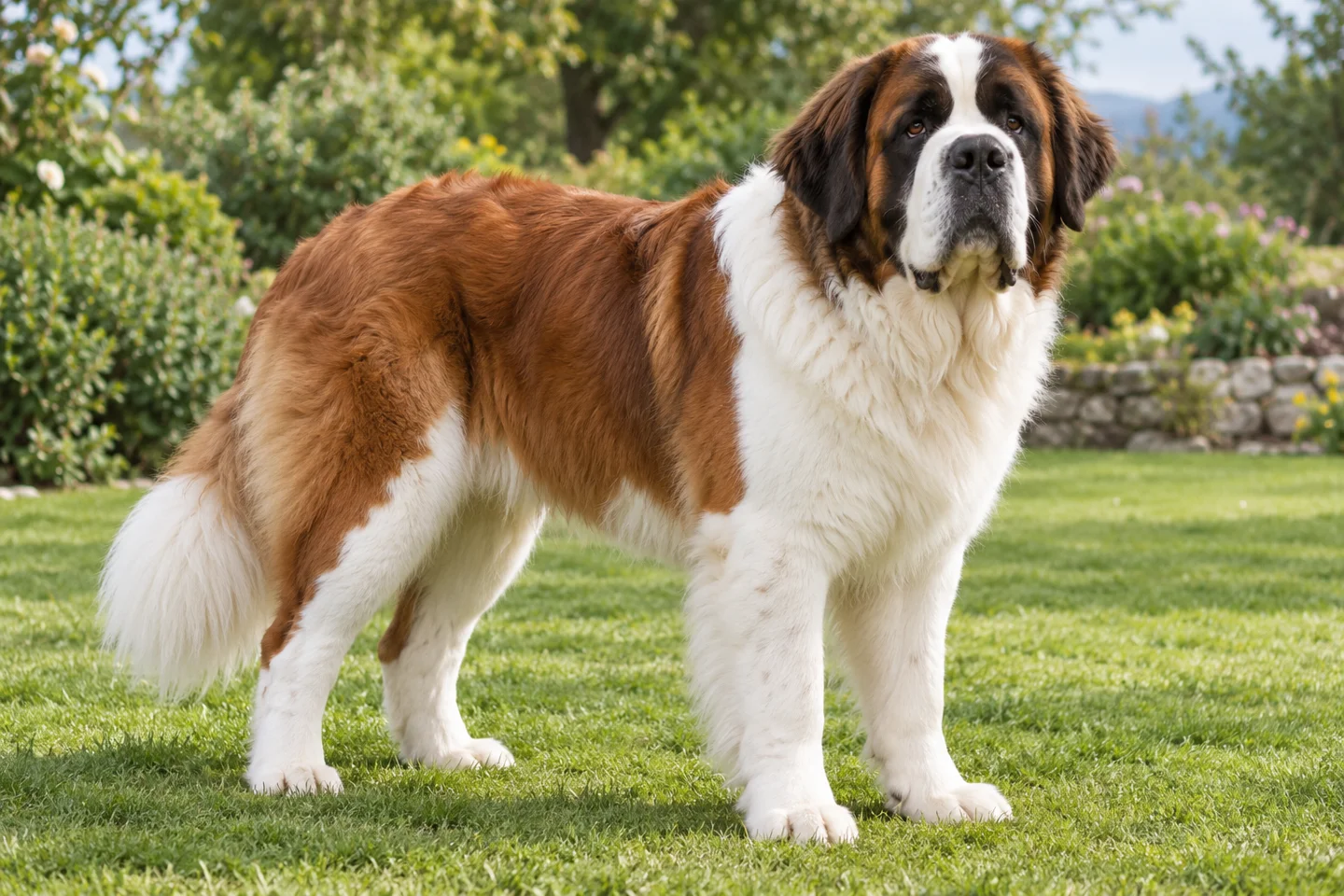
- Origin
- Switzerland
- Adult standard size
- Males 70–90 cm; females 65–80 cm; balanced larger dogs accepted
- Illustrated coat
- Long-haired red mantle and white
General information for owners. These articles have not been reviewed by a veterinarian. Medical decisions need your dog's history and an examination.
A mountain dog in a domestic room
The Saint Bernard is a giant dog of Swiss origin, associated with the hospice at the Great Saint Bernard Pass and historical rescue work. The modern owner should translate that background into practical questions about a large working body rather than romantic expectations. Where will the dog sleep, turn, travel, and recover from illness? Can the household manage those needs when the puppy has become a fully grown adult?
The FCI recognizes short-haired and long-haired varieties. Both are substantial dogs with a large head, strong frame, and natural hanging ears. A short coat does not make the dog small, and a long coat does not create a separate temperament. Meet adults if possible and discuss daily care with people who can describe wet floors, transport, grooming, and veterinary visits as clearly as they describe affection.
A reputation for kindness should never become permission to leave a child unsupervised or ignore early training. A giant dog can cause harm through ordinary movement without intending aggression. The goal is a household where the dog's size has been planned for and cooperation is taught before strength makes improvisation difficult. A realistic home can appreciate the breed without expecting a historical rescue story to train the individual animal.
Adult size and the limits of a number
The FCI standard sets male height at 70 to 90 centimeters at the withers and female height at 65 to 80 centimeters. Larger dogs may be accepted if their proportions and movement remain appropriate. This is not an invitation to pursue maximum size. The standard's acceptance of a balanced larger dog does not mean that every puppy should be fed toward the largest adult a buyer has seen.
Weight needs interpretation against frame, muscle, age, and condition. Avoid treating an internet chart as a required monthly achievement. Ask the veterinarian to follow growth and demonstrate how the ribs and waist should be assessed. In the long-haired variety, feel beneath the coat rather than judging the fluffy outline. A heavier puppy is not automatically developing better, and a giant breed still needs protection from excess body fat.
The standard describes white with red markings or a red mantle, with particular white markings and a desirable dark facial mask. Our illustrations show the long-haired red-mantle pattern, natural ears, and a complete tail. They are labeled AI-generated illustrations. They cannot show a clinical gait assessment, establish joint health, or document the full range of permitted markings.
Housing, flooring, and safe transport
Walk through the home while imagining the adult dog's turning space. A narrow gap beside a table may be manageable for the puppy and awkward later. Provide stable footing, comfortable bedding, and access that does not depend on repeated leaps. Ask the veterinary team about stairs and other arrangements as the dog grows. Decisions made early can prevent a situation in which an injured adult must negotiate an avoidable obstacle.
Transport deserves a trial before it becomes urgent. Check that the vehicle can hold the dog securely and that entry and exit are manageable. Introduce any suitable ramp gradually with a stable surface and rewards. A ramp that slides or a rushed attempt may create lasting reluctance. Plan how another person could help without lifting beyond their ability or causing the dog further pain.
Discuss emergency access with the clinic. Know where to go outside normal hours and how to move the dog if it cannot walk. Keep essential records and insurance details available. These arrangements are ordinary giant-dog ownership, not an assumption that illness is inevitable. They allow decisions to be made calmly while the dog is well rather than improvised when time, physical strength, and transport space are already under pressure.
Check daily access to drinking water as well. A bowl should sit where the dog can use it without blocking a narrow passage, and the surrounding floor needs attention when water spills. If an older dog begins avoiding that area, consider footing and comfort alongside appetite and thirst. Moving the bowl may help access, while the underlying change still deserves assessment.
Training while the puppy is easy to guide
Teach a mat, a doorway wait, and calm lead attachment before the dog becomes difficult to hold. Reward the behavior in a quiet setting and add distraction in small steps. A visitor arriving with bags is a harder doorway lesson than an empty room. Practice the easy version often enough that the dog knows what earns a reward before relying on it during a busy arrival.
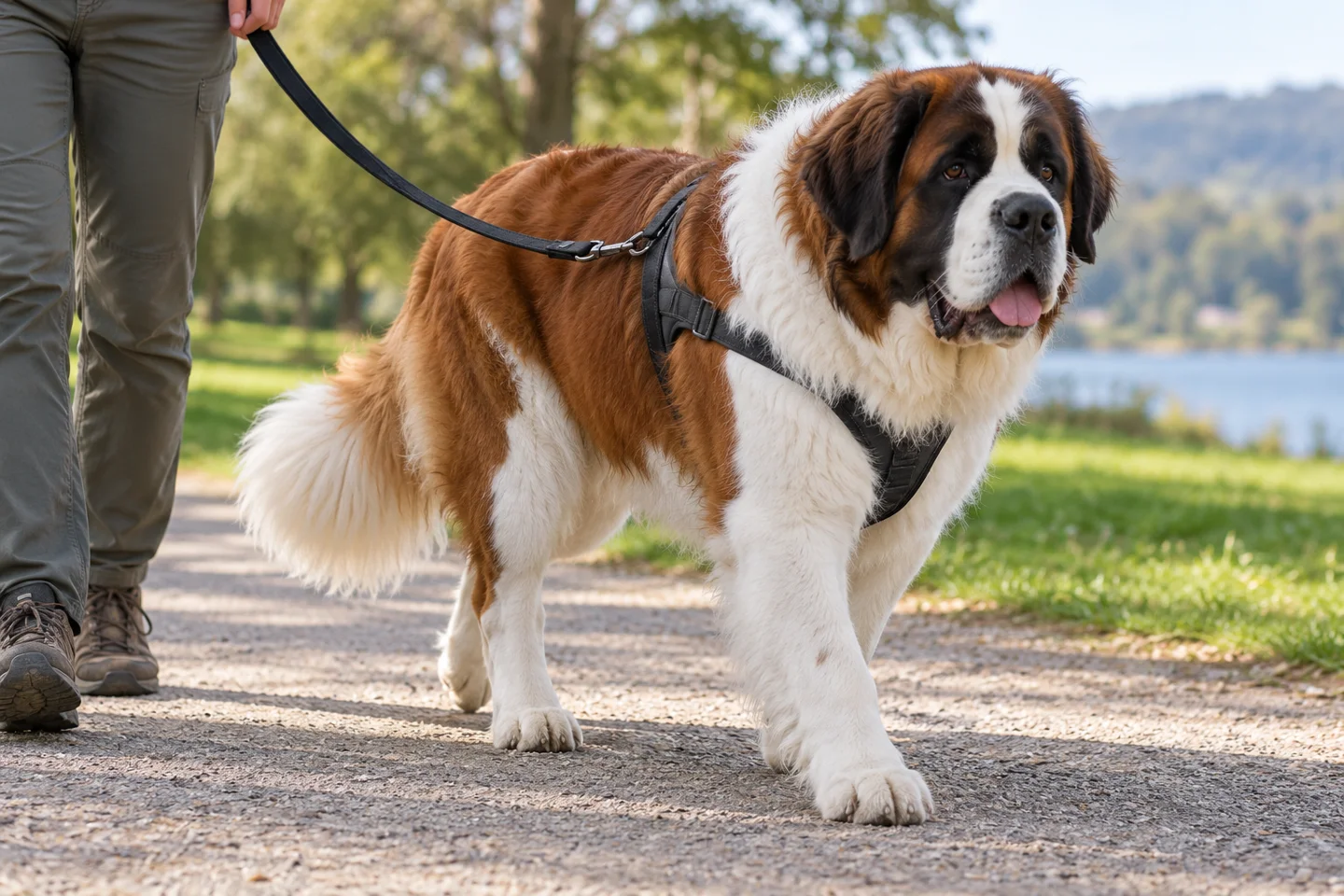
Loose-lead walking should begin as a skill rather than a contest over equipment. Reinforce following the handler's direction and learn a calm turn away from a distraction. A reward-based trainer can assess the setup and the regular handler's ability. The plan should not depend on a person winning a pulling match with a mature Saint Bernard. Equipment supports management, while teaching makes cooperation more likely.
Cooperative care needs its own practice. Brief checks of the mouth, paws, ears, and skin can be rewarded separately. Teach standing on a non-slip surface and entering a suitable care area. If a grooming or veterinary task becomes difficult, tell the professional before the appointment. Gradual preparation, suitable assistance, and clinical support when necessary are preferable to discovering at the table that the dog cannot tolerate the procedure.
Exercise and recovery in a giant body
Provide daily movement and opportunities to investigate while adjusting effort to the individual. A growing puppy, a conditioned adult, and an older dog with arthritis need different plans. Avoid repetitive strenuous work intended to make a young giant dog tired. Ask the veterinarian about the proposed activity, including surfaces and duration. Willingness to follow the owner does not establish that the workload is appropriate.
Gentle searches, ordinary walks, and brief teaching sessions can create variety without constant high-impact play. Build adult conditioning gradually and observe the dog afterward. Difficulty rising, altered gait, or a change in enthusiasm should be investigated rather than dismissed as inevitable laziness. A dog may avoid an uncomfortable activity while still appearing sociable and interested in food.
Warm conditions require particular care. Arrange shade, water, and cooler activity periods, and check the temperature inside vehicles and sheltered areas. Watch breathing and recovery directly. Heavy panting that does not settle, weakness, or other concerning changes require prompt advice. The historical association with cold mountains does not prepare a dog automatically for a warm home, and a short-haired Saint still needs a suitable heat-management routine.

Aggression, pain, and practical separation
A calm reputation cannot certify an individual Saint Bernard as safe in every situation. Growling over a bed, stiffening during handling, or lunging at a visitor needs attention. Protect people by preventing the setup from recurring while veterinary and behavioral support is arranged. With a dog this large, a barrier must be genuinely suitable for the animal rather than selected because it contained a previous smaller pet.
Pain should be considered when tolerance changes. A dog that resists being moved may have difficulty rising or discomfort in the position a person is requesting. Avoid forcing it physically to prove authority. Teach movement through cues and rewards when the dog is comfortable, and obtain a clinical assessment for new problems. A good behavior plan explains what the owner should do before a conflict, not only how to react afterward.
Keep meals and valuable items away from passing children and other pets. If guarding occurs, seek qualified help with a gradual plan and stop rehearsing confrontations. Disclose bite incidents accurately to carers, including contact and injury. A basket muzzle can be useful in an individual plan after positive introduction, but it does not replace distance, barriers, or careful handling. Managing the environment remains essential even when additional equipment is used.
Children and the meaning of gentle contact
An adult Saint Bernard can move a child unintentionally with its head, shoulder, or tail. Arrange interactions with room and stable footing. Children should not ride the dog, lean on its back, or use it for balance. A dog remaining still does not establish enjoyment. Adults need to observe whether it moves away, turns its head, or becomes tense and respond before the child continues.
Protect sleeping and feeding places. If the dog is resting in a hallway that children must use, provide a more suitable bed and teach that location. Avoid expecting the child to negotiate around a giant body without help. Visiting children need the same rules as household children, and excitement during a group visit can justify separation even when the dog usually appears relaxed.
Give children suitable tasks: preparing a search with an adult, filling supplies away from the dog, or practicing an established cue under supervision. Lead handling and physical restraint are separate responsibilities requiring realistic judgment. When adults become occupied, use the agreed separation routine. Familiarity and good intentions cannot replace supervision, particularly when a large dog is tired, painful, or carrying a valued object.
Other dogs and smaller companions
A Saint Bernard's friendly approach can overwhelm a smaller dog through sheer scale. Introduce dogs where they can move independently and stop if one repeatedly tries to escape. Calm parallel walking may be a better first activity than physical play. Assess whether both can disengage, not simply whether tails move. Excitement is information, but it is not proof that the experience is comfortable for each participant.
Inside, provide separate eating and resting areas initially. Watch narrow doorways and access to people, where one dog may block another without an obvious fight. Older or smaller companions may need routes and beds the giant dog cannot crowd. A household can allow companionship while still offering each animal privacy. Constant togetherness is not a requirement for a successful relationship.
Cats and small pets need individual consideration and appropriate protection. A gentle encounter with a familiar cat does not predict the response to a running unfamiliar animal. Avoid testing the dog by allowing pursuit. If either animal remains worried, change the setup and obtain advice. The Saint Bernard's historical work and public image do not remove the owner's responsibility to assess the actual interactions.
Grooming, drool, and clean skin
Both coat varieties need regular brushing and skin inspection. The long-haired coat needs careful attention where tangles develop, including behind the ears and under equipment. Divide the work into manageable sections and ask a groomer about tools and drying. A giant dog that cannot stand comfortably through a long session may need a different arrangement. The plan should account for mobility and tolerance as well as the amount of hair.
Keep suitable cloths available for the mouth and clean damp areas gently. Persistent wetness, odor, or inflamed skin should be discussed with the clinic rather than treated as unavoidable drool. Wash and dry bedding and check the dog's usual resting places. Practical cleanliness helps owners notice changes and makes daily care easier, but it should not become a reason to use harsh products on the face.
Inspect ears without putting implements into the canal. Pain, repeated shaking, discharge, or a marked odor needs veterinary attention. Introduce nail care and toothbrushing in small stages with rewards. A giant mouth still needs dental assessment, and a powerful foot can still have a painful nail injury. If the dog begins resisting one area, look for a medical reason rather than increasing restraint automatically.
Health screening and urgent abdominal signs
The AKC working-group summary lists hip evaluation, elbow evaluation, cardiac examination, ophthalmologist evaluation, and a common-variant degenerative myelopathy DNA test for Saint Bernards. The Saint Bernard Club of America's published statement supports those areas. Request identifiable reports for both parents and confirm the current protocol. Actual results and the age of assessment matter more than a general claim that the parents have been checked.
Different tests provide different information. A DNA result concerns the variant tested and does not establish freedom from every neurological disorder. A normal clinical eye examination does not replace joint screening. A CHIC number indicates completion and disclosure under the relevant program, rather than promising that every result is normal. Discuss findings with the veterinarian if a source's explanation is unclear, and ask about the health of close relatives as well.
A large dog with unproductive retching, a swollen abdomen, or sudden marked distress needs urgent veterinary contact because these can be signs of gastric dilatation-volvulus. Do not wait for every sign or attempt home treatment. Know the emergency destination and transport plan in advance. Ask the veterinarian about the individual dog's risk and whether preventive gastropexy is appropriate. No feeding gadget or exercise rule should be presented as guaranteed prevention.
Keep ongoing records of movement, appetite, weight, and medication. Screening cannot answer every future clinical question. Persistent lameness, reduced tolerance for walking, or difficulty rising deserves examination. An owner can help by noting timing and bringing a safe video of an intermittent change. Avoid assuming that every problem is a normal consequence of being large or old; many causes require specific assessment and care.
Feeding, mixes, costs, and a dogsDating plan
Use a complete diet appropriate to the dog's life stage and follow body condition and growth with the clinic. Do not add mineral supplements to a balanced puppy food without guidance. Measure intake and account for rewards. Feeding costs can be substantial, but the aim is appropriate nutrition rather than the largest ration the dog will accept. A sudden appetite or weight change needs attention even when a large bowl makes the difference difficult to judge.
A Saint Bernard mix may have a different size, coat, drooling pattern, and temperament. Ask what is documented about both parents. A fashionable cross name cannot guarantee health or predict the space an adult will need. Budget locally for transport, grooming, boarding, preventive care, insurance, and emergency treatment. Check whether a backup carer can manage the adult safely. The acquisition price rarely captures the practical commitment of a giant dog.
On dogsDating, describe the Saint's pace, size, and comfort with smaller dogs. Choose a wide public route with room for separate walking and avoid a crowded gate greeting. Keep exact user coordinates private; approximate discovery and an agreed public meeting point suffice. Begin with enough space that both dogs can disengage, and leave if one remains tense or overwhelmed. A calm short walk can establish a useful partnership without requiring physical play or access to either home.
Sources and editorial notes
Sources checked October 22, 2026. Breed measurements describe reference ranges, not a diagnosis or an individual dog's ideal weight. Images are AI-generated breed illustrations and do not document a particular dog or health condition.
- AVSAB: Humane Dog Training Position Statement
- VCA Animal Hospitals: Food aggression in puppies
- VCA Animal Hospitals: Common emergencies in dogs
- Orthopedic Foundation for Animals: CHIC health screening programs
- VCA Animal Hospitals: Aggression toward unfamiliar dogs, diagnosis
- VCA Animal Hospitals: Grooming and coat care for your dog
- VCA Animal Hospitals: Ear infections in dogs (otitis externa)
- AAHA: Feeding plans for healthy, appropriate weight cats and dogs
- VCA Animal Hospitals: Heat stroke in dogs
- AVSAB: Puppy Socialization Position Statement
- VCA Animal Hospitals: Dog behavior problems, aggression toward children
- American Kennel Club: Working group health testing requirements
- Saint Bernard Club of America: Health statement
- Fédération Cynologique Internationale: Saint Bernard official breed standard
Keep getting to know dogs.
Read another guide or return to your dogsDating community.
Explore breed guidesBack to dogsDating