Samoyed
A practical guide to Samoyed companionship, double-coat care, health screening, comfortable exercise and suitable social outings.
How these guides are researched and reviewed
- Origin
- Northern Russia and Siberia
- FCI ideal height
- Males 57 cm; females 53 cm, each ±3 cm
- Coat
- Dense double coat
- Daily planning
- Coat maintenance, activity and company
General information for owners. These articles have not been reviewed by a veterinarian. Medical decisions need your dog's history and an examination.
Samoyed identity and northern background
The Samoyed is a northern spitz breed with upright ears, a full double coat and a plumed tail. It has a working history alongside people, including sledging and other practical tasks. That background is useful when thinking about daily occupation and companionship. Choosing one requires more than liking a white fluffy coat. Consider where the dog will exercise, how its coat will be maintained and who will provide care during ordinary working days.
The FCI standard gives the origin as northern Russia and Siberia under Nordic Kennel Union patronage. Its account traces the western breed's development through imported dogs and an early English standard. That history does not make every white spitz a Samoyed. Ask for verifiable lineage if a registered breed identity matters. When adopting an animal with uncertain ancestry, base care on its actual body, behaviour and clinical history rather than treating a resemblance to a photograph as proof.
Size, coat and the familiar expression
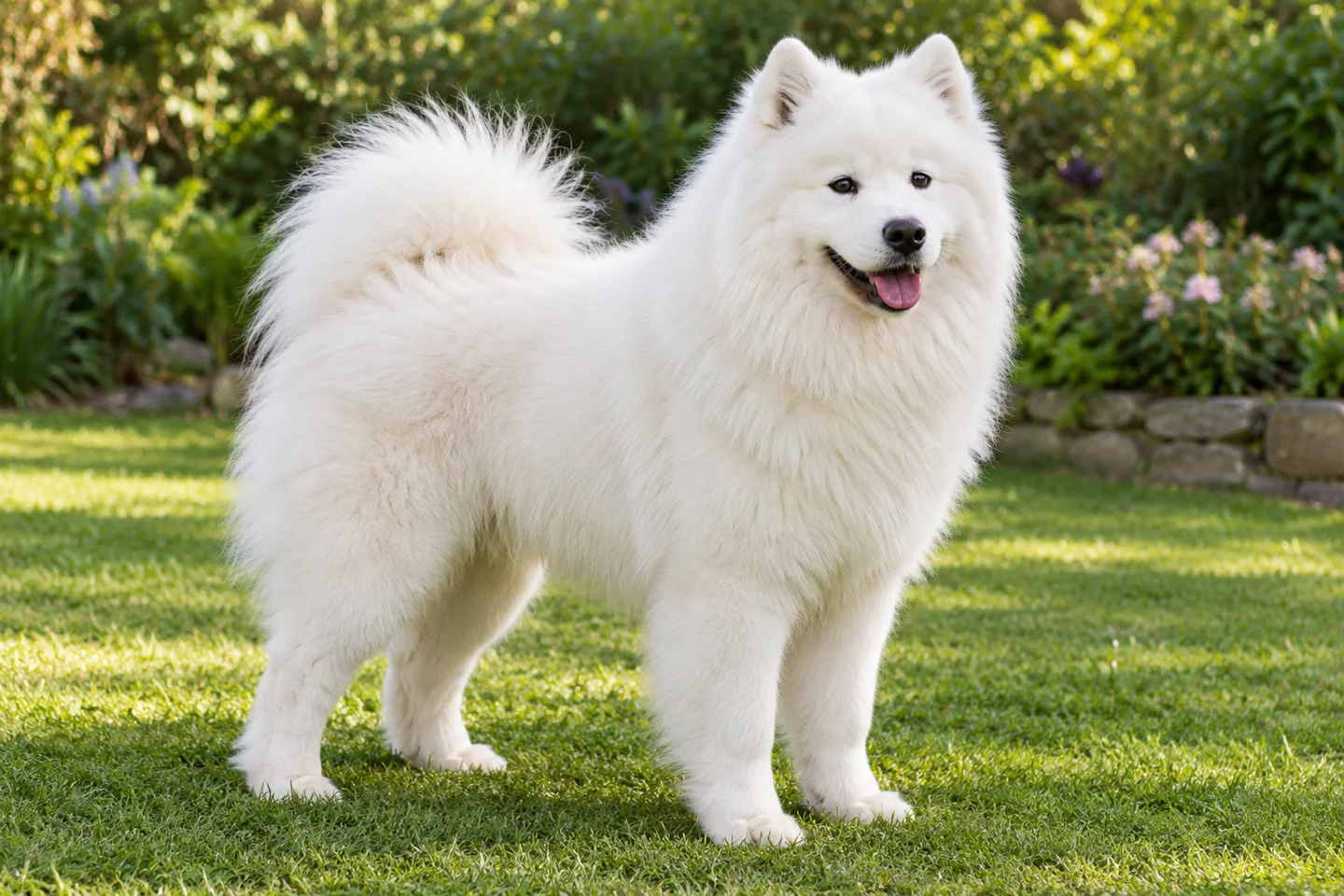
The FCI height reference is an ideal 57 centimetres for males and 53 centimetres for females, with a tolerance of three centimetres either way. Its colour description includes white, cream and white with biscuit markings. The coat has a soft dense undercoat and longer harsher outer hair. The natural tail can bend forward over the back or side when alert and may hang at rest. These details describe a breed standard rather than the health or suitability of any individual.
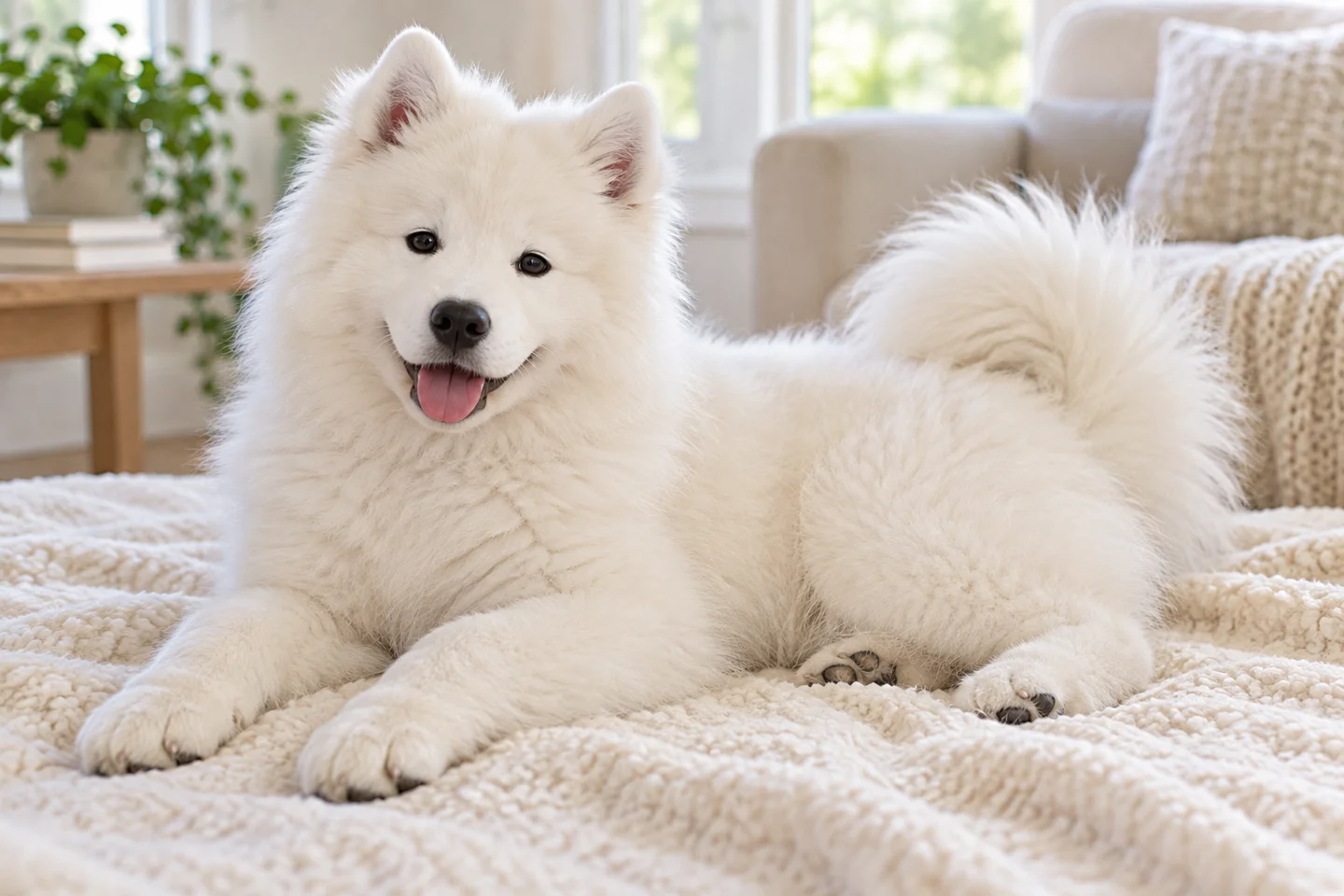
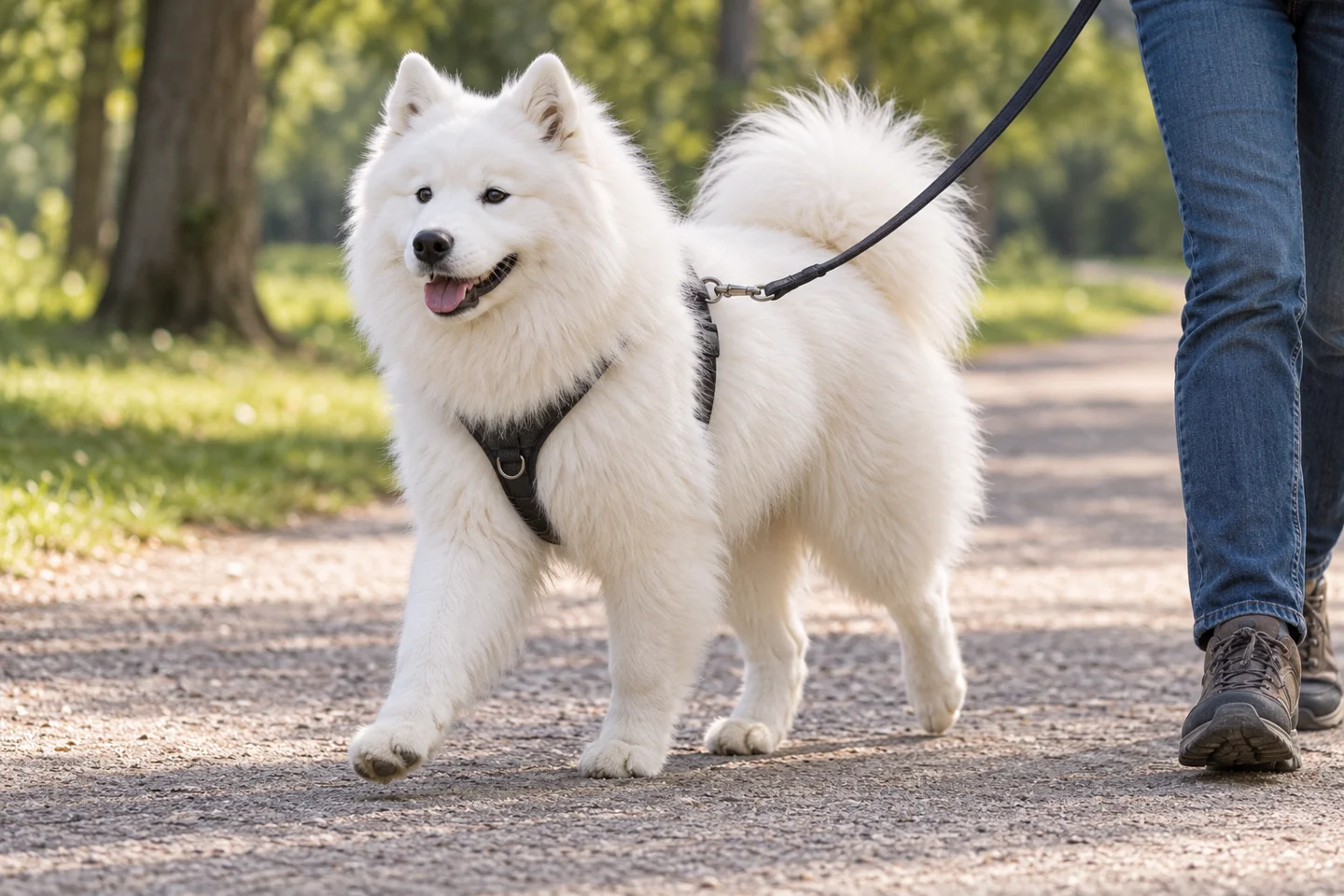
The pictures here show a white example at different life stages and during an ordinary harness walk. Each is labelled an AI-generated illustration. They are visual examples, rather than documentary photographs of a particular dog or evidence of a health result. The upward corners of a Samoyed's mouth contribute to its familiar expression, but owners still need to read the whole animal. A smiling-looking face alone does not show whether a dog is relaxed, worried, tired or comfortable with touch.
Temperament, company and realistic expectations
A sociable breed description cannot promise that a particular Samoyed will enjoy every dog, visitor or busy setting. Ask for examples from ordinary life. Does the dog settle while people eat, remain comfortable with a groomer and recover after a surprising noise? What happens when its person leaves? Those answers reveal useful support needs that a cheerful photograph cannot show. A dog may enjoy attention in its own home while finding a crowded pavement difficult.
Offer predictable company alongside comfortable independent rest. Set up a bed outside the busiest traffic route and let the dog finish a nap without repeated interruptions. Introduce short separations gradually, noticing whether it actually rests. If it becomes distressed, seek an appropriate plan rather than relying on exhaustion or prolonged crying to teach independence. Backup care should fit what the dog can currently manage. A working schedule needs arrangements that remain practical during poor weather, illness and changes in family commitments.
A workable routine for a vocal, active household companion
Plan outlets for activity before frustration becomes a household pattern. A walk with opportunities to sniff, a short teaching session and a chance to rest can help organise the day. Watch which events make barking likely, such as seeing dogs through a window or waiting while equipment is prepared. Reduce unnecessary triggers and teach a manageable alternative. Closing a view and rewarding calm movement to a bed can be more practical than repeatedly calling for quiet after arousal has already risen.
If barking changes suddenly or becomes persistent, review the cause instead of assuming that the breed name explains everything. Pain, distress or a change in the environment may need attention. Keep a simple record of timing and what happened beforehand. A suitable trainer can help distinguish an activity routine that needs adjusting from difficulty with a particular trigger. Teach quieter care tasks too, such as waiting while a lead is attached, so going out does not depend on everybody managing an increasingly excited dog at the door.
Training with clear rewards and useful choices
Start with moving toward a hand target, coming when called and waiting briefly behind a gate. Reward the response while it is happening, then release the dog to an appropriate activity. Make the first version easy enough to repeat without frustration. Gradually add distractions rather than asking for the finished response in a crowded park. A dog that responds in the kitchen still needs practice with scent, other animals and movement competing for its attention.
Introduce grooming cooperation as a training goal from the beginning. A short brush touch, a moment of paw handling and standing comfortably beside equipment can each earn a reward. Let the dog take breaks before it starts pulling away. Avoid painful corrections or physical intimidation when cooperation becomes difficult. Consider discomfort and ask for help. The aim is a care routine that remains manageable as the coat develops and the dog reaches adult strength, rather than a puppy that tolerates being held still until it can escape.
Socialization and learning to observe calmly
Arrange safe puppy experiences with veterinary advice about infection protection. Choose places where you can increase distance and leave easily. Let the puppy observe an unfamiliar person, a bicycle or another dog without being pushed into a greeting. Reward comfortable attention and the ability to turn back to you. A successful session can finish after a small amount of calm learning. Staying longer because the puppy has not met enough people can turn a manageable outing into an overwhelming one.
Include quiet indoor experiences, safe travel and surfaces the puppy will meet during care. A dog accustomed to lively outdoor play may still need help with a veterinary scale or grooming table. Watch for freezing, repeated avoidance and difficulty recovering. Reduce the task when these appear, and seek guidance if everyday handling remains difficult. An adopted adult can learn at an appropriate pace too. Age alone does not reveal what an animal has experienced, so ask its previous carers what it already manages comfortably.
Exercise and recovery through changing weather
Give the dog regular movement suited to its age, condition and interests. Walks, scent tasks and suitable games can provide different forms of engagement. Keep control around roads, wildlife and unfamiliar dogs, even when the dog is sociable at home. Use secure equipment while recall develops. Before trying a new sport or strenuous outing, ask about safe preparation for the individual rather than assuming that northern working ancestry provides immediate fitness for any challenge.
A dense coat does not remove the risks of hot weather. Choose cooler timing, offer water and plan an easy return. Watch effort and recovery rather than expecting the dog to decide when enough is enough. Puppies need developmentally appropriate activity and rest, while older dogs may need changes based on comfort and examination. Unusual reluctance, repeated stiffness or breathing difficulty warrants advice. Avoid treating an unfinished route as a failure. Turning back while the dog remains comfortable can be the most useful decision of the outing.
Aggression and the limits of a friendly reputation
A Samoyed can bite, guard food or react when frightened or painful. A generally friendly breed reputation cannot determine an individual's response to a specific situation. Notice the circumstances around a warning. A dog disturbed during rest may need a protected sleeping area, while one reacting during brushing may have a painful coat or skin problem. Prevent a repeat and investigate the cause instead of asking another person to try the same handling as a test.
Punishing growling can make future warnings less clear without resolving the underlying discomfort. Create space and seek veterinary help for sudden changes. A qualified behaviour professional can assess persistent fear, guarding or conflict with another dog. Be factual about incidents when arranging care or introductions. If a muzzle is appropriate, introduce it gradually with rewards and learn the correct fit. It supports management while the dog learns or receives care; it does not make pressure, crowding or an unsuitable play session comfortable.
Children and handling a full-coated dog
Adults should supervise contact and give the dog an exit. A child may want to hug the soft coat, but pulling hair, leaning over a resting animal or holding it in place can be uncomfortable. Teach children to invite contact and allow the dog to leave. Keep food, chews and sleeping areas protected. During busy play or visiting children's games, use a comfortable separate space instead of expecting the dog to ignore every sudden movement.
Put an adult in charge of walks and care tasks. A Samoyed's size and enthusiasm can pull a child off balance even without aggressive intent. A history of pleasant family contact is useful information, but it does not replace supervision today. Ask a breeder or rescue which ages of children the dog has met and under what conditions. If the household cannot maintain separation when adults are distracted, resolve that practical problem before bringing the dog home.
Other dogs, cats and compatible play
Assess introductions according to the individual animals. Begin with room to move apart and let both dogs investigate the surroundings. Parallel walking can reveal whether they remain comfortable without requiring a greeting. If play follows, look for mutual breaks and the ability to disengage. Repeated pursuit of a dog trying to leave is a reason to stop. A quiet dog may prefer a walking companion to a lively wrestling partner, regardless of the breeds involved.
Cats and smaller pets need protected spaces and a gradual plan. Do not release the dog to find out whether it will chase. Comfort with one familiar cat provides information about that relationship, rather than a guarantee for every animal encountered outdoors. Separate meals and valued objects in a multi-pet household until safe routines are established. If one animal cannot rest without being followed or blocked, change access arrangements and seek help. Owners' wishes for friendship should respond to what the animals actually show.
Grooming through the full double coat
The coat requires regular attention through to the skin. A smooth outer surface can hide tangles near the body, especially behind the ears, beneath equipment and around the hindquarters. Ask an experienced groomer to demonstrate gentle section-by-section care. Introduce it gradually and keep sessions comfortable. Do not pull painfully through a tight mat to retain an ideal appearance. A professional can explain the kindest treatment when neglected hair cannot be separated safely.
Check how the coat feels after rain or bathing, and dry it appropriately without leaving damp tangled areas against the skin. Maintain hygiene around the rear and inspect feet and nails. Tooth brushing needs its own calm routine rather than being forgotten because coat work takes time. Shaving is not a routine shortcut for shedding or hot-weather management. If severe matting or a medical condition requires clipping, discuss the individual plan with the groomer or veterinary team. Comfort and skin health should guide the decision.
Health screening: five recommendations with different purposes
The Samoyed Club of America's breeder guidance and the current AKC recommendations identify hip evaluation, cardiac examination, ophthalmologist evaluation and DNA testing for X-linked PRA and retinal dysplasia with oculoskeletal dysplasia. The current AKC list names XLPRA1 and OSD2. Ask the breeder to identify the relevant tests and show the parents' original reports. A result described simply as PRA clear needs its exact variant explained because different forms and tests exist.
Clinical eye examination and genetic testing complement each other. A favourable result for a tested variant cannot exclude every cause of future visual impairment. Hip and cardiac reports also answer their own questions and should not disappear behind the phrase fully tested. Check identity and dates, and ask how results informed the mating. A CHIC number concerns completion and publication of the applicable programme, rather than a blanket normal-health certificate. For an adult rescue with missing records, individual veterinary assessment is the practical starting point.
Eye health beyond a clear DNA result
The American club recommends regular specialist eye assessment for breeding dogs and discusses inherited eye disorders separately. That is a useful distinction when comparing records. Ask which examination the parents received and when it took place, then consider the named genetic reports alongside it. Do not assume that a single screenshot from a panel replaces the clinical history. If a known eye condition exists in a family, request the actual diagnosis rather than relying on a general statement that it was corrected.
For the dog at home, squinting, rubbing, a suddenly cloudy appearance or a change in vision warrants prompt veterinary advice. A previous normal assessment cannot explain a new painful eye. Keep hair and equipment from creating avoidable irritation, but do not select eye drops from an online description or use an old prescription without instructions. If vision changes are confirmed, ask how to adapt routes, stairs and approaches by people. A dog that sees less clearly may need more predictable handling even when it still enjoys normal company.
Health monitoring, family reports and diabetes questions
The Samoyed Breed Council discusses diabetes as an ongoing concern and supports collection of illness and cause-of-death information. Such reporting can help researchers and breeders understand patterns. It should not be turned into an invented probability that an individual dog will become diabetic. Ask about diagnosed conditions in relatives, the age at diagnosis and what information is documented. Distinguish a confirmed finding from an owner's suspicion repeated without investigation.
Report persistent changes in drinking, urination, appetite or weight to the veterinarian. Those signs can have several causes, and a breed association cannot diagnose the patient. Keep measured feeding information and current medication details available. If the dog has an established disease, follow the individual care instructions and ensure another adult can find them. Do not adjust treatment based on another Samoyed's experience. Marked weakness, collapse or a rapid deterioration needs urgent contact rather than waiting for an online group to suggest an explanation.
Familial enamel hypoplasia and dental care
UC Davis describes a breed-relevant DNA test for familial enamel hypoplasia in Samoyeds, an inherited problem affecting tooth enamel. Ask about the specific report if a family has a history of abnormal permanent teeth. This result is separate from the five screening recommendations discussed above. A puppy with normal-looking baby teeth cannot be assumed free of every problem affecting its later teeth. Report discoloration, unusual wear or apparent mouth discomfort to the veterinarian. The clinician can assess the teeth and discuss appropriate care instead of the owner choosing a cosmetic whitening product or assuming that brushing harder will correct an enamel defect.
Nutrition and assessing condition beneath the coat
Use a complete food appropriate to the dog's life stage and measure what is actually offered. Ask the clinic to demonstrate how to feel ribs and assess the waist beneath dense hair. The coat can make a dog look substantial while concealing either weight gain or loss. Include treats and food used during grooming practice when reviewing intake. If several people offer rewards, agree on a daily amount rather than each adding an unrecorded portion.
Feed in a quiet place without competition from another pet. Children should leave meals and chews alone. Teach an appropriate exchange with rewards instead of routinely removing food to test tolerance. Discuss supplements and homemade diets before relying on them, especially during growth or illness. A product associated with working dogs does not automatically fit this individual's needs. Persistent digestive changes, loss of appetite or unexplained weight change deserves a clinical discussion with a clear account of food and other products used.
Samoyed mixes and coat promises
A Samoyed cross can vary in adult size, coat, activity and handling needs. Names used in advertisements are descriptions of claimed parentage, rather than reliable standards for the resulting puppies. Ask what is known about both parents and which health assessments are relevant. A cross does not guarantee that hereditary concerns disappear or that the dog will inherit only the easier care requirements. Some combinations can produce coats that need more work than the owner expected.
No particular cross can be promised suitable for every person with allergies. If allergies affect a household, seek appropriate medical advice and consider the individual animal before committing. For rescue dogs, honest uncertainty about ancestry can coexist with a clear practical care plan. Ask carers about observed grooming tolerance, settling and animal introductions. Those details will help daily life more than insisting on an exact label that cannot be documented. The dog needs the same careful placement and clinical care whether ancestry is known or uncertain.
Costs and choosing the right daily arrangement
Include professional grooming or suitable home-care equipment and instruction in the budget. Add food, preventive veterinary care, secure walking equipment and an emergency reserve. Ask local providers about current costs based on the individual dog and appointment requirements. A difficult coat or additional handling support may affect the arrangement. Plan backup care with someone who understands grooming, containment and the dog's response to being apart from its usual person.
Meet adults where possible and discuss the work behind their ordinary routines. Ask a breeder about health reports, later owner updates and puppy handling experiences. A rescue should explain what is known, what remains uncertain and how the placement will be supported. Choose according to the time, space and care you can provide now. If maintaining the coat or arranging daily support would be unrealistic, acknowledge that before arrival. An appealing appearance does not reduce those continuing responsibilities.
Comfortable dogsDating walks and play dates
Describe the individual Samoyed's walking pace, play preferences and any limits in your dogsDating profile. Use an approximate area and keep exact home coordinates private. Choose a public starting point with enough room for the dogs to remain apart. Agree on an easy route and an exit option before arrival. Cooler timing may suit the dog better, while a quiet location can make it easier for both owners to notice how the animals respond.
Begin with parallel walking and separate sniffing before considering close play. Keep shared food and toys out of the introduction. Pause if either dog becomes tense, repeatedly retreats or cannot settle after excitement. The owners can enjoy conversation while the animals remain at a comfortable distance. A useful meeting need not include wrestling or photographs of touching noses. Note what worked and decide whether another walk in similar conditions, a different location or a different partner would better suit the dog next time.
Sources and editorial notes
Sources checked October 22, 2026. Breed measurements describe reference ranges, not a diagnosis or an individual dog's ideal weight. Images are AI-generated breed illustrations and do not document a particular dog or health condition.
- AVSAB: Humane Dog Training Position Statement
- VCA Animal Hospitals: Food aggression in puppies
- VCA Animal Hospitals: Aggression toward unfamiliar dogs, diagnosis
- VCA Animal Hospitals: Grooming and coat care for your dog
- AAHA: Feeding plans for healthy, appropriate weight cats and dogs
- VCA Animal Hospitals: Heat stroke in dogs
- VCA Animal Hospitals: Common emergencies in dogs
- Orthopedic Foundation for Animals: CHIC health screening programs
- AVSAB: Puppy Socialization Position Statement
- VCA Animal Hospitals: Dog behavior problems, aggression toward children
- FCI Standard 212, 2019: Samoyed origin, size, coat and natural structure
- Samoyed Club of America: choosing a breeder and recommended health examinations
- AKC: current Samoyed club health recommendations including XLPRA1 and OSD2
- Samoyed Club of America: eye health, clinical examinations and genetic screening
- Samoyed Breed Council: health reporting, diabetes research and cause-of-death information
- UC Davis Veterinary Genetics Laboratory: familial enamel hypoplasia in Samoyeds
Keep getting to know dogs.
Read another guide or return to your dogsDating community.
Explore breed guidesBack to dogsDating