Shih Tzu
A practical guide to Shih Tzu companionship, coat care, airway health, family safety and relaxed introductions.
How these guides are researched and reviewed

- Origin
- Tibet, China; developed in China
- FCI adult height
- No more than 27 cm
- FCI adult weight
- 4.5–8 kg; ideal 4.5–7.5 kg
- Daily planning
- Coat care and breathing comfort
General information for owners. These articles have not been reviewed by a veterinarian. Medical decisions need your dog's history and an examination.
Shih Tzu identity and background
The Shih Tzu is a small companion dog with a long coat, a short muzzle and a plumed tail carried over its back. It needs the same patient training, veterinary care and protection from uncomfortable handling as a larger dog. Its size can make it easier to share a home with, but also easier for people to pick up without warning or overlook when it wants space. A good daily routine lets the dog participate while keeping rest and handling predictable.
The FCI identifies its origin as Tibet, China, and describes its development in China under British patronage of the standard. The Shih Tzu has its own breed identity rather than being a different haircut for a Lhasa Apso. If you are choosing a puppy, establish its parentage and records rather than relying on a seller's chosen label. For an adopted adult, the individual dog's health, behaviour and observed preferences are the starting point for care.
Size, coat and comfortable structure
The English FCI standard dated October 2026 gives a maximum shoulder height of 27 centimetres and a weight range of 4.5 to 8 kilograms, ideally 4.5 to 7.5 kilograms. These are breed-standard figures, not a feeding target for every individual. Ask the veterinarian to assess body condition using the dog's frame and examination. A pet should not be made heavier or thinner merely to resemble a show photograph or meet a seller's description of a special miniature size.
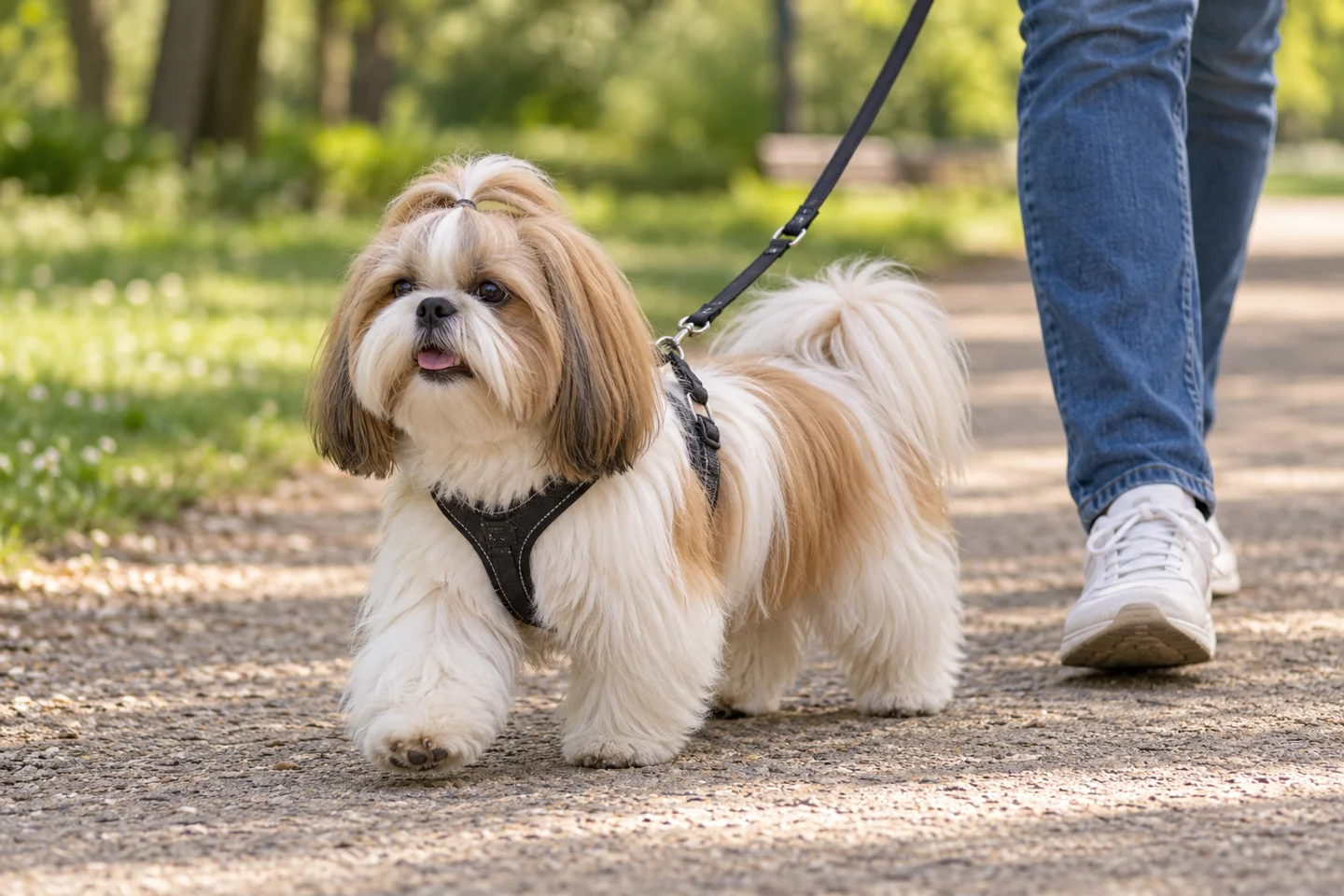
The standard calls for open nostrils and eyes that are not prominent. Coat should not obstruct vision or movement. Those details have practical meaning: a dog needs to see approaching hands, walk without dragging tangled hair and breathe comfortably during ordinary activity. The three pictures here are labelled AI-generated illustrations. They show a gold-and-white adult, a younger puppy and a harness walk, rather than serving as photographs of a particular dog or evidence of its clinical health.
Companionship and realistic household expectations
A Shih Tzu may enjoy being near its people without wanting to be handled continuously. Watch how the individual asks for contact and how it leaves when it has had enough. A dog that moves to its bed should be allowed to finish that choice. Give it comfortable resting places outside the busiest part of the room. When everyone can recognise its need for space, ordinary companionship becomes easier and there is less reason for the dog to defend a small refuge.
Avoid assuming that a companion breed needs no occupation or can always be carried through difficult situations. Sniffing, short training sessions and safe exploration give the dog useful ways to engage with its surroundings. Some dogs enjoy visitors, while others prefer a gradual introduction. Ask a breeder or rescue for examples of the dog's behaviour during grooming, meals and time alone. A description such as friendly is more useful when it comes with the conditions in which that friendliness has actually been observed.
Preparing the home and settling in
Prepare a sleeping area, food and water stations, and a route to an appropriate toilet spot before the dog arrives. Block access to gaps behind furniture and places where a small puppy could fall or become trapped. Keep medicines, cleaning products and tempting objects out of reach. A first day with a limited, comfortable area can be easier to manage than access to every room. Introduce the rest of the home as the dog settles.
Allow the newcomer to learn your routine before expecting long visits or busy outings. Take it to the toilet after waking, eating and playing, and reward the result you want. Supervise between trips so accidents are less likely. If an accident happens, clean it and improve the schedule rather than frightening the dog. A small bladder and an unfamiliar house require planning. Persistent difficulty or a sudden change in a previously reliable adult also merits a veterinary conversation.
Training, handling and independence
Start with a name response, following a hand target and settling on a mat. Keep sessions short enough that the dog remains interested, and reward actions as they happen. Small pieces of food can make repeated practice possible without an excessive amount of extra calories. Teach a recall indoors before relying on it around other dogs or traffic. A cue becomes dependable through appropriate practice, rather than through repeating it more loudly when the environment becomes difficult.
Practise being picked up only when necessary, using an approach the dog can anticipate. Support the body and avoid dangling the dog by its front legs. Handling practice can include a brief touch near the ears, a look at a paw or a moment of stillness beside a brush. Reward cooperation and stop before the dog struggles. Build short comfortable separations too. If the dog becomes distressed when left, seek a suitable gradual training plan instead of leaving it to panic until it becomes quiet.
Socialization for a small dog
A puppy needs safe opportunities to notice people, dogs, household sounds and different surfaces. Discuss infection precautions with the veterinarian when choosing locations and puppy classes. Start with experiences that allow the puppy to observe and retreat. A large dog rushing toward a tiny puppy can be overwhelming even when its owner calls it friendly. Distance and control are more useful than a long list of greetings completed in one afternoon.
Help unfamiliar people interact politely. They can stand or sit sideways and allow the puppy to approach instead of reaching over its head. If the puppy hides, pauses or stops accepting food, make the next step easier. Socialization should also include quiet care routines, safe travel and comfortable rest in a new place. An adult rescue dog may need the same patient process. Previous age or breed reputation does not reveal which experiences that particular dog has learned to manage.

Exercise, play and breathing comfort
Offer walks and play that suit the dog's condition, age and interest. A Shih Tzu still benefits from walking on the ground, investigating scent and choosing a direction within safe boundaries. Use a well-fitted harness and a manageable lead. Choose routes with shade and the option to return early. A short outing can be worthwhile if the dog explores comfortably and recovers normally. Distance alone is a poor measure of whether the outing met its needs.
Short-muzzled dogs need particular attention to heat and breathing effort. Stop if the dog appears distressed, struggles to recover or cannot keep moving comfortably. Do not use noisy breathing as encouragement to keep exercising. Cooler timing and an easier route can reduce a challenge, but they cannot diagnose or correct an airway problem. Seek veterinary advice about recurring difficulty. Severe breathing distress, collapse or marked weakness requires urgent contact with a veterinary service rather than waiting for the dog to improve during the journey home.
Aggression, guarding and listening to warnings
A Shih Tzu can growl, snap or bite. Small size changes the likely physical consequences of some incidents, but it does not remove the need to protect people or understand the dog's discomfort. Common situations to investigate include being lifted unexpectedly, painful grooming, pressure around food and disturbance during sleep. Record what happened immediately before a reaction. That account helps a veterinarian or behaviour professional identify a practical plan for the actual trigger.
Do not punish a growl or repeatedly recreate the situation to test whether the dog will react again. Give space, prevent another incident and seek appropriate help. Sudden intolerance of touching the face or body deserves a medical assessment, especially if the dog previously accepted that handling. A reward-based trainer can help teach exchanges and cooperative care. Until those skills are reliable, physical management should prevent children or visitors from putting hands near the dog's food, bed or painful areas.
Children, lifting and safe family contact
Young children need an adult actively supervising contact. Keep interactions on the floor when appropriate, with the child calm and the dog free to leave. Carrying a small dog can lead to a fall or a frightened struggle, so adults should manage necessary lifting. Teach children to leave the dog alone while it eats, sleeps or chews. A dog that fits on a lap is still an animal with boundaries, rather than something a child can hold whenever they wish.
Use a gate or separate room when supervision is not possible. Visiting children also need the rules explained, and adults must arrange the environment to make those rules workable. Rough play, hugging and reaching into a hiding place can create an avoidable problem. If the dog repeatedly withdraws during family activity, provide a quieter routine rather than requiring more contact. Some households need professional help to establish a safe arrangement, and an individual dog may be unsuitable for the level of activity a particular family has.
Other dogs, cats and play partners
Choose dog introductions by behaviour, size compatibility and play style. A large enthusiastic playmate can injure or frighten a small dog without an aggressive intention. Start with parallel movement and enough space for both dogs to disengage. Pause before excitement becomes rough chasing. Look for voluntary returns to the interaction, loose movement and genuine breaks. If one dog repeatedly hides behind its owner or cannot escape pursuit, end the activity and reconsider the pairing.
A Shih Tzu that lives comfortably with one cat may still chase another animal. Introduce household pets gradually, using barriers and protected escape routes for the cat. Separate meals and valued chews to reduce competition. Small mammals and birds need secure protection; a companion breed label does not establish safety around them. Ask about a rescue dog's actual animal history and observe carefully over time. Do not leave animals together unsupervised merely because an early controlled introduction looked calm.
Health screening and family history
The American Shih Tzu Club's April 2024 statement says the club does not impose universal required health testing. It also describes a voluntary CHIC programme using an eye examination by an ACVO ophthalmologist and an OFA patella evaluation, with hip and cardiac evaluations as optional additions. Explain which programme a breeder is using before comparing paperwork. A voluntary programme can still provide useful evidence, but its existence should not be presented as a rule every breeder has fulfilled.
Ask to see the reports for the actual parents. A CHIC number concerns completion and publication of the programme's requirements; it is not an assurance that every result is normal. Discuss the findings with a veterinarian if the meaning is unclear. The club also recommends discussion of family history, including renal dysplasia, liver shunts and other conditions. Ask what occurred in close relatives, how it was investigated and what information the breeder can document. A verbal promise of perfect health cannot replace those questions.
Airway health and the limits of breed averages
A 2026 study by Tomlinson and colleagues assessed brachycephalic obstructive airway syndrome across fourteen short-muzzled breeds and included Shih Tzus. Its findings support taking breathing problems seriously beyond the most familiar affected breeds. Results from a studied sample do not establish the condition of a particular dog in your home. A clinical assessment is needed when breathing effort, exercise tolerance or sleep raises concern. A normal-looking photograph and an entertaining snore cannot provide that assessment.
Before sedation or anesthesia, tell the veterinary team about noisy breathing, difficulty in hot weather and any previous recovery problem. The team can assess risks and plan monitoring for the individual. Do not avoid needed dental or other treatment simply because the dog has a short muzzle, and do not assume a routine procedure needs no preparation. Ask how the dog will be assessed and cared for. Follow the specific instructions given for that appointment rather than copying fasting or medication advice from another animal's experience.
Eye discomfort, urinary changes and clinical assessment
Check the face during normal gentle care. Squinting, rubbing, a suddenly cloudy eye or an obvious injury needs prompt veterinary advice. Keep hair away from the eyes without pulling the skin, and ask a groomer or veterinarian to demonstrate safe management. Do not use leftover eye medicine because two episodes look similar. Different eye conditions can need different treatment, and inappropriate drops may delay an assessment of a painful or worsening problem.
The club's discussion of renal dysplasia and liver shunts is a reason to ask about family history, rather than proof that every Shih Tzu will develop those conditions. Poor growth, persistent appetite change, unusual drinking or recurrent vomiting deserves investigation on its own merits. A routine examination and any indicated testing should follow the dog's signs and history. A broad commercial DNA panel cannot serve as a universal clearance for every kidney or liver disorder named in a breed conversation.
Grooming the coat without painful mats
Choose a coat length you can maintain comfortably. A practical pet trim still needs regular brushing and inspection. Work through small areas so the brush reaches beyond the surface, paying attention to the armpits, behind the ears and areas rubbed by a harness. Stop when a mat cannot be separated without pulling. A groomer can explain whether clipping is the kindest option. Cutting tight mats close to the skin at home risks an injury to skin hidden inside the hair.
Keep the eyes, mouth and rear clean using a method suited to the dog. Dry damp hair carefully and check the skin beneath it. The dog should be able to see and move freely after grooming. Introduce nail care and tooth brushing gradually, rewarding small amounts of cooperation. Schedule professional grooming around how the coat actually grows and tangles, rather than an arbitrary promise that a certain haircut requires no upkeep. Tell the groomer about breathing problems, painful areas or handling difficulties before leaving the dog.
Nutrition and body condition beneath the coat
Use a complete diet appropriate to the dog's life stage and measure the amount offered. Ask the veterinarian to show you how to assess ribs and waist beneath the coat. An apparent change in fluffiness can hide a real change in body condition. Include treats and training food when reviewing the daily ration. If several people offer snacks, agree on an amount so each person does not unintentionally add another allowance.
Food should be accessible without competition from another pet. Keep water available and report persistent changes in eating or drinking. A selective appetite may involve learned routines, but dental discomfort or illness also needs consideration. Avoid repeatedly introducing richer foods while a problem remains unexplained. Discuss homemade diets, supplements and restrictive feeding plans before relying on them. Puppies need nutrition that supports growth, while older dogs may need adjustments based on examination and disease rather than age alone.
Shih Tzu mixes and marketing claims
Names such as Shih-poo and Malshi describe crosses involving a Shih Tzu, but they do not guarantee a particular adult coat, size or personality. Ask what the other parent actually is and what health assessments are relevant to both sides. A puppy may need considerable coat care even if a seller promises a low-maintenance result. Likewise, mixing a short-muzzled parent with another breed does not guarantee comfortable breathing in every offspring.
No dog can be promised to suit every person with allergies. If allergies affect the household, discuss them with an appropriate medical professional and spend time with the particular animal before making a commitment when possible. For rescue dogs with uncertain ancestry, focus on observed behaviour, grooming needs and veterinary findings. A guessed label can be a convenient description, but it should not override what the dog actually needs. Responsible care remains the same whether ancestry is documented or uncertain.
Budgeting for care and choosing responsibly
Plan for recurring grooming, preventive care, dental assessment, suitable food and an emergency reserve alongside the initial adoption or purchase cost. Ask local providers for current estimates that reflect the individual dog and the work involved. A heavily matted coat or a dog that needs extra handling support can require a different appointment. Consider transport and backup care as well. A small dog can still need substantial treatment, and its size does not limit veterinary bills.
When meeting a breeder, ask about the parents' examinations, the litter's veterinary care and the puppies' experience of gentle grooming. A rescue should be able to explain what has been observed and what remains unknown. Be wary of pressure to buy quickly based on an unusual colour or unusually tiny size. Choose a dog whose needs fit the care you can provide. Honest information about an existing condition helps planning more than a claim that no problems are possible.
A comfortable dogsDating meeting
Use your dogsDating profile to explain what your Shih Tzu enjoys, including walking pace, preferred play size and any need for extra space. Share a general location while keeping exact home coordinates private. Arrange the first meeting in a quiet public place with shade, safe footing and an easy exit. Ask the other owner about their dog's play style before arriving. A calm small-dog pairing may be more suitable than a dog that greets by charging forward.
Begin with space and parallel walking. Keep the session short enough that breathing and energy remain comfortable, and pause before play becomes crowded. Separate food and toys during the first introduction. Either owner should be able to end the meeting without pressure to make the dogs interact. The owners can enjoy conversation while the dogs sniff separately. A relaxed departure gives everyone a better basis for deciding whether another walk, a carefully managed play date or a different partner would suit the dog.
Sources and editorial notes
Sources checked October 22, 2026. Breed measurements describe reference ranges, not a diagnosis or an individual dog's ideal weight. Images are AI-generated breed illustrations and do not document a particular dog or health condition.
- AVSAB: Humane Dog Training Position Statement
- VCA Animal Hospitals: Food aggression in puppies
- VCA Animal Hospitals: Aggression toward unfamiliar dogs, diagnosis
- VCA Animal Hospitals: Grooming and coat care for your dog
- AAHA: Feeding plans for healthy, appropriate weight cats and dogs
- VCA Animal Hospitals: Heat stroke in dogs
- VCA Animal Hospitals: Common emergencies in dogs
- Orthopedic Foundation for Animals: CHIC health screening programs
- AVSAB: Puppy Socialization Position Statement
- VCA Animal Hospitals: Dog behavior problems, aggression toward children
- FCI Standard 208: Shih Tzu, English version dated October 2026
- American Shih Tzu Club 2024 health statement: voluntary screening and family health discussion
- Tomlinson and colleagues, 2026: BOAS risk across fourteen brachycephalic dog breeds
- AVMA: understanding veterinary anesthesia and preparing a pet for a procedure
Keep getting to know dogs.
Read another guide or return to your dogsDating community.
Explore breed guidesBack to dogsDating