Slovak Cuvac
A white Slovak mountain guardian whose substantial coat and independent watchfulness require secure management, cooperative handling, and an honest assessment of the household’s capacity.
How these guides are researched and reviewed
- Origin
- Slovakia
- FCI male size
- 62–70 cm; 36–44 kg
- FCI female size
- 59–65 cm; 31–37 kg
- Coat
- White dense mountain-dog coat
General information for owners. These articles have not been reviewed by a veterinarian. Medical decisions need your dog's history and an examination.
A white mountain guardian needs a deliberate home
The Slovak Cuvac, or Slovenský čuvač, is a substantial white mountain dog with a background in guarding livestock and property. Its appearance can suggest an oversized fluffy companion, but the home must account for independent observation, strength, and the ability to make its own decisions. Before choosing a puppy, decide how visitors enter, who manages the dog during deliveries, and what happens if the usual handler is unavailable. A suitable placement includes practical arrangements for ordinary days, rather than confidence based only on affection toward a familiar person.
Meet adults and discuss the daily routine behind their behavior. Ask how they respond to unfamiliar people, animals beyond a fence, grooming, and necessary time apart. A working guardian may have experience very different from a family-raised youngster. Neither background tells the whole story without concrete observations. Prepare secure boundaries, a comfortable resting area, transport, clinical care, and a source of qualified help. Choose an individual whose needs can be met through work commitments, illness, and changing circumstances. The breed's traditional role should inform care, not excuse a plan that leaves a strong watchful animal to solve every situation alone.
Slovak identity and relationships between white guardians
English sources use several spellings, including Slovak Cuvac, Slovakian Chuvach, and Tatra Chuvach. The FCI breed is Slovenský čuvač, under Slovak sponsorship. It belongs to a wider history of white mountain guardians, but it is not interchangeable with the Polish Tatra Sheepdog, Kuvasz, or other pale-coated breeds. Accurate identification matters when looking for records, selection advice, and relatives. A white adult cannot be assigned confirmed Cuvac ancestry from color and size alone. For a rescue with incomplete history, retain uncertainty and give observed behavior and current condition priority.
Historical accounts of mountain dogs contain claims whose precision exceeds what a modern pedigree can establish. The useful documented context is guarding, shepherding support, and life around farms and mountain stock. A household can respect that background without claiming a particular puppy has an unchanged ancient personality. Ask how current selection balances temperament, health, and structure, and how sources communicate later owner findings. For imported dogs, keep original names and identification consistent across translated records. A recognized national identity helps organize information, while the practical placement decision still concerns this particular animal and the people responsible for it.
Adult dimensions, white hair, and natural tail carriage
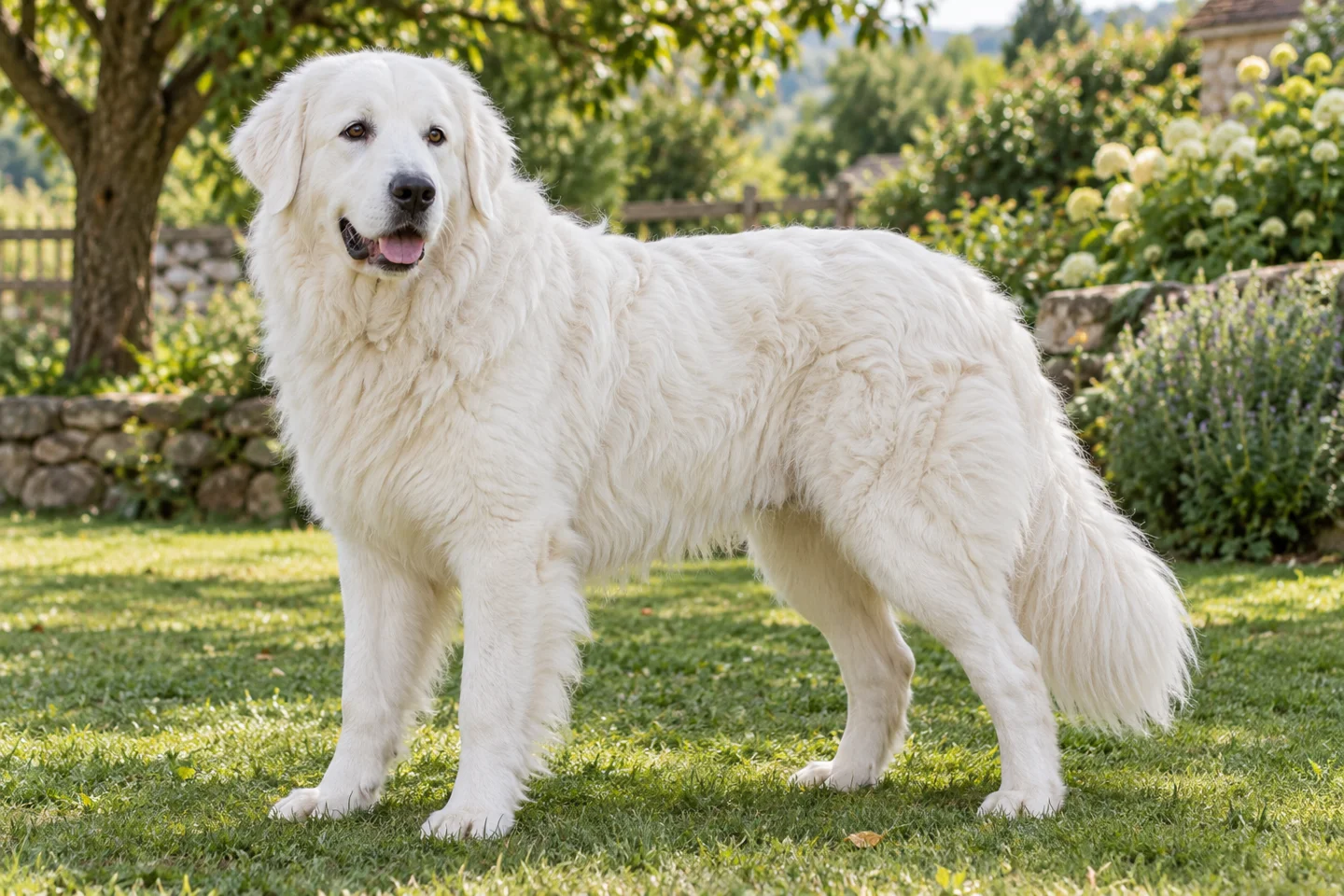
The FCI gives male height as 62–70 cm and weight as 36–44 kg, with females 59–65 cm and 31–37 kg. The body is strong and moderately rectangular, with a substantial head, dark eyes, black nose, and natural triangular hanging ears. A dense white coat forms the familiar outline and a more developed neck ruff. The full tail hangs to the hock when relaxed and rises in a curved carriage when active, without resting curled over the back. These features distinguish a visual example; they do not establish an individual dog's health.
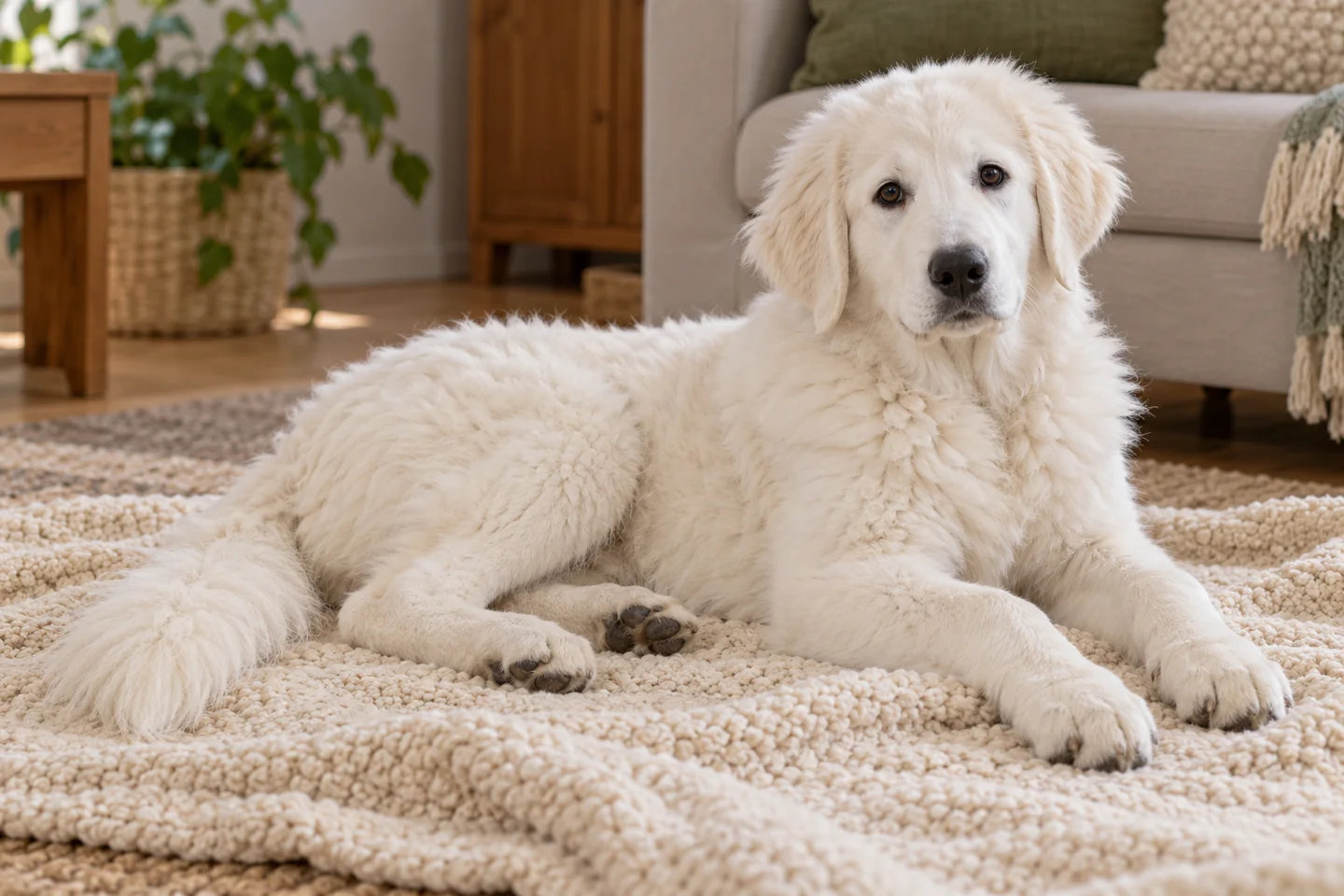
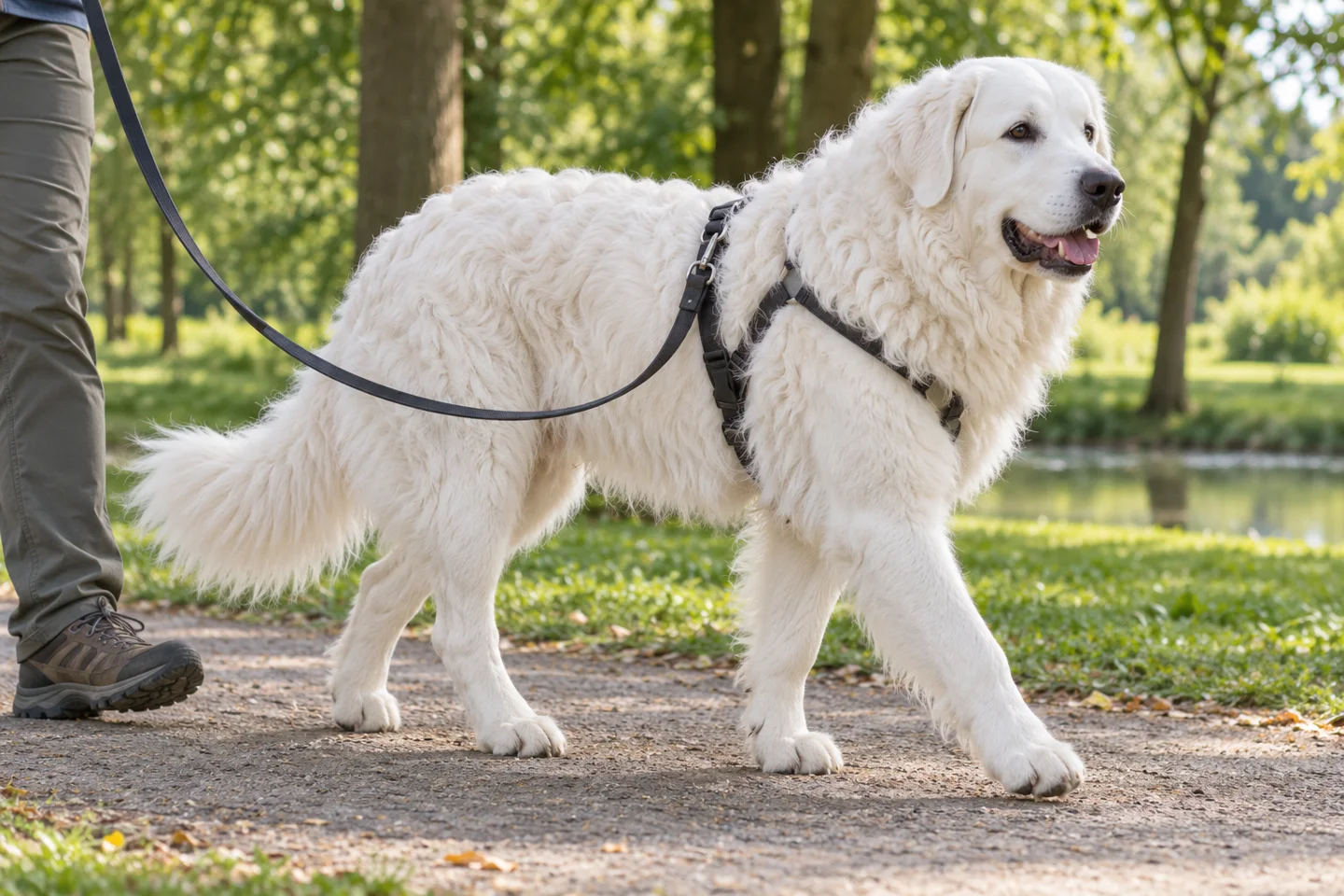
The accompanying AI illustrations show white dogs with natural ears and full tails. They are explanatory images, rather than records of a named animal or available litter. When meeting a real dog, watch walking, turning, rising, and comfortable rest. Feel body condition beneath the coat with appropriate handling. Standard ranges are descriptive, not instructions to force a puppy toward maximum size or make an adult heavier for a more impressive photograph. Fit equipment to the actual frame and recheck beneath thick hair for restriction or friction. Clinical assessment matters when movement, growth, or recovery raises concern.
Watchfulness, visitors, and learning what can be ignored
A guardian's attention to unfamiliar activity needs management in a modern neighborhood. Repeated fence rushing or window alarm can become part of the daily routine if the environment continually rehearses it. Move resting space away from the busiest view and reward disengagement. Give visitor arrivals a clear sequence, using a secure barrier before doors open. A stranger should not enter a yard and expect the dog to infer permission from a cheerful voice. Every household member needs to understand the arrangement so one person's casual greeting does not undermine another person's attempt to prevent conflict.
Exposure should be manageable and predictable. Let the dog observe people at a distance where it can recover and choose engagement. Forcing close contact, cornering it for petting, or deliberately encouraging suspicion can make ordinary encounters harder. Ask the source for examples of how its adults adapt to visitors and unfamiliar locations. A new dog may need a quieter first week than its eventual routine, with reliable sleep and familiar cues. Confidence is not measured by how much intrusion the animal tolerates. Comfortable attention and the ability to return to another activity are more useful goals for daily life.
Training cooperative control before strength becomes the issue
Teach waiting at gates, moving with the handler, a reinforced recall, and resting on a mat while the environment is easy. Use rewards and clear steps so the animal understands the response before distractions become intense. A strong adolescent at the end of a lead should not be the first test of a household's training plan. Practise a turn away from activity on a quiet route, and choose secure equipment that fits the dog. Physical strength helps an adult maintain safety, but it should support preparation rather than replace learning with repeated contests.
Make care skills practical priorities. Reward standing on a non-slip surface, offering a paw, allowing a brief coat part, and accepting a mouth or ear check. Teach a comfortable predictable position for examinations and use short sessions. Do not wait until a painful mat or injured foot requires extensive handling. Practise exchanges for safe objects and protect meals from interference. If possession creates stiffness or guarding, change management and seek qualified guidance. A guardian's independent background is compatible with cooperative learning, while an owner still needs fair expectations and the ability to prevent rehearsals of behavior that has become unsafe.
Exercise, boundaries, and quiet recovery
Provide varied movement and investigation appropriate to age, health, and fitness. Access to land is useful only when the animal also receives interaction, care, and suitable activity. A growing large dog needs coordination and sensible exploration rather than forced adult distances or repetitive high jumps. Build new workloads gradually and watch recovery afterward. Persistent stiffness, reluctance to rise, or changed tolerance deserves veterinary assessment. Enthusiasm at a gate does not prove that joints and feet are comfortable, and a quiet animal may be resting rather than needing another demanding outing.
Inspect fences, gates, and transfer points before relying on them. A guardian should not patrol public paths, roam beyond the property, or confront passersby because its history involved protecting a boundary. Supervise outdoor time and provide shelter, water, and appropriate company. Thick white hair does not remove heat risk. Adjust timing, shade, and duration in warm conditions and provide a cool resting location. After wet outings, dry the coat and equipment comfortably. A sustainable routine includes days when the owner is ill or the weather prevents a usual route, using safe alternative engagement without reproducing a strenuous walk inside the house.
Aggression and the responsibility to prevent rehearsal
The effect of a bite from a substantial guardian makes prevention a practical priority. Assess the individual, its context, and any history rather than assuming affection within the family predicts every encounter. Watch withdrawal, freezing, a fixed stare, or growling and increase space. Do not punish the warning while leaving the perceived threat in place. Sudden intolerance of touch or movement needs veterinary attention. A painful ear, skin problem, or orthopedic issue can change behavior, and a guardian label should not cause an owner to overlook a medical contribution.
Use secure barriers, planned visitor routines, protected meals, and appropriate separation while obtaining help. Tell carers the actual history of bites or close calls before they accept responsibility. Where risk exists, involve the veterinarian and a suitably qualified behavior professional. Positively introduced basket-muzzle training may form part of that plan, but it does not permit forced greetings. Prevent deliberate protection practice by unqualified people. The aim is a dog that can live safely within understandable arrangements, with the environment managed before the animal is repeatedly placed in situations its current skills or comfort cannot handle.
Children and a dog that needs protected rest
Adults must supervise contact and provide a resting area children cannot enter. A white coat can invite hugging or climbing, but a large animal is not furniture and may not welcome face-to-face contact. Prevent ear pulling, riding, chasing, and interruption of meals or sleep. Separate before noisy games become intense. Teach a child to invite brief contact and pause, respecting the dog's choice to leave. A child's promise to follow rules cannot replace a physical arrangement that remains effective when excitement, visitors, or divided adult attention makes good judgment less reliable.
An adult should handle walks and difficult care tasks. A guardian can pull a child off balance or make a quick decision near a visitor even without an established bite history. Ask the source about actual experience with children, including ages and settings, while retaining supervision in the new home. The arrival of visiting children may differ from familiar family contact. Plan where the dog will rest before a party begins. A comfortable separate space is part of responsible family life, rather than a punishment or a test of whether the animal deserves to remain included in every activity.
Other dogs, household pets, and stock introductions
Introduce another dog with separate handlers and room for parallel movement. Compare the ability to disengage and tolerate space sharing before expecting play or access to valued items. A guardian may be comfortable with familiar animals while reacting differently at its own boundary. Begin on suitable neutral ground where possible and plan separate rest and feeding at home. Do not treat breed history as evidence that every small dog or cat will be protected automatically. Each combination needs accurate prior information and management tailored to the actual animals.
Livestock work requires appropriate selection, supervision, and gradual learning with an experienced person. An unprepared dog should not be released into a flock to discover whether instinct supplies safe behavior. Protect stock from chasing and the dog from injury, and respect the livestock owner's rules. Household poultry and small pets also need physical safeguards and potentially lasting separation. Prior tolerance is useful evidence, not an unlimited promise for new animals or contexts. A sensible placement accepts those limits before arrival, rather than expecting a photograph of every species together to prove that the dog has understood its traditional role.
Grooming a dense white coat through to the skin
Part the coat and inspect small areas beneath the visible surface. Pay attention behind ears, in the armpits, around the rear, and under collars or harnesses. Loose undercoat and friction can create tangles that remain hidden beneath a tidy outline. Ask a knowledgeable groomer to demonstrate gentle tools and a schedule suited to the individual. A painful mat needs appropriate assistance, with comfort taking priority over retaining length. Avoid turning a long neglected coat into a single prolonged restraint session that teaches the dog to fear the brush.
Dry thoroughly after bathing or wet activity and keep bedding clean. Inspect feet, nails, and the visible outer ears. Redness, odor, discharge, or repeated head shaking warrants advice rather than deep probing or leftover medication. A white coat can make some skin changes easier to see, but it cannot diagnose their cause. Report persistent itching, thinning, or painful patches to the veterinarian. Include dental care and calm mouth handling in the routine. Grooming should help the owner notice changes and the dog remain comfortable, rather than function mainly as preparation for an attractive photograph.
Health screening: understand the named club’s hip assessment
The Czech Slovak Cuvac club's breeding-assessment rules require hip radiographs evaluated through the specified professional process. The rules describe a named programme, including identity and assessment conditions, rather than a worldwide guarantee that every registered dog has the same records. Ask which registry and current club rules apply to a proposed litter and obtain the actual parental reports. A breeding assessment also considers exterior and temperament. Those components should be read separately, because successful participation does not turn every possible inherited condition into a tested and excluded risk.
Have unfamiliar grades explained before relying on a qualifying label. Ask how findings informed the pairing and what information is available from older relatives. A clinical screen differs from a genetic identity profile or a panel of disease variants, and none supplies an unlimited health clearance. For an adopted adult, collect its own injury, medication, and treatment history first. Missing parental records should remain an acknowledged limit. The next useful step is an individual examination and practical follow-up, rather than borrowing a disease panel from another white mountain breed or assuming the Cuvac's working history prevents illness.
Growth and mobility deserve patient-specific decisions
A large puppy needs a complete diet appropriate to growth, with body condition reviewed as it develops. Do not add calcium or other supplements to a balanced food without veterinary advice, or deliberately encourage rapid size gain. Ask the clinic to explain feeding and safe activity for this animal. A standard's adult weight range is not an early growth target. Keep simple weight and movement observations so a meaningful change can be described. A puppy that repeatedly struggles to rise or avoids a previously easy movement deserves assessment, rather than a conclusion that it will grow out of discomfort.
For an adult with a diagnosed mobility problem, follow its clinical and rehabilitation plan. Non-slip surfaces, suitable access to the vehicle, and appropriate assistance may help daily care when advised. Plan how capable adults could transport a dog that cannot walk, before an urgent situation occurs. Do not give human pain medication while deciding what to do. A new limp, collapse, or sudden marked weakness needs direct clinical advice. Reassuring parental records cannot identify the cause of today's symptoms, while an accurate account of previous findings can help the treating professional make better decisions.
Mixes, costs, and choosing a workable commitment
A Cuvac mix may vary in size, hair, guarding behavior, and comfort around unfamiliar activity. Ask what is known about both parents and preserve uncertainty where ancestry is guessed. A white coat cannot confirm the label, and crossing does not guarantee reduced inherited risk or an easier temperament. Feed the individual according to life stage, condition, and medical needs, with measured portions and rewards included in the total. The household should evaluate the dog it can actually observe rather than expect a precise halfway result from two breed summaries.
Budget for routine and urgent care, appropriate insurance or an emergency reserve, grooming, training support, transport, secure boundaries, and capable cover during absences. Find a carer willing and able to follow visitor and gate procedures before relying on one during an emergency. Clarify the source's ongoing support and return arrangements. A rural address or large garden cannot compensate for missing handling and care resources. The placement should remain manageable through ordinary employment, a family illness, and later changes in the dog's health. Those details make a commitment sustainable beyond the appeal of a white mountain-dog puppy.
dogsDating introductions need room and informed handlers
A Cuvac's dogsDating introduction should take place beyond the boundary it ordinarily watches. Meeting at its gate gives both handlers unnecessary complications, particularly when a visitor must cross a confined entrance. Suggest a public walking area with broad sightlines and specify how much clearance the dog needs. Publish only the general locality: exact coordinates, entrance details, and a home address belong outside public profiles. Each owner should retain control of their own animal while walking in the same direction from separate starting positions. Decide where the route can be shortened before setting off. A comfortable walk beside an unfamiliar dog is a useful outcome even if neither animal seeks direct contact.
Observe whether both animals can turn away and move without repeated fixation. Increase distance or finish if one stiffens, tries to leave, or repeatedly blocks the other. Calm shared walks can be useful without close play. Review the practical conditions afterward, including route, spacing, pace, and duration, and use those observations for another invitation. Keep public images free of precise address details or another person's private information. A meeting should make safe departure easy, even if the dogs require more separation than their owners expected from the initial profile exchange.
Sources and editorial notes
Sources checked October 22, 2026. Breed measurements describe reference ranges, not a diagnosis or an individual dog's ideal weight. Images are AI-generated breed illustrations and do not document a particular dog or health condition.
- AVSAB: Humane Dog Training Position Statement
- VCA Animal Hospitals: Food aggression in puppies
- VCA Animal Hospitals: Common emergencies in dogs
- Orthopedic Foundation for Animals: CHIC health screening programs
- VCA Animal Hospitals: Aggression toward unfamiliar dogs, diagnosis
- VCA Animal Hospitals: Grooming and coat care for your dog
- VCA Animal Hospitals: Ear infections in dogs (otitis externa)
- AAHA: Feeding plans for healthy, appropriate weight cats and dogs
- VCA Animal Hospitals: Heat stroke in dogs
- AVSAB: Puppy Socialization Position Statement
- VCA Animal Hospitals: Dog behavior problems, aggression toward children
- Official breed standard: Slovak Cuvac
- Czech Slovak Cuvac club: breeding assessment rules including hip radiographs
- Slovak Cuvac club: breed information, current records, and owner resources
Keep getting to know dogs.
Read another guide or return to your dogsDating community.
Explore breed guidesBack to dogsDating