South Russian Shepherd Dog
A large shaggy guardian whose coat can hide an agile body, requiring experienced handling, secure visitor arrangements, substantial maintenance, and an individually informed health plan.
How these guides are researched and reviewed
- FCI origin
- Russia
- FCI minimum male size
- 66 cm; 35 kg
- FCI minimum female size
- 62 cm; 30 kg
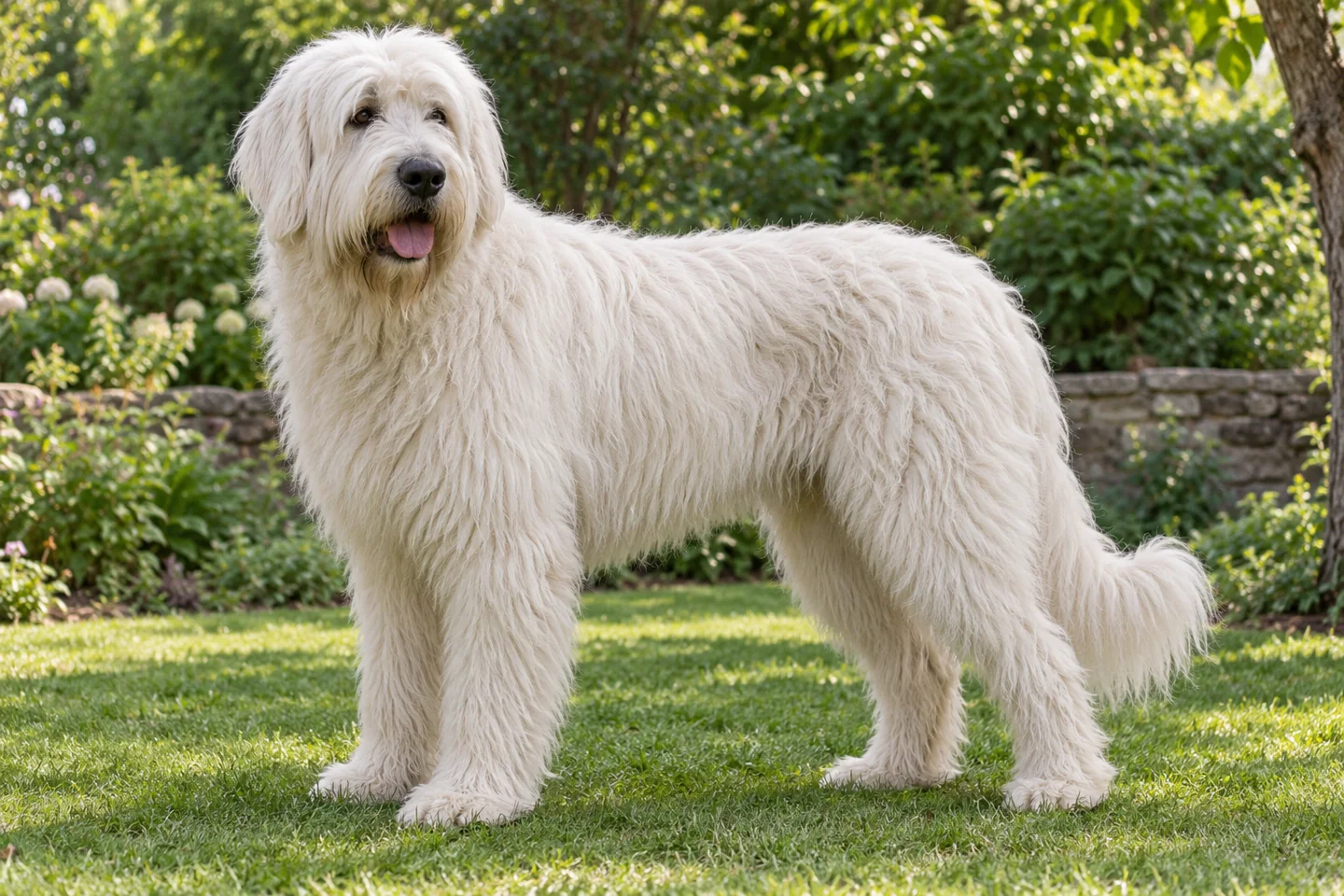
- Illustrated coat
- White long coarse shaggy coat with natural ears and full tail
General information for owners. These articles have not been reviewed by a veterinarian. Medical decisions need your dog's history and an examination.
A shaggy coat belongs to a serious guardian
The South Russian Shepherd Dog is a large guardian with long coarse hair and an agile body beneath it. Its appearance can suggest a softer, slower companion than the working description supports. A prospective home needs experienced handling, secure boundaries, planned visitor access, and enough time for demanding coat care. Before selecting a puppy, decide how a delivery enters, where the dog rests during a party, and who can manage it if the usual handler is ill. A strong animal should not be expected to solve those situations without preparation because a familiar owner finds it affectionate.
Meet adults and ask what daily life requires. How do they respond to unfamiliar people at home, examinations, grooming, and animals beyond a boundary? What does the source do to prevent repeated alarm or conflict? A pleasant encounter outside the property is useful but cannot answer every territorial situation. Choose an individual whose needs fit a realistic household plan, with appropriate professional support available. A puppy is still developing and an adult changing homes needs time to learn new routines. Secure accommodation, transport, clinical care, and practical assistance should be ready before collection, rather than improvised after the animal is already responsible for watching a new home.
Names, history, and the breed’s recorded origin
South Russian Shepherd Dog, South Russian Ovcharka, and Yuzhnorusskaya Ovcharka are names used for this breed. Sweden uses the transliteration Juzjnorusskaja ovtjarka. The FCI standard lists Russia as origin and describes historical selection in southern steppe regions, including Askania-Nova. Those recorded details should be attributed accurately without expanding a historical account into a simple modern ancestry recipe. The breed is distinct from the Caucasian Shepherd and other dogs carrying an Ovcharka name. Similar working labels do not make their size, temperament, medical findings, or coat care interchangeable.
The practical background concerns livestock and property protection, with independent decisions and reserve toward unfamiliar people. That helps frame a suitability conversation. It should not be turned into a promise that a puppy will protect only in situations its owner considers appropriate. Ask how current selection addresses temperament, health, and functional movement and how later owner information is collected. For a rescue with uncertain pedigree, retain uncertainty while documenting observed behavior. A long white coat alone cannot confirm ancestry. The new household's responsibility is to provide a safe, sustainable arrangement for the actual animal, rather than defend a guessed label through an impressive historical story.
Minimum dimensions and the long natural outline
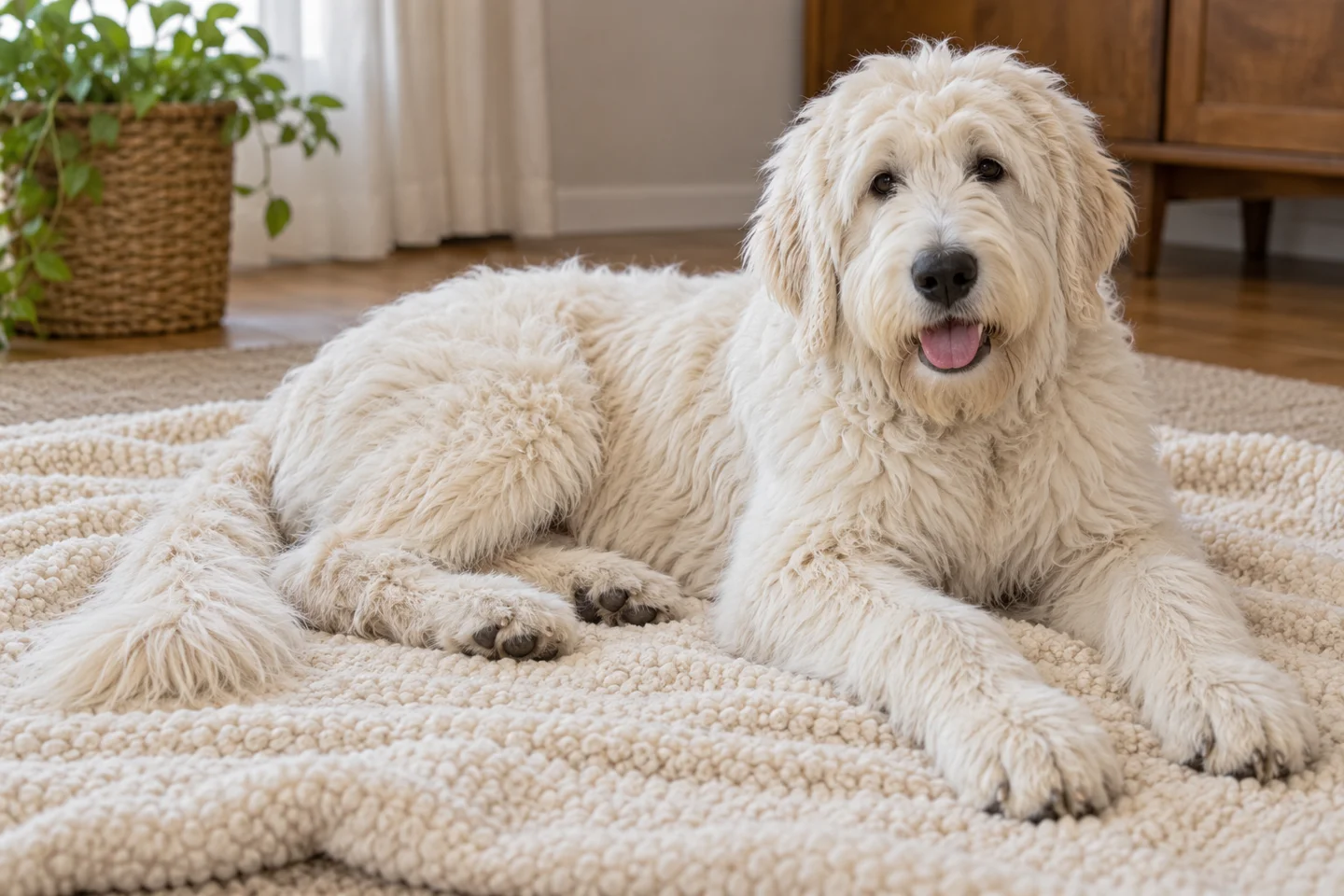
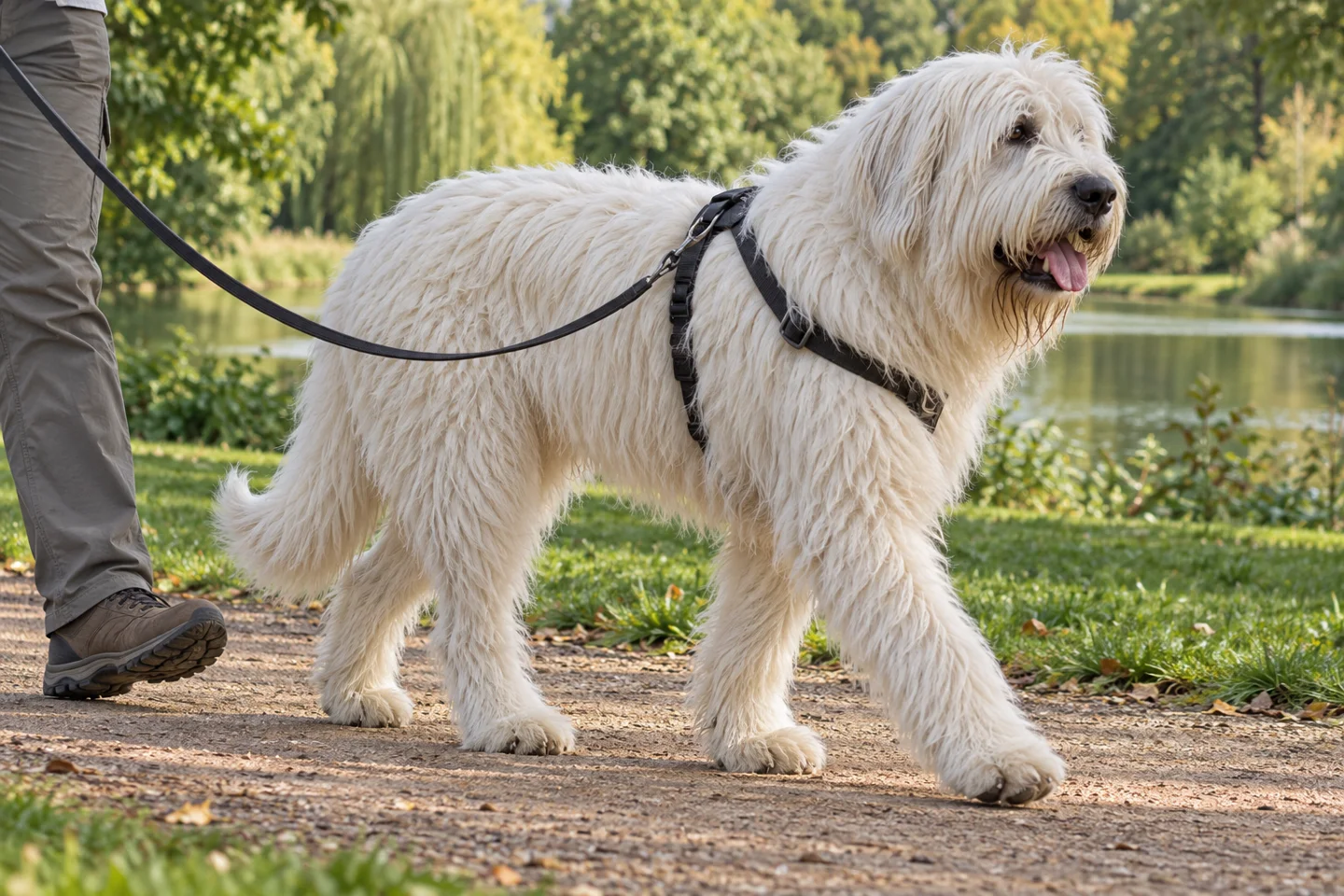
The FCI minimum height is 66 cm for males and 62 cm for females, with minimum weights of 35 kg and 30 kg respectively. These are minimum references, not a complete adult range or an instruction to maximize size. The moderately long body has a characteristic slight curve over the loin. Long harsh shaggy hair, with softer thick undercoat, covers head, body, limbs, and tail. The illustrations choose white, natural hanging triangular ears, a black nose, and a full tail carried low or modestly raised without curling over the back. Each image is labeled as an AI illustration.
A correct-looking shaggy outline cannot establish comfortable movement or skin health. Watch walking, turning, rising, and rest, and ask about any change in tolerance or recovery. Feel condition beneath the hair with appropriate handling. The coat may obscure both a weight change and equipment rubbing. Fit a harness and transport restraint to the actual frame, then recheck contact areas. Young dogs need balanced growth and age-suitable activity rather than supplements or adult workloads intended to create an impressive finished body. If size or movement raises concern, clinical assessment should guide care instead of a photograph or an unexplained standard number.
Territorial behavior and a workable visitor system
Sweden's kennel club cautions that this breed can be strongly territorial and requires experience. Take that as a reason for a reliable visitor system. Put the dog in a secure comfortable area before a gate or front door opens. Explain access arrangements to tradespeople and family members rather than expect strangers to infer them from a sign. A source should describe what happens when the owner is absent as well as when the familiar handler is present. The household's plan needs to remain effective during deliveries, emergencies, and visits that do not follow a predictable social script.
Teach calm alternatives and manage exposure to repeated triggers. Window watching or fence rushing can become a rehearsed routine if the environment continually supplies it. Reward disengagement and provide rest away from the busiest view. Let unfamiliar people remain at a distance that the dog can manage, without insisting on petting. Deliberately encouraging suspicion can make ordinary care harder. A guardian's reserve should never justify overlooking fear, pain, or unsafe behavior. The useful goal is an animal that can live comfortably within clear arrangements, with owners able to prevent difficult encounters before they become repeated confrontations.
Training cooperative skills while the environment is easy
Begin with waiting at exits, moving with the handler, a reinforced recall, and resting in a designated place. Teach each through achievable steps before distractions become intense. A strong adolescent at a gate is a poor first opportunity to find out whether the adults agree about handling. Practise a turn away from activity on quiet routes and check equipment securely. Use physical management to prevent dangerous mistakes while learning develops, rather than make every instruction a contest of force. An independent working background is compatible with cooperative teaching when the cues and outcomes are clear.
Handling deserves particular attention because the coat requires substantial maintenance. Teach standing or lying comfortably on a non-slip surface, brief brushing, ear lifting, foot checks, and mouth inspection. Reward participation and allow pauses. A painful mat should not be the first time an animal experiences sustained restraint. Practise exchanging safe items and protect food from interference. If possession or care produces stiffness or growling, revise the setup and obtain qualified help. Useful training should make the dog's daily care possible without repeated pressure, not merely create an impressive response in a familiar place while examinations and grooming remain unmanageable.
Exercise, secure space, and rest
Provide movement and investigation suited to age, condition, health, and established fitness. A large yard does not by itself supply companionship, learning, or varied activity. Growing dogs need coordination and safe exploration without a forced adult distance target. Build demands gradually and inspect recovery later that day and the next morning. Persistent stiffness, reduced stride, or changed willingness to rise deserves veterinary assessment. The dog can be agile despite a heavy-looking coat, but agility does not establish unlimited stamina or excuse using exhaustion as the only means of obtaining a quiet evening.
Check gates, fences, garages, and vehicle transfers so the animal cannot patrol public space or confront passersby. Supervise outdoor time and provide shelter, water, and appropriate company. Thick hair does not remove heat risk or make every wet cold outing comfortable. Adjust timing and duration, provide shade, and dry the coat and equipment appropriately. Have safe alternative activities for days when illness or weather changes the normal schedule. A sustainable routine makes rest possible without abandoning the dog to constant boundary surveillance, and it includes a way to shorten an outing when the individual or conditions call for an earlier finish.
Aggression and preventing a serious incident
The consequences of a bite from a large guardian make prevention essential. Assess the animal and circumstances instead of assuming either inevitable danger or guaranteed safety from a breed name. Freezing, a fixed stare, stiffness, withdrawal, and growling call for increased distance and a change in the interaction. Punishing the warning while the pressure remains does not identify the cause. A sudden change around touch or movement requires veterinary attention. A painful ear, skin problem, or orthopedic issue can influence behavior, and a territorial history should not obscure a treatable contribution.
Use secure separation while arranging professional help for persistent risk. Protect meals and rest, manage visitor arrivals, and make the same plan clear to every adult and carer. Share bite or close-call history honestly before another person accepts responsibility. The veterinarian and a suitably qualified behavior professional can advise on an individual plan, including positively introduced basket-muzzle training where appropriate. A muzzle is not permission for intrusive handling. Avoid unqualified protection practice or staged confrontations. Improvement should be measured through comfort, manageable choices, and reliable prevention rather than evidence that the animal can be made to endure increasingly difficult contact.
Children need a protected arrangement, not a breed promise
Adults must supervise and prevent climbing, hugging, pulling hair, chasing, and interruption of sleep or meals. A long coat can invite a child to bury their face in it, while hiding the dog's eyes and early expression. Keep interactions brief and optional, with a comfortable area children cannot enter. Separate before running games or busy visits become intense. A child who understands a rule may still forget it when excited. The physical arrangement must remain safe when adult attention is divided, rather than depend on perfect behavior from either child or animal.
An adult should manage walks and difficult care. A large quick dog can pull a child off balance or react before the child recognizes what changed. Ask the source about actual child experience, including ages and circumstances, while keeping supervision in the new home. Visiting children, friends arriving unexpectedly, and loud games can differ from familiar quiet contact. Plan separation before the event begins. A calm private space is part of responsible family care, not a punishment or an admission of failure. The placement needs an honest assessment of whether those arrangements can be maintained consistently throughout the dog's life.
Other dogs, household pets, and livestock
Introduce unfamiliar dogs with capable separate handlers and room for parallel movement. Avoid beginning at the guardian's own gate or placing valued items between the animals. Observe whether each can disengage before expecting play or close space sharing. Familiar companions do not establish acceptance of every visitor. Provide separate rest and feeding where needed and plan gradual transitions at home. Size, pace, and play style matter, while a shared guardian background does not guarantee compatibility. Some pairings will remain comfortable only with separation or quieter forms of companionship.
Livestock history does not supply an untrained dog with safe working skills in every situation. Stock introductions require suitable selection, supervision, and experienced guidance, with the owner's permission and safeguards for both dog and animals. Household cats, poultry, and small pets need their own assessment and physical barriers. Acceptance of one familiar animal cannot predict every outdoor encounter. Never release the dog toward vulnerable animals as a test of instinct or affection. A workable plan can include lasting separation, and that possibility should be accepted before placement rather than discovered after the household has made an avoidable unsafe experiment.
Grooming is a major daily-life responsibility
The long coarse coat and dense undercoat require substantial attention. Part the hair and work systematically through small areas, checking the skin rather than smoothing only the visible surface. Pay attention behind ears, in the armpits, around the rear, and beneath equipment. Shedding undercoat can make the task more demanding. Ask a groomer experienced with the coat to demonstrate appropriate tools and a realistic schedule. Tight matting should not become a prolonged painful pulling session. Comfort may require professional assistance, and preserving an ideal silhouette must not take priority over the animal's welfare.
Keep sight, hygiene, and movement practical. Hair around the face can obscure expression and collect debris, so ask how to maintain it without irritating eyes or skin. Dry thoroughly after washing or wet outings and keep bedding clean. Inspect nails, feet, mouth, and the visible outer ears as part of regular care. A sudden change in tolerance needs investigation before more force. Tell the groomer about medical concerns and known handling limits. A household unable to maintain the coat between appointments needs a different workable plan, rather than assume a shaggy rustic look makes neglect less likely to cause discomfort.
Health: documented hip and ear concerns need distinct questions
The Swedish Kennel Club identifies hip dysplasia and ear problems among conditions occurring in this breed. That supports specific questions about the family without establishing a universal screening panel or a current whole-population rate. Ask what parental joint assessments were performed, which reporting system was used, and how the findings informed the pairing. Obtain the actual identified reports rather than rely on a working title or a statement that the dogs move well. A genetic identity profile and a commercial disease panel cannot replace every relevant clinical examination.
Ear history deserves its own discussion: repeated treatment, diagnosed causes, discomfort during grooming, and whether follow-up was completed. A long hairy ear can be difficult to inspect, making cooperative handling especially useful. Redness, odor, discharge, pain, or repeated head shaking calls for veterinary advice. Avoid probing the canal or repeatedly applying leftover medication. Keep the actual diagnosis and treatment instructions available to carers. A recurrent problem should be assessed rather than accepted as inevitable for a shaggy dog. The aim is comfortable care based on findings, without inferring one cause from appearance or borrowing another guardian breed's medical claims.
Coat and movement changes need an individual examination
Dense hair can conceal a new wound, weight change, swelling, or painful area. Establish a comfortable hands-on baseline and notice when the animal no longer accepts a familiar movement or care step. A reluctance to be brushed may reflect tight hair, skin inflammation, an ear problem, or another source of pain. Describe the location and timing to the veterinarian rather than assume disobedience. Photograph a visible change if useful, but do not let documentation delay assessment. Repeated trials of unprescribed products can make it harder to know what caused or altered the problem.
Plan transport for an animal that cannot walk, including capable adults and appropriate assistance if a clinician advises it. Collapse, severe breathing difficulty, major bleeding, or rapid deterioration needs urgent contact. Do not give human pain medicine while deciding how to proceed. Follow patient-specific instructions after injury or diagnosis and ensure another carer can find them. Parental screening informs a breeding discussion but cannot explain today's symptom. Accurate records help a new clinic distinguish an established finding from a suspected inherited explanation, preserving useful information when the dog changes home or receives care from more than one professional.
Nutrition, mixes, and the cost of keeping care practical
Feed complete nutrition appropriate to life stage, health, and workload. Measure portions and include rewards used during handling practice. Review condition beneath the coat with the veterinary team and adjust when activity changes. A South Russian Shepherd mix can vary in frame, hair, guarding behavior, and comfort around unfamiliar activity. Ask what is known about both parents and preserve uncertainty. A white shaggy appearance cannot confirm the ancestry, and crossing does not guarantee reduced care demands or freedom from inherited illness. The actual animal's behavior and condition should guide planning.
Budget for substantial grooming time, routine and urgent clinical care, suitable insurance or an emergency reserve, training support, secure boundaries, transport, and capable cover during absences. Find a carer able to follow visitor procedures and maintain the coat before one is urgently needed. Clarify source support and return terms in writing. A large property cannot compensate for missing handling and care resources. The commitment must remain sustainable through ordinary work, human illness, and later mobility changes. Choose the individual because those daily arrangements are realistic, rather than because its unusual appearance seems to promise a self-sufficient guardian who needs little supervision.
dogsDating meetings should protect space and optional contact
For dogsDating, the important first choice is a setting where this guardian is not receiving an unfamiliar animal at its own boundary. Use a spacious public walking route, explain its actual handling history, and agree that the outing may involve no physical greeting. Keep exact coordinates of the property, access instructions, and the home address out of the public profile. Both adults need an unobstructed exit and enough room to turn their dogs without crossing leads. Begin moving at a generous separation. Do not recruit the other dog as a way to challenge territorial behavior or prove that an intimidating appearance is misleading. The purpose is an encounter that the individual can manage comfortably under reliable adult supervision.
Watch for relaxed investigation and the ability to look away. Increase distance or finish when fixation, freezing, withdrawal, or repeated blocking prevents comfortable movement. Calm shared walks can provide companionship without wrestling. Review pace, spacing, route, and duration afterward and change another plan according to those observations. Keep precise address details and another owner's private information out of public photographs. A useful introduction makes departure straightforward and leaves both handlers able to manage their animals, including the option to conclude that this pairing needs more distance or does not suit further meetings.
Sources and editorial notes
Sources checked October 22, 2026. Breed measurements describe reference ranges, not a diagnosis or an individual dog's ideal weight. Images are AI-generated breed illustrations and do not document a particular dog or health condition.
- AVSAB: Humane Dog Training Position Statement
- VCA Animal Hospitals: Food aggression in puppies
- VCA Animal Hospitals: Common emergencies in dogs
- Orthopedic Foundation for Animals: CHIC health screening programs
- VCA Animal Hospitals: Aggression toward unfamiliar dogs, diagnosis
- VCA Animal Hospitals: Grooming and coat care for your dog
- VCA Animal Hospitals: Ear infections in dogs (otitis externa)
- AAHA: Feeding plans for healthy, appropriate weight cats and dogs
- VCA Animal Hospitals: Heat stroke in dogs
- AVSAB: Puppy Socialization Position Statement
- VCA Animal Hospitals: Dog behavior problems, aggression toward children
- Official breed standard: South Russian Shepherd Dog
- Swedish Kennel Club: South Russian Shepherd guarding, coat maintenance, and health concerns
- United Kennel Club: South Russian Shepherd identity and names
Keep getting to know dogs.
Read another guide or return to your dogsDating community.
Explore breed guidesBack to dogsDating