Standard Schnauzer
The medium Schnauzer is a square-built German dog with a harsh coat and beard, needing useful learning, practical grooming, and health records specific to its own breed.
How these guides are researched and reviewed
- Origin
- Germany
- FCI height
- 45–50 cm for both sexes
- FCI weight
- 14–20 kg for both sexes
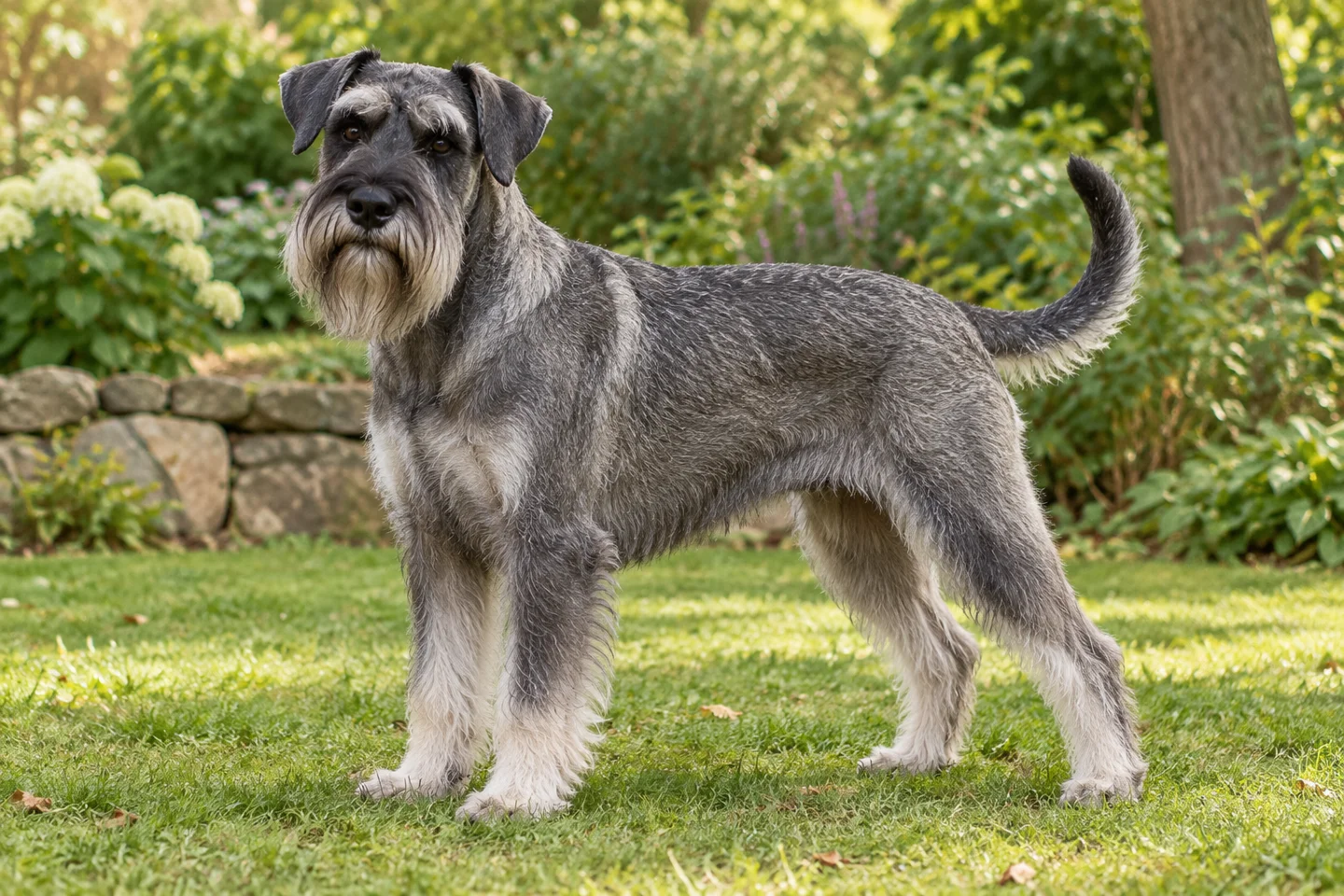
- Illustrated coat
- Pepper and salt with a dark mask, natural ears and full tail
General information for owners. These articles have not been reviewed by a veterinarian. Medical decisions need your dog's history and an examination.
The medium Schnauzer has its own identity
The Standard Schnauzer is a medium German dog with a square sturdy body, a rough coat, and a bearded muzzle. It is a distinct breed from the Miniature and Giant Schnauzers, rather than a convenient middle size whose behavior and health can be inferred by averaging the others. A prospective home should plan activity, learning, grooming, company, and rest. Ask what the source's adults are like in ordinary life before choosing a puppy because its expression seems alert and amusing. A compact working frame can still make considerable demands on a household's time and preparation.
Useful questions concern visitors, moving animals, handling, valued objects, and necessary time apart. How does the individual settle after a game, and what support makes that possible? Meet adults where practical and ask for descriptions of difficulties as well as achievements. A puppy is developing, while an adult changing homes may need time to transfer its routines. Prepare secure rest, transport, clinical care, suitable equipment, and reliable advice before arrival. A good placement remains manageable during ordinary employment, human illness, and later health changes, rather than depend on an ideal schedule that exists only during the first weeks of ownership.
Stable and farm work behind a familiar beard
The FCI account describes use around southern German stables and rodent control, with the earlier rough-haired Pinscher name. That background gives a reason to discuss watchfulness, investigation, and pursuit without staging unsafe live-animal encounters. The beard and eyebrows belong to an established breed identity; they do not make every similar-looking dog a confirmed Schnauzer. For a rescue with uncertain ancestry, preserve uncertainty while using observed behavior and condition to plan care. Accurate naming helps a clinic or owner locate the correct records instead of borrowing claims from a different sized breed.
Ask how present selection addresses health, temperament, and functional movement. A working description cannot establish that a puppy knows when to bark, which visitor is welcome, or how to remain comfortable during grooming. Those are practical ownership tasks requiring preparation and learning. A source should explain the routine behind successful adults and keep later family information available. If importing, retain original identification and understandable reports. A prestigious ancestor or appealing historical account does not excuse vague medical documentation. The new home's decision should concern this animal and its daily needs, with a plan that can adapt when activity or household circumstances change.
Size, pepper and salt, and a natural tail
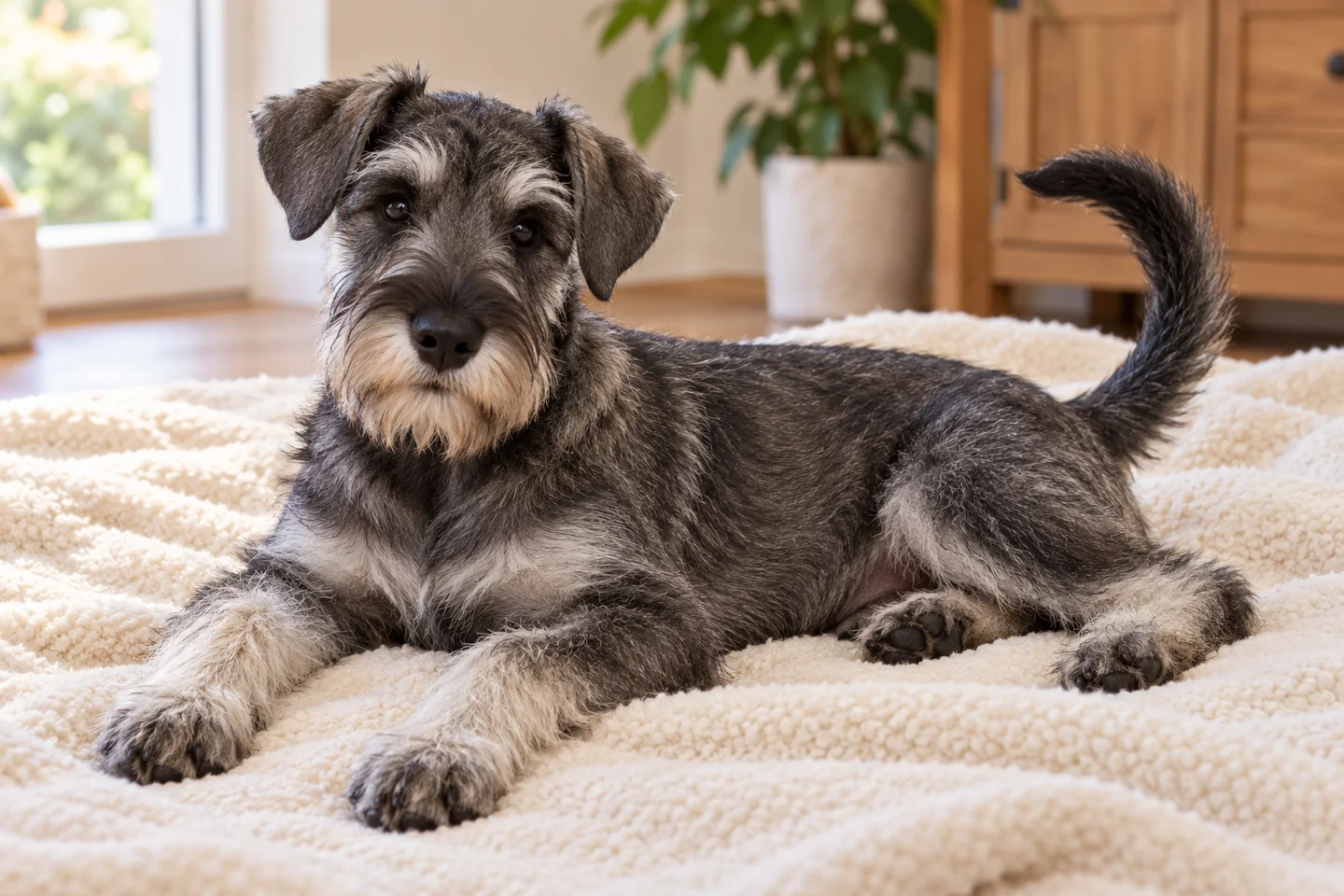
The FCI height range is 45–50 cm and weight 14–20 kg for both sexes. The body is nearly square, with a long strong head, dark oval eyes, a blunt-wedge muzzle, and characteristic beard and brows. Natural V-shaped ears fold forward close to the cheeks. The full tail is carried in a sabre or sickle fashion. Black and pepper-and-salt coats are recognized; the illustrations select evenly grizzled pepper and salt with a dark mask. Each picture is labeled an AI illustration, not a photograph documenting a named animal or its health assessment.
The harsh outer hair and undercoat should not be confused with a soft silky finish. For a real dog, look beyond the haircut and examine comfortable movement and condition. Watch walking, turning, rising, and rest, and ask about injuries or altered recovery. Standard numbers are descriptive rather than feeding targets. Do not accelerate puppy growth or pursue an impressive heavy outline through unnecessary supplements. Fit equipment to the actual frame and recheck beneath the coat for friction and restriction. A correct-looking beard cannot establish sound joints or explain a new change in activity without individual clinical assessment.
Attention, watchfulness, and ordinary indoor quiet
An attentive dog can notice every movement at a window, fence, or doorway. Arrange the environment so repeated alarm does not become its main daily occupation. Reward turning away, moving with the handler, and returning to a resting place. A quiet area away from the busiest view helps make recovery possible. Visitors should follow a predictable arrival routine rather than crowd the dog or grab its beard. The useful goal is an animal able to observe and disengage, instead of one repeatedly encouraged to give a dramatic reaction because people find its expression entertaining.
Teach quiet transitions as deliberately as games. End activity predictably and offer rest without constantly asking for another response. Begin short comfortable absences gradually and observe whether the animal is relaxed before extending them. Another pet cannot be promised to cure distress. An adult entering a new household may need familiar cues and a modest first schedule, while a puppy needs appropriate experiences balanced with sleep. Ask the source how its adults handle ordinary changes. A manageable routine depends on evidence about this individual, rather than assuming a general description of intelligence means the animal will adapt to everything without assistance.
Training a practical response before distractions become intense
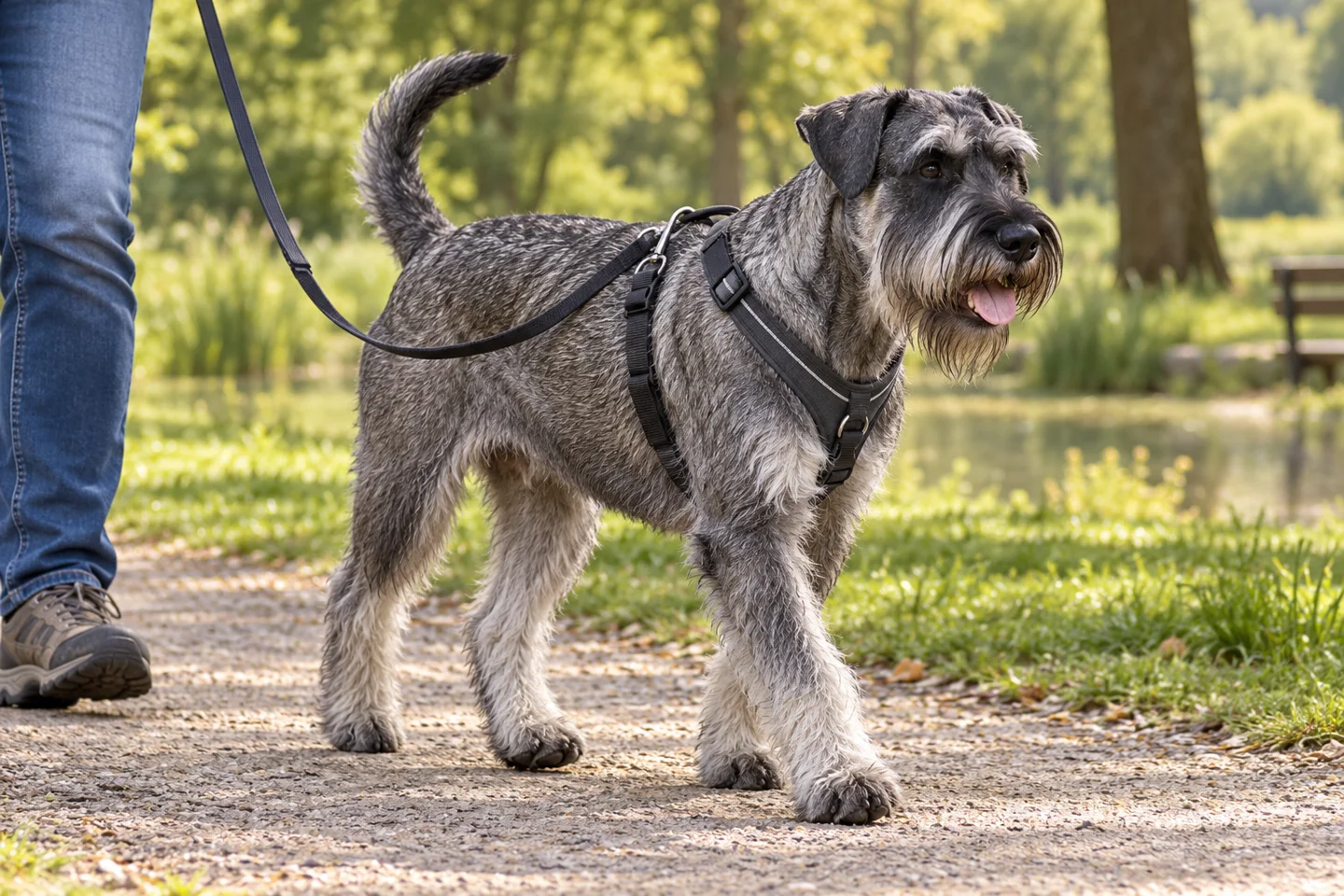
Build recall in quiet secure places, reward returning, and add difficulty gradually. Often let the dog resume a permitted investigation after a successful response. Use suitable equipment to manage opportunities while skills develop. A safely handled long line on a fitted harness may help where there is enough space to prevent entanglement. Do not release near roads, livestock, or vulnerable wildlife to test reliability. Waiting at exits and turning with the handler are useful before an unexpected loose dog or bicycle makes a route harder than the lesson the animal has actually learned.
Keep object games cooperative and practise release through a worthwhile exchange. Prevent access to hazardous material rather than chase the dog around the house. If possession creates stiffness or guarding, revise management and obtain qualified help. Short scent tasks and clear achievable lessons can engage attention without constant high-speed throwing. Add comfortable handling positions, feet, mouth, ears, and coat inspection. Reward seconds of participation and allow pauses. Useful training should make daily life and care safer, rather than demonstrate a polished command in one setting while the dog remains afraid whenever a brush, nail tool, or unfamiliar examiner approaches.
Exercise and recovery for a sturdy active dog
Provide varied movement, investigation, learning, and rest matched to age, health, and fitness. A square sturdy frame does not establish unlimited endurance or one mandatory daily distance. Build new demands gradually after illness, travel, or reduced activity. Puppies need safe exploration and coordination without forced adult workloads or repetitive high-impact jumps. Watch comfort later in the day and the next morning. Persistent stiffness, unusual fatigue, or reduced tolerance deserves veterinary assessment. An enthusiastic response to a toy is useful information about interest, but cannot alone prove that more physical demand is comfortable or beneficial.
Inspect boundaries, gates, and vehicle transfers before relying on them. Supervise outdoor time and choose routes with manageable traffic, wildlife, and livestock exposure. Carry water and adjust timing, duration, and shade in heat. A familiar walk can become unsuitable after a weather change. Quieter days should also have a workable plan using appropriate engagement, without turning the home into an endless throwing lane. Comfortable rest is part of sustaining activity. The handler needs an easy way to shorten a route when the individual or conditions change, rather than treat completion of a planned distance as the measure of successful care.
Aggression and preventing pressure from becoming a bite
Watchfulness and confidence do not make aggression irrelevant or inevitable. Assess the individual and circumstances, including pain, fear, restraint, and resources. Withdrawal, freezing, a fixed stare, stiffness, or growling calls for more space and a revised interaction. Do not punish a warning while continuing unwanted contact. A sudden change around a familiar care step deserves veterinary attention, especially if touching an ear, foot, mouth, or other area appears involved. Describe the actual approach, distance, object, and recovery rather than assume a motive such as jealousy from one incident.
Protect meals and rest, manage visitor arrivals, and prevent unsafe object access while obtaining help. Make the same routine clear to all adults and carers and share bite or close-call history honestly. Persistent risk warrants veterinary and suitably qualified behavior support. Positively introduced basket-muzzle training may be useful where advised, but it does not permit forced greetings or painful grooming. Progress should mean comfortable manageable behavior and successful choices at appropriate distances. An animal that remains silent under restraint may still be experiencing the discomfort that caused the warning, so endurance alone cannot establish that the situation has become safe or welcome.
Children, dog companions, and small pets
Plan children's access around the Schnauzer's rest and feeding arrangements before relying on reminders. A gate can preserve a quiet room while a visiting child plays elsewhere, and an adult can put the meal down without inviting anyone to touch the bowl. Teach children to ask the handler before approaching and to let the dog close the remaining distance if it chooses. Brief stroking can end before the child becomes excited or the animal moves away. Running beside a watchful dog, grabbing its beard, and leaning across its body create avoidable pressure. Supervision means an adult can notice that pressure and separate the pair immediately, rather than watching from across a crowded room.
For canine company, observe how this Schnauzer handles another dog's speed and proximity. Start an introduction where both handlers can keep walking without tangling leads, and defer shared chews or lively games until the pair's responses are better understood. A familiar playmate does not establish comfort around an unfamiliar animal that rushes forward. Small pets require a separate plan: a cat needs protected routes and refuges, while rodents or birds should remain behind dependable physical barriers. Do not stage a pursuit to obtain a clearer answer about hunting interest. Where the background is uncertain, manage access conservatively and seek qualified advice about whether the household can maintain the necessary separation throughout ordinary daily routines.
Grooming the rough coat and maintaining a clear face
Ask a breed-experienced groomer to explain appropriate maintenance of the harsh outer coat and undercoat. The chosen method and pet length should keep the animal comfortable and manageable between appointments. Part the coat to inspect skin beneath straps and in friction areas, and maintain the beard without letting food or moisture remain against irritated skin. A surface tidy can hide a tangle below. A painful mat needs assistance rather than a prolonged pulling session intended to preserve appearance. The functional outline matters less than whether the animal can see, move, and accept care comfortably.
Introduce brushing, comb contact, a stable non-slip position, and grooming sounds in manageable steps. Reward participation and allow pauses. Tell the professional about skin changes, medical restrictions, and known handling limits. Dry the dog and equipment appropriately after wet outings or bathing and keep bedding clean. Persistent itching, odor, thinning hair, or a new lesion needs clinical assessment rather than an automatic cosmetic solution. A dog that suddenly avoids a familiar care step may be painful. Investigating the change before demanding more tolerance helps prevent a medical problem from becoming a repeated conflict over handling.
Ears, feet, and mouth care belong beside the beard
Inspect the visible outer ears for redness, discharge, smell, sensitivity, or repeated head shaking. Follow veterinary advice for this patient's cleaning needs rather than probe deeply or apply old medication to an unexplained episode. Check feet, pads, and nails after rough ground. Vegetation and equipment can create trouble even when the animal remains eager to walk. Introduce paw inspection in seconds of comfortable contact before a painful injury makes it urgent. A practical routine should reveal small changes without requiring the dog to struggle through a full examination every time it enters the house.
Dental care needs its own plan with the veterinary team. A beard can collect debris without showing what is happening inside the mouth, and a chew is not a substitute for every examination or home-care step. Watch changes in chewing, appetite, odor, or tolerance of mouth touch. Keep tools clean and ensure another carer knows the routine. If a diagnosis changes handling or activity, record the instructions where they can be found. The goal is accurate comfortable care rather than an attractive outer finish that causes people to assume the animal must also be healthy beneath it.
Health: use the September 2026 club practices accurately
The Standard Schnauzer Club of America's Best Practices, revised in September 2026, identify required hip radiographs, specialist eye examination, and a DCM DNA test within its programme. The document distinguishes those from additional recommended tests. It also specifies that PennHIP may be additional to its hip screening rather than replace the required OFA process. Ask which current framework applies to the planned litter and obtain the actual identified reports. These are a named club's provisions, not an identical worldwide legal rule or evidence that every registered dog has completed all optional examinations.
Read each finding separately. A molecular test, orthopedic image, eye examination, and genetic identity profile answer different questions. A CHIC number should lead to published information rather than replace interpretation or promise lifelong health. Ask how results informed the pairing and what later family diagnoses are known. The club's document also seeks public reporting of unfavorable results, which makes honest records more useful than a selectively displayed badge. For an adult rescue without parental information, collect its own clinical history first and arrange a patient-specific plan while keeping uncertainty about relatives visible.
Age-specific eye history and frozen-semen records
The current club practices include an eye examination within twelve months before breeding and discuss later examinations for stud dogs because some ocular disease may become apparent with age. They also address available lifetime records when frozen semen is considered. This is a useful reminder that an old favorable result and a later diagnosis belong in the same family account. Ask what was actually examined, at what age, and whether new information changed a proposed decision. A famous deceased sire's reputation should not erase documented medical findings or substitute for reviewing the record that exists.
For the living dog, a painful, red, closed, or suddenly altered eye needs prompt veterinary advice regardless of a previous normal result. Avoid leftover drops or waiting for the next routine screening appointment while discomfort continues. Keep original reports accessible to carers and new clinics. A clinical examination has a different purpose from a DNA result for a named variant, and neither explains every future symptom. If vision changes are diagnosed, ask how to adapt routes, steps, and approaches by people. Patient-specific guidance is more useful than inferring that a particular breed should tolerate the change without support.
DCM risk testing and clinical heart assessment
Dilated cardiomyopathy affects the heart muscle and can impair pumping. Cornell identifies Standard Schnauzers among predisposed breeds, while the American club's practices include a breed-relevant DCM DNA test and specify pairing restrictions. Ask for the exact result and professional interpretation. A carrier label is not interchangeable with a clinical diagnosis, and a clear result for a defined variant does not establish freedom from every possible cardiac condition. Do not substitute a genetic identity profile or an ordinary statement that a puppy sounds healthy for the particular evidence being claimed.
Changes in stamina, coughing, collapse, or breathing difficulty warrant clinical attention, with urgent help for severe or rapidly worsening signs. Record timing and preceding activity when safe, and provide the actual medical and family reports. Do not wait for a breed-club reply or copy another dog's medication. If a diagnosis is made, follow the patient's treatment and activity plan and ensure alternate carers understand it. Reassuring parental paperwork informs context; the dog experiencing symptoms still needs its own assessment. Organized records help distinguish established findings from a guessed inherited explanation and make follow-up clearer across professionals.
Nutrition, mixes, and keeping ownership sustainable
Use complete nutrition appropriate to life stage, medical needs, and workload. Measure portions and include training rewards, especially when several people teach or groom the dog. Review condition beneath the hair with the clinic as activity changes. A Standard Schnauzer mix can vary in frame, coat, pursuit interest, and handling needs. Ask about both known parents and preserve uncertain ancestry. A beard cannot confirm a particular cross, and crossing does not guarantee easier maintenance, moderate activity, or freedom from inherited disorders. Choose care around the actual animal rather than the most convenient prediction from two breed descriptions.
Budget for grooming, routine and urgent clinical care, suitable insurance or emergency funds, training support, secure equipment, transport, and competent cover during absences. Ask a sitter how it will manage doors, objects, and grooming before relying on one during an emergency. Clarify source support and return terms in writing. Obtain local estimates instead of trusting a universal lifetime price. A suitable home remains practical through employment, illness, and later mobility changes. The commitment is to reliable ordinary care as well as enjoyable activities, with resources that do not disappear once the initial appeal of an expressive bearded puppy becomes everyday responsibility.
dogsDating introductions should leave space around a watchful dog
A watchful Standard Schnauzer may need time to observe an approaching dog before walking beside it. Explain that requirement in a dogsDating invitation and choose a public starting area with space beyond the busiest entrance. Keep the residential address and exact coordinates confidential; a broad district is sufficient for the public profile. Arrange for both handlers to be ready before approaching, so neither dog must wait while strangers crowd its parked vehicle. Walk on nearby lines, allowing the gap to reflect the individuals' responses. Avoid stopping immediately for food, photographs, or touching. The first useful question is whether this pair can move through the environment comfortably together, with each owner still able to turn away when necessary.
After the first few minutes, compare what the handlers are seeing. A dog that keeps returning attention to the route and can move without crowding the companion may be ready for another short circuit. Repeated blocking, rigid posture, or efforts to retreat call for a wider gap or departure. Agree openly that either person can end the walk without explaining away their animal's discomfort. When arranging a second meeting, retain the details that helped, such as quieter timing or a particular side of the path. Check photographs before sharing them so a house number, vehicle detail, or the other owner's private information does not appear inadvertently.
Sources and editorial notes
Sources checked October 22, 2026. Breed measurements describe reference ranges, not a diagnosis or an individual dog's ideal weight. Images are AI-generated breed illustrations and do not document a particular dog or health condition.
- AVSAB: Humane Dog Training Position Statement
- VCA Animal Hospitals: Food aggression in puppies
- VCA Animal Hospitals: Common emergencies in dogs
- Orthopedic Foundation for Animals: CHIC health screening programs
- VCA Animal Hospitals: Aggression toward unfamiliar dogs, diagnosis
- VCA Animal Hospitals: Grooming and coat care for your dog
- VCA Animal Hospitals: Ear infections in dogs (otitis externa)
- AAHA: Feeding plans for healthy, appropriate weight cats and dogs
- VCA Animal Hospitals: Heat stroke in dogs
- AVSAB: Puppy Socialization Position Statement
- VCA Animal Hospitals: Dog behavior problems, aggression toward children
- Official breed standard: Standard Schnauzer
- Standard Schnauzer Club of America: Best Practices revised September 2026, required and recommended testing
- American Kennel Club: Standard Schnauzer identity, grooming, and activities
- Cornell University: dilated cardiomyopathy, clinical assessment, and breed predisposition
Keep getting to know dogs.
Read another guide or return to your dogsDating community.
Explore breed guidesBack to dogsDating