Thai Bangkaew Dog
A square, double-coated Thai companion spitz whose watchfulness, coat care, and personal space need deliberate attention in a family home.
How these guides are researched and reviewed
- Origin
- Thailand
- Adult standard size
- Males 46–55 cm; females 41–50 cm
- Illustrated coat
- White with red-fawn patches
General information for owners. These articles have not been reviewed by a veterinarian. Medical decisions need your dog's history and an examination.
The Bangkaew is a distinct Thai spitz
The Thai Bangkaew Dog is a medium-sized companion breed from Thailand, named for the village associated with its development in Phitsanulok province. Its double coat, upright ears, and feathered tail give a spitz outline. It should not be confused with the short-coated Thai Ridgeback, which has a different body and a reverse-growing ridge of hair along the back. A country name does not make the two breeds interchangeable in appearance or care.
The FCI standard describes a square body, alert behavior, and some possible reserve toward strangers. An owner should translate those features into sensible visitor routines and opportunities for manageable experience. A watchful dog needs help deciding what to do when something changes. It cannot be expected to infer that a delivery worker may enter or that every child near the gate is safe to approach without guidance.
The standard includes a traditional account of the breed's origins and later selection. That account should not be used to advertise a modern puppy as a wild animal or promise unusual immunity to illness. For a real placement, ask about the actual parents, the puppy's surroundings, and the evidence available. A household benefits from clear information about handling, daily care, and response to people rather than an exciting ancestry story.
Square proportions and adult height
The FCI lists male heights from 46 to 55 centimeters at the withers and female heights from 41 to 50 centimeters. The body should be well proportioned and square, with legs slightly deeper than the chest. The coat should not conceal an exaggeratedly low or heavy outline. Ask the veterinarian to assess growth and condition instead of feeding toward an invented maximum weight or judging the dog only through photographs.
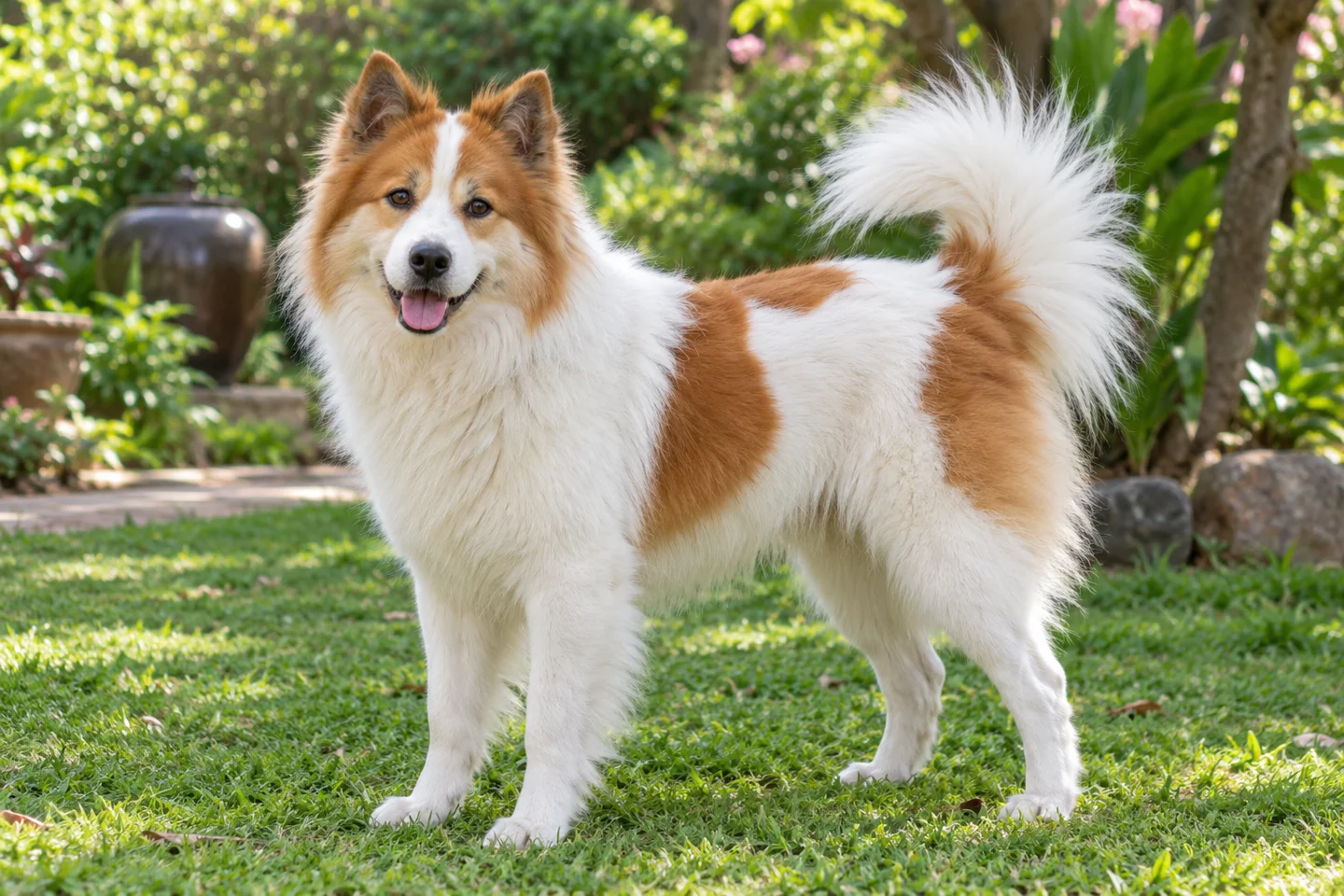
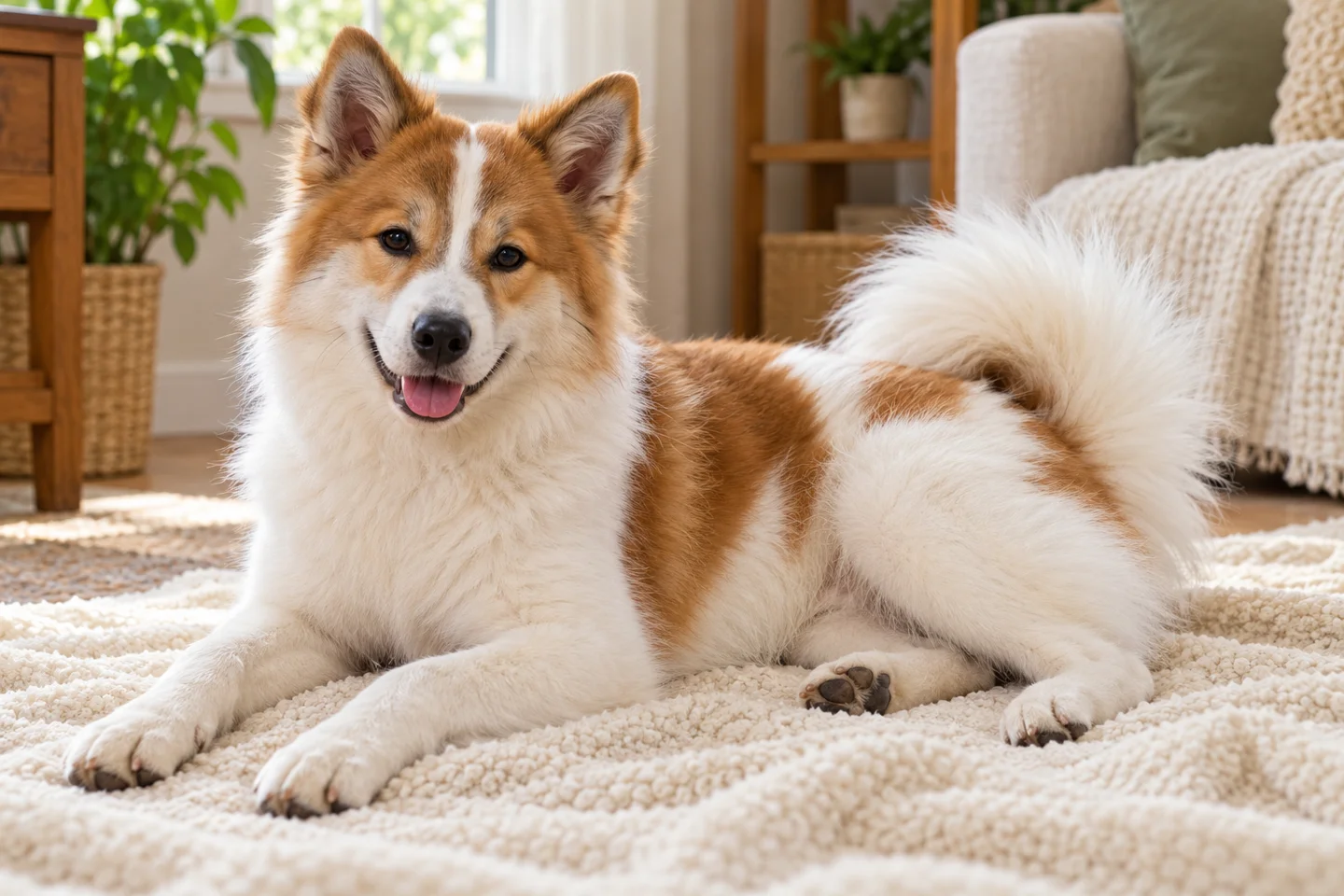
The outer coat is straight and coarse over a dense soft undercoat. Hair around the neck and shoulders forms a ruff, with feathering on the limbs and tail. White with defined colored patches is characteristic. Our illustrations use white with red-fawn patches and balanced facial markings, dark eyes, black nose, and natural erect ears. A puppy has less mature ruff and feathering than an adult.
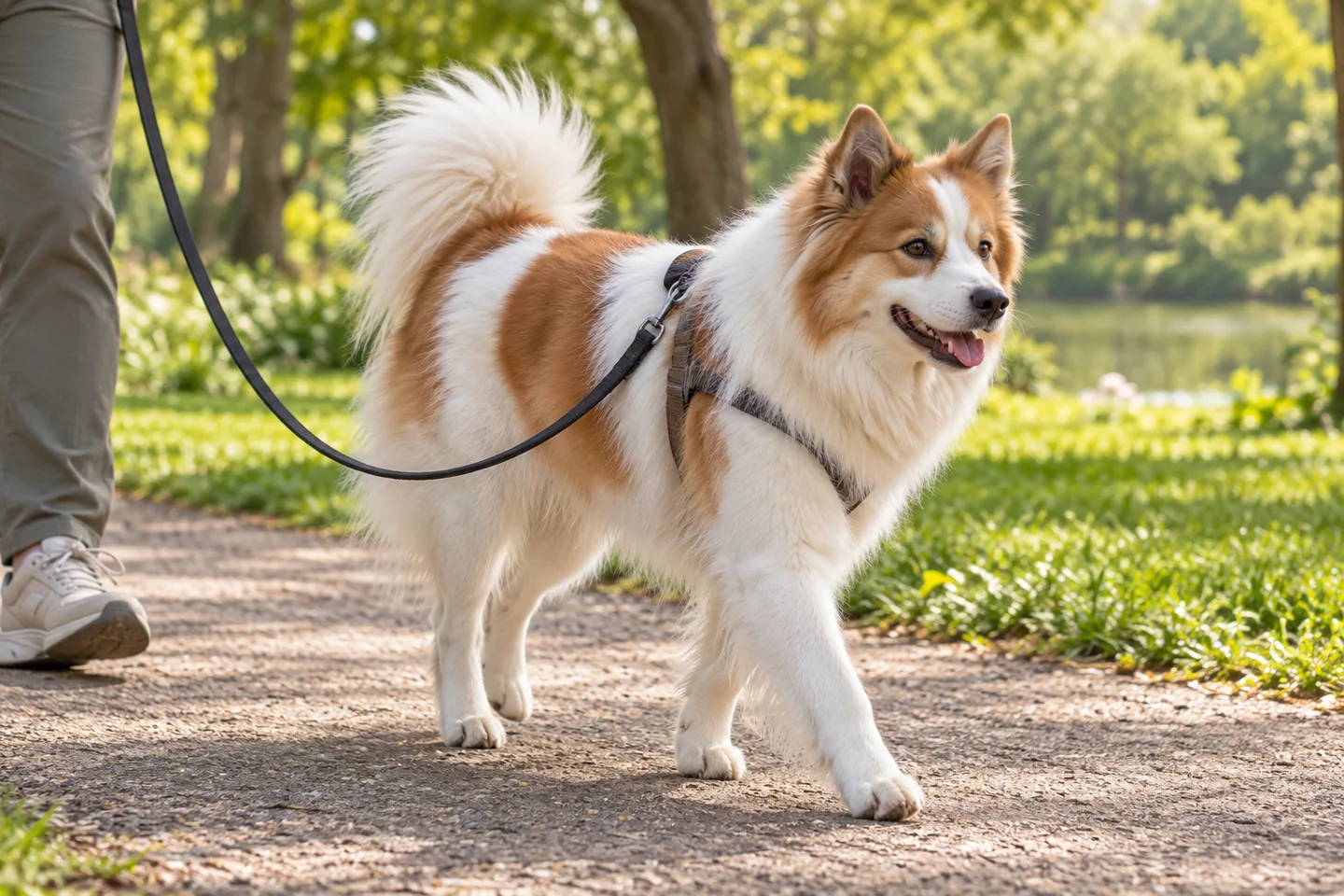
The full tail is carried with a moderate upward curve over the back. The standard distinguishes this from a tightly curled tail or one pressed against the back. That detail matters when choosing artwork rather than drawing every spitz with the same coil. The three images are labeled AI-generated illustrations. They explain a selected appearance without establishing ancestry, clinical findings, or the acceptable features of any specific real dog.
A useful visitor routine begins before the knock
Choose where the dog will wait while someone enters. A comfortable area behind a dependable barrier can let the owner open the door without holding the collar and managing a conversation simultaneously. Practice the routine with no visitor first. The dog needs to know what earns a reward and where it can rest before the arrangement is used during an unexpected delivery.
Visitors should allow time and avoid reaching over the head. Let the dog observe from a manageable distance, and permit withdrawal. A quiet view of a guest may be an appropriate stage of the introduction. If the dog remains tense, shorten the experience rather than asking the person to prove confidence by coming closer. The owner controls access and should not place the responsibility on an unfamiliar visitor.
Repeated boundary activity also deserves attention. Notice whether barking begins at a side path, a window, or the garden gate. Changing the resting location or screening a view may prevent many rehearsals. A garden alone does not supply a behavior plan. The useful question is what the dog practices there while people are occupied, and whether that daily pattern supports the calm routine the household wants.
Training a clear role during busy moments
Teach a mat, a turn toward the handler, and a comfortable wait while equipment is fitted. Begin in quiet surroundings with small rewards and short sessions. Once the behavior is familiar, add one distraction at a time. A dog that can wait in an empty room may need easier practice before doing it while a visitor carries shopping through the doorway. Progress should follow actual success rather than the owner's timetable.
Use physical management to prevent unsafe repetitions while teaching develops. Store tempting objects securely, block access to rubbish, and arrange a safe place during food preparation. A capable dog can learn from successful exploration of the bin just as readily as from a planned lesson. Preventing that opportunity leaves the owner free to reward the behavior wanted instead of repeatedly confronting the one already rehearsed.
Reward-based help should explain how fear and excitement change the exercise. Ask what the dog is learning and how the professional will simplify if it cannot respond. Teach foot, ear, and mouth checks through brief voluntary participation. If tolerance changes suddenly, consider pain. A physical struggle may make the next attempt harder while obscuring why the dog objected in the first place.
Exercise and a watchful dog's chance to relax
Provide regular movement and exploration that suits age, health, and conditioning. A square athletic outline does not prove readiness for a sudden demanding run. Build effort gradually and inspect recovery after rest. A puppy, an adult returning after illness, and a fit mature dog need different plans. The owner should be prepared to change distance and intensity when the individual response differs from expectation.
Walks can include investigation without constant high arousal. Simple searches using an appropriate part of the measured ration can offer another task. Choose safe locations and make the exercise understandable before increasing difficulty. If considering sport, use an instructor who explains preparation, surfaces, and equipment. The dog's willingness to continue is information about motivation, not a guarantee that the body is ready for every proposed demand.
Warm conditions require shade, water, and sensible timing. The coat should not be treated as automatic protection from heat, and its thickness can make direct observation particularly important. Shorten an outing when conditions change. At home, offer a quiet place away from repeated visual triggers. A dog that spends the entire afternoon scanning the boundary may need a different environment as well as more physical activity.
Socialization and personal space
Introduce a puppy to the ordinary events its future routine will contain. Coordinate infectious-disease precautions with the veterinarian while arranging manageable exposure to people, traffic, travel, and surfaces. The dog should be able to investigate and recover. If it repeatedly attempts to hide or leave, simplify. Staying until it no longer reacts may produce exhaustion rather than the useful familiarity the owner intended.
Allow people to pass without compulsory greetings. A watchful companion can learn that nearby strangers require no action. Reward attention to the handler and keep enough room to avoid crowding. Guests do not need to touch the dog to make the visit successful. Voluntary approach and a clear retreat route provide more useful information about comfort than holding the dog still for contact.
Reassess during adolescence or a change of home. New reactions can reveal gaps in experience, discomfort, or a harder environment. Record what occurred and the recovery afterward. A shared corridor, evening visitor, and quiet garden are different situations. Describing those details helps a trainer or veterinarian identify what should change. A broad label such as protective says little about whether the specific encounter was manageable.
Aggression, resources, and accurate disclosure
Threatening behavior needs an individual assessment rather than reassurance based on attachment to the family. If a Bangkaew stiffens over an object, snaps during grooming, or lunges at a visitor, prevent another close encounter while veterinary and qualified behavioral support is arranged. Pain may alter tolerance. The household should use dependable separation instead of repeatedly recreating the trigger to discover whether the dog reacts again.
Meals and valuable chews belong away from passing children and animals. Teach exchanges in easy circumstances before a found object creates an urgent problem. If guarding already occurs, obtain professional guidance rather than taking every item to establish control. The plan should make an approaching person predict something manageable. Repeated physical confrontation can teach concern about hands without improving the underlying situation.
Tell carers about incidents factually, including contact, injury, and what preceded the event. A friendly public meeting cannot erase a different response at home. A basket muzzle can support some individual plans after gradual positive introduction, but it does not make forced contact comfortable. Distance, barriers, and an informed handler remain necessary. The practical plan must work for the people who will actually provide care, including a backup person.
Children and a coat that invites touching
The full coat can make a Bangkaew appear especially inviting to a child. Explain that touching still requires adult guidance and the dog's willingness. No pulling hair, hugging the neck, or following into a resting place should occur. A dog moving away has already supplied information. Give it a route that does not end in a corner where the child can continue approaching.
A medium dog can knock over a small child while turning or playing. Choose an activity with a predictable structure, such as a brief familiar cue or a search prepared by an adult. Fast noisy games with a visiting group may need complete separation. Comfort with one household child cannot certify every setting. When supervision ends, use the planned safe area rather than waiting for a warning to justify it.
Children should call an adult about stolen items or conflict between animals. They should not grab the collar or reach into the mouth. Older children can take increasing responsibility when their skills and the dog's comfort support it, but the adult remains accountable for safety decisions. A companion dog's watchful background cannot turn it into a childcare arrangement or guarantee appropriate judgment around unfamiliar children.
Animals in the home and outside it
Assess dog relationships through repeated manageable experiences. Initial walking compatibility is useful, but food preparation, doorways, and resting places may reveal different pressures at home. Separate resources initially and observe whether one animal blocks or repeatedly follows another. Provide more than one bed and a way for each to rest privately. A successful relationship does not require constant close contact.
Cats need gradual assessment and escape routes. A puppy's small size does not remove the need to plan for adulthood. Rabbits, rodents, and poultry require secure protection, and a quiet look through a barrier cannot establish what will happen if an animal runs. Do not stage a chase to test restraint. Gather information through controlled arrangements that protect all participants.
Keep appropriate control around livestock and wildlife. Familiarity with the home garden cannot establish recall in a new location. Inspect fencing and gates before release in any exercise area. An owner can provide exploration and purposeful tasks without allowing uncontrolled pursuit. If the desired lifestyle depends on effortless roaming among unfamiliar animals, discuss that expectation candidly with experienced breed owners before making a commitment.
Grooming the ruff and feathered tail
Work through the double coat in sections so loose undercoat and skin changes are not hidden beneath a tidy surface. Pay attention around the neck, behind the ears, under the harness, and through the tail feathering. A groomer can demonstrate suitable tools and how to avoid scraping or pulling. Short sessions can be more manageable than waiting until accumulated tangles require prolonged work.
After bathing, rinse thoroughly and check that deeper areas dry. Bedding and sheltered resting places should remain clean and dry as well. Persistent odor, itching, or recurrent redness needs veterinary attention rather than progressively stronger shampoos. Record what changed and what products were used. Those details help distinguish a new problem from an old one that has never been fully assessed.
Inspect feet after rough ground and maintain nails and teeth through gradual rewarded handling. Look at ears without pushing tools into the canal. Repeated scratching, discharge, or pain requires advice. A naturally upright ear does not guarantee freedom from disease. If grooming suddenly becomes difficult in one area, consider discomfort before increasing restraint or assuming that the dog has simply become unwilling to cooperate.
Health questions when a universal panel is not established
A prospective owner should ask which examinations and tests have actually been performed in this family. Do not invent an international Bangkaew panel because another spitz has one. If a source advertises hip, patella, eye, or other screening, request its named report and ask how the finding is interpreted. A broad commercial DNA package cannot silently replace a clinical assessment that was never completed.
Ask about confirmed diagnoses in parents and close relatives, including the age when a problem appeared and any ongoing treatment. Distinguish a veterinary diagnosis from an owner's impression of slowing down. A source should explain what information remains unavailable and how later findings are communicated. Missing evidence is a limitation to plan around, rather than a reason to declare that a less common breed has no inherited health concerns.
The coat creates a practical reason for regular skin and condition checks. Feel beneath the hair and note changes in comfort during care. An owner may notice a recurring damp area, reluctance to have one region brushed, or a different way of rising from rest. Those observations do not diagnose a condition, but they can help the veterinarian decide what to investigate. Avoid treating a behavioral change as a training issue until pain has been considered.
For a new adult, transfer the available original clinical notes and resolve any follow-up that remains open. Identify medication by name and dose rather than by the color of a tablet. A baseline consultation can establish the current needs without claiming to erase uncertainty about the past. The pet's individual examination remains necessary even when the source describes the whole breed as robust or naturally healthy.
Food, mixes, money, and a workable placement
Offer a complete food appropriate to life stage and measure intake. Training rewards and extra food from several people can add substantially to the ration. Ask the veterinary team to demonstrate body-condition assessment beneath the coat, then repeat it consistently. Review feeding when activity or treatment changes. Persistent appetite, thirst, or weight changes deserve investigation rather than an automatic addition of richer food or supplements.
A Bangkaew mix may differ in body proportions, coat, tail, and response to strangers. Ask whether both parents are documented and what is based only on appearance. A white patched coat and erect ears cannot establish a particular cross. Crossbreeding cannot promise predictable temperament or freedom from disease. For an adult, observed life with people and animals may provide more useful placement evidence than a guessed family tree.
Price local grooming support, veterinary care, training, secure transport, boarding, and emergency arrangements. Check whether a backup carer can follow the visitor and handling plan. Read insurance conditions and ask the source how help continues after placement. The household needs a sustainable daily routine, not only enthusiasm for an unusual breed. A useful decision accounts for the dog's work, quiet time, and care when the usual owner is unavailable.
A dogsDating walk away from the gate
On dogsDating, describe comfort with unfamiliar dogs and unfamiliar people separately. A Bangkaew may be interested in a walking partner while preferring that the other handler keep distance. Explain the present routine before meeting and ask about the partner's pace and play. The first encounter can be a walk with room, without an expectation of touching, toys, or free running.
Choose a public route away from the dog's home boundary and begin with separate movement. Leave space for either person to turn and for each dog to investigate independently. Watch recovery after the dogs notice each other. Repeated fixation, blocking, or attempts to leave call for more room or an end to the outing. Do not insist on a close greeting simply because the owners have already traveled.
Keep exact user coordinates private. Approximate discovery and a selected public landmark can arrange the meeting without disclosing a residence or a private exercise site. Afterward, record which distance and pace allowed comfort. Use those details to decide whether another short outing would help. A digital match creates an opportunity to compare information while the animals' observed responses determine how far the encounter progresses.
Sources and editorial notes
Sources checked October 22, 2026. Breed measurements describe reference ranges, not a diagnosis or an individual dog's ideal weight. Images are AI-generated breed illustrations and do not document a particular dog or health condition.
- AVSAB: Humane Dog Training Position Statement
- VCA Animal Hospitals: Food aggression in puppies
- Orthopedic Foundation for Animals: CHIC health screening programs
- VCA Animal Hospitals: Aggression toward unfamiliar dogs, diagnosis
- VCA Animal Hospitals: Grooming and coat care for your dog
- VCA Animal Hospitals: Ear infections in dogs (otitis externa)
- AAHA: Feeding plans for healthy, appropriate weight cats and dogs
- VCA Animal Hospitals: Heat stroke in dogs
- AVSAB: Puppy Socialization Position Statement
- VCA Animal Hospitals: Dog behavior problems, aggression toward children
- Thai Bangkaew Dog: official breed standard
Keep getting to know dogs.
Read another guide or return to your dogsDating community.
Explore breed guidesBack to dogsDating