Thai Ridgeback
A practical guide to Thai Ridgeback identity, secure outings, gradual introductions and clinical questions about dermoid sinus.
How these guides are researched and reviewed
- Origin
- Thailand
- FCI ideal male height
- 56–61 cm, with ±2.5 cm tolerance
- FCI ideal female height
- 51–56 cm, with ±2.5 cm tolerance
- Selected coat
- Solid red with dark muzzle
General information for owners. These articles have not been reviewed by a veterinarian. Medical decisions need your dog's history and an examination.
Thai Ridgeback identity and the dorsal ridge
The Thai Ridgeback is a short-coated Thai breed named for the strip of hair growing in the opposite direction along its back. It is distinct from the Rhodesian Ridgeback, and the two breeds should not share one medical or temperament description simply because both have ridges. A prospective owner needs to investigate this individual's background, the family's behaviour and the source's placement practices. A striking outline is only one part of living with the dog.
The Kennel Association of Thailand describes hunting, cart-escort and watchdog work in its history. That context helps explain why secure movement and a thoughtful approach to unfamiliar events matter. It does not establish how an unexamined dog will behave in your home. Ask about ordinary routines rather than accepting a claim that an ancient or primitive breed can look after itself. Modern roads, crowded paths and household visitors still require an owner who can organise safe daily life.
Size, solid colours and natural ears
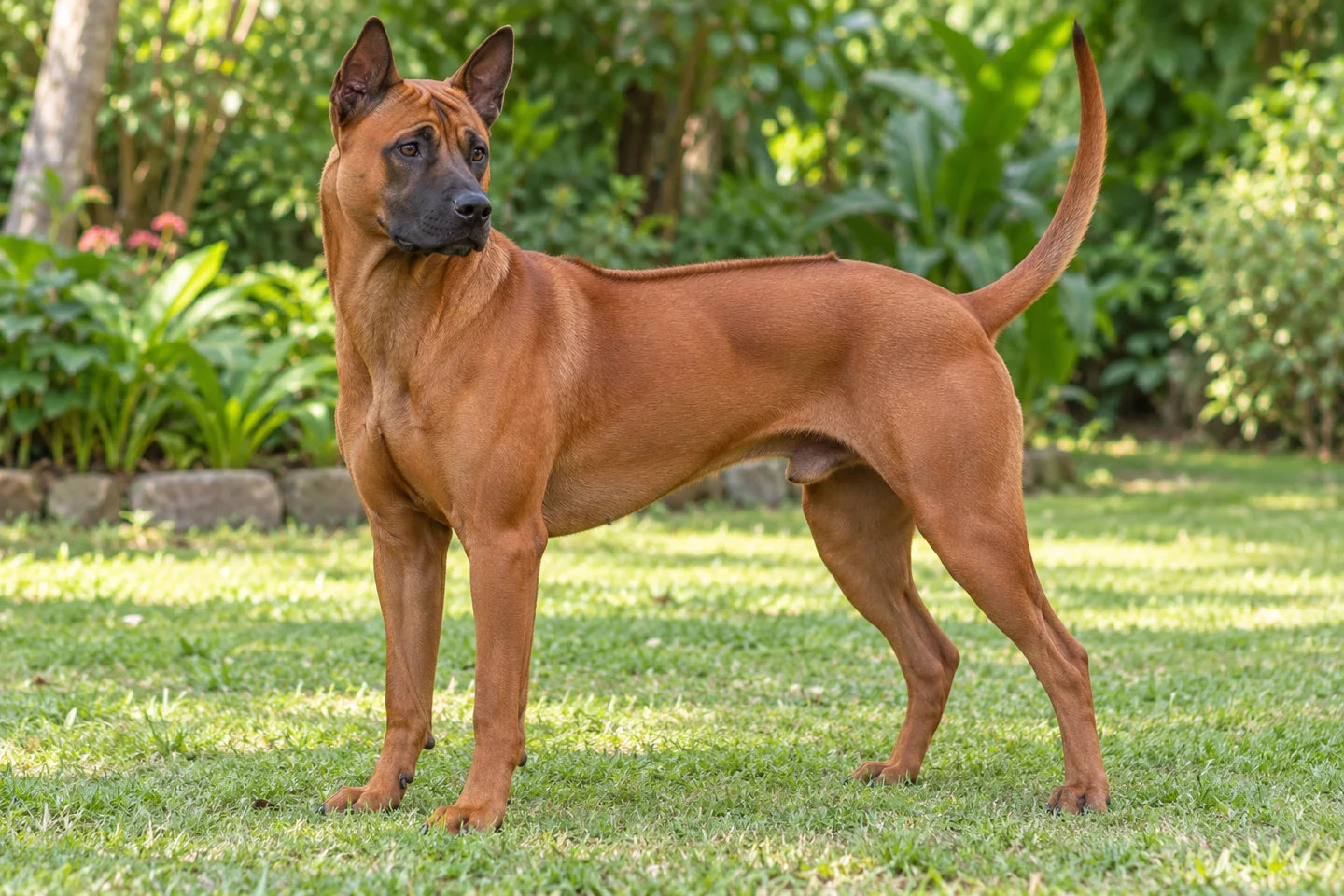
The FCI gives ideal male height as 56 to 61 centimetres and female height as 51 to 56 centimetres, with a stated tolerance of 2.5 centimetres either way. Its allowed solid colours include red, black, blue and very light fawn. The selected illustration is red with a dark muzzle. Upright natural triangular ears, a lean muscular body and a complete tapering tail distinguish the intended example from a generic cropped-ear dog.
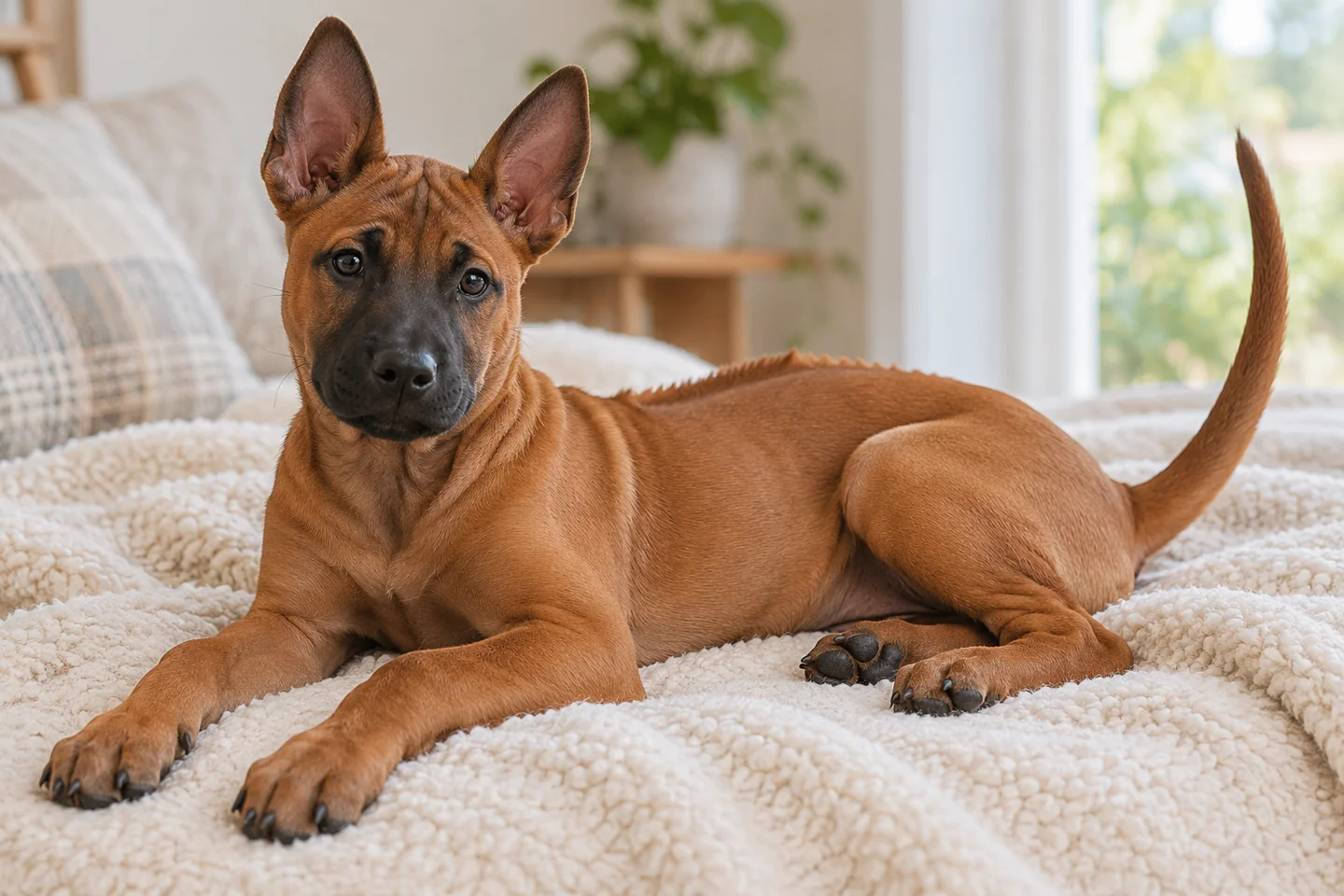
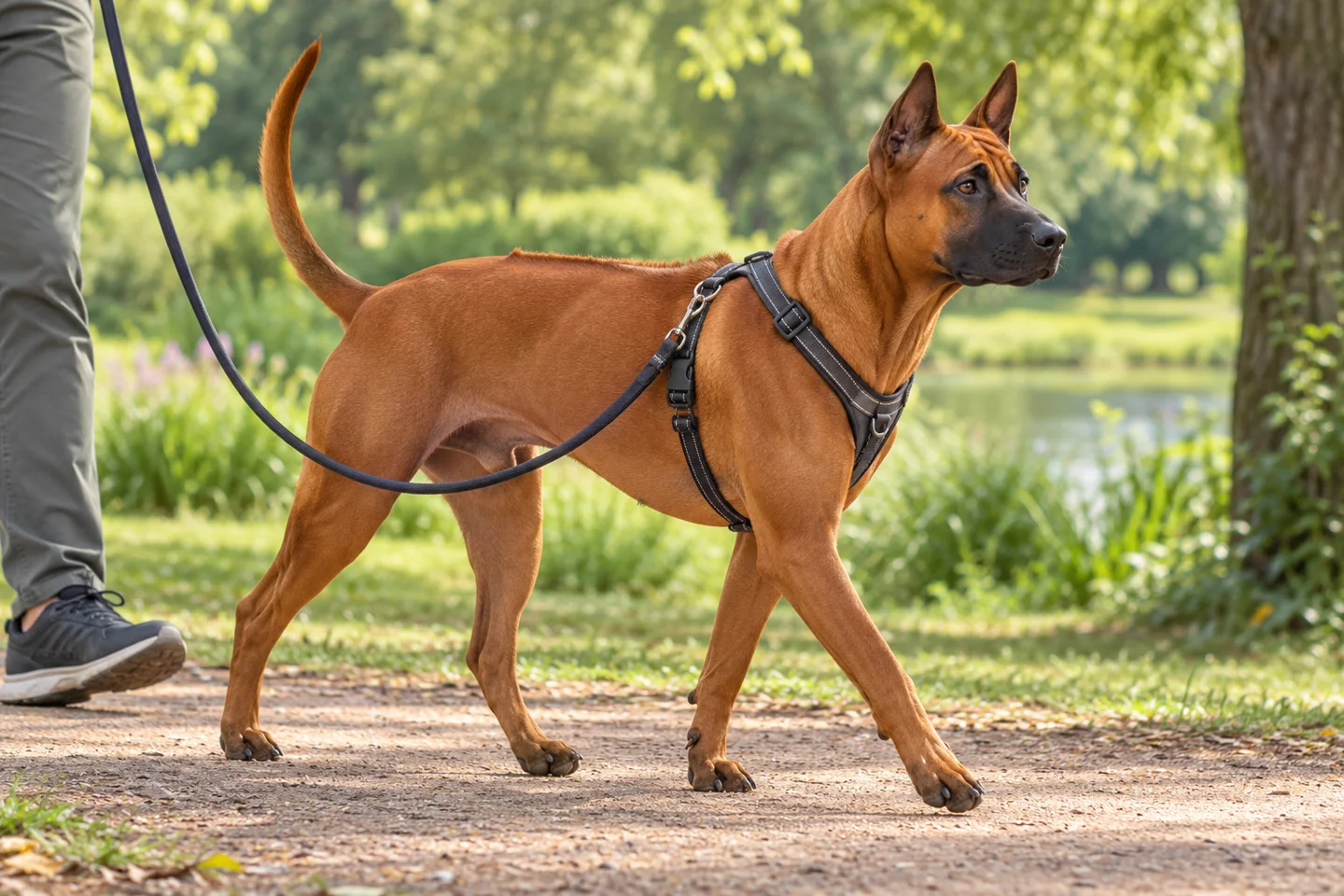
The ridge is made of reversed hair rather than an open wound or a fold of skin. Its appearance cannot establish that every underlying structure is normal. The three pictures are labelled AI-generated illustrations, showing an adult, a developing puppy and a controlled walk. They should be used as visual examples rather than proof of parentage or clinical health. When meeting a real dog, ask to see ordinary comfortable movement and a veterinary history instead of judging only a posed profile.
Temperament and choosing an individual
Investigate how the particular dog responds when an unfamiliar person pauses nearby, a cyclist passes or a household member handles its feet. A source should be able to describe both comfortable situations and those needing support. Ask what the dog does after a surprise, including whether it can resume investigating or remains focused on the event. These observations can help you plan a route and introduction more effectively than an advertisement describing loyalty alone.
A dog may show confidence in familiar surroundings and need more distance elsewhere. Give it opportunities to move away from attention and a resting area visitors do not enter. Quiet observation is a legitimate choice. Do not require a retreating dog to accept touch as proof that it belongs in a family. If the home normally has unpredictable arrivals or crowded activity, consider whether adults can provide the separation and steady routines the individual needs.
Security for a dog interested in movement
Inspect boundaries before arrival, including spaces below gates and objects beside a fence that could help a dog get over it. The Thai standard notes jumping ability, which is a reason for practical containment rather than a challenge to demonstrate. A fence needs to work when you are distracted and when a delivery arrives. Use an additional barrier during door opening so an unexpected event outside does not become an escape.
Fit equipment to the actual body and ask for a demonstration if you are unfamiliar with a secure harness arrangement. Practise in a quiet place before relying on it beside traffic. A dog that reverses from a frightening event should not be able to slip free. Keep identification current and plan secure vehicle entry, especially in unfamiliar car parks. Containment should allow normal rest, companionship and suitable exercise; leaving a dog outside to monitor every passing event can make calm daily routines harder.
Settling, absence and changes of home
When bringing the dog home, begin with a manageable area and a predictable sequence for meals, toilet outings and sleep. Avoid inviting a crowd to meet it immediately. A dog may need time to learn that someone approaching its resting room will not always demand interaction. Let it investigate new rooms under supervision, and teach returning to a familiar place with a reward. Small reliable routines can reduce the amount of improvisation needed during the first weeks.
Introduce time apart in amounts the dog can manage. If it becomes distressed, seek a gradual plan and arrange support for necessary absences. Ask a rescue about previous changes of home and what helped the dog settle, while recognising that a new environment may produce a different response. A carer should learn entry, equipment and containment routines before the owner travels. Handing over a lead at the last minute can be difficult for a dog that has not yet learned to trust that person.
Training attention before the distraction arrives
Choose an easy setting to teach following a hand target, coming toward you and waiting behind a gate. Reward a prompt response, then allow a suitable release. Outside, practise turning away while the distraction is still distant. That gives the dog a familiar action when something more difficult appears. Waiting until it is already staring or pulling leaves less room to teach. A good instructor should help choose distances and tasks in which the dog can participate comfortably.
Teach safe exchanges for objects without repeatedly taking valued items to test tolerance. Keep dangerous material inaccessible while the skill develops. Cooperative handling can include a brief touch, standing on a stable surface and accepting equipment near the body. Stop before a prolonged struggle begins. Forceful corrections or intimidation can add fear to an already difficult situation. If the dog reacts around a particular task, assess discomfort and seek professional advice rather than treating resistance as a reason to apply more pressure.
Exercise and secure opportunities to explore
Arrange walks and exploration suited to the individual's physical condition. A change of route or a safe scent task can add interest without requiring constant high-speed exercise. Use controlled access around wildlife and traffic, and choose enclosed areas carefully before considering off-leash activity. Check entrances, ground hazards and other users. A dog that returns reliably in one quiet place still needs appropriate management where movement or unfamiliar animals compete for attention.
Introduce demanding activity gradually, with advice on development for puppies and comfort for older dogs. Notice how the dog moves after rest, rather than judging the whole day by enthusiasm during play. Carry water, consider heat and choose an outing with a shorter return option. Do not assume a breed associated with a warm country is immune to heat illness. Unusual fatigue, changed gait or difficulty recovering deserves attention. Stop and seek urgent advice for collapse or serious breathing distress.
Aggression and avoiding confrontational tests
Assess a warning by its circumstances rather than by a belief that a breed is either automatically safe or naturally dangerous. A dog crowded beside a door, disturbed while eating or touched on a painful area may react for different reasons. Separate it from the immediate trigger and prevent another incident while arranging help. A sudden change in tolerance needs veterinary consideration. Record the sequence accurately, including the dog's opportunities to move away.
Do not corner the dog to prove it will accept handling, and do not punish a growl while continuing the interaction that caused it. Warnings provide information for a safer plan. Persistent fear, guarding or aggression merits qualified behavioural support, with barriers and distances the household can reliably maintain. If a muzzle is appropriate, introduce it through rewards and learn correct fit. It supports care and management; it does not give permission to force attention from a stranger or continue a stressful gathering.
Children and a retreat that remains available
Adults should supervise children with the dog and protect a quiet resting area. A child must not follow a retreating animal, pull its tail or hold its face for a photograph. Teach invitations to contact and respect for the dog leaving. Keep meals and chews away from children and visiting pets. If the supervising adult is cooking, answering the door or helping another child, use dependable separation rather than relying on a rule remembered from earlier.
Consider the household's normal pace before choosing a dog. Repeated children's parties and sudden arrivals may require a management arrangement that not every home can provide. Ask a source what contact the individual has actually experienced, including children's ages and the degree of adult control. A brief friendly encounter cannot answer every family question. Some dogs and homes will be a poor match, and acknowledging that before placement can prevent an avoidable difficult situation for everyone involved.
Other dogs, cats and small animals
Begin dog introductions with space, separate handlers and an easy route away. Walking in the same direction can offer information without requiring face-to-face contact. Watch for the ability to investigate the surroundings and disengage from the other dog. If one animal becomes fixed on the other, repeatedly avoids it or cannot recover after excitement, increase distance and end when necessary. Friendship with one familiar companion does not establish comfort with a whole group.
Cats and smaller animals need physical protection while compatibility is assessed. Do not release them together as an experiment. Provide escape areas the dog cannot enter, separate feeding and an arrangement that remains safe when no adult can watch. A hunting history warrants realistic planning, while the individual's observed behaviour still matters. Shared walks can be worthwhile for two dogs even when physical play is unsuitable. Owners should let the animals' comfort determine access rather than requiring a particular kind of social relationship.
Health questions about the ridge and hips
The AKC identifies hip dysplasia and dermoid sinus among Thai Ridgeback health concerns. Its short breed overview does not provide a current universal testing panel or a reliable worldwide frequency. Ask the breeder which registry and programme apply, what examinations the parents received and how puppies are checked. Request documents connected to the actual animals. A visible ridge and confident movement during a visit cannot answer all of those questions.
Make family history specific without inventing extra predispositions. Ask about diagnosed problems, previous surgery and reports from older relatives. If a source advertises a genetic panel, identify the tests and why they are relevant. DNA identity, ancestry and disease-variant results have different purposes. For an adult placement, its own records and current condition come first. A veterinarian can explain which missing information matters to care now, while uncertainty should remain acknowledged instead of being converted into either a disease-free claim or a diagnosis.
Dermoid sinus needs a clinical assessment
ACVS describes dermoid sinus as a developmental skin tract whose depth can vary, sometimes extending toward deeper structures. An opening or unusual area along the back or neck needs veterinary assessment rather than an owner attempting to probe it. The AKC's Thai Ridgeback information makes this a relevant question for this breed, while ACVS notes that the condition is particularly associated with Rhodesian Ridgebacks and also occurs elsewhere. Do not transfer one population's frequency to another.
Ask whether a puppy was examined and whether any suspicious finding was investigated. If treatment or surgery has occurred, obtain the actual report and follow-up instructions. The absence of an obvious problem in a photograph is not a screening result. A painful area, discharge, fever or new neurological difficulty should be described promptly to the clinic. Treatment depends on the individual finding, and a breed article cannot determine how deep a tract extends or whether a procedure is appropriate for that patient.
Grooming a short coat and checking exposed areas
Use gentle brushing to remove loose hair and inspect places where a harness or collar rubs. Check feet after rough or grassy routes, and introduce nail care before overgrowth makes handling uncomfortable. Short hair can make a small skin change easier to see, but repeated redness, itching or sensitivity still needs an explanation. Avoid applying stronger products merely because the dog's coat looks easy to maintain.
Keep ears and teeth in the routine using methods demonstrated by a suitable professional. Ear pain, odour or discharge should not be treated with leftover medicine from another episode. Tell the groomer or veterinarian if an area has become difficult to touch. A dog that suddenly resists a familiar check may be uncomfortable. The aim is brief cooperative care that gives useful observations, rather than holding the animal through a long examination at home that it cannot safely tolerate.
Nutrition and useful observations at meals
Choose a complete food for the dog's life stage and measure portions. Ask the veterinarian to show how body condition should be assessed on this lean frame. Muscle definition does not tell you that a dog needs extra calories, and ribs or waist should be interpreted in context. Keep track of training rewards as well as meals. When several adults feed the dog, a simple shared record can prevent accidental double portions or missed medication.
Give meals in a place where another animal will not interfere. Observe appetite and drinking over time, and report persistent changes with relevant dates. Do not repeatedly add supplements or switch products while an unexplained problem continues. Homemade or restrictive diets require an appropriate nutritional assessment. If a condition has been diagnosed, follow the individual plan and clarify what carers should do when the dog eats poorly. Another owner's successful routine may not fit this animal's age, workload or clinical findings.
Thai Ridgeback mixes and uncertain names
A Thai Ridgeback mix may have a ridge, a different coat or an appearance that provides little reliable evidence of its exact parents. The presence of reversed hair does not by itself prove a complete pedigree. Ask what documentation exists and keep reported ancestry distinct from verified records. Crossing with another breed cannot promise a particular temperament or remove every relevant health concern from either parent.
For a rescue with limited background, a clear account of observed handling, animal contact and home routines can be more useful than a confident guess based on looks. Ask what made previous introductions successful and what management is still needed. A cross may require different grooming or activity from either description you have read. Plan for the actual dog and update the care arrangement as you learn, rather than insisting that every action confirms the breed label attached to its adoption advert.
Ownership costs and preparation before placement
Allow for secure boundaries, suitable transport, training support, food and veterinary care. Ask local providers for current costs and discuss known conditions before making a financial commitment. Backup care may take preparation if the dog needs time to accept an unfamiliar person. Arrange meetings, practise equipment changes and ensure the carer can follow entry and separation routines before an urgent absence makes the choices narrower.
Meet adults where possible and ask the source to explain difficult days as well as enjoyable outings. Find out what support is available after placement and how significant health information will be shared. A responsible discussion should leave room to decide that the timing or household is unsuitable. If the current home cannot provide dependable containment or patient introductions, resolve those limits first. The distinctive ridge cannot compensate for a daily arrangement that repeatedly exposes the dog or others to avoidable conflict.
dogsDating introductions that start with distance
Give a factual dogsDating description of this Thai Ridgeback's preferred pace, response to unfamiliar dogs and current restrictions. Keep exact home coordinates private and choose a public starting point with room to move separately. Agree beforehand that either person can end the outing when their dog needs a break. Avoid making the first encounter at a home entrance, a narrow gate or a crowded play area where leaving calmly is difficult.
Walk in parallel before considering closer contact. The owners can talk while the dogs investigate separately, without shared food or toys. Repeated stiffness, avoidance or intense attention calls for more space or an early finish. A meeting can be worthwhile without any play. Note which conditions helped, including route width, time and distance, then decide whether another walk would suit both animals. The purpose is to create comfortable real-life company while respecting the dog beside each owner.
Sources and editorial notes
Sources checked October 22, 2026. Breed measurements describe reference ranges, not a diagnosis or an individual dog's ideal weight. Images are AI-generated breed illustrations and do not document a particular dog or health condition.
- AVSAB: Humane Dog Training Position Statement
- VCA Animal Hospitals: Food aggression in puppies
- VCA Animal Hospitals: Aggression toward unfamiliar dogs, diagnosis
- VCA Animal Hospitals: Grooming and coat care for your dog
- VCA Animal Hospitals: Ear infections in dogs (otitis externa)
- AAHA: Feeding plans for healthy, appropriate weight cats and dogs
- VCA Animal Hospitals: Heat stroke in dogs
- Orthopedic Foundation for Animals: CHIC health screening programs
- AVSAB: Puppy Socialization Position Statement
- VCA Animal Hospitals: Dog behavior problems, aggression toward children
- FCI Standard 338: Thai Ridgeback identity, ridge, size and natural structure
- Kennel Association of Thailand: Thai Ridgeback history and official standard
- American Kennel Club: Thai Ridgeback care and named health concerns
- American College of Veterinary Surgeons: dermoid sinus assessment and treatment
Keep getting to know dogs.
Read another guide or return to your dogsDating community.
Explore breed guidesBack to dogsDating