Bichon Frise
A small curly-coated companion whose care includes ongoing grooming, respectful handling, learned independence, appropriate screening, and prompt attention to urinary signs.
How these guides are researched and reviewed

- Coat
- Curly white coat requiring maintenance
- Build
- Small and sturdy
- Care priorities
- Coat, teeth, handling, and urinary changes
General information for owners. These articles have not been reviewed by a veterinarian. Medical decisions need your dog's history and an examination.
Choosing a Bichon Frise
A Bichon Frise needs regular grooming, suitable exercise, patient teaching, and a household that can provide company while building comfortable independence. A small white dog can seem easy to fit into everyday life before questions about coat care, toilet routines, dental care, and absences have been answered. Describe your actual weekday before adopting. Decide who will walk, groom, supervise, train, and help the dog rest. A companion breed still needs a plan that works when people are busy or the usual carer is unavailable.
Meet adults and ask about ordinary behavior rather than relying on a cheerful photograph. Find out how the dog responds to visitors, grooming equipment, vehicles, other animals, and the end of a game. A puppy's easy early coat and friendly approach do not predict every adult need. An adult foster assessment may provide useful observations. Choose according to the individual and care you can maintain over years, rather than assuming a companion reputation guarantees quietness, easy absences, or safe contact with every child and unfamiliar dog.
Small sturdy body and a white coat
The breed has a small sturdy outline, a curly white coat, dropped ears, and a natural tail carried over the back. Grooming shapes the familiar rounded appearance. The illustrations are generated examples rather than documented animals or medical reference images. A full trim can hide weight gain, muscle loss, and skin irritation. Use hands as well as sight during routine checks, with a veterinarian demonstrating assessment of ribs, waist, muscle, and comfortable condition rather than judging only by the outer silhouette.
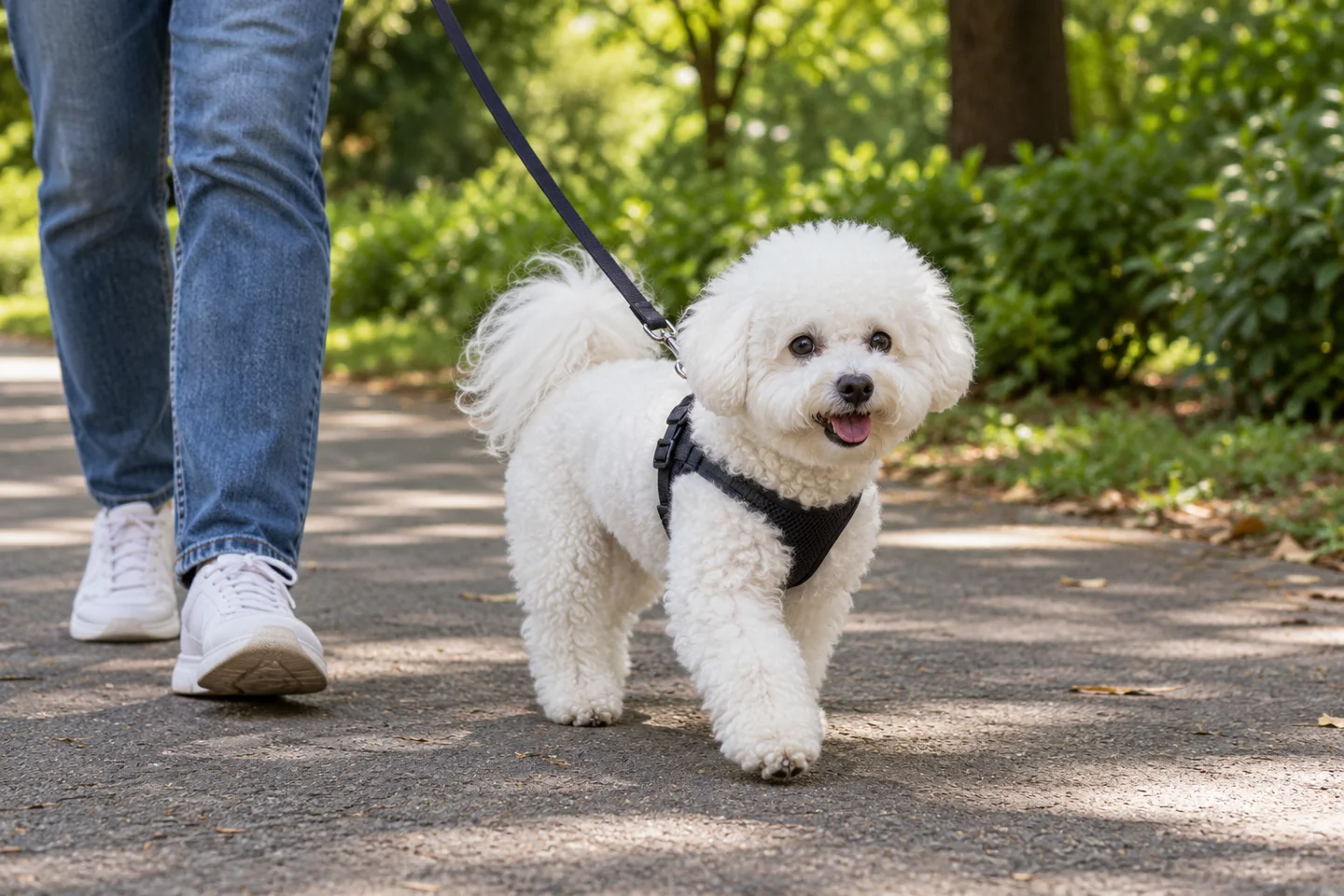
Watch a real dog walk, turn, rise, and move over ordinary surfaces. Persistent skipping, limping, or reluctance to jump deserves assessment even when the dog remains interested in play. Fit equipment to actual measurements and check that straps do not rub or restrict the shoulders. Puppies need repeated adjustment during growth. Teach calm fitting and waiting at doors. Reliable clips, readable identification, and a secure travel arrangement matter for a small dog as much as for a larger animal that could pull its handler visibly off balance.
Grooming through the coat
Brush and comb to the skin in manageable sections rather than only smoothing the outer coat. Pay attention behind ears, beneath equipment, around legs, and wherever hair tangles. Learn suitable tools and technique from a groomer familiar with the breed. A puppy's maintenance can change as adult coat develops, so ask what to expect and arrange support before mats become painful. A low-shedding description does not mean hair requires no care or that an occasional bath can replace a consistent maintenance routine.
Stop rather than pulling through tight tangles or completing a prolonged struggle simply to preserve a style. A professional can advise on safe removal and a practical companion trim. Check skin during grooming for redness, wounds, parasites, or irritation. Bathe when needed with suitable products and dry comfortably. The objective is a routine the household can maintain while protecting comfort. A tidy round silhouette cannot establish healthy skin, and persistent odor or sensitivity needs veterinary advice rather than a cosmetic adjustment alone.
Eyes, skin, and cooperative body care
Keep the face comfortable and vision unobstructed through appropriate grooming advice. Tear staining can be visible on a white coat, but redness, squinting, discharge, or sudden visual changes needs veterinary assessment. Avoid treating every facial change as a cosmetic issue or using improvised products near eyes. Persistent scratching, licking, odor, or skin irritation also deserves investigation. A white coat does not identify the cause of an allergy, and repeated unplanned food changes may delay a clearer assessment of what is happening.
Introduce nail care, tooth brushing, ear inspection, and standing for examination through brief rewarded steps. A new objection to familiar handling can indicate discomfort. Stop to investigate rather than increasing restraint to finish. Persistent ear odor, discharge, or pain needs veterinary advice instead of deep cleaning or reused medication. Tell groomers and clinic staff about handling concerns before arrival so appointments can be planned. Cooperative care improves maintenance and assessment, while necessary treatment should not wait for perfect home training or an owner's complete examination of a painful area.
Children and safe small-dog handling
Children need active adult supervision with a Bichon. Prevent hugging, climbing, pulling hair, and leaning over the face. Teach calm invitations on the floor and let the dog leave. Small size can make a dog vulnerable to being picked up or carried without choice, so adults should manage lifting and access. Keep children away from meals, chews, and sleeping places. They should call an adult when something is beside the dog rather than moving it or taking an object from its mouth.
Visiting children create different movement and noise from the usual routine. Use separation before energetic games when close supervision is impractical, and provide a retreat children cannot enter. Watch freezing, turning away, hiding, or repeated efforts to leave. A dog should not need to escalate warnings to obtain space. Review arrangements when children become mobile or the dog develops pain. Comfortable behavior with familiar family members cannot promise tolerance of every crowded gathering, unfamiliar friend, or sudden attempt to lift a tired animal.

Dogs, cats, and physical mismatch
Assess compatibility with other dogs individually. Begin introductions with parallel walking in a suitable neutral place and enough room to disengage. At home, separate resources and resting areas while observing comfort. Both dogs need pauses and control over distance. Repeated blocking or pursuit deserves interruption when the recipient is trying to rest. A larger dog's friendly intent cannot prevent injury through rough collisions, so size and play-style mismatch needs management even when neither owner sees obvious aggression.
Cats need gradual introductions and dog-free escape routes. Familiarity with one cat does not predict safety with a running stranger outdoors. Small pets require secure protection rather than a test of intentions, and a companion breed label does not eliminate pursuit or rough play. Stop access when stalking, fixation, or chasing appears and seek qualified advice. The household needs reliable separation while assessing whether this individual and its resident animals can be accommodated safely, rather than assuming that a small white dog will be accepted or harmless in every encounter.
Aggression, fear, and useful warnings
Stiffness, freezing, growling, snapping, or attempts to retreat mean pressure should stop. Increase space and review what preceded the response, including handling, resources, sleep, and escape routes. Avoid cornering the dog, lifting it during every dispute, or repeatedly removing a valued object to establish control. Breed identity cannot determine safety in a particular encounter. Barriers and separate resources protect people and animals while the owner obtains an assessment rather than asking someone else to repeat the same unresolved pressure as an informal test.
New irritability or grooming sensitivity warrants veterinary examination. Pain and illness can affect tolerance before obvious loss of activity. Keep a factual incident record and consult a veterinary behaviorist or qualified reward-based professional for recurring threats. Punishing warnings can make risk less visible while leaving fear or discomfort unresolved. A basket muzzle introduced gradually with rewards may add protection within an appropriate plan, with careful small-dog fit. It supports management and treatment rather than making painful care comfortable or replacing supervision, suitable distance, and an opportunity to leave.
Toilet learning and a predictable arrival period
Provide frequent supervised toilet opportunities appropriate to age and health, especially after waking, eating, or activity. Reward promptly in the chosen place and manage access indoors while learning develops. Avoid punishment after an accident, which does not explain where the dog should go next time. Clean effectively and review timing, access, and supervision. A small dog still needs clear teaching rather than an assumption that pads or a garden automatically establish the household routine without guidance.
A newly adopted adult may need help learning unfamiliar doors, surfaces, weather, and schedules. Keep early demands manageable and provide a quiet sleeping area. Initial inhibition can change as the dog settles, so do not treat the first few quiet days as a complete assessment. Sudden accidents in a previously comfortable routine need medical consideration, particularly with altered thirst, pain, or urinary signs. A veterinary assessment can distinguish health concerns from a training issue rather than assuming the dog has become spiteful or forgotten its education.
Exercise, play, and recovery
Provide daily movement suited to age, health, and conditioning. Walks with investigation, simple searches, controlled games, and suitable learning can create variety. Small size does not mean the dog should never walk a meaningful distance, while long outings still need gradual conditioning. Puppies need sleep and age-appropriate exploration, with demanding or repeated high-impact activity discussed with their veterinarian. A garden supplements the plan without showing whether the dog receives useful movement or spends its time waiting for company.
Observe gait after activity and after rest. Persistent limping, repeated skipping, reluctance to rise, or slow recovery needs assessment. In heat, shorten outings and provide water and shade; collapse or severe breathing difficulty requires urgent advice. Check feet after rough ground and adjust surfaces when necessary. Teach a predictable finish to games and allow rest. Quiet days can include manageable walks and calm tasks without frantic indoor activity intended to compensate for every missed outing, leaving both dog and household able to settle comfortably.
Health screening and actual reports
The AKC lists patellar, hip, and ophthalmologist evaluations among national club recommendations for Bichons. Request identifiable reports for both parents and read dates, methods, and findings. A routine puppy examination answers different questions from formal adult screening. Ask how the breeder's current program accounts for significant illness in close relatives. A statement that dogs look healthy or have never seemed unwell is insufficient detail about what was assessed, and the word tested cannot substitute for understanding the actual result.
A CHIC number records completion and disclosure of specified testing, not a guarantee that every finding was normal. Broad DNA panels cover selected variants and cannot exclude all inherited or acquired conditions. New eye pain, persistent movement changes, skin problems, or altered behavior needs investigation regardless of earlier results. For an adopted adult with missing records, acknowledge gaps and plan from current examination. Ordinary vaccination, parasite, dental, and travel considerations remain important alongside inherited concerns, family information, and continued observation of the individual's comfort.
Urinary signs and bladder-stone questions
The Bichon club discusses urinary stones and bladder problems among health topics owners should understand. Blood in urine, repeated attempts to urinate, discomfort, or a sudden change in toilet behavior needs veterinary advice. Inability to pass urine is urgent. Those signs have several possible causes and cannot be diagnosed from breed identity. Avoid treating every accident as a training failure or assuming a previous episode establishes the same cause this time without examination and appropriate testing.
If stones are diagnosed, ask what type was identified and how treatment and prevention fit that result. Different problems can require different plans, so do not copy another owner's diet, supplements, or medication. Follow the veterinary team's instructions and understand the schedule for reassessment. Keep records available for backup carers and other clinics. A prescribed feeding or monitoring plan should be specific to the individual findings, and new symptoms still deserve advice rather than an assumption that a familiar brand of food guarantees no recurrence.
Feeding, mixes, and allergy expectations
Use a complete diet appropriate to age and health, measure portions, and count training rewards within the allowance. Small extras can become a meaningful share of a small dog's intake. Adjust using weight trends and hands-on body assessment. Feed separately from children and other animals and teach exchanges without confrontation. Avoid supplements without a veterinary reason and seek qualified guidance for home-prepared meals. Persistent appetite, thirst, weight, or digestive changes needs assessment rather than repeated unplanned food switches or an assumption that a lively dog cannot gain excess weight.
A Bichon mix can vary in coat, size, activity, and social preferences. Names such as Bichon and Poodle cross do not define a standardized outcome or guarantee easier grooming. Ask what parentage is documented and assess actual needs. Mixed ancestry does not eliminate inherited concerns. No coat or cross guarantees tolerance for someone with allergies, because allergens are not confined to loose hair. Discuss personal concerns with the affected person's clinician and assess contact with the individual appropriately rather than relying on a low-shedding or hypoallergenic marketing claim.
Costs, later years, and dogsDating
Plan for grooming tools or appointments, food, suitable equipment, preventive care, dental assessment, training, emergency treatment, and backup care. Arrange a trial stay with a trusted carer and leave written routines and veterinary contacts. Review flooring, bedding, furniture access, transport, and recovery as the dog ages. New reluctance to jump or sensitivity during grooming can indicate pain. Retain appropriate exploration and learning with physical demands adjusted to present comfort, and know how the dog would travel securely if urgent treatment were needed.
For dogsDating, explain the individual's social history and preferred distance while keeping exact home coordinates private. Meet on a quiet public route with separate adult handlers and a companion whose size and play style can be managed safely. Use parallel walking and avoid shared toys or food initially. Add space or finish if either dog becomes stiff, overwhelmed, or persistently pursued. A relaxed walk provides information about that particular setting without proving comfort in shared housing, vehicle travel, or situations involving valued resources.
A practical grooming handover
Before a longer stay away from home, let the backup carer practice checking a small coat section and fitting the harness without trapping hair. Explain which changes around eyes, skin, or ears need veterinary advice rather than another cosmetic product. Leave the groomer’s details and a realistic maintenance schedule. A short trial gives useful information about whether the dog can remain comfortable with that person’s handling before an urgent absence makes the arrangement necessary.
Sources and editorial notes
Sources checked October 21, 2026. Breed measurements describe reference ranges, not a diagnosis or an individual dog's ideal weight. Images are AI-generated breed illustrations and do not document a particular dog or health condition.
- VCA Animal Hospitals: Hypoallergenic dog breeds
- Orthopedic Foundation for Animals: CHIC program and interpretation of numbers
- Bichon Frise Club of America: Health research and reported concerns
- VCA Animal Hospitals: Ear infections in dogs
- VCA Animal Hospitals: Food aggression in puppies
- American Kennel Club: Relevant national breed-club health testing recommendations
- VCA Animal Hospitals: Heat stroke in dogs
- American Kennel Club: Bichon Frise breed identity and care
- VCA Animal Hospitals: Aggression toward unfamiliar dogs, diagnosis
- AVSAB: Humane Dog Training Position Statement
- Bichon Frise Club of America: Understanding urinary stones and individual treatment
Keep getting to know dogs.
Read another guide or return to your dogsDating community.
Explore breed guidesBack to dogsDating