Bouvier des Ardennes
A Belgian rough-coated cattle dog needing practical work, secure visitor routines, and careful distinction from the Bouvier des Flandres.
How these guides are researched and reviewed
- Origin
- Belgium
- Coat
- Rough, tousled coat
- Care priorities
- Cattle-dog activity and boundaries
General information for owners. These articles have not been reviewed by a veterinarian. Medical decisions need your dog's history and an examination.
Choosing a Bouvier des Ardennes
A Bouvier des Ardennes needs a household prepared for an alert cattle dog with a sturdy body, a rough coat, and useful daily activity. Its relatively unfamiliar name can make a photograph seem more informative than it is. Begin by asking what the dog actually does during an ordinary day. Find out how it settles indoors, responds to visitors, handles unfamiliar dogs, and behaves when a person opens a gate. Those details help more than a description that calls every dog loyal or protective.
Meet adults when possible and consider the demands of the mature dog. A puppy's size and friendliness during a short visit cannot establish how easily an owner will manage adolescence, frustration, or adult strength. An experienced rescue or breeder should discuss difficult traits as plainly as appealing ones. Choose a dog whose care fits your routine and physical capacity, including periods when work is busy or someone is ill. A working background does not excuse leaving the dog to invent its own occupation outdoors.
Belgian identity and cattle-dog history
The Fédération Cynologique Internationale identifies Belgium as the breed's country of origin and describes its work with cattle. The name reflects that practical cattle-dog background. The Ardennes is a distinct breed from the Bouvier des Flandres. It should not be sold as a clipped, miniature, or less expensive version of that dog. Shared language in the names does not make pedigrees interchangeable, and a rough coat alone cannot establish which breed a dog belongs to.
Ask which registry issued the pedigree and whether the source can explain the dog's family and breeding goals. For a rescue without records, keep uncertainty about ancestry visible instead of treating a plausible visual identification as proof. Historical work can help owners anticipate the need for movement, responsiveness, and boundaries. It does not tell you that a particular dog is trained to work livestock or safe to turn loose among animals. Present-day experience and deliberate training remain necessary.
A compact rough-coated appearance
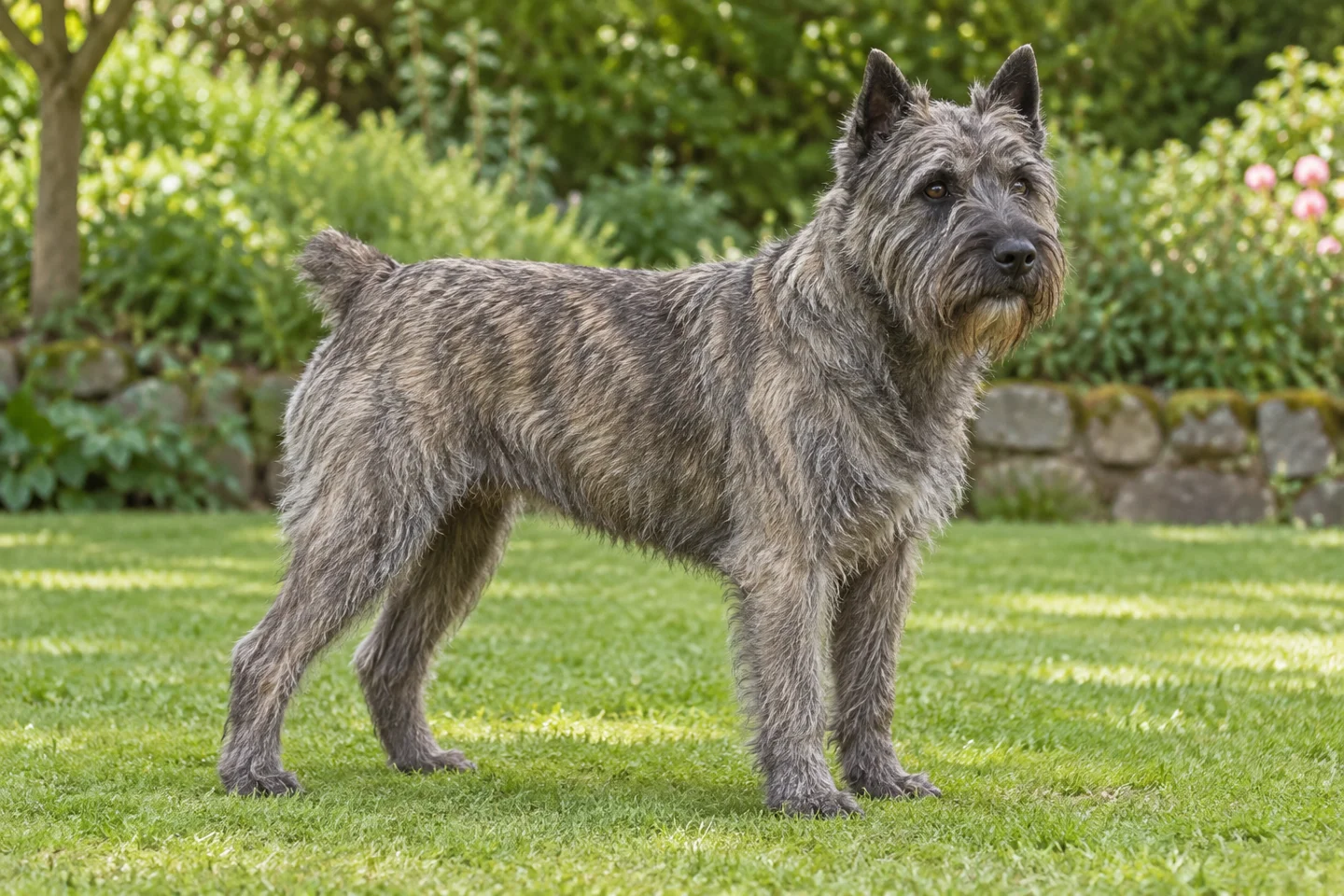
The FCI standard describes a sturdy, compact dog with a rough and tousled coat. A beard and eyebrows contribute to the expression without requiring an exaggerated curtain of hair. The breed's outline differs from the heavier-coated appearance many people associate with the Flandres. Look for comfortable movement and the ability to use the body easily. Coat and posture can hide weight changes, so assess condition with your hands and ask a veterinarian to demonstrate what an appropriate condition feels like.
Ear carriage can be erect, semi-pricked, or folded outward under the standard. Many Ardennes are naturally short-tailed or tailless, so photographs should not assume a long tail is universal. Appearance needs to be described accurately without implying that a shortened tail proves a particular procedure occurred. When choosing a dog, focus on identity records, physical comfort, and the care of the individual. An unusual silhouette is not evidence that a rare dog has fewer health or behavior needs.
Boundaries around movement
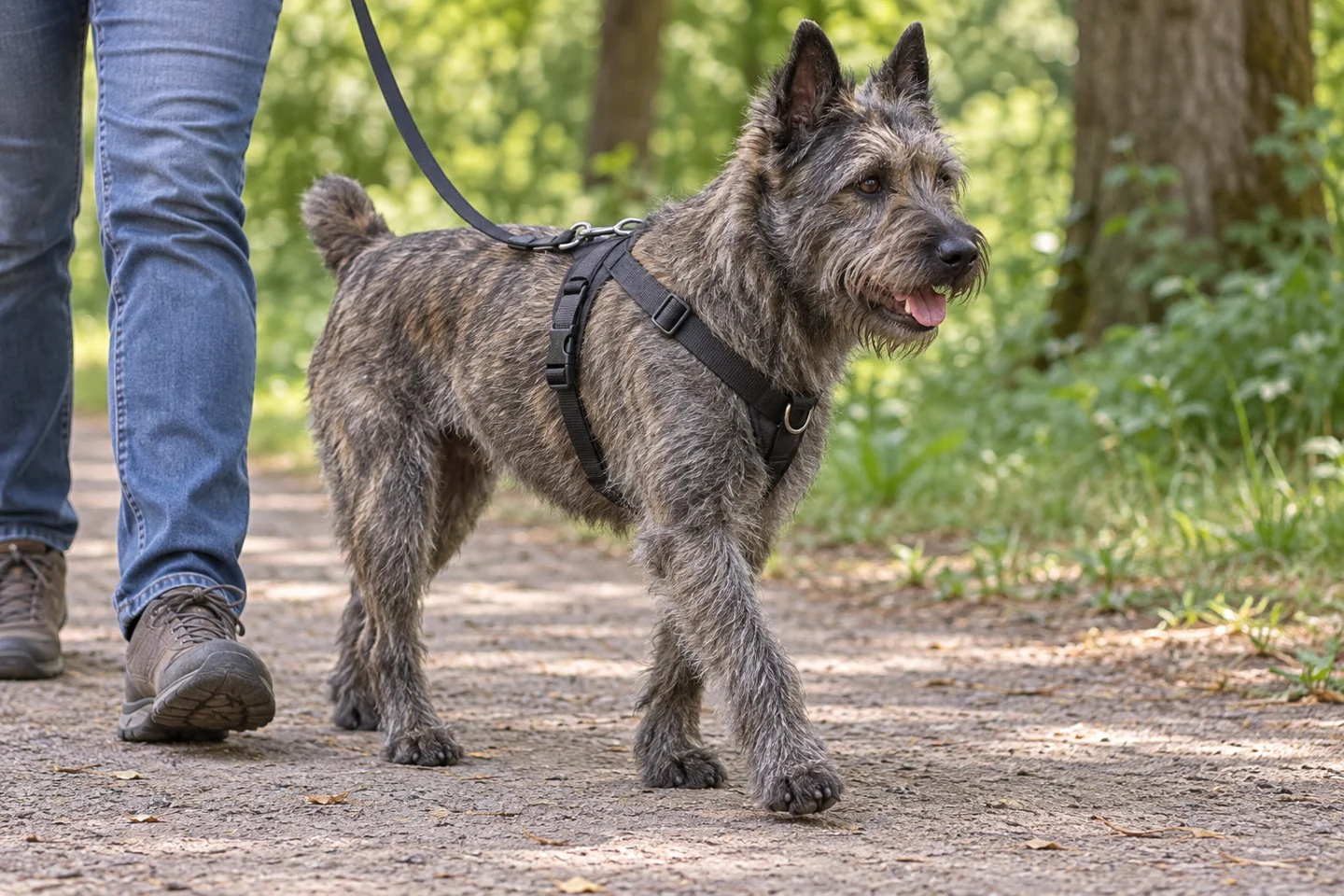
A cattle-dog background makes it sensible to ask about responses to running children, bicycles, vehicles, and other animals. Some individuals may try to control movement or become highly excited when something passes their boundary. Prevent rehearsals while you teach an alternative. Use a secure lead, a suitable harness, and enough distance for the dog to notice the event without lunging. Reward looking back to the handler or moving away before the reaction becomes difficult to interrupt.
Check the garden from the dog's point of view. A latch that opens under pressure, a gap beside a shed, or repeated access to a busy roadside can defeat an otherwise reasonable fence. Outdoor time should include supervision and companionship, rather than a long shift patrolling every passerby. If fence-running has become an established habit, restrict the view and access while you work on calmer routines. More exposure at the boundary is unlikely to teach a dog to relax by itself.
Visitors and household routines
Teach the dog where to wait before a visitor enters. A gate and a comfortable resting area give the owner time to manage the door without holding the collar against an excited body. Ask visitors to allow space and avoid reaching over the dog's head. A dog that notices unfamiliar people does not need to investigate every person immediately. Some visits can take place with the dog resting separately, especially while an owner learns its responses in a new home.
Do not encourage suspicious behavior because it looks like evidence of working ability. A household companion needs predictable decisions from people, including when to disengage and how to settle. Rehearse the routine before a busy gathering and provide a quiet place away from the event. If the dog repeatedly cannot recover after someone arrives, seek a qualified behavior professional. Explain the actual sequence of behavior and any bite history, rather than using a flattering label such as natural guardian to avoid the problem.
Children and safe shared space
Children need close adult supervision around an Ardennes, particularly during fast games or crowded transitions. A sturdy dog can knock over a child without intending harm, and grabbing clothing or blocking movement should not be dismissed as helpful herding. Stop the activity, separate calmly, and plan a different arrangement. Give children routes through the home that do not require stepping over a sleeping dog or squeezing between its bed and a doorway.
Teach children to leave the dog alone while it eats, chews, sleeps, or retreats. Adults should handle difficult exchanges and necessary care. A useful shared activity might involve a child placing a reward after an adult gives a familiar cue, with the dog free to move away. Avoid assigning a young child responsibility for controlling the lead outdoors. Breed identity does not establish child safety, and a dog's comfortable behavior with one familiar child cannot be generalized to a loud group of visiting children.
Other dogs, cats, and livestock
Ask for specific information about dog interactions. Does the Ardennes share space quietly, enjoy brief play, or become tense when another dog approaches an object? Arrange early meetings with room to move and handlers who can maintain distance. Separate food, chews, and favored resting places while the dogs learn each other's routines. A peaceful walk together is useful progress even when the dogs never choose physical play. Do not force proximity to prove that both animals are sociable.
Cats need protected spaces and escape routes beyond the dog's reach. Prevent chasing while you assess compatibility. Livestock access requires its own plan with someone competent to teach both dog and handler; cattle-dog ancestry does not supply automatic skills. Keep poultry and small pets securely separated. An owner should be able to explain what the individual has actually done around animals, including circumstances where management was needed. A broad promise that a farm breed understands all farm animals is insufficient.
Aggression and preserving warnings
Aggression can arise when a dog feels threatened, frustrated, sore, or concerned about losing a resource. Watch for stiffening, prolonged staring, avoidance, and a sudden change in willingness to be touched. Create space before the dog feels it must escalate. Do not repeatedly take its food or pin it down to establish authority. Quiet feeding areas and planned exchanges can prevent unnecessary conflict while a professional helps assess more serious guarding or handling concerns.
AVSAB supports reward-based methods. Punishing a growl can suppress a useful signal without changing the emotion that produced it. A veterinary examination matters when behavior changes suddenly or appears linked to touch, movement, sleep, or eating. Describe incidents accurately, including distance, context, and recovery, so a behavior professional can design a workable plan. Barriers, leads, and separate rooms should protect people and animals while the plan develops. Deliberately provoking another episode to test the dog creates avoidable risk.
Training practical cattle-dog choices
Start with responses that make daily life easier: coming away from a boundary, walking without dragging, releasing an object, and resting on a mat. Use rewards the individual values and keep the task understandable. Practice in a quiet place before trying it beside traffic or another dog. A dog that can sit in the kitchen has not automatically learned to do so while a bicycle passes. Increase difficulty in small steps and give the dog enough room to succeed.
Build cooperation with body handling as part of training. Reward a brief paw touch, a look at an ear, or standing comfortably on a stable surface. Stop before a session becomes a wrestling match. These skills help with grooming and veterinary care throughout life. If you want to pursue herding, use an instructor who works humanely and can judge the suitability of the individual dog and livestock. Avoid improvising a lesson with frightened animals or assuming rough handling is part of preserving working ability.
Exercise and useful mental activity
An Ardennes needs regular physical activity appropriate to age, health, weather, and conditioning. Combine walks with opportunities to sniff and brief training rather than trying to exhaust the dog through endless high-speed play. A garden can support games and toileting but does not replace shared outings and interaction. Look at how the dog settles afterward. Persistent frantic behavior may reflect an unsuitable routine, lack of rest, or another problem that simply adding more running will not resolve.
Scent searches, controlled retrieving, and well-taught movement exercises can provide useful occupation. Keep surfaces secure and avoid repeated sharp turns on slippery ground. Puppies need developmentally appropriate activity rather than forced distance or repetitive jumping. After unusual exertion, monitor for stiffness, altered gait, or reluctance to move. Stop and seek veterinary guidance if these appear. A working identity is not a reason to expect the dog to ignore discomfort or recover without suitable rest.
Grooming a weathered-looking coat
A rough coat still needs regular attention. Work through it with suitable tools, check close to the skin, and pay attention to friction areas, the beard, feet, and collar. Remove debris after countryside walks before it becomes tangled against the skin. A deliberately rustic appearance should not conceal matting, sores, or retained moisture. Ask a groomer familiar with harsh coats how to maintain this particular coat without making routine care uncomfortable for the dog.
Dry a wet beard and check the skin beneath it rather than relying on perfume to cover a smell. Examine ears and paws gently, keeping sharp tools away from sensitive tissue. Persistent head shaking, redness, discharge, or pain needs veterinary assessment. Introduce nail care gradually and obtain help if the dog struggles. Avoid using sedation products or human medications on your own. Cooperative care lessons and a patient professional can make necessary maintenance safer than repeatedly forcing a frightened dog through it.
Health evidence and appropriate questions
Reliable, broad health information is more limited for the Bouvier des Ardennes than for many widely registered breeds. The FCI appearance standard does not establish disease prevalence or provide a complete screening program. Ask the relevant national breed organization and your veterinarian what evaluations are currently appropriate for the family and breeding population. Request actual results and a discussion of significant illness in relatives. Rarity should not be treated as proof that inherited problems are absent.
Distinguish a clinical examination, an orthopedic assessment, an eye examination, and a DNA test. Each answers a different question, and a large genetic panel cannot rule out every cause of future disease. Keep records with identifying details so results can be matched to the correct dogs. Ask what happens if a problem is discovered after placement and whether owners' reports are collected. Avoid declaring a universal Ardennes test list or a reliable lifespan guarantee where the evidence available does not support one.
Food, weight, and mixes
Feed a complete diet suitable for the dog's life stage and adjust amounts according to body condition and activity with veterinary advice. Working days and quiet weeks may require different portions. Include food rewards in the daily total and check condition beneath the coat. Provide fresh water and investigate persistent digestive changes or appetite loss. Claims that every cattle dog requires raw meat or a particular supplement need individual nutritional justification rather than an appeal to traditional work.
An Ardennes crossed with another breed remains a mix, even if both parents have working backgrounds. Adult size, coat, reactivity, and livestock behavior can vary. Ask about health evaluations for both parents and the circumstances in which the puppy was raised. For a rescue with uncertain ancestry, practical observations matter more than a confident label. A rough-coated dog with a bobtail is not automatically an Ardennes. Avoid advertising a mix as combining every desirable quality while removing the demands of its parents.
Suitability, costs, and later life
This breed can suit an owner who enjoys regular training and can provide secure boundaries, purposeful outings, and predictable household routines. It is a poor fit when a dog is expected to spend most of its time alone outdoors or provide protection without professional management. Consider access to knowledgeable veterinary care, suitable holiday arrangements, and help during illness. The cost of locating a relatively uncommon breed may be only a small part of the expense over its lifetime.
Budget for food, routine care, parasite prevention, grooming tools or appointments, training, insurance or emergency savings, and transport. Ask how an injured adult would be moved safely. With age, walking routes, floor traction, and resting places may need adjustment. Record gradual changes in mobility or tolerance for touch and seek assessment before assuming they are simply unavoidable aging. The dog should retain comfortable opportunities to explore and choose company, even when strenuous activity is no longer suitable.
A manageable dogsDating introduction
Describe the individual Ardennes on dogsDating through concrete behavior: walking pace, response to unfamiliar dogs, play style, lead needs, and known concerns about resources or close handling. Keep exact home coordinates private. Choose a quiet public place with room to move away and agree on an easy way to end the meeting. Avoid using a first encounter to test livestock skills, guard behavior, or tolerance of a crowded dog group. Both owners need a practical plan before arrival.
Begin with parallel movement at a comfortable distance. Watch for loose posture, voluntary checking in, and the ability to disengage. Increase contact only when both dogs remain comfortable, and interrupt persistent body-blocking or pursuit. Separate treats and toys if resources could complicate the encounter. A short calm walk is useful information even without play. Future meetings should follow the dogs' actual responses, while owners remain responsible for safe handling and respecting a request for more space.
Sources and editorial notes
Sources checked October 21, 2026. Breed measurements describe reference ranges, not a diagnosis or an individual dog's ideal weight. Images are AI-generated breed illustrations and do not document a particular dog or health condition.
- VCA: Ear Infections in Dogs
- VCA: Food Aggression in Puppies
- AVSAB: Humane Dog Training Position Statement
- Orthopedic Foundation for Animals: Diseases
- VCA: Feeding Guidelines for Dogs
- FCI: Bouvier des Ardennes Breed Standard
- Orthopedic Foundation for Animals: Canine Health Assessments
- VCA: Grooming and Coat Care for Your Dog
Keep getting to know dogs.
Read another guide or return to your dogsDating community.
Explore breed guidesBack to dogsDating