Braque d’Auvergne
A black-and-white French pointing dog that benefits from field-minded training, calm family routines, and candid evidence about health and temperament.
How these guides are researched and reviewed
- Origin
- France; Auvergne and Cantal
- Coat and identity
- Short black-and-white, often ticked or roan
- Care priorities
- Scent-led walks, black-and-white coat care, and company
General information for owners. These articles have not been reviewed by a veterinarian. Medical decisions need your dog's history and an examination.
Deciding whether an Auvergne fits your week
Put the walks on the calendar before choosing a Braque d’Auvergne. Write down who is available on the difficult days, including when work runs late or the usual outdoor plan is cancelled. This is a pointing dog with practical interests to satisfy beyond an attractive black-and-white coat. A fenced garden can support daily life, but it does not supply company or explain how to respond when something interesting happens on the other side. Consider what the dog will do throughout the day, including the periods between outings.
A useful visit includes ordinary downtime. Ask an owner if you can watch how an adult behaves after a walk, while food is prepared, and when a visitor arrives. These moments reveal care tasks that photographs cannot show. An adult foster placement may have information about indoor routines, whereas a puppy has more of its development ahead. Neither source should promise perfect behavior in every setting. Choose according to the evidence available and the support your household can sustain rather than the hope that a pleasant greeting answers every question.
Keep a small record of the circumstances around successful walks. Note the route, weather, nearby wildlife, and whether the dog could respond before its lead tightened. This gives a new walker useful instructions beyond saying the dog is energetic. A shaded route with room to turn may work better than a short crowded circuit, even when both take the same time. When holidays or visitors alter the routine, preserve a familiar resting place and allow the dog to finish exploring before requesting complicated exercises. Adjust the environment when concentration drops. Repeating a louder cue rarely solves a problem created by excessive excitement or insufficient distance.
Cantal origins and the breed name
The FCI identifies the Braque d’Auvergne as a French pointing dog from the Auvergne region, particularly Cantal. Its standard describes a breed shaped for the work of a hunting companion. That background provides a sensible starting point for questions about scent interest and outdoor learning. It does not document the exact ancestry of every living dog or establish the temperament of a particular litter. Recent family experience matters when deciding what the first year of ownership may involve.
Ask a seller to name the registry and provide the recorded breed identity. The Auvergne is separate from the Braque du Bourbonnais and the Gascogne and Pyrénées types of Braque Français. Similar jobs do not make their records interchangeable. A rescue described as an Auvergne may have a visual identification rather than verified parentage; keep that distinction clear. A dog with uncertain ancestry can still make a suitable companion, but its care should follow observed needs rather than an unsupported assumption about a breed-specific trait or medical program.
Black-and-white markings and an athletic body
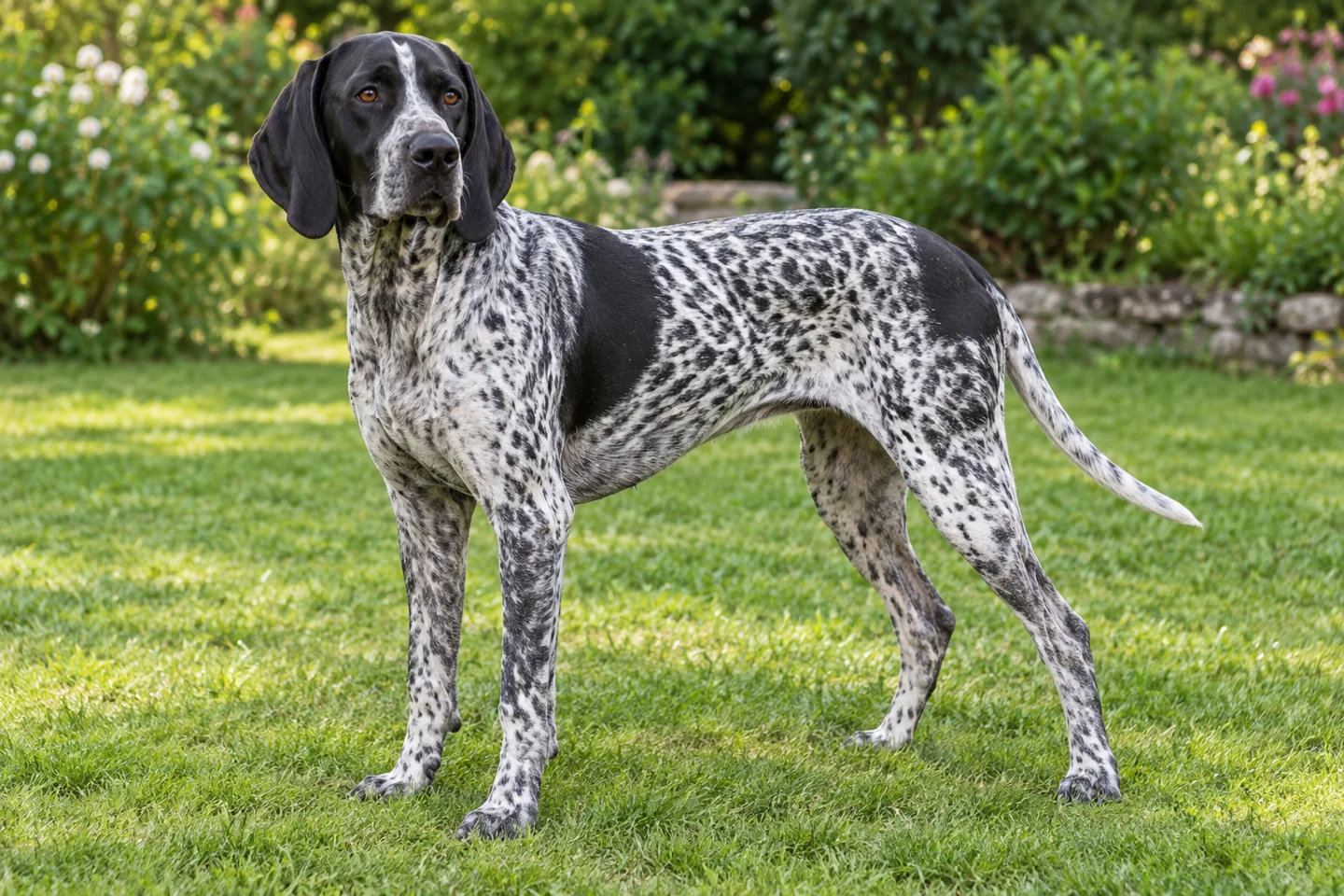
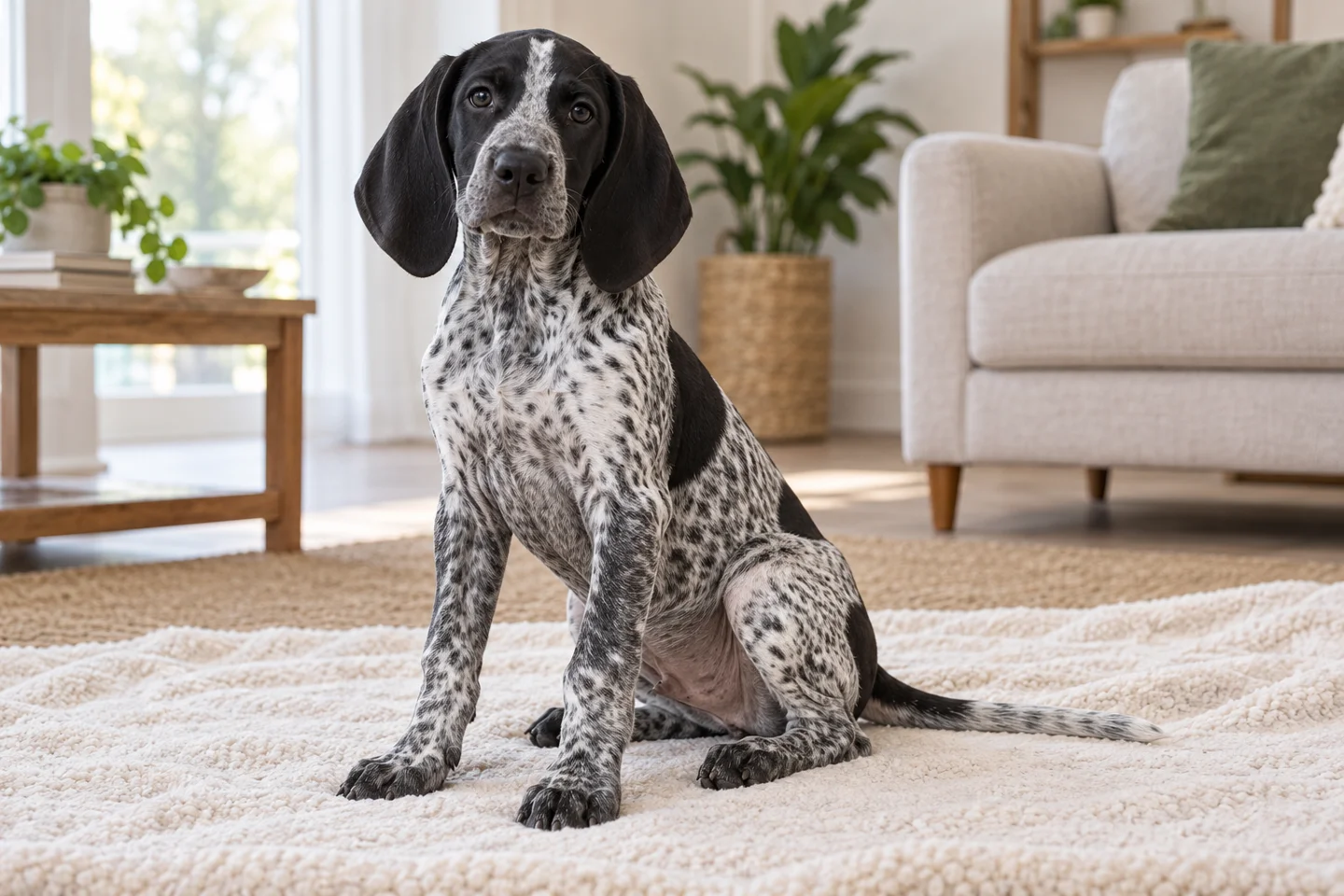
The short coat is black and white, often with ticking or roaning. Individual markings vary. The FCI's description helps explain the recognizable appearance without making one pattern a test of health or suitability. These images are generated illustrations, not documentary photographs. They show breed features for orientation and cannot establish an animal's ancestry, physical comfort, or future behavior. Meet a real dog before deciding how its size and movement fit your home, car, and walking routes.
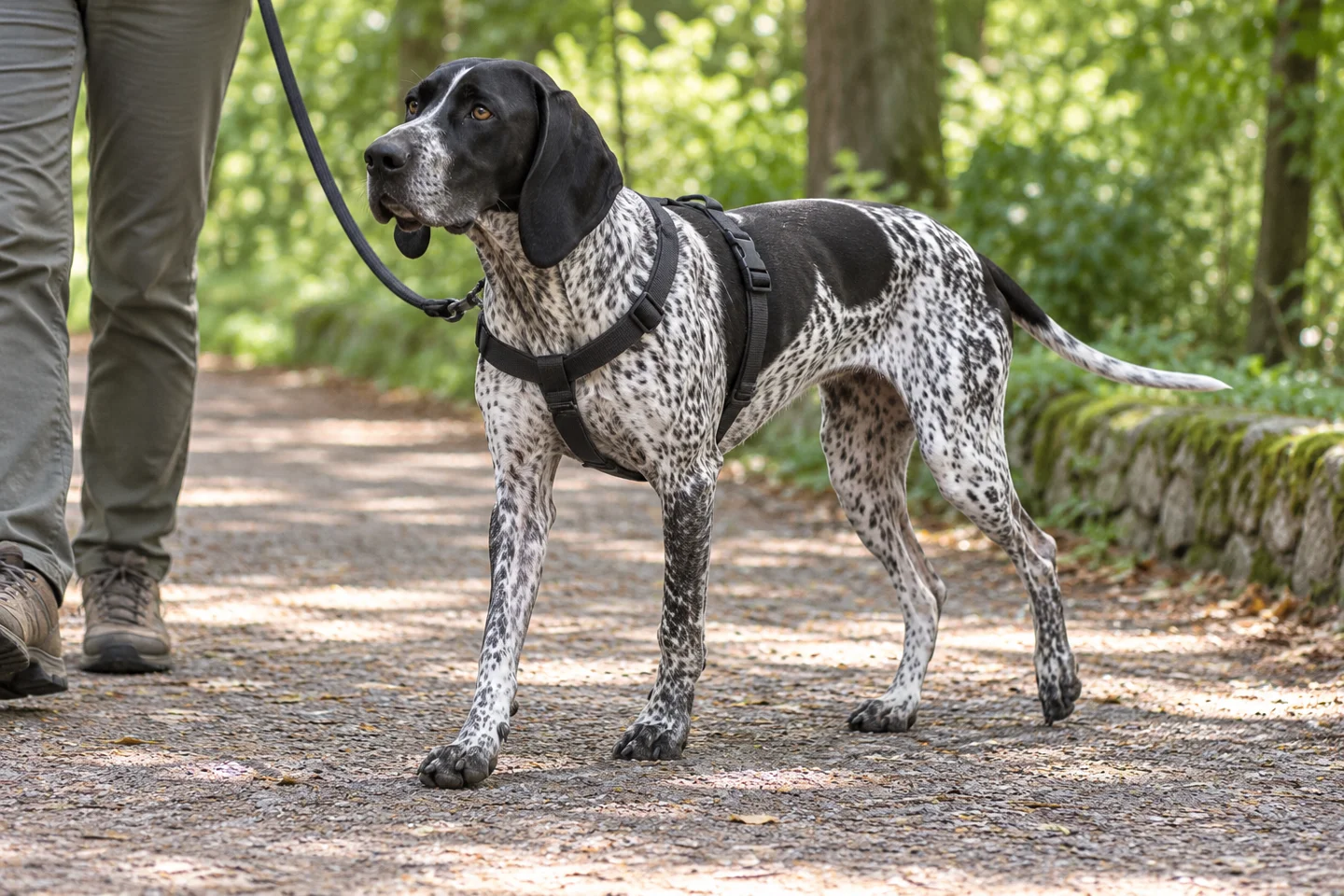
Watch the dog on an unhurried walk, particularly during changes of direction and when it rises after resting. Ask about anything that repeatedly looks uncomfortable. Coat condition alone cannot tell you whether a dog is fit. Have a veterinarian demonstrate body-condition assessment and discuss any persistent change in gait. Try a harness on the individual instead of buying from a breed label. The useful fit stays secure during a backward step and leaves the shoulders free. Adjust it as the dog develops and check the contact areas after wet outings.
Building a walk around scent
An Auvergne can find a roadside verge more absorbing than the route you intended to complete. Decide where investigation is safe and allow time there, then teach movement away in easier circumstances. Reward a glance back before the lead becomes tight. If the dog is already struggling to disengage, change distance or direction instead of repeating a cue continuously. The handler's job includes choosing a workable environment rather than relying on obedience to compensate for every unsuitable setting.
Countryside access requires particular care around birds, livestock, and other users. Do not release the dog near a hazard merely because it returns well in the garden. Use a secure enclosure or appropriately managed line for training and follow local restrictions. Check gates and fence gaps at rented fields yourself. Plan what happens when someone else opens the car or front door. A clear routine, practiced by every carer, prevents an exciting smell from becoming an unexpected escape before the walk has even started.
Training with an achievable outdoor task
Give the dog a specific job it can understand. A short search for a safe object in a controlled area can use its interests while letting you practice waiting, release, and returning toward a person. Keep difficulty low enough to maintain willingness. You do not need to introduce live prey to make companion activities meaningful. If you want field training, obtain qualified instruction that includes the owner's handling, environmental decisions, and welfare responsibilities as well as the dog's responses.
Teach the less exciting parts too: standing for equipment, pausing at an open doorway, and settling after the lead comes off. Use rewards and clear timing. AVSAB recommends reward-based methods; fear or painful corrections can create problems that outlast a single lesson. When a dog cannot perform a known skill, examine what changed. A busier location, unfamiliar person, or strong odor may require an easier version of the task. A patient instructor can help identify that adjustment without turning the lesson into a contest.
Exercise without making every day a field day
Ask about current conditioning before planning strenuous activity. A dog's willingness to follow you does not establish readiness for a long ascent or a full day over uneven ground. Build distance and complexity gradually, observing comfort afterward and following rest. For a puppy, discuss sensible exploration and any proposed repetitive impact activity with its veterinarian. Provide sleep and breaks rather than expecting a youngster to keep pace with an adult dog simply because the adults appear similar in energy.
Maintain a modest alternative for bad-weather days. A manageable local outing, a brief search, and quiet household learning can fit an altered schedule without creating a frantic indoor session. In warm weather, choose cooler conditions, provide water, and shorten the route when needed. Collapse or serious breathing distress requires urgent veterinary help. After vegetation, inspect paws and the body for loose debris, wounds, or painful swelling. Do not dismiss a new limp as the normal price of a satisfying walk. Seek assessment and adapt the next outing accordingly.
Children, guests, and quiet space
Arrange arrivals so a child is not responsible for managing an excited dog at the door. An adult can handle equipment in a separate area and invite contact later. Children need straightforward rules about leaving bowls, chews, and beds alone, with an adult available to help retrieve misplaced belongings. Physical separation is useful during games that involve running or sudden noise. It allows family life to continue without asking the dog to endure every activity at close range.
When contact occurs, supervise closely and let the dog choose whether to stay. Avoid restraint for photographs, face-to-face hugs, or repeated stroking after it turns away. A visitor may read a wagging tail as permission without noticing the rest of the body. Explain the dog's preferences and interrupt pressure early. Reassess the plan after illness, an injury, or a change in the child's mobility. The same household can need different arrangements as its members develop. Previous comfortable interactions do not remove the need to observe the next one.
Birds, cats, and sharing a home with dogs
An Auvergne's pointing background makes pet birds and poultry a serious placement question. Ask which animals it has actually encountered and whether those experiences were controlled. A report that a dog works with birds does not establish safe companionship beside a cage or run. Set up barriers that stay effective while people feed, clean, and move between areas. If the separation relies on one person always being present, consider what happens when that person is ill or a visitor opens the wrong door.
Cats require protected routes and a gradual introduction that prevents chasing. A dog may behave differently when a familiar animal rests indoors and when an unfamiliar one runs across a field. With another dog, look beyond the initial outdoor greeting. Allow each access to rest and water without being followed constantly. Separate valuable items while you learn their habits together. If one repeatedly moves away and the other keeps pursuing, intervene. A quieter dog should not have to escalate a warning before the household provides it with a break.
Aggression and changes during handling
Suppose an Auvergne that normally accepts a harness begins growling when it passes over the head. Stop and investigate rather than insisting that a familiar task must be safe. An equipment problem, pain, or an earlier frightening event may need attention. Explain the exact sequence to the veterinarian and keep others from repeating it as a test. Aggression is a description of behavior requiring assessment, not a diagnosis supplied by a breed name.
Food or object guarding needs similarly careful management. Give meals without interference and teach exchanges in calm, low-stakes situations. Do not repeatedly take the bowl away to establish control. VCA's guarding advice explains how such competition can worsen concern over resources. For repeated threats, a bite, or escalating fear, obtain a qualified behavior plan alongside veterinary care. Protect people with barriers and distance while assessment proceeds. Punishing warnings can leave discomfort unresolved and make the next incident harder to anticipate. Record what occurs factually rather than minimizing it for a prospective carer.
Grooming after a black-and-white dog’s outing
A pale area of coat can make some dirt conspicuous without revealing every skin problem. Check under the harness and around the toes, brush loose hair, and wash when needed using a dog-appropriate product. Keep drying practical and comfortable. For a dog that dislikes towels, begin with a brief touch in an easy moment and reward cooperation instead of waiting until a muddy return makes a full session unavoidable. Small preparatory lessons can prevent ordinary care from becoming a recurring struggle.
Dropped ears need a sensible monitoring routine. Tell the veterinarian about head shaking, tenderness, an odor, or discharge; do not diagnose the cause by color alone. Ask whether cleaning is needed and request a demonstration. Dental and nail maintenance also benefit from short stages rather than a prolonged wrestling session. New objections to touch deserve attention, particularly when they occur in one location. Advise groomers or clinic staff about handling concerns when booking so they can plan an appointment suited to the dog's welfare and immediate care needs.
Health evidence without a borrowed checklist
A comparatively uncommon breed may have fewer publicly accessible population studies than a widely registered one. That gap should change the questions you ask, not invite an invented disease ranking. For the Auvergne, request the source's own screening policy and the reason for each assessment. Ask whether joint imaging, specialist eye examinations, or other tests were chosen because of family findings, a club program, or veterinary advice. The FCI standard supplies breed identity and conformation details; it cannot establish how frequently a disorder occurs.
Look at the actual reports. Does the identifier match the claimed dog, what method was used, and when was the examination done? A normal clinical check is useful but differs from formal screening of a breeding adult. Ask about close relatives that developed significant illness and whether the source followed up on puppies after placement. An unwillingness to discuss missing or adverse information is itself useful placement information. With rescue records, distinguish unknown from negative rather than transforming an absent report into a reassuring result.
Health observations, feeding, and ordinary prevention
Create a baseline during an initial veterinary visit: current condition, movement, mouth, parasite plan, and vaccination needs appropriate to the dog's activities. Then keep concise notes of changes. A loss of enthusiasm for a familiar route can be worth investigating even without dramatic lameness. Increased thirst, altered appetite, repeated digestive signs, or new sensitivity should be described with timing and circumstances. They can have many causes. A breed label or reassuring ancestral report should not delay clinical assessment of the individual.
Feed a complete diet appropriate to life stage and any medical requirements. Measure portions while learning what maintains comfortable condition and include rewards offered during outdoor practice. Separation at meals helps avoid competition and makes intake easier to monitor. Ask a veterinarian before adding supplements or constructing a home-prepared diet. Keep food choices stable enough to notice what changes, and seek advice rather than cycling through products when symptoms persist. Emergency care is needed for collapse, severe respiratory distress, major trauma, or other rapidly worsening illness; keep the relevant clinic details accessible.
A useful travel rehearsal includes a short drive followed by an ordinary walk, rather than making the first journey a major event. Check whether the restraint remains secure when the dog lies down and whether it can enter without slipping. Carry familiar bedding and clean water. Ask the clinic about motion sickness if salivation or vomiting repeatedly occurs in the vehicle, and investigate reluctance to load instead of pulling the dog through it.
Mixes, ownership costs, and dogsDating
For an Auvergne mix, ask how ancestry was established. Black ticking is not a pedigree, and mixed ancestry cannot promise a certain size, easy behavior, or freedom from inherited illness. Assess the actual coat, activity, and social needs. A placement agreement should explain veterinary records, ongoing support, and what happens if circumstances change. Budget beyond food for training, secure equipment, preventive treatment, unexpected diagnostics, and competent backup care. Practice the backup arrangement while you are available to resolve difficulties.
A dogsDating profile should describe the individual's present social experience, including preferred distance and any relevant chase or guarding history. Keep exact home coordinates private. Arrange a first outing on a public route where handlers can change direction freely, and allow the dogs to walk separately before considering contact. Remove pressure to play or share resources. Stop if either dog cannot disengage comfortably. If you later plan shared transport or a home visit, assess those situations in their own right. One agreeable walk supplies useful information about that walk, not a universal promise about living together.
Sources and editorial notes
Sources checked October 21, 2026. Breed measurements describe reference ranges, not a diagnosis or an individual dog's ideal weight. Images are AI-generated breed illustrations and do not document a particular dog or health condition.
- AVSAB: Humane Dog Training Position Statement
- VCA Animal Hospitals: Food aggression in puppies
- VCA Animal Hospitals: Heat stroke in dogs
- VCA Animal Hospitals: Aggression toward unfamiliar dogs, diagnosis
- VCA Animal Hospitals: Common emergencies in dogs
- AAHA: Feeding plans for healthy, appropriate weight cats and dogs
- Fédération Cynologique Internationale: Braque d’Auvergne breed standard
- Orthopedic Foundation for Animals: CHIC health screening programs
- VCA Animal Hospitals: Grooming and coat care for your dog
- VCA Animal Hospitals: Ear infections in dogs
Keep getting to know dogs.
Read another guide or return to your dogsDating community.
Explore breed guidesBack to dogsDating