Braque du Bourbonnais
A French pointing breed with liver or fawn ticking, variable natural tail length, and practical needs for scent work, company, and thoughtful introductions.
How these guides are researched and reviewed
- Origin
- France; Bourbonnais
- Coat and identity
- Short liver- or fawn-ticked white coat
- Care priorities
- Pointing outlets, natural tail variation, and calm handling
General information for owners. These articles have not been reviewed by a veterinarian. Medical decisions need your dog's history and an examination.
Start with the Bourbonnais household plan
A Braque du Bourbonnais deserves a placement conversation about daily life before a discussion of color or tail length. This French pointing breed can attract someone looking for an outdoor companion, but the ordinary hours at home matter just as much. Work out when the dog will walk, eat, learn, and sleep, then ask who takes over if the usual person is unavailable. A dog cannot organize those arrangements around a changing work schedule or compensate for them simply by having access to a garden.
Request examples rather than broad assurances. If a source describes a dog as good with visitors, ask what happens at the door and whether visitors have stayed overnight. If the dog is called active, ask about its current routine and recovery after outings. Answers from a foster household may help you understand an adult. With a puppy, discuss the experiences already provided and the support available as it develops. Choose a dog whose requirements fit the care you can actually maintain, including the difficult parts of the week.
Arrange a handover walk with the person currently caring for the dog when possible. Watching how they reward a check-in, pass livestock, or settle after an outing provides practical information a written description can miss. Ask which cues have actually been taught and which equipment the dog has worn comfortably. Carry those familiar elements into the first days at home, then change routines gradually as you learn what suits your household.
A French name with a particular history
The FCI standard places the breed's origins in Bourbonnais, France. It records an early literary description and explains how earlier selection became overly focused on characteristics such as color and naturally short tails. That history makes a useful point for present-day buyers: a distinctive appearance should not displace attention to health, behavior, and function. Ask about the source's priorities and how they evaluate the complete dog rather than paying a premium for a single visible feature.
Braque du Bourbonnais is its own breed identity. The Auvergne and the French Pointing Dog types are separate entries, despite related names and work. Check the recorded identity when reading pedigrees or medical reports. A rescue's suggested breed may reflect appearance alone. It is reasonable to retain uncertainty when ancestry is unavailable. Medical care and placement decisions should follow the evidence that exists, not an invented pedigree assembled from coat flecks, a short tail, and a convincing sales description.
Ticking, head shape, and natural tail variation
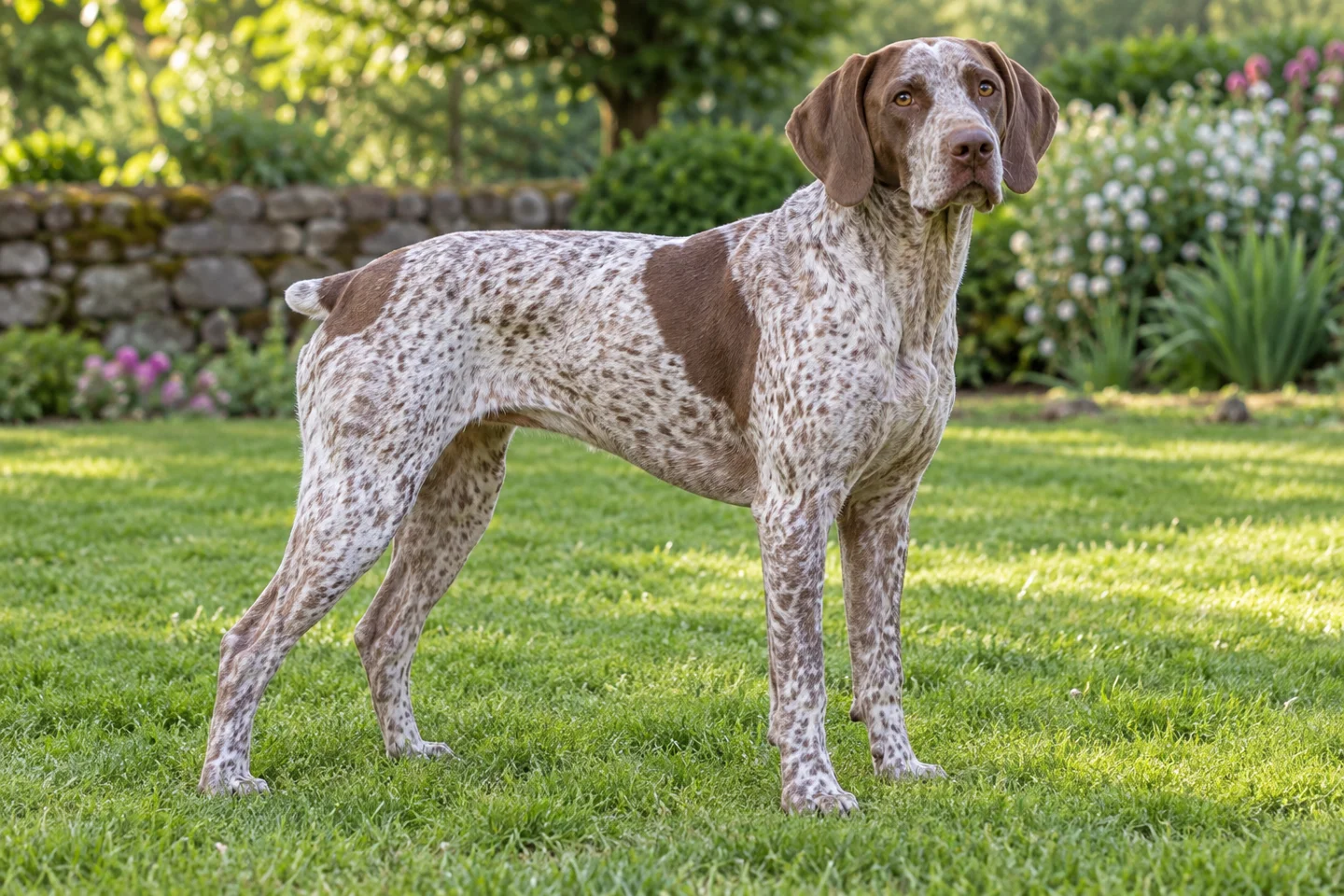
The Bourbonnais has a short coat with liver or fawn ticking on white and a recognizable pointing-dog outline. Markings can vary considerably. The breed's association with naturally short tails does not mean every dog has an identical tail or that a short tail proves ancestry. Ask how a particular tail developed if that is relevant to the dog's record. The accompanying AI-generated illustrations show naturally short-tailed breed examples; they cannot document the anatomy or history of a real animal.
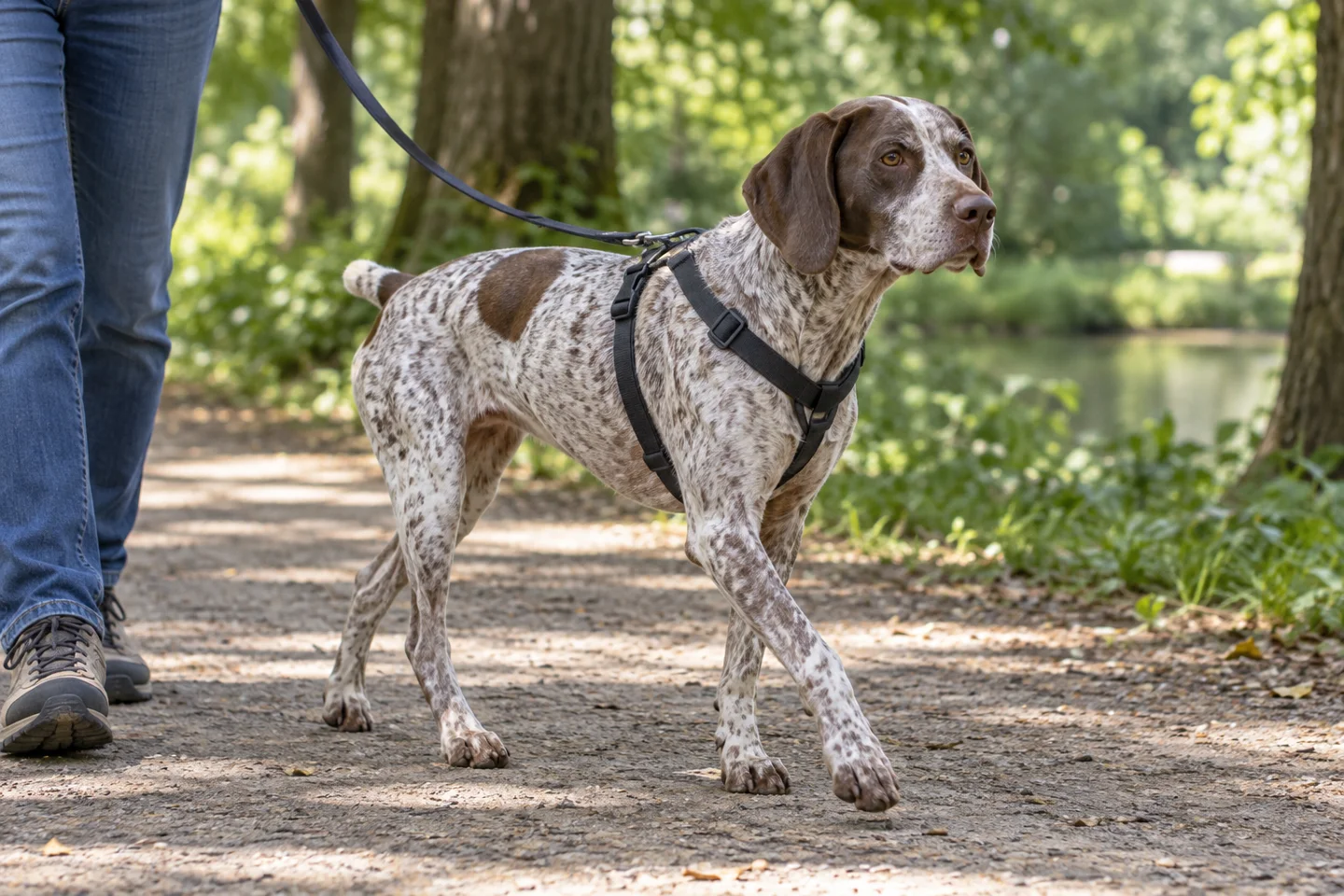
Assess comfort through ordinary observation. Watch the dog turn toward a handler, move across level ground, and settle after activity. A striking head or unusual marking cannot reveal whether something hurts. Ask the veterinary team to demonstrate an appropriate body-condition check and discuss recurring stiffness or lameness. Equipment should fit the individual chest and allow movement without rubbing. A growing puppy needs frequent reassessment. Check both fastening and security before using a new harness outside, especially if the dog tends to reverse away from an unfamiliar object.
Training a bird-interested companion
A Bourbonnais that pauses at a bird has shown an interest relevant to its background, not mastered the skills needed for safe field work. If hunting is part of your plan, find instruction that teaches the owner as well as the dog. Ask how sessions protect welfare and comply with local requirements. Do not introduce gunfire or uncontrolled wildlife encounters as a casual experiment. Early fear or an unsafe pursuit can create consequences well beyond that afternoon's lesson.
In a companion household, create tasks with a clear start and finish. Hide a safe object at an easy level and reward finding it, then put the equipment away. Teach returning toward a person separately before adding a difficult outdoor distraction. AVSAB recommends reward-based approaches, which allow the handler to show the dog which choices lead to useful outcomes. If motivation disappears, consider fatigue, environment, and task design. Repeated correction may make the dog wary without making the original instruction any clearer.
Exercise that prepares rather than tests
Build an outing from what the dog currently does comfortably. An adult arriving from a different home may have less fitness than its age or apparent enthusiasm suggests. Increase the duration and terrain gradually, making time to check its condition after rest. For a youngster, obtain advice about development before introducing repetitive running or jumping. A growing dog benefits from exploration and sleep without being expected to meet an adult training target.
Consider the whole trip, including the car journey and inspection afterward. Bring water, allow recovery, and look at the feet after rough ground. If a dog repeatedly slows at the same point, record the circumstances and discuss them rather than assuming reluctance is a behavioral issue. Warm weather can require a different time or a shorter plan. Severe distress, weakness, or collapse warrants urgent veterinary help. A working breed description cannot make heat or an injury less dangerous, and an owner should be ready to abandon a route when necessary.
Boundaries near birds and livestock
Choose outdoor freedom according to the setting and the dog's demonstrated skills. A familiar response in a quiet field leaves uncertainty beside a nesting area or moving livestock. Use an appropriate lead arrangement where you cannot safely obtain control. Check the entire enclosure before letting the dog explore, particularly gates someone else may use. Give visiting family members a simple door routine and practice it. An extra moment to attach a lead is easier than managing an escape into an unfamiliar street.
Treat poultry and captive birds as a placement issue requiring reliable separation. A hunter's report about working with birds is not a statement that the dog can live unsupervised beside vulnerable pets. Cleaning a run or opening a cage can weaken an otherwise adequate boundary. Plan those tasks too. If an existing arrangement depends on everyone never making a mistake, consider whether another layer of physical security is needed. Ask for professional guidance when fixation or pursuit occurs rather than staging a closer encounter to discover the limit.

Children and daily transitions
Focus supervision on moments when competing needs meet. A child coming home with food, a dog waiting for its walk, and an open hallway can create avoidable pressure. An adult can separate the routines so the dog is not asked to resist every temptation at close range. Give it a resting area outside children's games, with a barrier available when adult attention is divided. Explain to visiting children that the bed and bowl are not places to approach for contact.
Teach a child how to invite the dog to come closer and how to accept that it may stay away. Do not hold the dog still while someone strokes or hugs it. A wagging tail does not answer every question about comfort. Look for attempts to leave, unusual stillness, or a change in the whole body. End the contact before the dog has to be more obvious. Review the arrangement when the dog is tired or unwell and when a child's age or behavior changes. Friendly history cannot replace observation today.
Other dogs and cats under one roof
Ask what living with another animal actually involved. Sharing a walking route differs from resting beside a favored person or waiting while meals are prepared. During early adjustment, give each dog independent resources and a way to be apart. Keep an eye on quieter behavior such as one dog repeatedly standing in the other's route. Intervention can mean a simple change in layout rather than waiting for a noisy disagreement that makes both animals more anxious.
Cats should have secure routes and resting places inaccessible to the dog. Introduce movement at a level where the Bourbonnais can remain responsive, and prevent pursuit while you assess compatibility. Tolerance of one familiar cat may not carry into a garden encounter with a running stranger. Ask the current carer for precise observations and retain uncertainty where no exposure has occurred. If maintaining separation would be unworkable in your home, acknowledge that before placement instead of relying on the animals to resolve the problem themselves.
Aggression, valuable objects, and discomfort
If a dog freezes over a found object, stop advancing and make the situation safe. Do not make repeated removal of valued items a routine lesson in authority. Teach rewarded exchanges with safe items before you face an urgent retrieval. VCA's guarding guidance explains the risks of increasing competition around resources. Arrange meals so children and other animals do not hover nearby. The aim is an animal able to eat without expecting conflict, with people using a practiced method when an exchange is needed.
Threats during handling deserve a different investigation. Note exactly where the dog was touched and whether the response is new. Arrange a veterinary examination for pain or illness and tell the clinic about the behavior before arriving. Recurrent aggression or any bite calls for qualified assessment and an explicit safety plan. Do not conceal an incident from a future carer or arrange an informal test with a stranger. Punishment can suppress the warning without resolving the underlying concern, leaving the next handler with less information about the risk.
Grooming a short coat and inspecting the feet
Use routine care as a chance to notice changes, not as a prolonged test of tolerance. A soft brush, a brief skin check, and inspection beneath equipment can be introduced separately. After an outing, look around the toes for material caught in the coat. Ask for assistance with embedded debris or painful swelling. Develop comfortable foot handling well before the first complete nail trim, using short touches and pauses the dog can predict.
Dropped ears can hide problems from casual view. Head shaking, odor, discharge, or soreness needs clinical advice rather than an assumed diagnosis. Ask the veterinarian which cleaning method, if any, suits the individual. Avoid pushing tools into the canal and do not reuse medication solely because the signs look familiar. Tooth brushing also needs gradual introduction with appropriate products. When a dog begins avoiding a care task it previously accepted, investigate the change. More force may complete one session while making necessary future treatment harder to provide.
Health questions tied to this family
For the Bourbonnais, ask how a breeding decision was made and what the source has learned from earlier relatives. Which significant diagnoses occurred, how were they confirmed, and was follow-up available after puppies went to new homes? A standard emphasizing breed identity does not provide a population-wide measure of disease frequency. Do not accept a list copied from another French pointer as proof that every relevant question has been answered. Ask the source to explain the evidence behind its own policy.
Request results that identify the actual dog, date, and assessment method. If a DNA panel was used, ask which variants it covers and how the result affects the proposed mating. A generic clear label can conceal very different types of information. Discuss the reports with your veterinarian and distinguish a formal specialist assessment from a routine physical check. Missing rescue records should remain marked as missing. They do not justify a claim that a test was normal, and they do not prevent a sensible care plan based on a present examination.
Health observations and feeding through change
Keep a record of the dog's usual appetite, condition, movement, and behavior. It need not be elaborate; dates and a few precise observations can help when something changes. If a dog avoids a familiar step, drinks more, repeatedly vomits, or loses enthusiasm for a regular outing, consult the veterinarian rather than explaining everything through breed or age. Many different causes can produce those signs. Urgent problems such as severe breathing difficulty, collapse, major trauma, or rapidly worsening illness require prompt assistance.
Use a complete diet chosen for age and clinical requirements. A new home, temporary reduction in exercise, or return to demanding activity can require a review of portions. Weigh food initially and account for training rewards while assessing body condition with the veterinary team. Eating separately allows you to see whether the dog finishes its own meal. Add supplements only after discussing a specific need, and seek qualified advice for home-prepared diets. A pleasant appetite cannot confirm that every nutrient is present in the correct amount.
Mixes and the practical cost of placement
A short tail and flecked coat can appear in a dog whose ancestry is uncertain. Describe a suggested Bourbonnais mix accordingly. A cross can inherit a different combination of physical and behavioral traits, and mixed parentage does not establish freedom from inherited illness. For a planned cross, ask about both parents' relevant records. For an adult rescue, a detailed account of behavior in a current household may be more immediately useful than an exact breed estimate that cannot be supported.
Include emergency treatment, training, safe equipment, suitable outdoor access, and backup care in the budget. Ask a prospective sitter to rehearse a walk and demonstrate door security while you can still help. Think about the arrangements if you become less mobile or have to move. A responsible source discusses what support or return process exists when a placement encounters serious difficulty. Rarity and appearance should not create pressure to decide before you understand the records, the costs, and the changes your home will need.
dogsDating and a meeting that stays manageable
Describe your Bourbonnais on dogsDating through actual experiences: calm walking beside a familiar dog, needing time before close contact, or difficulty around valued items. Do not replace those facts with a claim that the breed is always sociable. Use an approximate location and keep exact home coordinates private. Select a public meeting route with room to increase distance. Separate handlers should control the dogs, and neither dog should have to pass through a narrow entrance directly toward the other.
Let exploration and parallel movement occupy the first meeting. There is no requirement to turn a relaxed walk into play. Leave chews and shared toys out and finish if one dog cannot stop pursuing or avoid being pursued. A subsequent home visit has different resources and boundaries and needs its own plan. Likewise, social compatibility is not a reproductive or medical assessment. Useful meetings depend on clear information, adaptable distance, and owners willing to end while the dogs are still comfortable rather than pressing for a particular photograph or outcome.
Sources and editorial notes
Sources checked October 21, 2026. Breed measurements describe reference ranges, not a diagnosis or an individual dog's ideal weight. Images are AI-generated breed illustrations and do not document a particular dog or health condition.
- AVSAB: Humane Dog Training Position Statement
- VCA Animal Hospitals: Food aggression in puppies
- VCA Animal Hospitals: Heat stroke in dogs
- VCA Animal Hospitals: Aggression toward unfamiliar dogs, diagnosis
- VCA Animal Hospitals: Common emergencies in dogs
- AAHA: Feeding plans for healthy, appropriate weight cats and dogs
- Fédération Cynologique Internationale: Braque du Bourbonnais breed standard
- Orthopedic Foundation for Animals: CHIC health screening programs
- VCA Animal Hospitals: Grooming and coat care for your dog
- VCA Animal Hospitals: Ear infections in dogs
Keep getting to know dogs.
Read another guide or return to your dogsDating community.
Explore breed guidesBack to dogsDating