Drever
A low-built Swedish tracking hound whose scent interests, secure exercise, practical handling, and individual household behavior deserve careful planning.
How these guides are researched and reviewed
- Origin
- Sweden
- Male height
- Ideal 35 cm; permitted 32–38 cm
- Female height
- Ideal 33 cm; permitted 30–36 cm
General information for owners. These articles have not been reviewed by a veterinarian. Medical decisions need your dog's history and an examination.
A small hound with a substantial working routine
A Drever is low to the ground, but its size does not describe the amount of attention it can give a scent. This Swedish hound was developed for tracking work. A household choosing one needs to plan for that interest whenever a door opens or a walk reaches a patch of cover. Begin with the actual places available for exercise and the hours someone can spend teaching useful habits. A secure route and patient handling are more valuable than assuming a short-legged dog will naturally stay close.
Ask to meet adult Drevers in circumstances that resemble your life. Watching an experienced hunting dog work answers different questions from watching it rest indoors or pass a strange dog beside a road. Discuss those differences with the breeder or rescue. Describe stairs, shared walls, resident animals, and the person who will provide weekday care. If you cannot offer an appropriate routine, consider that before reserving a puppy. A rare opportunity to obtain the breed is not a reason to make an unsuitable placement happen quickly.
Swedish development and a distinct identity
The FCI history traces the Drever to Westphalian Dachsbracke imported to Sweden in 1910, with the first registrations following in 1913. It describes development as a hunting hound and the later naming of the Swedish variety. This background helps explain why owners should take following scent seriously. It does not tell you how any one dog will respond to a cat, a visitor, or being left alone. Those subjects require direct observations and honest reports from the people who have managed the individual.
The Drever is not simply a Beagle with shorter legs, and the name does not describe every long-backed, tricolored rescue. For a registered puppy, verify the registry and parent details. For uncertain ancestry, keep the description appropriately cautious and work from observed needs. A working certificate or pedigree can contain useful information without guaranteeing an easy companion. Ask what training the dog has received, how it travels, and which situations remain difficult. The answers should be specific enough to influence your arrangements at home.
Height, proportions, and coat
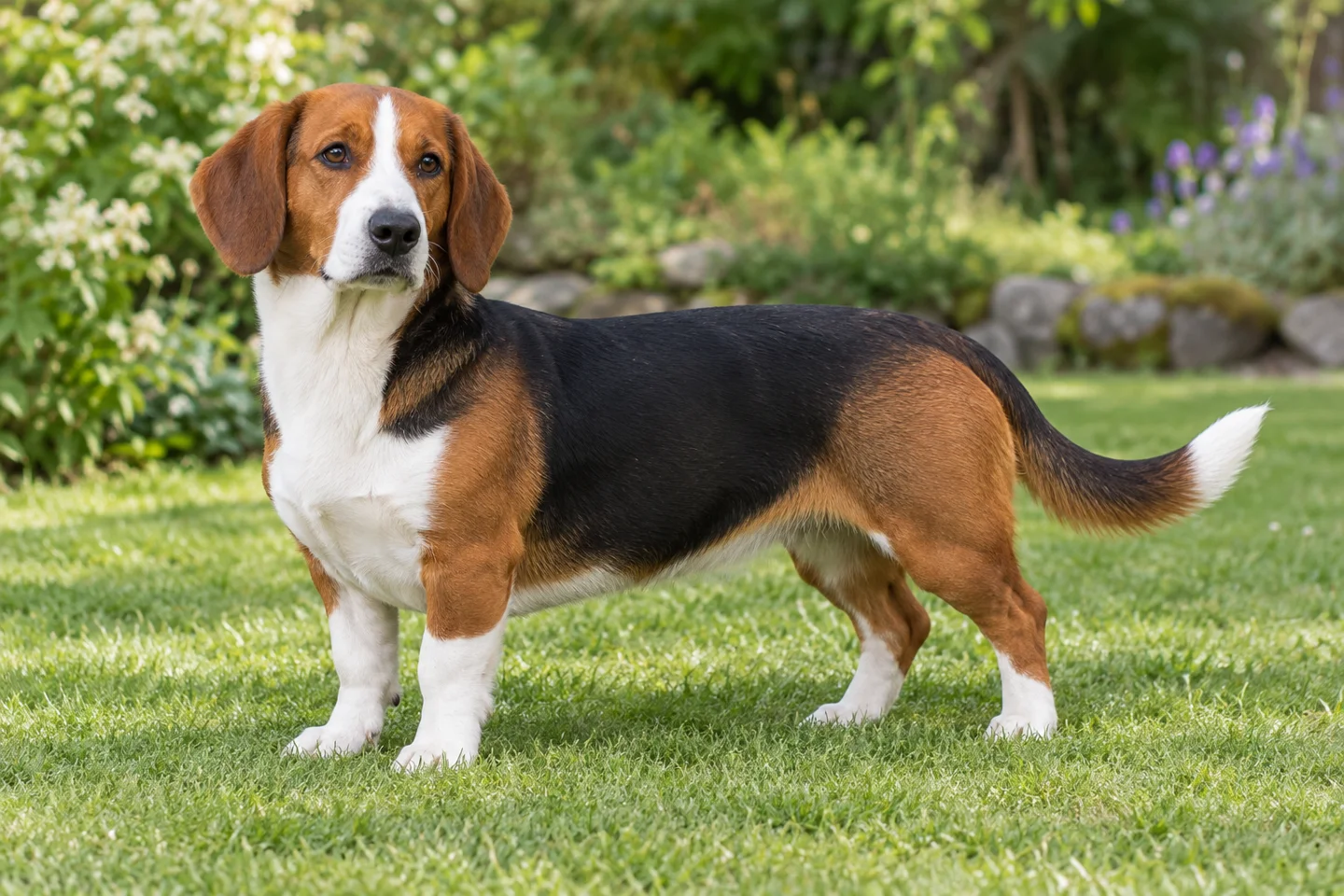
The FCI gives an ideal male height of 35 centimeters, within a permitted 32–38 centimeter range. For females, the ideal is 33 centimeters within 30–36 centimeters. The body is relatively long and the legs short, with an overall strong outline. Do not turn a height measurement into a feeding target or guess an ideal weight from another breed's chart. Your veterinarian can assess the actual dog's condition, movement, and growth. Make sure equipment fits the chest and body rather than buying on height alone.
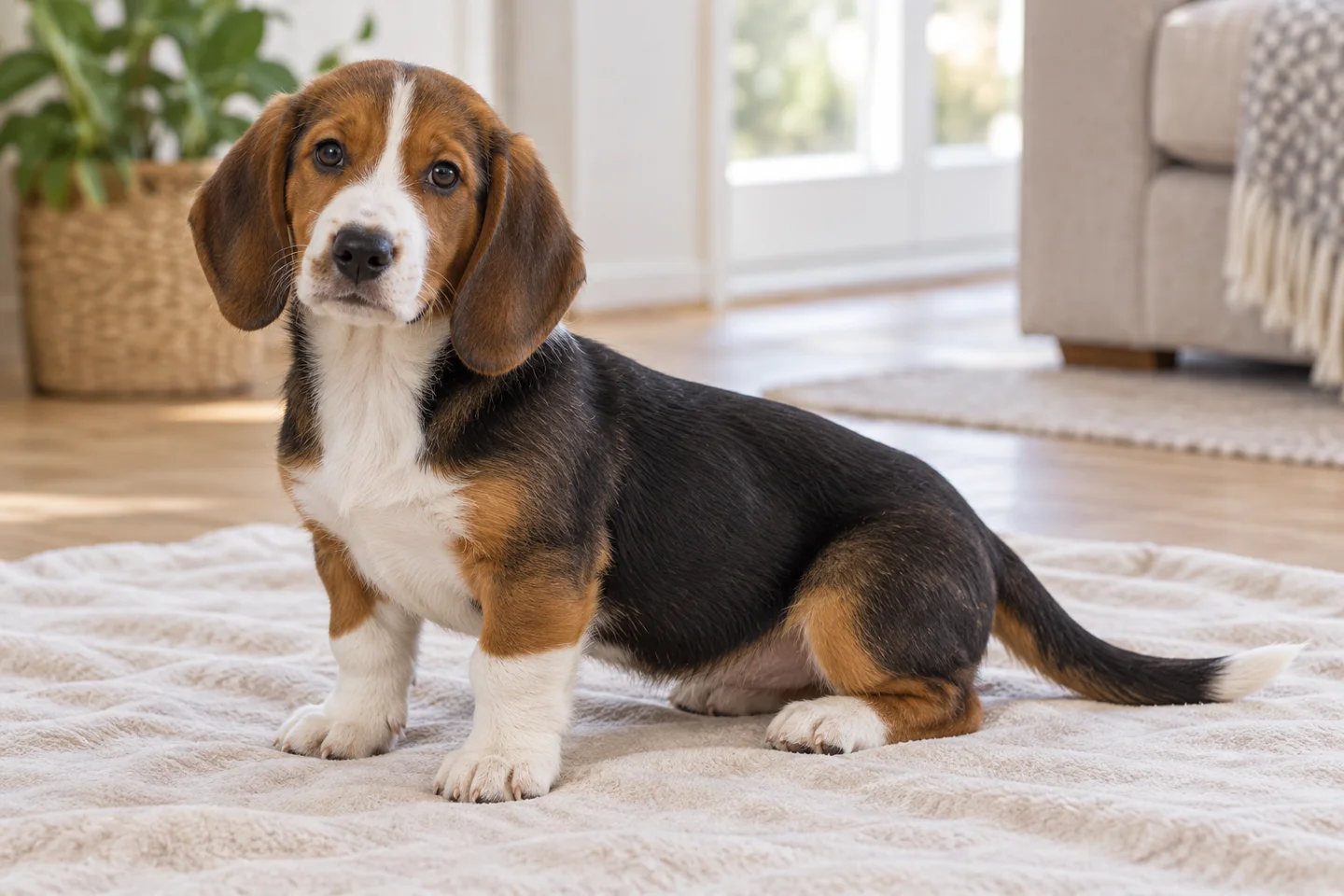
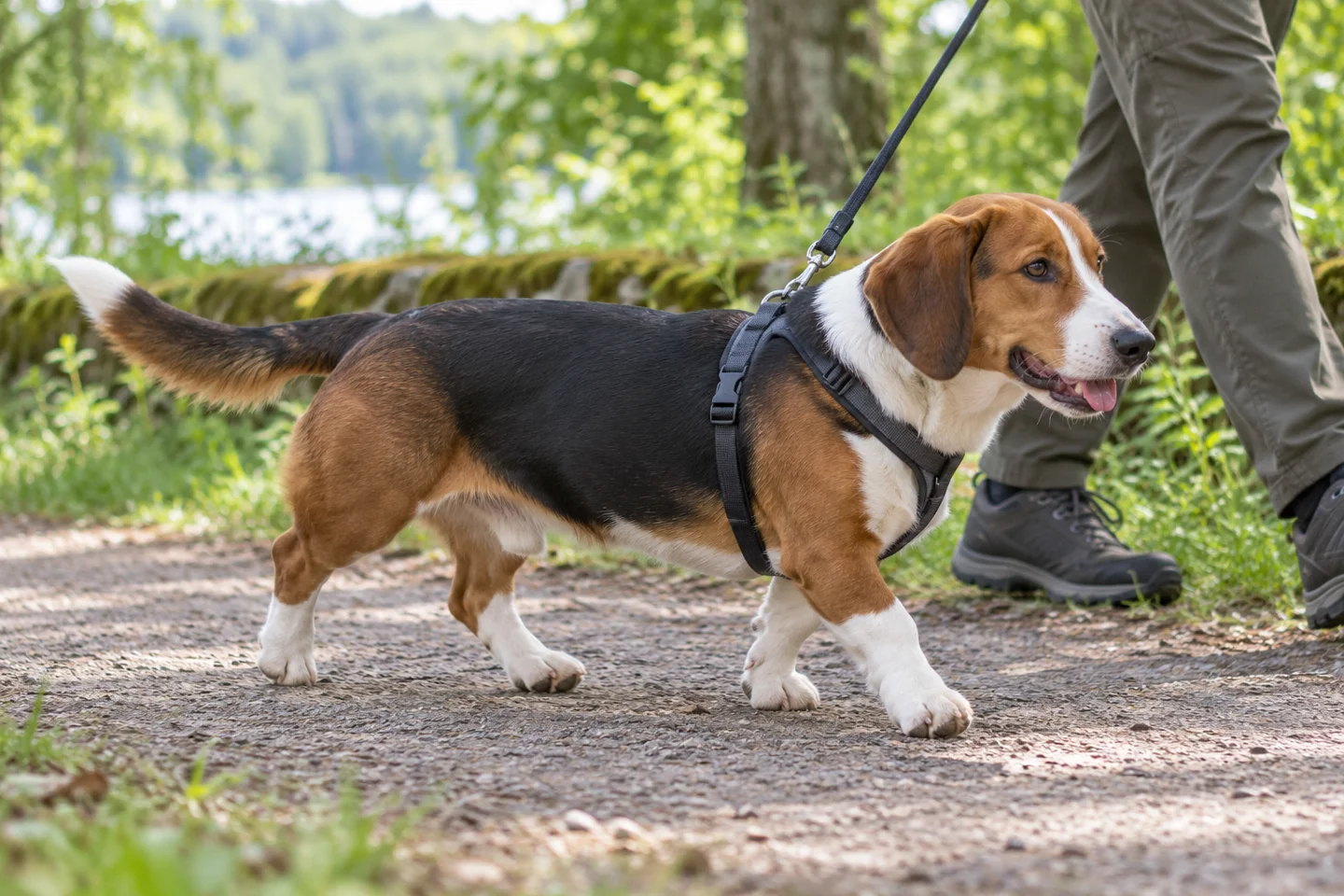
The close coat is harsh and straight. Well-defined colored areas and white markings are part of the standard's description, and a natural long tail contributes to the outline. The images here depict a tricolored example with dark areas, tan, and white. They are AI-generated illustrations, not records of a particular dog or proof of correct construction. Real markings vary, and show preferences do not establish whether an animal can move comfortably or cope with an ordinary household. Evaluate those practical qualities in person.
Living with scent interests and a hound's voice
A day needs more structure than opening the back door and hoping the dog invents suitable entertainment. Arrange a sleeping place, a place for drying wet paws, and a predictable way to start outings. Reward the Drever for waiting while the lead is attached. Practice a brief pause before leaving so an opening door does not become permission to rush into the street. Secure gates with hardware that all household members can operate reliably, including anyone delivering care when you are absent.
Ask about vocal behavior without assuming that every individual will bark in the same circumstances. A dog may react differently to separation, visible wildlife, frustration at a fence, or another animal's arrival. Record what happens before the noise and change that setup while teaching an alternative. A shared-wall home requires a realistic discussion with the source about the dog's experience. Punishing sound without understanding its function can leave the original problem untouched. An animal that repeatedly becomes distressed needs a plan suited to that distress, not merely an expectation of silence.
Children, rest, and handling at floor level
Because a Drever is accessible at a child's level, adults should protect it from being cornered, lifted unexpectedly, or used as an obstacle in play. Establish a resting area that children leave alone. Keep the dog's meals separate from children's snacks and teach youngsters to call an adult when a toy ends up beside the dog. Reaching into a bed or pulling at a chew creates unnecessary conflict. An adult must supervise interaction actively and end it before excitement overwhelms either participant.
Choose activities that leave the dog room to opt out. A child can help scatter a few rewards in a designated search area while an adult controls access, then watch from a comfortable distance. Do not expect a young child to walk the Drever alone where wildlife or traffic may appear. Ask about previous contact with children and be precise about age and context. A history of calm evenings beside teenagers does not answer questions about a toddler falling onto a sleeping dog or visiting children running through a narrow hallway.
Aggression and bite prevention need concrete observations
A breed standard's desired temperament is not an individual safety assessment. If the dog stiffens over an object, guards a passage, snaps during handling, or lunges at another animal, arrange management before repeating the situation. Write down what happened and involve a veterinarian when pain or a new medical problem could contribute. Do not wait for an injury simply because the animal is usually affectionate. The time of day, location, distance, and competing resources can help a professional understand the problem.
Teach an exchange for safe objects with rewards and leave meals undisturbed. Avoid forcing the mouth open or removing bowls to demonstrate control. Introduce a basket muzzle gradually with qualified guidance if it forms part of a behavior or veterinary plan. A muzzle does not make rough handling or unsafe proximity acceptable. Explain restrictions clearly to sitters and visiting family. Consistent prevention is kinder to everyone than repeatedly arranging a situation that produces a warning and then punishing the dog for giving it.
Training a useful return from a strong scent
Recall begins with small successes. Choose a secure area, call when the Drever can respond, and reward coming all the way back. Let some returns lead to further exploration so the cue does not always predict losing access to a rewarding place. Add distractions in manageable stages. Where scent is strong and the response remains uncertain, use a suitable lead or secure enclosure. Equipment helps prevent an escape while teaching continues; it is not evidence that the dog has learned a reliable off-lead response.
Reward attention around gate openings, road crossings, and changes of direction. Practice walking away from a low-level distraction before trying it at the edge of a busy woodland. A brief training session that ends with the dog still able to participate is useful. Repeating a cue while the animal is fully occupied elsewhere often adds noise without improving the skill. AVSAB supports reward-based training. If someone proposes pain or intimidation as the only way to control a hunting hound, seek a professional who can teach the required behavior without those methods.
Social experience and being alone
Introduce ordinary sights and sounds at a distance the dog can manage. A puppy watching traffic from a quiet entrance may learn more comfortably than one carried into the center of a crowded event. Let unfamiliar people ignore it initially. Give the youngster time to investigate surfaces and objects without being dragged forward. Follow the veterinary team's guidance about disease exposure while preserving opportunities for safe learning. The purpose is a dog that can recover and make choices, rather than one made to endure every possible stimulus.
Build short periods of separation into a predictable day, starting while you remain nearby. Make the resting space comfortable and avoid using confinement only when the household leaves for hours. Watch what the Drever actually does through a safe monitoring arrangement if needed. Persistent pacing, escape attempts, or prolonged distress should change the plan. A long walk before departure cannot substitute for teaching or clinical help. Discuss care cover while that work proceeds, especially when your employment requires absences longer than the dog can presently tolerate.
Exercise, tracking games, and boundaries
A Drever needs opportunities to move and use its nose, with the amount adjusted to age and condition. Ask the veterinary team about a young dog's developing routine or an older dog's changed mobility. There is no useful guarantee in a fixed mileage requirement copied from another owner's adult hunter. Start with manageable outings and observe recovery. Offer easy scent searches in a secure area, allowing success before increasing difficulty. A deliberate search can provide a satisfying task without requiring uncontrolled pursuit of wildlife.
Plan lead handling around low cover and obstacles. A long line can snag or wrap around a person, so learn the technique in an uncomplicated space before entering rough ground. Respect access rules and keep away from livestock when you cannot prevent disturbance. Take water and choose cooler conditions in hot weather. Stop for distress rather than insisting that a working breed should finish the planned distance. Back home, reward a quiet resting habit so the routine contains recovery as well as activity and repeated requests for attention.
Grooming a close coat without missing skin problems
Run your hands over the coat after outdoor work and look at the skin where mud or plant material has collected. The short coat still benefits from gentle brushing and prompt removal of debris. Pick a tool the dog accepts without abrasion and reward standing comfortably while you inspect the chest, belly, and feet. Bathe when appropriate with a suitable canine product and dry the dog in a comfortable environment. A change in coat texture, persistent itch, or sore area needs assessment rather than heavier brushing.
Lift the ears gently to inspect them, allowing the dog to learn the movement before a lengthy examination. Redness, discharge, repeated head shaking, or pain warrants veterinary advice. Do not insert objects deeply or use leftover ear medicine without a diagnosis. Keep nail care gradual: touch a paw, reward, then introduce the next part of the process. Ask a professional for help if nails are difficult or the dog becomes defensive. Being small enough to restrain does not make repeated forced handling a sound care routine.
Health questions without an invented universal test list
For a less common breed, buyers should resist both unsupported reassurance and a borrowed list of disorders from another hound. Ask for the health records relevant to the parents and the breeding organization involved. Discuss diagnoses in close relatives, ages at diagnosis, and how later information is communicated to owners. If someone names a screening scheme, request the actual report and its interpretation. A general examination, a genetic result, and a structural assessment each answer different questions. None proves that illness will never develop.
Arrange routine veterinary care and bring previous records so the clinician can plan prevention for the dog's location and activities. Note reluctance to move, altered gait, pain when handled, or a sudden change in elimination or appetite. Long body shape alone cannot diagnose a spinal disorder, and an internet photograph cannot establish the cause of a limp. Sudden inability to walk, collapse, or severe pain calls for urgent veterinary contact. Do not give human medication or another animal's prescription while waiting for an online explanation of the signs.
Nutrition, lifting, and a practical home layout
Use an appropriate complete diet and measure portions, including rewards from training and food searches. Review condition with the veterinarian when the exercise season changes. An animal that works harder during some weeks may need adjustment, but permanent extra food can remain long after that work ends. Feed without competition and protect the meal area from children or other pets. A sudden appetite change deserves observation and advice, especially if combined with vomiting, discomfort, or unusual tiredness. Repeatedly offering richer extras can make the original problem harder to assess.
Think through access to the car and sleeping area before a problem arises. Teach calm use of a suitable ramp if one will be needed, and ask the veterinary team to show safe support when lifting is unavoidable. Do not drag a reluctant dog up by its collar. Check where gates and furniture create bottlenecks for an older animal. These arrangements are useful household planning rather than a claim that every Drever will develop a particular injury. Review them when the dog's comfort or mobility changes instead of relying indefinitely on the setup used for a puppy.
Other pets and Drever mixes
Scent work and interest in animals require management around cats, rabbits, and birds. Ask for the dog's observed history with each species, and preserve a secure retreat for resident cats. A shared room should not become a chase experiment. Use barriers and controlled distances, then assess whether the animals remain comfortable. A dog that ignores one familiar cat indoors may still react to an unfamiliar animal running outside. Check doors and outdoor enclosures as carefully as you plan the first formal introduction.
A Drever mix may have different height, coat, voice, hunting interest, or handling needs from either parent's typical description. Crossbreed names do not guarantee reduced medical risk or easier companionship. Where parentage is documented, review both family histories. Where it is unknown, use the individual's condition and behavior to plan care. An adult rescue can show established habits, but allow for context and adjustment. Choose a home arrangement capable of managing the dog in front of you, including separation from another pet when the evidence requires it.
Ownership costs and reliable relief care
Budget beyond the purchase or adoption fee. Veterinary visits, preventive care, emergency funds or insurance, secure equipment, training, transport, and competent sitting all belong in the calculation. Ask whether the sitter has managed a scent-focused hound and inspect the gate arrangements. A person who usually leaves dogs loose while unloading a car needs a clear alternative for this one. Provide a written routine and practice a handover during a short stay before relying on the arrangement for a holiday.
Consider how changes in your own circumstances would affect the dog. Illness or a new work schedule may remove the person who normally supplies most exercise. Identify realistic cover rather than assuming another family member will automatically manage. Talk openly with the breeder or rescue about return support and the reporting of later health findings. A rare breed can require extra effort to meet knowledgeable people, but rarity does not excuse missing information or pressure to decide before you have evaluated the everyday commitment.
dogsDating meetings that leave room to sniff
Describe the Drever's walking style on dogsDating, including whether it pauses frequently for scent or becomes vocal when another dog moves away. Keep exact home coordinates private. Suggest a broad, quiet walking route with secure handling and places to change direction. Agree that both owners can stop the meeting, and discuss any guarding or previous conflict before arriving. Avoid beginning at a narrow entrance where the dogs must pass nose to nose or where an excited animal could pull its handler into traffic.
Allow the dogs to share space without insisting that their noses meet. Watch whether each can return to sniffing, move away, and follow its handler. If one repeatedly crowds the other, use distance and end the outing when necessary. Do not add a dropped food trail or a prized toy to the first encounter. A pleasant parallel walk supplies useful information for another meeting. It does not establish that the animals can share meals, travel together, or remain unsupervised in the same home without further assessment.
Sources and editorial notes
Sources checked October 21, 2026. Breed measurements describe reference ranges, not a diagnosis or an individual dog's ideal weight. Images are AI-generated breed illustrations and do not document a particular dog or health condition.
- AVSAB: Humane Dog Training Position Statement
- VCA Animal Hospitals: Food aggression in puppies
- VCA Animal Hospitals: Aggression toward unfamiliar dogs, diagnosis
- VCA Animal Hospitals: Grooming and coat care for your dog
- VCA Animal Hospitals: Ear infections in dogs
- VCA Animal Hospitals: Feeding guidelines for dogs
- VCA Animal Hospitals: Common emergencies in dogs
- VCA Animal Hospitals: Heat stroke in dogs
- Orthopedic Foundation for Animals: CHIC health screening programs
- Fédération Cynologique Internationale: Drever standard 130
Keep getting to know dogs.
Read another guide or return to your dogsDating community.
Explore breed guidesBack to dogsDating