Flat-Coated Retriever
A Flat-Coated Retriever needs an owner prepared for an athletic dog whose interests extend beyond an appealing glossy coat.
How these guides are researched and reviewed
- Origin
- Great Britain
- Identity
- Sporting / Retriever
- Care priorities
- Retrieving skills, water safety, candid family health
- Adult standard size
- FCI preferred: males 59–61.5 cm, 27–36 kg; females 56.5–59 cm, 25–32 kg
General information for owners. These articles have not been reviewed by a veterinarian. Medical decisions need your dog's history and an examination.
Choose the retriever that fits your ordinary day
A Flat-Coated Retriever needs an owner prepared for an athletic dog whose interests extend beyond an appealing glossy coat. The FCI identifies it as a British retriever and describes a lively, friendly working outline. That background should lead to questions about handling objects, outdoor access, rest, and company. A home needs a plan for the normal weekday as well as the enjoyable weekend trip. Consider who provides care when a walk is cancelled or the familiar person is unavailable.
Meet an adult in everyday circumstances if possible. Watch how it returns from activity, enters a vehicle, and responds when a game ends. Ask its owner which skills required deliberate teaching. A sociable greeting supplies information without predicting every response around children, unfamiliar dogs, or resources. An adult rescue may have useful household observations, while a puppy has more uncertainty ahead. Choose on the basis of the individual, recent family, and sustainable care rather than assuming a happy expression makes every arrangement easy.
A separate retriever with a functional identity
Flat-Coated Retriever is a distinct breed, separate from the Labrador, Golden, and Curly-Coated Retrievers. Similar work does not make their proportions, coats, or health information interchangeable. Ask for the exact recorded identity when ancestry is claimed. A rescue estimate based on appearance should stay explicit. A black feathered dog can resemble the breed without documentary proof, and appropriate care can proceed through examination and observation without inventing the missing family tree.
The FCI places the breed among retrieving gundogs. That intended work provides useful context but does not establish that an individual has learned a safe retrieve, water entry, or response around wildlife. Ask what experience it actually has. Recent relatives and their living routines may help a placement more than an unsupported precise origin story. A responsible source discusses the complete dog, including what happens when the activity finishes, instead of focusing only on a field achievement, show result, or particularly attractive head.
Flat black coat, long head, and adult dimensions
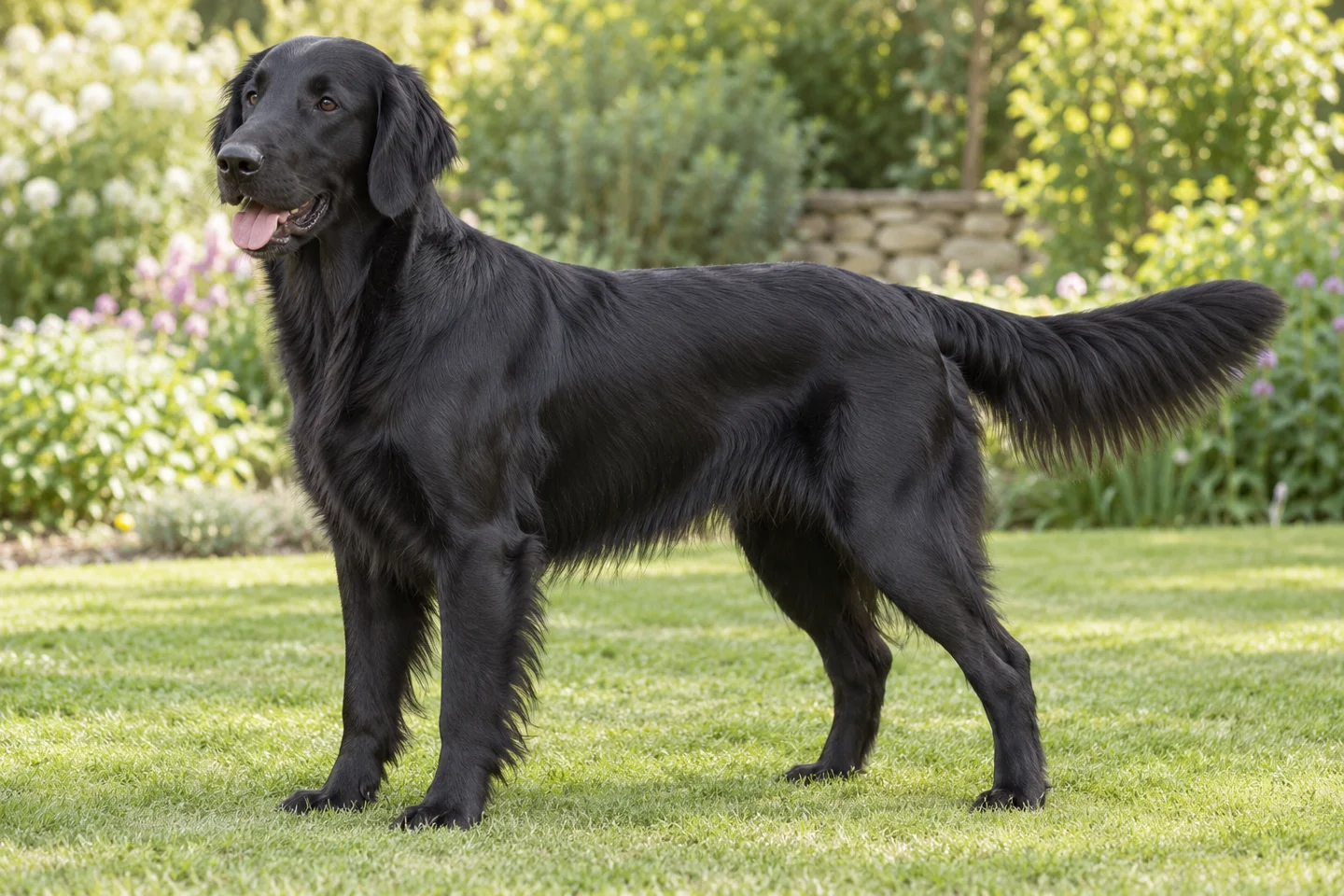
The standard allows solid black or liver and describes a flat coat with feathering rather than curls. The long clean head and slight stop help distinguish the intended outline from a heavier retriever head. The illustrations select solid black examples with natural ears and tails. They are generated breed illustrations rather than photographs documenting identity, movement, or a medical finding. One selected color cannot represent every dog within the recognized standard.
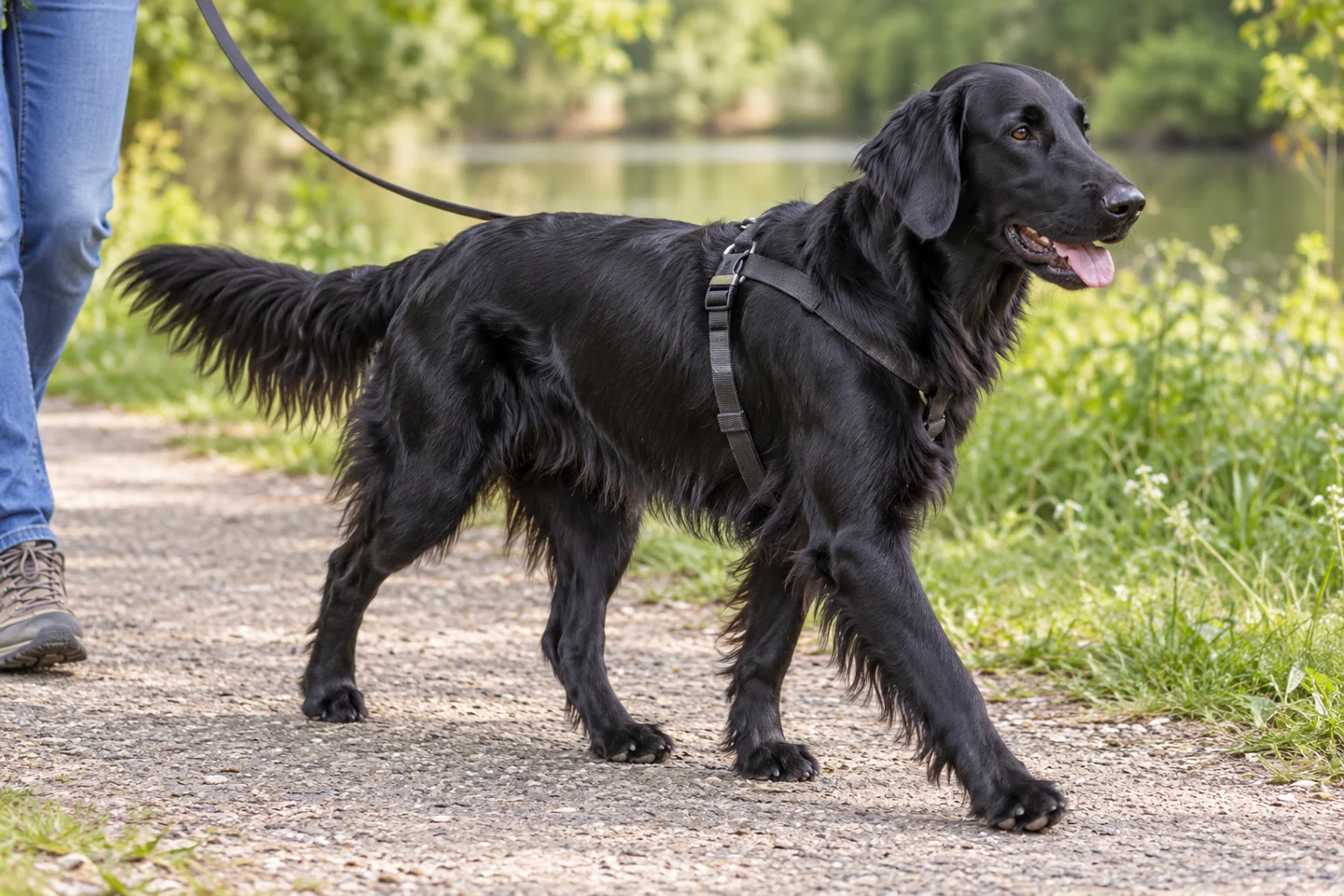
Assess the actual body beneath the hair. Ask the veterinary team how to check condition, and watch walking, turning, and rising after rest. Repeated stiffness or reluctance at a vehicle entrance deserves investigation even if excitement makes the dog move eagerly elsewhere. Fit equipment so it remains secure when reversing and permits shoulder movement without trapped feathering. Check contact areas after use. A puppy grows and an adult's condition changes, so neither a breed-size label nor an earlier good fit guarantees that the same adjustment remains suitable.
FCI preferred adult heights are 59–61.5 cm for males and 56.5–59 cm for females; preferred weights in hard condition are 27–36 kg and 25–32 kg respectively. These reference figures must be read alongside the individual’s proportions and clinical condition. They are not instructions to feed toward the top of a range. Measure the actual dog and plan assistance and transport for an adult that cannot load itself.
Training a retrieve that includes a comfortable exchange
Teach approaching with an appropriate object before an urgent retrieval is necessary. Choose a safe item and a reward the dog will willingly exchange for. Reward moving toward the handler and avoid turning possession into a repeated chase around furniture. If every approach ends in an abrupt confiscation, the animal may learn that keeping distance protects what it has found. Manage access to unsuitable household items while teaching a more useful pattern in low-pressure circumstances.
A dog that stiffens, growls, or threatens over an object needs space and an assessment, not a demonstration of authority. VCA's guarding guidance supports avoiding confrontational removal and teaching exchanges carefully. Keep children and other animals away while managing the issue. If something dangerous has been swallowed, contact the veterinarian and follow advice about the object and timing. The absence of an immediate obvious symptom cannot prove that no harm will follow. An emergency is different from an opportunity to practice a training exercise.
Training the end of an enthusiastic activity
A retrieve has a beginning, but household life also needs an end. Put equipment away, provide water and an appropriate quiet place, and reward manageable settling rather than restarting play every time the dog appears restless. If people repeatedly respond to insistent approaches with another throw, review the sequence being taught. More exercise can improve conditioning without necessarily changing anticipation or teaching independent rest. Persistent difficulty settling deserves attention to the whole routine.
AVSAB recommends reward-based methods. Teach useful actions such as moving onto a mat, waiting while a clip is fastened, and turning toward the handler before distractions become overwhelming. Keep sessions understandable and choose rewards meaningful to the individual. A dog that fails in a busy setting may need an easier environment rather than stronger correction. Practice with another trusted adult so essential care is not dependent on one person's habits. An instructor should help the owner improve timing, route decisions, and expectations as well as teach the animal.
Water is an environment to assess, not an automatic privilege
Retrieving ancestry does not guarantee safe judgment around water. Before entry, consider current, depth, banks, access out, local warnings, and the dog's condition. An unfamiliar edge should not become a jumping experiment. Seek appropriate instruction and use suitable safety equipment where needed. The owner remains responsible for deciding whether conditions are manageable. A dog entering enthusiastically has shown willingness, not proved swimming endurance or a reliable route back to land.
Build experience in controlled stages and stop before fatigue dominates. Prevent the dog from repeatedly taking in unsafe material or entering water under a warning. Plan how to recall or guide it before access is granted, and do not rely on an untested response beside a hazard. Afterward, observe recovery and any concerning respiratory change. Seek prompt advice when something appears wrong. Drying and checking the coat belong to the outing too, especially when the return involves a vehicle, confined equipment handling, and a tired dog that still wants another turn.

Exercise, terrain, and recovery after rest
Provide regular movement, exploration, and suitable learning matched to the individual. Ask about recent routines before adding long distances or demanding terrain. Fitness develops through preparation rather than a breed name. A growing puppy needs sensible opportunities and sleep, with professional guidance before repetitive impact or sport. Watch movement after a nap and the next day, since discomfort may be less apparent during an exciting activity. Persistent stiffness or limping should lead to assessment and an altered plan.
Keep a shorter alternative for days when weather, illness, or work changes the intended outing. In heat, choose cooler times, shade, drinking water, and an easy early return. Severe distress, weakness, or collapse needs urgent help. After rough ground, inspect feet, skin, and equipment-contact areas. Obtain care for embedded material or painful swelling instead of expecting the dog to walk through it. An active working background should inform preparation without becoming an excuse to ignore discomfort or require a fixed target despite the animal's response.
Children and a full-sized retriever in a narrow room
Think about excited greetings where space is limited. A turning adult and a sweeping tail can knock over a young child even without threatening behavior. Arrange the entrance so an adult manages the dog separately from bags, food, and the child's movement. Provide a resting area outside active games and use barriers when close supervision is unavailable. A dog accustomed to affectionate contact still needs time to sleep undisturbed and a route away from attention.
Teach invitations rather than restraint for a cuddle. Prevent pulling ears or feathering, climbing, and faces close to the muzzle. Children should leave meals and chews alone and ask an adult to retrieve objects beside the dog. Watch avoidance or unusual stillness and end contact early. Visiting friends may require different arrangements from a quiet family evening. Review the plan after pain, fatigue, or changes in the child's mobility. The adult must protect both participants instead of relying on the dog to tolerate every well-meant interaction.
Aggression is an individual problem requiring explanation
A friendly breed description cannot resolve an incident. If the dog snaps during grooming or threatens another animal near a bed, record the immediate context and prevent repetition. Was an area touched, was a valued resource present, and could it leave? New handling sensitivity warrants veterinary review. An animal can remain sociable in many situations while pain or fear affects a particular one. Avoid reproducing the event for reassurance from visitors or family members.
Recurrent threats, escalating fear, or a bite calls for qualified behavior support with clinical involvement and a clear interim safety arrangement. Protect resources and teach exchanges without manufacturing conflict. Punishing warnings can obscure discomfort while leaving the underlying cause intact. Inform carers honestly about incidents and demonstrate the management plan. Any muzzle recommended by a professional needs gradual positive introduction and belongs alongside barriers, distance, and changes to the difficult situation. Equipment cannot make an unwanted greeting comfortable or justify forcing a painful procedure.
Dogs, cats, and retrieving interests around other pets
Ask whether previous canine experience included living together or only walking and sport. Separate resources during adjustment and allow independent rest. Watch repeated following or blocking when another dog tries to disengage. A playful-looking approach is not proof that the recipient welcomes it. Size, energy, and access to valued people can matter even without noise. Owners should provide breaks rather than wait for the quieter dog to escalate its request for space.
Cats need routes the retriever cannot follow and introductions managed to prevent pursuit. Birds, poultry, rabbits, and rodents require reliable security. A soft-mouth reputation or game-retrieving background cannot establish safety beside a vulnerable animal. Ask for actual observations and retain uncertainty about untested circumstances. Think through cleaning, feeding, and care by someone else. If fixation or chasing appears, stop access and obtain guidance. Decide whether the household can maintain the required boundaries sustainably instead of expecting familiarity or a generally sociable breed to solve every relationship automatically.
Grooming the flat coat after ordinary adventures
Brush and inspect beyond the glossy top layer, especially behind ears, beneath equipment, along the underside, and around feet. Use gentle methods and ask an experienced groomer about tools suited to this coat. Remove loose outdoor material before it becomes tangled, and seek help for tight mats or irritated skin. Scissors near concealed skin can cause injury. A practical maintenance plan should leave the dog comfortable between appointments rather than preserve an appearance the owner cannot maintain.
Introduce short sessions, a towel, and foot handling during easy moments. Reward participation and allow changes of position. Ear odor, discharge, soreness, or repeated head shaking needs veterinary assessment, not a presumed diagnosis or old prescription. Maintain teeth and nails using suitable products and a gradual teaching process. A new objection to a familiar check deserves attention. Tell professionals about handling concerns beforehand. Immediate treatment and longer-term cooperative care may need different arrangements, and a painful condition cannot wait indefinitely for perfect home training.
Health records and the need to discuss cancer candidly
The AKC's national-club recommendations for the Flat-Coated Retriever include patella, hip, and ophthalmologist evaluations. Request identifiable reports and understand which questions each answers. The Flat-Coated Retriever Society of America also identifies cancer among its health concerns. A placement conversation should include significant diagnoses and ages in close relatives, with clarity about which diagnoses were confirmed. Do not replace that discussion with a promise based only on attractive parents, working ability, or normal orthopedic screening.
A screening panel does not establish that every form of cancer or other illness has been excluded. Ask the source how it follows older offspring and shares relevant findings. Avoid invented prevalence figures or treating one family's experience as a prediction for an individual. Your veterinarian can interpret the records and help plan observation. An adult adoption may bring missing information; mark that uncertainty honestly and establish present care. Medical planning benefits from candid evidence without turning a breed concern into a diagnosis for every new lump or change.
Health changes and a prepared clinical conversation
Report a new lump, persistent lameness, altered appetite, weight change, or unusual tiredness rather than deciding at home which disease explains it. Several causes may be possible. Record timing and what changed, and follow through on the examination or diagnostic plan. A dog can still seek games while unwell. Earlier screening or a reassuring family account should not delay assessment of a current problem. Keep clinical reports together so a different veterinarian can understand what has already been checked.
Discuss routine prevention, including parasites, vaccination, mouth care, and travel exposure, around the actual activities. Know which clinic provides urgent help and how an adult unable to walk would reach it safely. Collapse, major trauma, serious respiratory distress, or rapidly worsening illness needs prompt assistance. A brief video of an intermittent movement change can be useful only if it does not provoke pain or delay care. Plan practical support and costs before an emergency makes every decision harder, while allowing the clinician's current findings to guide treatment.
Food, absence, and the costs of continued support
Use a complete diet appropriate to age and medical needs and adjust the measured allowance to real condition and activity. Include food used in retrieval and care practice. Feed separately so intake remains visible and other animals cannot create competition. Persistent digestive or appetite changes deserve advice rather than repeated unplanned product switches. Supplements need a clear reason within the complete diet, and home-prepared feeding should receive qualified nutritional guidance. A willing eater cannot demonstrate that its food is balanced.
Prepare comfortable absences gradually and observe the response. A recording can reveal pacing or calling after departure. Seek help for sustained distress and arrange care when working hours exceed current coping ability. Budget for prevention, diagnostics, training, transport, grooming assistance, and reliable backup people. Have the carer rehearse an outing and equipment while you are available. Later-life changes may require easier access and shorter activities without removing every familiar pleasure. New sensitivity or reduced willingness should prompt clinical review instead of being accepted automatically as a personality change.
Mixes and dogsDating with accurate expectations
A Flat-Coated Retriever mix can combine physical and behavioral traits differently, and a black coat with feathering cannot verify ancestry. Ask what parentage is documented and assess the individual. For a planned cross, relevant health questions include both parents. Mixed ancestry does not guarantee freedom from inherited concerns or easier daily care. A responsible source discusses limitations, support, and return arrangements instead of using a crossbreed label to avoid difficult questions.
On dogsDating, describe known preferences, resource issues, and relevant incidents plainly. Keep exact home coordinates private and select an initial public route with room for separate handlers. Allow independent walking before considering close contact, leaving shared toys and food out. End when either dog cannot disengage comfortably. A calm outing may be enough without retrieving games or play. Home visits and shared travel introduce different resources and boundaries; reproductive or clinical suitability is also a separate question. Let the animal's comfort and accurate information guide decisions rather than a friendly photograph.
Agree how either handler will request a pause and confirm that the route remains suitable on the day. Unexpected crowds or warm conditions can change a previously sensible meeting plan.
Sources and editorial notes
Sources checked October 21, 2026. Breed measurements describe reference ranges, not a diagnosis or an individual dog's ideal weight. Images are AI-generated breed illustrations and do not document a particular dog or health condition.
- VCA Animal Hospitals: Grooming and coat care for your dog
- VCA Animal Hospitals: Ear infections in dogs
- VCA Animal Hospitals: Common emergencies in dogs
- Flat-Coated Retriever Society of America: Health concerns and longevity information
- VCA Animal Hospitals: Food aggression in puppies
- VCA Animal Hospitals: Heat stroke in dogs
- VCA Animal Hospitals: Aggression toward unfamiliar dogs, diagnosis
- AAHA: Feeding plans for healthy, appropriate weight cats and dogs
- Orthopedic Foundation for Animals: CHIC health screening programs
- American Kennel Club: sporting group recommended health tests
- Federation Cynologique Internationale: Flat-Coated Retriever breed standard
- AVSAB: Humane Dog Training Position Statement
- VCA Animal Hospitals: Water sports for dogs
Keep getting to know dogs.
Read another guide or return to your dogsDating community.
Explore breed guidesBack to dogsDating